How Much Do Forex Traders Really Make? (2026 Income Reality)
Real income data for retail vs funded forex traders in 2026. Realistic monthly earnings, pass rate statistics, payout frequency, and profit split math.
The honest answer is that the average retail forex trader loses money. Studies across regulated brokers show that 70% to 80% of retail accounts lose money in any given quarter.
For the 20% to 30% who are consistently profitable, income depends on three things: account size, monthly return percentage, and whether they trade personal capital or access funded capital through a prop firm.
Here are the actual numbers.
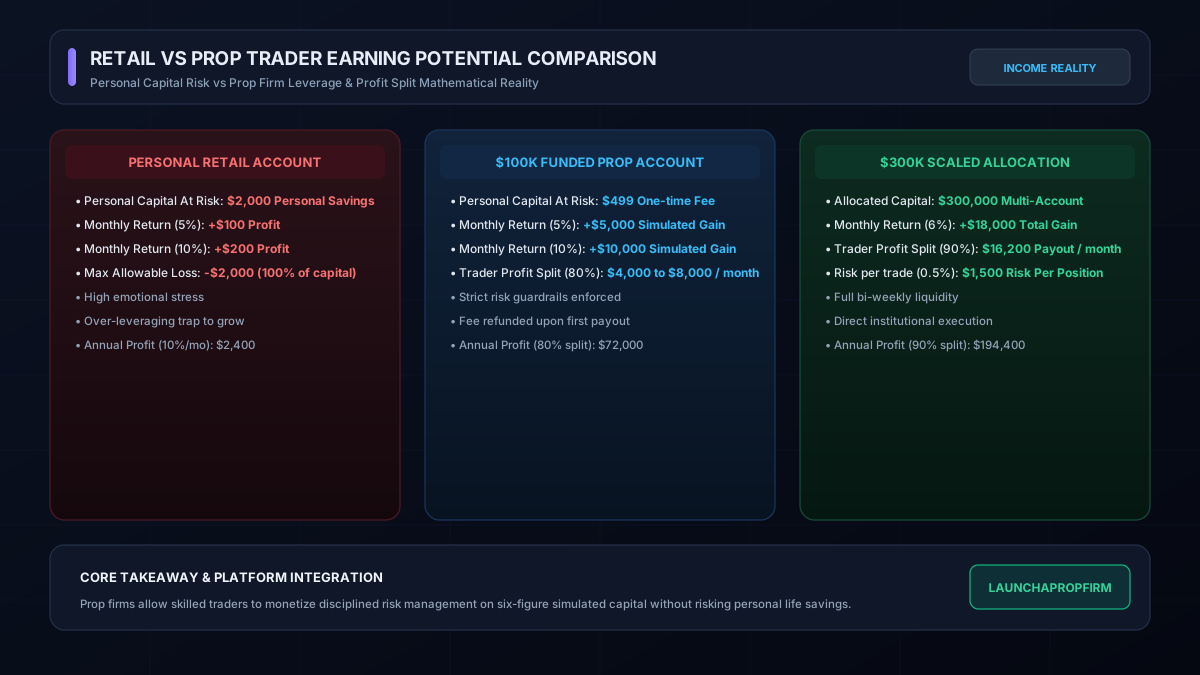
What a Retail Forex Trader Actually Makes
A retail trader's income follows one formula: account size multiplied by monthly return percentage equals gross monthly income.
A trader with $10,000 generating 5% per month earns $500 before tax. Over 12 months that is $6,000. For most people, that is a supplement, not a salary.
To earn $5,000 per month from forex trading at a consistent 5% monthly return, you need $100,000 in personal trading capital. That is the number most trading courses do not put in the headline.
Forex Trader Income by Account Size
| Account Size | Monthly Return (5%) | Annual Income | Realistic Position |
|---|---|---|---|
| $1,000 | $50/month | $600/year | Training account |
| $10,000 | $500/month | $6,000/year | Part-time supplement |
| $50,000 | $2,500/month | $30,000/year | Part-time income |
| $100,000 | $5,000/month | $60,000/year | Full-time income |
| $250,000+ | $12,500+/month | $150,000+/year | Institutional range |
Most retail traders start with $1,000 to $5,000. At those sizes, consistent profitability produces real monthly income but not a living wage without years of compounding first.
What Funded Prop Firm Traders Make
A funded trader earns differently because they are not trading their own capital. They earn a split of profits, typically 80%, on an account funded by the prop firm.
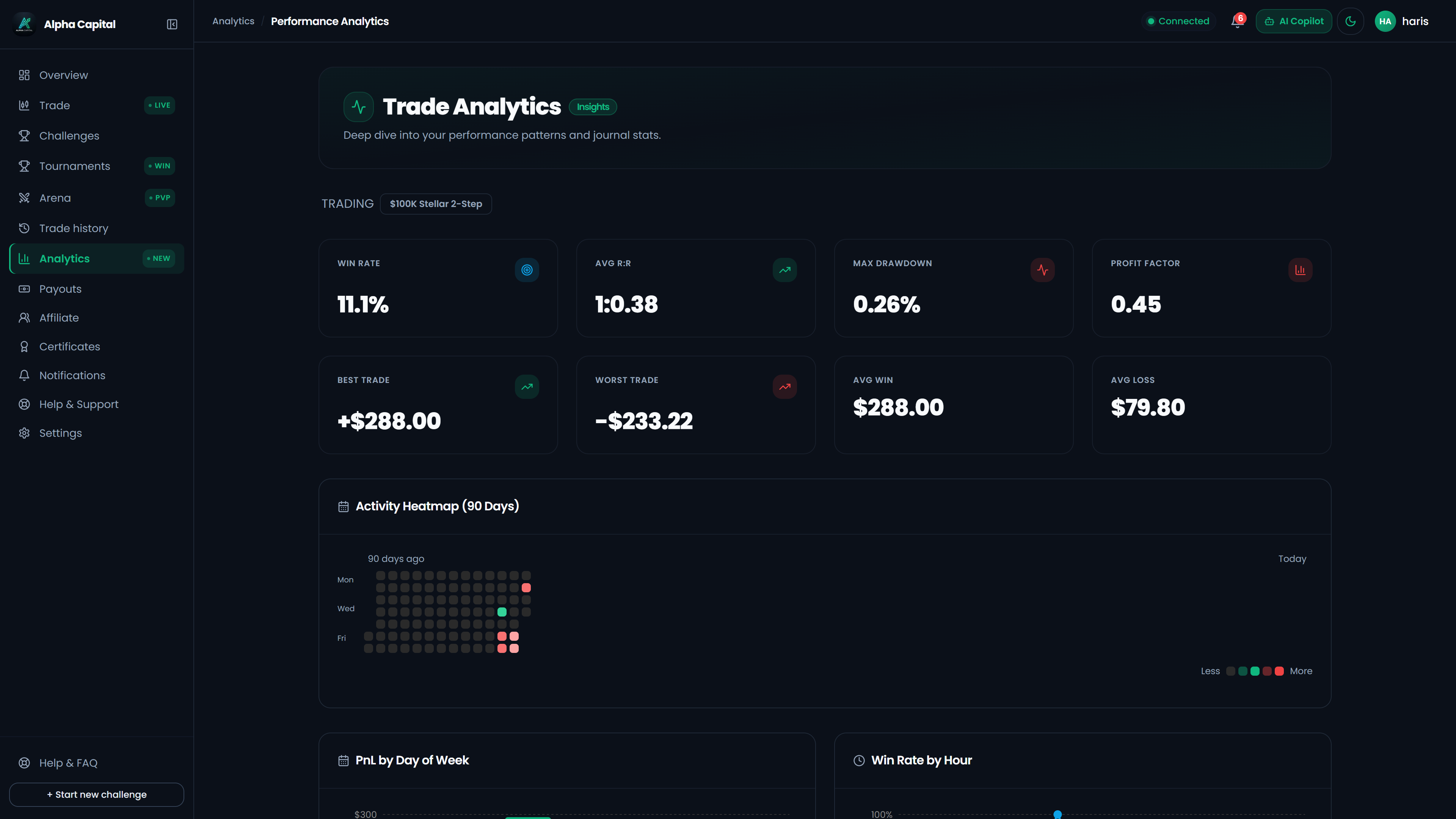
Trader analytics engine providing in-depth performance statistics, drawdown monitoring, and trading behavior analysis.
On a $50,000 funded account generating 5% per month, the trader receives 80% of $2,500, which is $2,000. The firm keeps $500. The trader risked only the challenge fee, not $50,000 of their own savings.
This is why funded trading has grown rapidly among retail traders. Skilled traders who cannot save $100,000 in personal capital can still access $100,000 in funded capital through a prop firm challenge.
You can see what a funded trader's payout panel looks like at demo.launchapropfirm.com. LaunchPropFirm powers white-label prop firms and the demo shows the full trader experience including payout requests, account history, and challenge tracking.
Skip the monthly fees
Own your prop firm platform outright. One time purchase.
Full source code. Live in 7 days. No revenue share. No monthly SaaS bill. See the exact platform before paying anything.
Demo login: haris / asdf1122. No signup needed
Retail vs Funded Trader: Income Comparison
| Trader Type | Capital | 5% Monthly Return | Take-Home | Capital at Risk |
|---|---|---|---|---|
| Retail trader | $5,000 (personal) | $250 | $250 (100%) | Full $5,000 |
| Funded trader | $50,000 (firm) | $2,500 | $2,000 (80%) | Challenge fee only |
| Funded trader | $100,000 (firm) | $5,000 | $4,000 (80%) | Challenge fee only |
| Funded trader | $200,000 (firm) | $10,000 | $8,000 (80%) | Challenge fee only |
The percentage is the same. The capital behind it is not. That gap is the income difference between a retail trader and a funded trader at identical skill levels.
How Much Do Forex Traders Make Per Day?
Risk Warning: Daily income is the wrong target to optimize for. Traders who set daily income targets usually end up forcing trades to hit a number, which is one of the fastest ways to breach a drawdown limit on a funded account.
A funded trader earning $2,000 per month averages about $100 per trading day across 20 trading days. But the actual distribution is never that smooth.
Some days produce $500 in gains. Some days produce $200 in losses. The monthly figure is what matters, not the daily one.
What Actually Determines a Trader's Income
Account size sets the ceiling. Three factors determine how close you get to it.
Win rate and risk-reward ratio combine to determine your expected value per trade. A trader with a 50% win rate and a 2:1 risk-reward ratio is profitable on average. The same trader at 1:1 breaks even at best before spreads and commissions.
Consistency across different market conditions is what separates profitable traders from traders who are only profitable sometimes. A trader who earns 10% in trending markets but loses 8% in choppy ones is not a consistently profitable trader overall.
Discipline under real pressure is the third factor. Funded accounts add the pressure of actual drawdown limits. Some traders who follow rules when nothing is at risk break those same rules when the drawdown clock is running.
Forex Trader Salary: What Industry Data Shows
Most published salary figures cover bank FX traders and institutional desk employees, not independent prop firm traders. Bank FX trader salaries in the United States range from $80,000 to $200,000 per year including performance bonuses.
For independent traders working through retail prop firms, income is entirely performance-based. A funded trader consistently earning $2,000 to $4,000 per month on a $50,000 to $100,000 account is performing in the top 10% to 15% of retail traders globally.
There is no formal earnings ceiling once scaling begins. Most LaunchPropFirm-powered firms include a built-in scaling plan that grows funded accounts as traders hit their targets over successive payout cycles.
FAQ
How much money do I need to make a living from forex trading?
At a consistent 5% monthly return, you need roughly $100,000 in trading capital to generate $5,000 per month. Most traders reach this faster through a funded prop firm account than by saving $100,000 personally, since the challenge fee is a fraction of the capital they gain access to.
How much does a forex trader make per day?
Daily income is not a reliable number. A funded trader earning $2,000 per month averages around $100 per trading day, but individual days range from significant gains to controlled losses. Monthly performance is the correct benchmark.
What percentage do most prop firms pay traders?
The industry standard in 2026 is 80% to the trader and 20% to the firm. Some firms start at 70/30 with the option to increase it through their scaling plan. Any split below 70% to the trader is below market rate for 2026.
Can you make a living trading forex without a prop firm?
Yes, but the capital requirement is the barrier. You need roughly $100,000 in personal trading capital at a consistent 5% monthly return to generate a modest full-time income. A funded account lets skilled traders access that level of capital with only a challenge fee instead of years of saving.
What is the average monthly return for a professional forex trader?
Consistently profitable traders generate 3% to 10% monthly. Returns above 10% per month as a sustained target usually involve risk levels that eventually produce a large losing month. Institutional funds generating 15% to 20% annually are considered strong performers by industry standards.
How does a prop firm challenge work for a trader?
A prop firm challenge is a paid trading test. You pay a fee, typically $80 to $400 depending on account size, trade the firm's simulated account, and must hit a profit target (usually 8%) without breaching a daily or total drawdown limit. Pass and you receive a funded live account with a profit split on all gains. Read best prop firm for beginners for a guide on where to start.
Evaluate Your Prop Firm Readiness Score (0-100)
Answer 5 quick operational questions about your acquisition channels, runway, and engine tech to get a personalized launch roadmap.
Prop Firm Monthly Profit Simulator
Simulate your challenge revenue, payout liability, and net monthly take-home profit.
$20,000
From upfront challenge fees-$2,800
~10 funded payouts budgeted$0 / month
Saves $3,000/mo vs SaaS$17,200/mo
Run-rate: $206,400/yr
M.Haris
Founder & Platform ArchitectBuilding open prop trading software infrastructure for operators worldwide
I built LaunchPropFirm to give forex educators, trading communities, and fintech operators complete ownership of their platform with full source code and zero monthly SaaS rent. Every article on this blog is drawn from hands-on platform development, live MT5 risk bridge mechanics, and real operator economics.
All content, financial models, ROI estimates, and architecture guides on LaunchPropFirm are published strictly for educational and informational purposes. LaunchPropFirm provides institutional prop trading software and technology infrastructure; it does not operate as a broker, custodian, or registered investment advisor.
Evaluation challenges and funded trader accounts referenced in this guide operate in simulated demo trading environments using real-time market data feeds. Simulated trading results do not represent actual trading performance or financial advice.
Recommended Next Reads
Hand-picked operator guides to scale your prop trading platform.
Funding Pips Account Sizes and Prices 2026: Evaluation Tiers, Rules, and Scaling Plan
Complete 2026 Funding Pips account sizes and prices guide. Compare challenge fees ($5k to $100k), 2-step evaluation rules, drawdown limits, and the $2M scaling plan.
List of Prop Trading Firms (2026 Directory): Best Evaluated and Instant Funding Programs
Complete 2026 list of prop trading firms. Compare the top 6 evaluated prop firms across platforms (MT5, cTrader), drawdown rules, profit splits, and entry fees.
Skip the monthly fees
Own your prop firm platform outright. One time purchase.
Full source code. Live in 7 days. No revenue share. No monthly SaaS bill. See the exact platform before paying anything.
Demo login: haris / asdf1122. No signup needed