List of Prop Trading Firms (2026 Directory): Best Evaluated and Instant Funding Programs
Complete 2026 list of prop trading firms. Compare the top 6 evaluated prop firms across platforms (MT5, cTrader), drawdown rules, profit splits, and entry fees.
Retail traders searching for a vetted list of prop trading firms in 2026 encounter an industry transformed by institutional risk governance, browser-based execution, and aggressive pricing compression. Unlike legacy retail brokerage accounts where traders deposit personal savings to trade fractional lots, modern proprietary trading evaluations provide simulated capital allocations from $5,000 to over $200,000. Traders who prove consistent risk discipline keep 80% to 100% of their net trading profits without risking personal trading balances.
Selecting the right provider from a crowded prop trading firms list requires looking beyond marketing slogans to inspect execution latency, drawdown calculation models, and settlement reliability. A firm offering an attractive profit split can become unprofitable if its daily loss limit is tied to floating equity peaks or if its payout approval queue drags across weeks. In this comprehensive directory, we evaluate the industry leaders across Forex, CFDs, indices, and crypto using operational data verified across live evaluation environments.
Traders seeking entry-level allocations can inspect our analysis on the cheapest prop firm challenge, while operators and traders who want to bypass multi-phase testing entirely can consult our guide on prop firm with no evaluation accounts. For domestic market participants affected by broker geoblocks, inspect our vetted directory of prop firms for US traders.
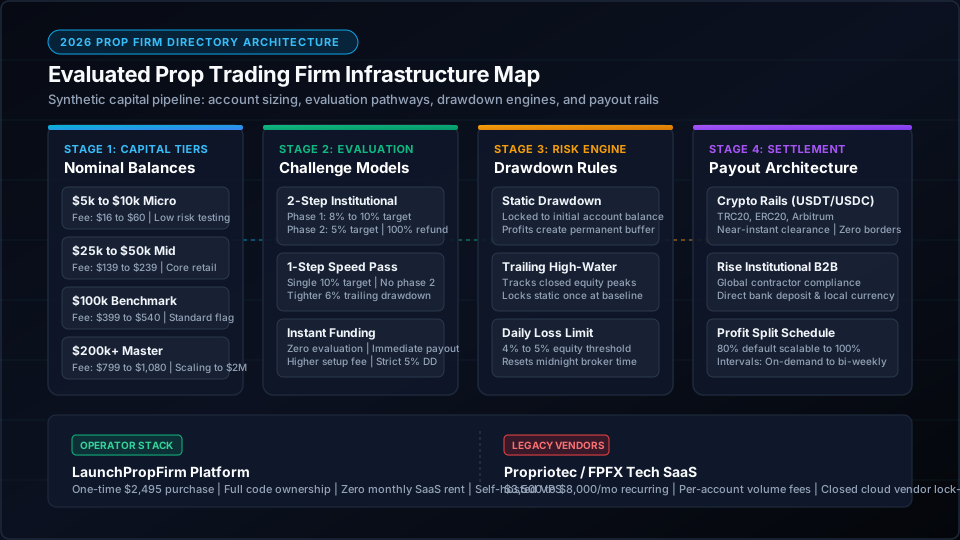
The 2026 Evaluated Prop Firm Master Directory: Complete List of Prop Trading Firms
When assessing the best prop trading firms 2026, professional market operators benchmark six core infrastructure variables: operational headquarters, trading terminal support, capital sizing range, maximum profit split, drawdown calculation model, and payout frequency. The master directory below outlines the top tier of synthetic evaluation firms operating in the international retail ecosystem.
| Firm Name | Headquarters | Supported Platforms | Capital Sizing | Max Profit Split | Drawdown Model | Payout Frequency | Entry Price ($100k) |
|---|---|---|---|---|---|---|---|
| FTMO | Prague, Czech Republic | MT5, cTrader, DXtrade | $10k to $200k | 90% | Static Equity (10% Max / 5% Daily) | Bi-Weekly on Demand | $540 |
| Funding Pips | Dubai, UAE | Match-Trader, cTrader | $5k to $100k | 100% | Trailing-to-Static (10% Max / 5% Daily) | 5 Days Post-Funded | $399 |
| The5ers | Ra'anana, Israel / London | MT5 | $5k to $250k | 100% | Static Equity (4% to 10% Max / 5% Daily) | Bi-Weekly / Monthly | $495 |
| Alpha Capital Group | London, United Kingdom | MT5, cTrader | $10k to $200k | 90% | Static Equity (8% Max / 5% Daily) | Bi-Weekly on Demand | $497 |
| Funded Trading Plus | London, United Kingdom | DXtrade, cTrader, Match-Trader | $5k to $200k | 100% | Relative Trailing or Static | Weekly Available | $499 |
| Maven Trading | New Brunswick, Canada | Match-Trader, cTrader | $2k to $500k | 90% | Trailing or Static by Challenge Tier | Bi-Weekly | $390 |
Detailed Institutional Analysis: The Top Prop Firms List
Navigating the top prop firms list demands an understanding of how each operator structures risk parameters, order routing, and technology stacks. Below is the operational deconstruction of each institutional provider.
1. FTMO: The Institutional Benchmark on Any Forex Prop Trading Firms List
FTMO remains the benchmark in any forex prop trading firms list. Operating out of Prague since 2015, the firm has cleared tens of millions of dollars in verified profit splits. Their evaluation architecture relies on a classic 2-step model requiring an 8% profit target in Phase 1 and a 5% target in Phase 2.
The key structural advantage of FTMO is its strict static drawdown engine. Maximum total loss is locked at 10% of initial starting capital, and daily loss is capped at 5% of starting equity. This ensures that unrealized intraday gains never ratchet your drawdown floor upward, giving swing traders room to breathe.
- Trading Platforms: MetaTrader 5 (MT5), cTrader, DXtrade
- Account Sizing Range: $10,000 to $200,000 (Scaling plan to $2,000,000)
- Drawdown Rules: 10% maximum static loss, 5% daily loss limit
- Profit Split & Payouts: 80% default scaling to 90%, bi-weekly on-demand withdrawals
Execution is routed across MetaTrader 5, cTrader, and DXtrade through tier-1 liquidity aggregators. While their entry fee ($540 for a $100,000 challenge) is higher than discount competitors, the fee is 100% refundable upon your first approved profit withdrawal.
2. Funding Pips: The High-Volume Micro-Challenge Pioneer
Funding Pips transformed the modern evaluation market by introducing micro-challenge tiers starting at just $32 for a $5,000 account. Headquartered in Dubai, the platform scales up to a $100,000 challenge tier priced at $399. Their 2-step Student model requires an 8% Phase 1 target and a 5% Phase 2 target with zero minimum trading days.
The firm utilizes a trailing-to-static drawdown mechanism. The 10% maximum loss limit trails your simulated equity high-water mark until your closed account balance reaches the initial capital starting line. From that point forward, the drawdown floor locks permanently at the starting balance, protecting accumulated gains.
- Trading Platforms: Match-Trader, cTrader
- Account Sizing Range: $5,000 to $100,000 (Micro tiers starting at $32)
- Drawdown Rules: 10% trailing-to-static drawdown, 5% daily equity limit
- Profit Split & Payouts: 80% scaling to 100%, eligible every 5 calendar days
Payout velocity is among the fastest in the industry. Traders qualify for their first profit split just 5 calendar days after receiving their funded credentials, scaling from an initial 80% split up to 100% on performance milestones. For an exhaustive fee schedule and contract review, inspect our breakdown of funding pips account sizes and prices 2026.
3. The5ers: The Long-Term Career and Instant Funding Architect
The5ers (The 5%ers) has operated continuously from Israel and the United Kingdom since 2016, distinguishing itself from standard evaluation storefronts. In addition to their 2-step High Stakes evaluation ($5k to $100k), The5ers offers direct instant funding through their Hyper Growth program and a three-step low-cost Bootcamp path.
Under their instant funding program, traders pay an upfront enrollment fee and bypass all evaluation phases entirely. Real-time profit splits activate immediately upon achieving an initial 10% milestone, with automatic balance doubling at every target milestone up to $4,000,000.
- Trading Platforms: MetaTrader 5 (MT5)
- Account Sizing Range: $5,000 to $250,000 (Hyper Growth & Bootcamp programs)
- Drawdown Rules: 4% to 10% static equity drawdown, 5% daily limit
- Profit Split & Payouts: 75% scaling to 100%, bi-weekly or monthly disbursements
The firm enforces static equity loss limits without hidden trailing traps. However, leverage is tightly managed at 1:10 to 1:30 on instant accounts to eliminate reckless gambling behavior. This makes The5ers the premier destination for patient swing traders and institutional system developers.
4. Alpha Capital Group: Zero-Commission Proprietary Execution
Alpha Capital Group operates out of London, delivering an evaluation ecosystem tailored for algorithmic EA developers and technical day traders. Their platform infrastructure features zero commissions on major forex pairs, tight raw liquidity spreads, and custom ACG market data feeds. For traders prioritizing currency pairs on a forex prop trading firms list, their raw spreads minimize order friction.
Their 2-step evaluation enforces an 8% Phase 1 profit target, a 5% Phase 2 target, and an 8% maximum static drawdown floor. Daily loss is governed by a 5% equity ceiling calculated against midnight broker equity.
- Trading Platforms: MetaTrader 5 (MT5), cTrader, direct TradingView chart feeds
- Account Sizing Range: $10,000 to $200,000
- Drawdown Rules: 8% maximum static drawdown, 5% daily loss limit
- Profit Split & Payouts: 80% scaling to 90%, zero commission on FX majors
Traders on Alpha Capital Group receive integrated performance analytics, automated trade journaling, and direct TradingView chart integration. Payouts clear bi-weekly via Rise Works and cryptocurrency rails once the initial 14-day funded cycle completes.
5. Funded Trading Plus: High-Water Flexibility and Instant Bridges
Funded Trading Plus provides one of the most flexible menus in any funded prop firm directory. Headquartered in the UK, the operator provides three distinct pathways: 1-step Experienced Trader, 2-step Advanced Trader, and instant Master Trader accounts.
Their 1-step program requires a single 10% target with no time limits, paired with a 6% relative trailing drawdown. Their 2-step program switches to a static drawdown engine with a 10% overall loss buffer.
- Trading Platforms: DXtrade, cTrader, Match-Trader
- Account Sizing Range: $5,000 to $200,000
- Drawdown Rules: 6% relative trailing (1-Step) or 10% static (2-Step)
- Profit Split & Payouts: 80% to 100%, weekly withdrawals available post-qualification
Traders enjoy weekly payout eligibility once their funded account survives the initial 14-day qualification period. Supported platforms include DXtrade, cTrader, and Match-Trader, ensuring multi-jurisdiction redundancy against single-vendor platform outages.
6. Maven Trading: Ultra-Low Barriers and Account Customization
Maven Trading, based in Canada, has established market share by catering to cost-sensitive retail traders. The platform offers micro evaluations starting at just $2,000 in capital with entry fees around $16 to $20, alongside standard accounts scaling to $500,000.
Traders can customize their challenge settings at checkout. Options include purchasing payout frequency upgrades, adjusting drawdown thresholds from 8% to 10%, or choosing between 1-step trailing or 2-step static rules.
- Trading Platforms: cTrader, Match-Trader
- Account Sizing Range: $2,000 to $500,000
- Drawdown Rules: 8% to 10% trailing or static based on challenge selection
- Profit Split & Payouts: 80% to 90%, bi-weekly base with optional payout upgrades
Maven routes order flow via cTrader and Match-Trader, providing an accessible pathway for retail participants testing manual strategies under realistic market execution.
Categorized Sub-Rankings: Matching Firms to Trading Archetypes
No single firm is universally optimal for every market participant. As an authoritative funded prop firm directory, we categorize the leading providers across distinct trader archetypes to streamline capital selection. Depending on your personal risk capital, technical style, and domicile, selecting from a categorized prop trading firms list yields superior outcomes. Traders filtering this top prop firms list should align account types with their proven trading edge.
1. Best for Budget Micro-Challenges ($16 to $32): Funding Pips & Maven Trading
If your objective is to test systematic strategies in simulated market conditions with minimal financial exposure, budget micro-challenges provide unbeatable risk-reward asymmetry. Instead of risking $500 on a personal account or buying an expensive $100,000 challenge, you can purchase a $5,000 challenge at Funding Pips for $32 or a micro-challenge at Maven for $16.
These low entry thresholds eliminate the psychological pressure that causes retail traders to over-leverage. To examine a full price-per-capital comparison across low-cost providers, read our detailed guide on the cheapest prop firm challenge.
2. Best for Instant Funding Without Evaluation: The5ers & Funded Trading Plus
Traders who possess verified track records often resent spending 30 to 60 days navigating multi-phase simulated exams. Purchasing an instant funding program eliminates testing friction and grants immediate profit-split eligibility from trade one.
The5ers leads this category through its Hyper Growth program, which scales funded balances dynamically up to $4,000,000. Funded Trading Plus offers instant Master Trader accounts with weekly profit disbursement cycles. For a comprehensive operational breakdown of instant capital models and trailing loss trade-offs, inspect our guide on prop firm with no evaluation accounts.
3. Best for United States Resident Compliance
American traders face severe geographic restrictions due to regulatory scrutiny surrounding offshore spot forex and CFD solicitation. Many top international firms geoblock US IP addresses or prohibit American passport holders during KYC verification.
To trade legally and avoid fund freezes, US residents must partner with firms that utilize pure simulated WebGL browser environments or domestic exchange execution. For an exhaustive legal and operational breakdown of platforms servicing domestic clients, review our guide to prop firms for US traders.
4. Best Payout Reliability and Rail Flexibility: Rise Works, Wise, and Crypto
Securing a funded account is meaningless if your profit disbursements are frozen by electronic money institutions. Direct bank wires from offshore shell entities frequently trigger AML compliance interrogations at traditional retail banks.
Elite operators utilize institutional contractor management platforms like Rise Works, enabling traders to receive funds via local bank deposits, Wise digital wallets, or stablecoins (USDT/USDC). To understand payout settlement compliance and how to protect your banking relationships, consult our deep dive on wise prop firms.
Skip the monthly fees
Own your prop firm platform outright. One time purchase.
Full source code. Live in 7 days. No revenue share. No monthly SaaS bill. See the exact platform before paying anything.
Demo login: haris / asdf1122. No signup needed
Drawdown Architecture: Static Equity vs Trailing High-Water Mark Rules
When evaluating any firm in this funded prop firm directory, the mathematical calculation of drawdown is infinitely more critical than marketing headline leverage. Across our evaluated list of prop trading firms, prop firm risk engines enforce two primary drawdown paradigms.
Static Equity Drawdown Mechanics
In a static drawdown model (deployed by FTMO and Alpha Capital Group), the maximum allowable loss is permanently fixed to your initial account balance. For example, on a $100,000 account with a 10% maximum loss limit, your account breaches if equity drops below $90,000.
If your trading system generates $8,000 in open profit, bringing your balance to $108,000, your drawdown floor remains anchored at $90,000. This provides you with an expanded $18,000 buffer against potential drawdowns. Static drawdown provides the highest statistical probability of passing an evaluation and maintaining long-term funded status.
Trailing High-Water Mark Drawdown Mechanics
In a trailing drawdown model (common in 1-step challenges and instant funding accounts), the loss floor ratchets upward as your simulated equity rises. If your $100,000 account with a 6% trailing drawdown climbs to $104,000, your new breach level immediately adjusts to $97,760.
If your profitable trade subsequently retraces before closing, you absorb losses against the newly elevated floor. Trailing drawdown significantly favors scalpers and rapid day traders while penalizing multi-day swing positions that experience natural profit drawdowns.
The Midnight Broker Server Reset Trap
Virtually every firm in this directory enforces a daily drawdown limit, typically 5% of starting daily equity. The daily loss limit resets at broker server midnight (usually 00:00 CE(S)T or GMT+2).
If you hold an open floating loss of $3,000 into the midnight rollover on a $100,000 account, your daily equity balance locks at $97,000. Your new daily loss floor for the following session becomes $92,150 ($97,000 minus 5%). Holding overnight positions into the midnight reset can accidentally trigger a daily drawdown breach even if your trade never violated your trade plan stop-loss.
Operator Note: Over 90% of challenge liquidations stem from daily equity resets rather than maximum total drawdown violations. When trading volatile news releases or holding overnight positions through 00:00 server rollover, spread widening can breach daily loss limits before stop-loss orders execute.
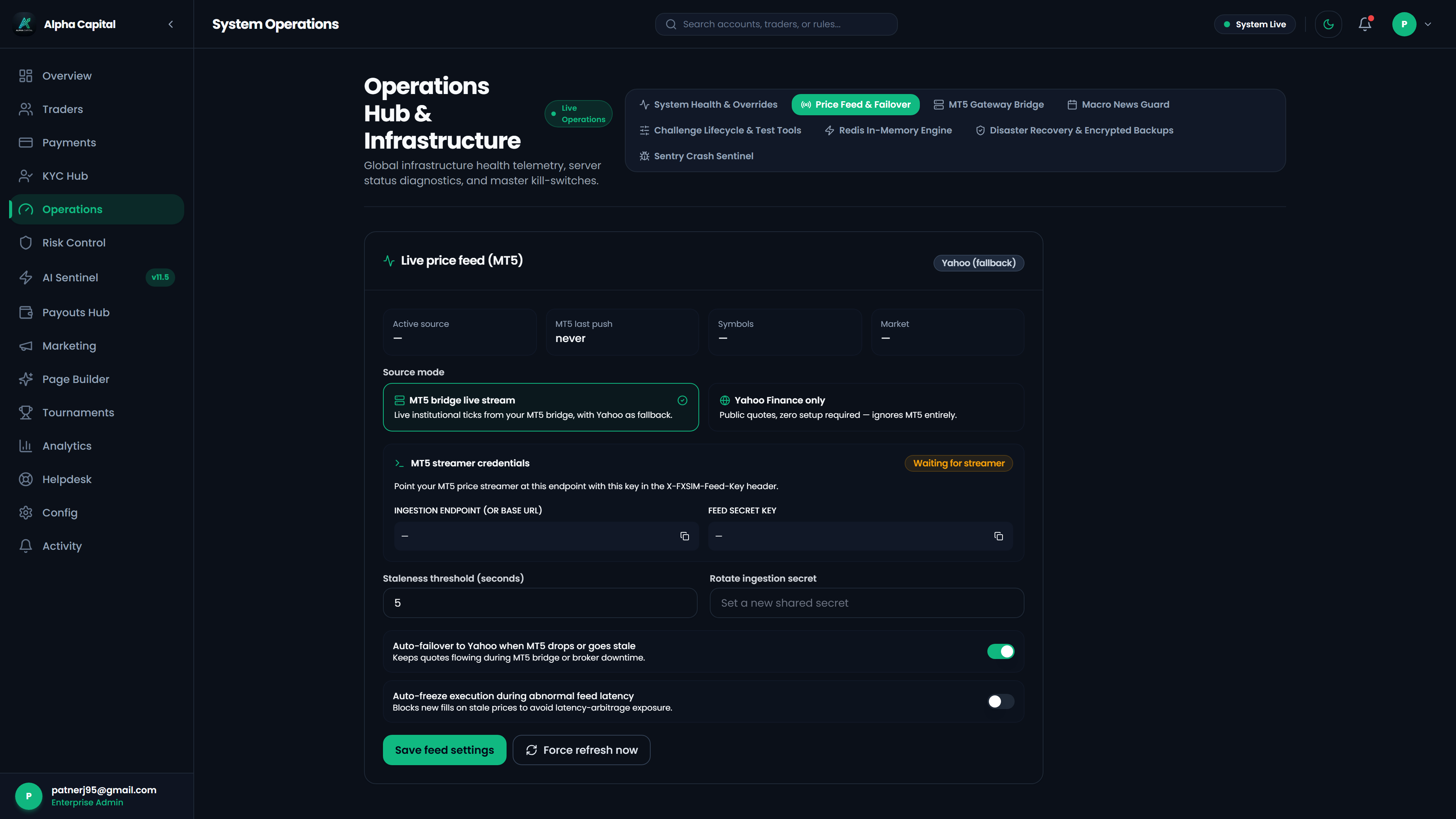
The Operator Architecture Behind the Directory: What Powers Prop Firms
Understanding the retail directory reveals only half the industry. Behind every successful brand on this list is a sophisticated institutional technology stack handling simulated execution, bridge risk routing, and treasury operations.
1. Simulated Demo Execution vs STP A-Book Routing
Retail traders often believe proprietary firms hand them millions in live liquidity on day one. In reality, over 95% of retail evaluation trading occurs entirely in simulated demo server environments.
Operators feed institutional liquidity pricing into custom demo environments. When a trader places an order, the platform's risk management engine calculates simulated slippage, spread markups, and commission rakes.
Only the top 1% to 3% of consistent, verified profitable traders are copied via STP (Straight-Through Processing) bridge technology into live institutional brokerage liquidity pools. The evaluation fees collected from the 90%+ of participants who breach drawdown rules provide the capital reserves used to fund payout splits.
2. Trading Terminal Bridges and Server Latency
Modern prop firm infrastructure requires high-performance bridge software connecting trading interfaces to core risk engines. Platforms like cTrader, DXtrade, and Match-Trader communicate with backend risk databases via ultra-low latency Redis queues and WebSocket telemetry.
Proprietary risk modules monitor accounts in real-time, detecting latency arbitrage, tick scalping abuse, and copy-trading syndicates within milliseconds. Automated breakers freeze compromised credentials before toxic order flow impacts simulated balance ledgers.
Operator Note: For prospective prop firm founders, offering both MT5 and browser-based terminals like cTrader or Match-Trader provides critical multi-platform redundancy. If an external bridge or liquidity provider experiences downtime, traders retain uninterrupted execution access.
Total Cost of Ownership: Legacy SaaS Rental vs LaunchPropFirm Self-Hosted Stack
Prospective entrepreneurs studying this directory often consider launching their own proprietary trading brand. However, the legacy B2B software vendor ecosystem is dominated by predatory SaaS rental pricing.
Legacy vendors like FPFX Tech, Propriotec, and B2Broker trap operators in crippling monthly overhead. They charge $3,500 to $8,000 every single month in platform rent, demand percentage cuts on active accounts, and retain sole custody of your user databases and client relationships. If an operator suffers a slow sales month, the SaaS provider terminates their server access, destroying their business overnight.
LaunchPropFirm changes the economics of the industry entirely. For a single one-time investment of $2,495, founders receive complete Next.js and Node.js source code ownership, private VPS deployment within 48 hours, and 100% database sovereignty.
The Total Cost of Ownership comparison over a 1-year operational timeline demonstrates the structural financial advantage:
| Expense Category | Legacy SaaS Vendors (FPFX / Propriotec) | LaunchPropFirm Turnkey Platform | Operator Advantage |
|---|---|---|---|
| Setup and Onboarding Fee | $5,000 to $15,000 upfront | $0 (Included in package) | Save up to $15,000 |
| Monthly Software Rental | $3,500 to $8,000 / month ($42,000 to $96,000/yr) | $0 / month (Zero recurring software rent) | Save $42,000 to $96,000 annually |
| Volume / Per-Account Rake | $1 to $3 per active trader account | $0 (Zero volume or trader fees) | 100% profit retained |
| Database & Client Sovereignty | Closed vendor cloud (Locked data) | 100% Private PostgreSQL on your VPS | Complete data ownership |
| Source Code Ownership | Closed proprietary binary | Full Next.js / TypeScript code delivered | Infinite customizability |
| Year 1 Total Cost of Ownership | $47,000 to $111,000 | $2,495 fixed one-time | Net Savings: +$44,505 to +$108,505 |
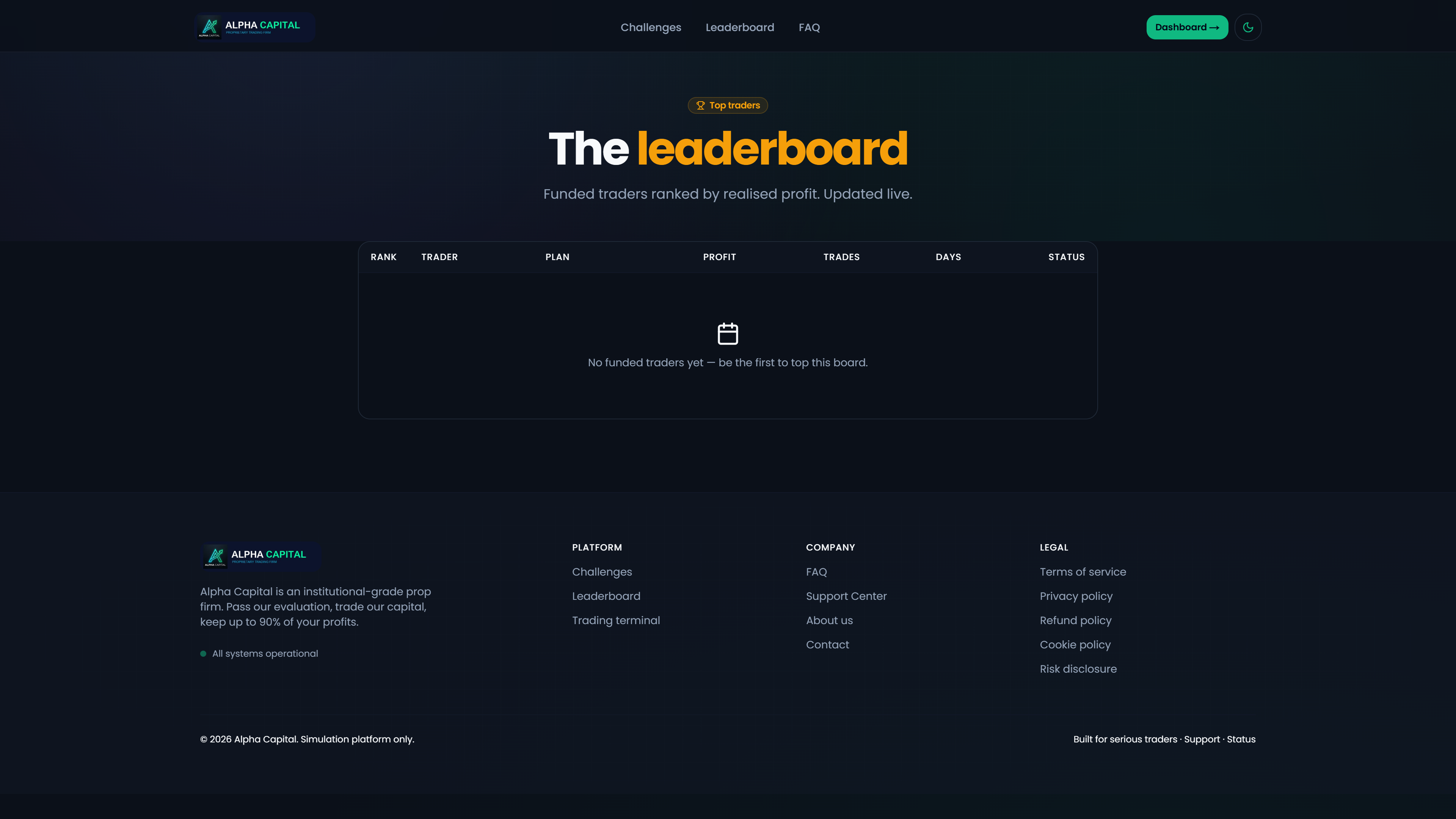
Founders can calculate their exact operational savings across trader volumes using our interactive SaaS vs Self-Hosted Calculator. To inspect the institutional client portal and backend risk console firsthand, test the live dual-credential demo.
Frequently Asked Questions
What are the best prop trading firms 2026 rankings based on?
Evaluating the best prop trading firms 2026 rankings requires analyzing real-world payout frequency, drawdown structure, and server bridge stability. The top evaluated prop trading firms in 2026 include FTMO, Funding Pips, The5ers, Alpha Capital Group, Funded Trading Plus, and Maven Trading. FTMO leads in institutional longevity and static drawdown stability, while Funding Pips dominates high-volume budget evaluations starting at $32. The5ers is recognized as the premier destination for instant funding and scaling programs up to $4,000,000.
What is the difference between static and trailing drawdown?
A static drawdown model fixes your maximum loss ceiling to your initial starting balance, meaning accumulated profits expand your risk cushion. A trailing drawdown model adjusts your loss ceiling upward as your simulated equity reaches new high-water marks. Static drawdown provides a significantly higher mathematical probability of maintaining your funded account over extended trading horizons.
How should beginners choose from this list of prop trading firms?
Beginners exploring this list of prop trading firms should prioritize micro-challenge accounts with static drawdown rules, such as Funding Pips or Maven Trading. Choosing smaller accounts with $16 to $32 entry fees minimizes capital risk while allowing traders to master emotional discipline and execution rules under authentic evaluation conditions.
Can United States citizens trade with firms on this prop firm list?
Yes, but American traders must select firms that operate compliant simulated WebGL environments or trade through domestic futures exchanges. Due to regulatory crackdowns on offshore CFD brokerages, many traditional spot forex firms restrict US residents. Review our curated directory of prop firms for US traders to verify current onboarding eligibility.
What payout methods do modern prop trading firms support?
Most tier-1 prop trading firms disburse profit splits through institutional contractor platforms like Rise Works, direct bank transfers, and major cryptocurrencies (USDT and USDC). Cryptocurrency rails provide near-instant settlement without intermediary banking fees. For detailed guidance on electronic money institution compliance, consult our guide on wise prop firms.
What is the average passing rate for prop firm evaluation challenges?
Industry-wide data indicates that only 5% to 8% of retail traders pass both Phase 1 and Phase 2 of a traditional 2-step challenge. The primary reasons for failure are over-leveraging and violating daily equity drawdown limits rather than poor market direction analysis. Micro-challenges with low upfront fees provide an optimal training ground to master risk discipline before attempting six-figure evaluations.
How much does it cost to launch a prop trading firm?
Launching a prop firm using legacy SaaS vendors costs between $45,000 and $100,000 in Year 1 due to high setup fees and monthly software rent of $3,500 to $8,000. With LaunchPropFirm's self-hosted turnkey solution, founders can deploy their firm for a one-time purchase of $2,495 plus modest VPS hosting costs ($50 to $100/month), retaining 100% of their challenge fee revenues and trader data.
Written by the LaunchPropFirm Engineering & Risk Architecture Desk.
Evaluate Your Prop Firm Readiness Score (0-100)
Answer 5 quick operational questions about your acquisition channels, runway, and engine tech to get a personalized launch roadmap.
Prop Firm Monthly Profit Simulator
Simulate your challenge revenue, payout liability, and net monthly take-home profit.
$20,000
From upfront challenge fees-$2,800
~10 funded payouts budgeted$0 / month
Saves $3,000/mo vs SaaS$17,200/mo
Run-rate: $206,400/yr
M.Haris
Founder & Platform ArchitectBuilding open prop trading software infrastructure for operators worldwide
I built LaunchPropFirm to give forex educators, trading communities, and fintech operators complete ownership of their platform with full source code and zero monthly SaaS rent. Every article on this blog is drawn from hands-on platform development, live MT5 risk bridge mechanics, and real operator economics.
All content, financial models, ROI estimates, and architecture guides on LaunchPropFirm are published strictly for educational and informational purposes. LaunchPropFirm provides institutional prop trading software and technology infrastructure; it does not operate as a broker, custodian, or registered investment advisor.
Evaluation challenges and funded trader accounts referenced in this guide operate in simulated demo trading environments using real-time market data feeds. Simulated trading results do not represent actual trading performance or financial advice.
Recommended Next Reads
Hand-picked operator guides to scale your prop trading platform.
Funding Pips Account Sizes and Prices 2026: Evaluation Tiers, Rules, and Scaling Plan
Complete 2026 Funding Pips account sizes and prices guide. Compare challenge fees ($5k to $100k), 2-step evaluation rules, drawdown limits, and the $2M scaling plan.
Prop Firm with No Evaluation Accounts: The Reality of Instant Funding Models
Explore prop firms with no evaluation accounts. Compare instant direct funding vs 2-step challenges, trailing drawdown floors, fee structures, and operator architecture.
Skip the monthly fees
Own your prop firm platform outright. One time purchase.
Full source code. Live in 7 days. No revenue share. No monthly SaaS bill. See the exact platform before paying anything.
Demo login: haris / asdf1122. No signup needed