Prop Firms for US Traders (2026): Legal Platforms, Rules & How to Get Funded
Discover legal prop firms for US traders in 2026. Learn how simulated trading models navigate post-MetaQuotes rules, TradingView execution, drawdown mechanics, and crypto payouts.
When MetaQuotes initiated its widespread crackdown on offshore brokers in early 2024, dozens of retail proprietary trading firms abruptly terminated or suspended service to American residents. For thousands of domestic traders holding funded accounts or working through multi-phase evaluations, accounts were frozen overnight, leaving the American proprietary trading community stranded.
The disruption exposed a structural vulnerability in the retail prop industry: the vast majority of firms were operating as unregulated white-label entities tethered entirely to offshore MetaTrader 4 and MetaTrader 5 broker infrastructure. When regulatory authorities scrutinized off-exchange foreign currency contracts and retail CFD solicitation, the legacy broker-bridge pipeline collapsed.
In 2026, the market for United States traders has bifurcated. While traditional offshore spot forex brokers remain off-limits under Commodity Futures Trading Commission (CFTC) scrutiny, a modern generation of prop firms has established sustainable, legally compliant architectures. By transitioning to regulated domestic futures execution or operating strictly closed-loop, simulated evaluation environments delivered via native browser-based charting, transparent operators continue to fund American traders with institutional capital allocations ranging from $10,000 to $300,000. To survey the broader global ecosystem of top-tier funding programs across all jurisdictions, consult our curated list of prop trading firms.
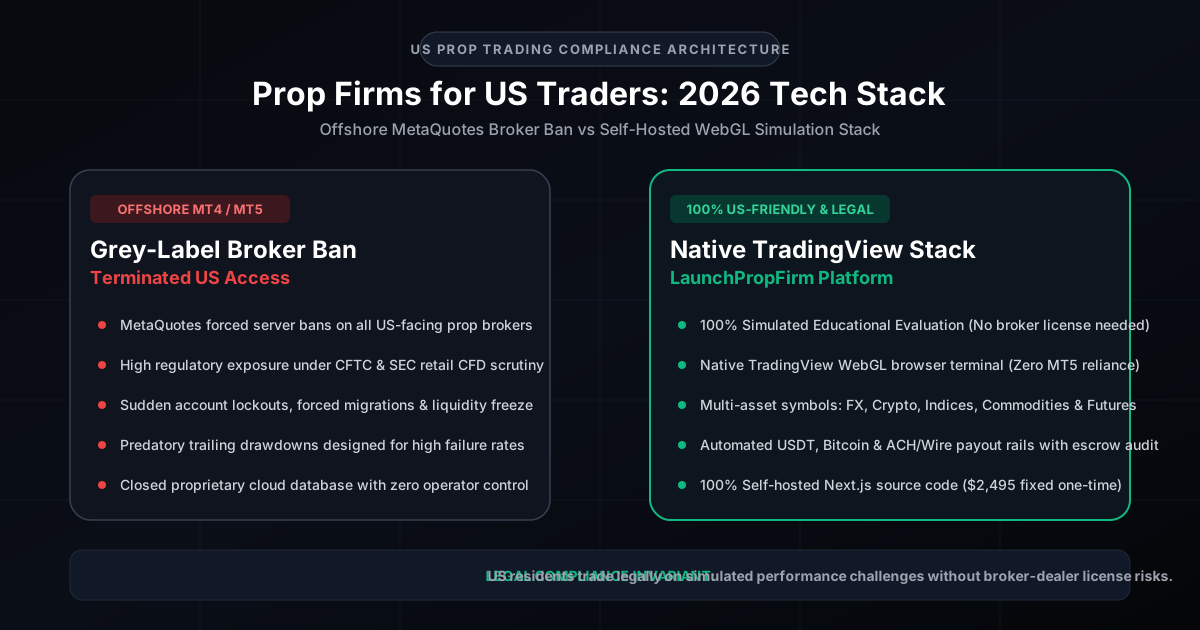
The Post-MetaQuotes Divide: Why US Traders Were Banned
To understand which prop firms are genuinely safe for United States residents in 2026, you must first understand the regulatory mechanics that forced offshore firms to geoblock American IP addresses.
Between 2020 and 2023, hundreds of retail prop firms relied on grey-label MetaTrader licenses issued through offshore brokerage partners in jurisdictions like Saint Vincent, Seychelles, or Vanuatu. These brokers fed live retail spot forex quotes into demo server environments while accepting evaluation challenge fees from American credit cards.
In early 2024, the CFTC and the Securities and Exchange Commission (SEC) intensified enforcement against foreign entities providing unregistered foreign exchange derivatives to retail American retail customers. Under direct regulatory pressure, MetaQuotes issued formal ultimatums to its licensed broker clients: immediately terminate data feeds and demo server hosting for any prop firm servicing US residents, or forfeit corporate server licenses entirely.
The resulting panic split the prop firm ecosystem into three distinct categories:
- The Casualties: Undercapitalized marketing storefronts that lacked custom technology infrastructure. Unable to secure alternative platforms, over thirty firms closed operations or refused payouts during forced platform migrations.
- The Regulated Futures Migration: Firms focusing exclusively on exchange-traded futures contracts (CME, CBOT, NYMEX). Because domestic futures are formally overseen by the National Futures Association (NFA) and CFTC, platforms like Topstep, Apex, and TradeDay remained operational by routing orders through registered Introducing Brokers (IBs) and platforms like Tradovate and NinjaTrader.
- The WebGL & Independent Engine Pioneers: Innovative prop firms that eliminated reliance on MetaQuotes desktop software altogether. By deploying self-hosted matching engines connected to browser-based TradingView interfaces or Devexperts DXtrade stacks, these firms operate 100% simulated evaluation challenges that comply with domestic prize-competition and educational software legal standards.
Legal Mechanics: How Simulated Prop Trading Operates Under US Law
A frequent question asked by American traders is whether trading with a prop firm violates CFTC or SEC regulations. The answer depends entirely on how the firm structures its contractual relationship, execution technology, and capitalization.
Under US law, trading actual client capital on margin in spot retail forex markets requires registration as a Retail Foreign Exchange Dealer (RFED) or Futures Commission Merchant (FCM). Similarly, providing discretionary investment advice requires Commodity Trading Advisor (CTA) registration.
However, modern retail prop firms do not offer broker-dealer services or manage customer deposits. Legally and operationally, they operate under an educational performance evaluation and prize model:
- Simulated Environment: Traders do not deposit margin into a brokerage account. Instead, they pay an evaluation or challenge fee to access a closed simulation server that mirrors live market prices.
- Independent Contractor Status: Upon passing evaluation targets, the trader does not become an employee or an investment client. They execute a performance-based consulting agreement as an independent contractor.
- Performance Rewards / Prize Payouts: Payouts disbursed to traders are classified legally as contractual performance fees or contest prize disbursements, not investment profits or dividend returns.
Tax Reporting Realities for US Traders
Because funded prop traders operate as independent contractors rather than retail brokerage account holders, tax obligations differ fundamentally from standard trading accounts:
- No Section 1256 Contracts: Spot forex and simulated CFDs on prop accounts do not qualify for 60/40 blended capital gains tax treatment under IRC Section 1256.
- IRS Form 1099-NEC / Schedule C: American prop traders report gross performance disbursements on Form 1099-NEC as self-employment income. Traders can deduct legitimate business expenses—such as challenge fees, data feeds, trading software, desk setups, and internet connections—on Schedule C to reduce their taxable net income.
- Crypto Payout Reporting: If a prop firm settles performance fees via stablecoins (USDT or USDC) or Bitcoin, the IRS treats the receipt as ordinary income valued in US Dollars at the spot rate of delivery. Any subsequent appreciation prior to converting to USD incurs standard capital gains tax.
Trading Technology Comparison: What Works for US Residents?
When choosing a prop firm in 2026, technology architecture is your primary risk filter. If a firm claims to accept US clients on an offshore MT4 or MT5 server, your capital and evaluation are at immediate risk of sudden de-licensing.
Below is an objective comparison of trading platforms currently serving American traders:
| Technology Platform | US Client Accessibility | Primary Supported Asset Classes | User Interface Quality | Structural Continuity Risk |
|---|---|---|---|---|
| MetaTrader 4 & 5 | Terminated for US Prop | Spot Forex / CFDs | Outdated Windows Desktop | Critical (Server revocation risk) |
| TradingView WebGL Stack | 100% Fully Supported | FX, Crypto, Indices, Futures | Institutional Browser Engine | Zero (Independent infrastructure) |
| DXtrade (Devexperts) | Supported | Multi-Asset CFDs | Modern Browser & Native Apps | Low (Enterprise SaaS provider) |
| Tradovate / NinjaTrader | Supported | Regulated Futures (CME) | Desktop & Web Hybrid | Low (US Regulated FCM Gateway) |
| cTrader (Spotware) | Severely Restricted | Spot FX / Commodities | High-Performance Desktop/Web | Moderate (Selective broker geoblocking) |
For most retail discretionary traders, a native browser-based TradingView terminal represents the gold standard. It provides professional drawing tools, multi-timeframe indicators, and sub-second order entry directly within Chrome or Safari—completely eliminating the need to install third-party Windows software or run virtual machines on Apple macOS hardware.
Skip the monthly fees
Own your prop firm platform outright. One time purchase.
Full source code. Live in 7 days. No revenue share. No monthly SaaS bill. See the exact platform before paying anything.
Demo login: haris / asdf1122. No signup needed
Critical Rules US Traders Must Scrutinize Before Buying a Challenge
Prop firms designed to accept US traders vary dramatically in their risk parameters. Many undercapitalized firms market accessible pricing while embedding predatory rules that guarantee a 95%+ failure rate. Before purchasing an evaluation, audit these four operational invariants:
1. Trailing Drawdown vs Static Balance Floor
The single most dangerous rule in retail prop trading is the intraday unrealized trailing drawdown (frequently used in futures prop firms).
Under an intraday trailing drawdown model, your account stop-out level continuously trails your highest floating profit during the trading day:
$$ ext{Drawdown Floor} = ext{Peak Intraday Equity} - ext{Max Loss Limit}$$
If you enter a morning trade on the E-mini S&P 500 (ES) or EUR/USD that pushes your balance from $100,000 to an unrealized high of $104,000 before retracing to $101,000, an intraday trailing threshold of $3,000 locks your account breach floor at $101,000 ($104,000 - $3,000). Despite remaining up $1,000 on the day, your account is permanently liquidated and breached.
In contrast, sustainable prop firms utilize a static balance floor or end-of-day (EOD) trailing drawdown. A static 6% drawdown on a $100,000 account remains locked permanently at $94,000 regardless of intraday floating profit spikes, giving traders the breathing room needed to hold winning positions to target.
2. The 30% Single-Day Consistency Rule Trap
Several popular prop firms advertise "No Minimum Trading Days," but conceal a restrictive consistency rule in their terms of service.
Under a 30% consistency rule, no single trading day may account for more than 30% of your total target profit. If you achieve a $10,000 profit target on a $100,000 account, but a high-conviction breakout yields $4,200 (42%) on a single morning, the firm will refuse to pass your account. You are forced to execute dozens of micro-lot "filler" trades over weeks to artificially dilute your daily profit distribution.
Look for firms that either enforce zero consistency restrictions or maintain clear, transparent guidelines on lot-size scaling.
3. News Trading Windows and Weekend Holding
If your trading strategy relies on trading high-impact economic releases—such as US Non-Farm Payrolls (NFP), Consumer Price Index (CPI), or FOMC interest rate announcements—verify the firm's news guard policies:
- Hard News Gate: Closes trades automatically or disqualifies accounts if orders are filled within 2 to 5 minutes before or after high-impact events.
- Soft Margin Freeze: Permits holding through news events, but temporarily expands simulated spreads to reflect actual institutional liquidity dry-ups.
4. Settlement Rails: How You Get Paid
Legitimate US-friendly prop firms disburse payouts on regular bi-weekly or monthly cycles with minimal friction. The standard institutional settlement rails include:
- Cryptocurrency Rails (USDT TRC20, USDC, BTC): Fast, non-custodial settlements completed within 2 to 6 hours without intermediary banking delays.
- Direct Bank Transfer (ACH / Wire): Domestic routing for traders who prefer direct depository credit into US bank accounts.
- Contractor Billing Platforms (Rise / Deel): Formal enterprise payout aggregators that generate compliant contractor invoices and local currency disbursements.
The Founder Blueprint: Why Operators Must Support US Traders
From the perspective of a proprietary trading firm owner or startup founder, ignoring the United States market is an enormous commercial mistake.
The United States represents over 52% of total global demand for funded trader evaluations. American traders possess the highest average challenge purchase cart sizes ($180 to $320 average order value compared to $35 to $65 across Tier-3 international jurisdictions) and demonstrate higher repeat purchase velocity following account breaches.
However, attempting to service US traders using offshore MT5 white-label brokers is fatal to a startup firm. Within weeks of launch, your broker bridge will face compliance shutdowns, locking your operational float and destroying trader trust.
The Turnkey TCO Breakdown: Launching a US-Compliant Firm
Building a modern, browser-based prop firm that legally services American traders does not require enterprise venture capital. Let us examine the true first-year Total Cost of Ownership (TCO) comparing a legacy multi-tenant SaaS provider (such as DXtrade or Propriotec) against LaunchPropFirm's self-hosted Next.js architecture:
| Operational Expenditure Item | Traditional Enterprise SaaS | LaunchPropFirm Independent Platform |
|---|---|---|
| Upfront Setup & Integration | $15,000 (Non-refundable) | $2,495 (One-time complete purchase) |
| Monthly Software Licensing | $5,000/mo × 12 = $60,000 | $0 / month = $0 |
| Per-Account Surcharges | $4,500 ($1.50–$3.50 per evaluation) | $0 (Unlimited challenge accounts) |
| Dedicated Private VPS (Linux) | Included in proprietary cloud | $45/mo × 12 = $540 |
| Total First-Year Infrastructure Cost | $79,500 | $3,035 |
| Net Founder Capital Retained | Baseline Overhead | +$76,465 Saved for Payout Reserves |
By deploying LaunchPropFirm's self-hosted source code on your private server, you eliminate over $76,000 in recurring platform rent. That capital remains in your firm's reserve treasury to guarantee instant trader payouts, launch marketing campaigns, and maintain dual-rail payment processing.
To model your specific startup cash flow projections, use our interactive SaaS vs Self-Hosted Calculator or forecast challenge pricing models with our Prop Firm Calculator.
Step-by-Step Setup: Onboarding US Traders in 48 Hours
If you are an aspiring operator launching a proprietary trading brand in 2026, you can deploy a US-ready trading infrastructure in four steps:
- Acquire 100% Owned Source Code: Purchase LaunchPropFirm for a flat fee of $2,495. You receive complete access to the Next.js frontend, Node.js WebSocket engine, and PostgreSQL schema.
- Deploy on Private VPS: Install the stack on an independent virtual private server (Ubuntu 22.04 LTS, 8 vCPUs, 16GB RAM) with automated Docker containerization. Your trader data and user balances remain 100% sovereign.
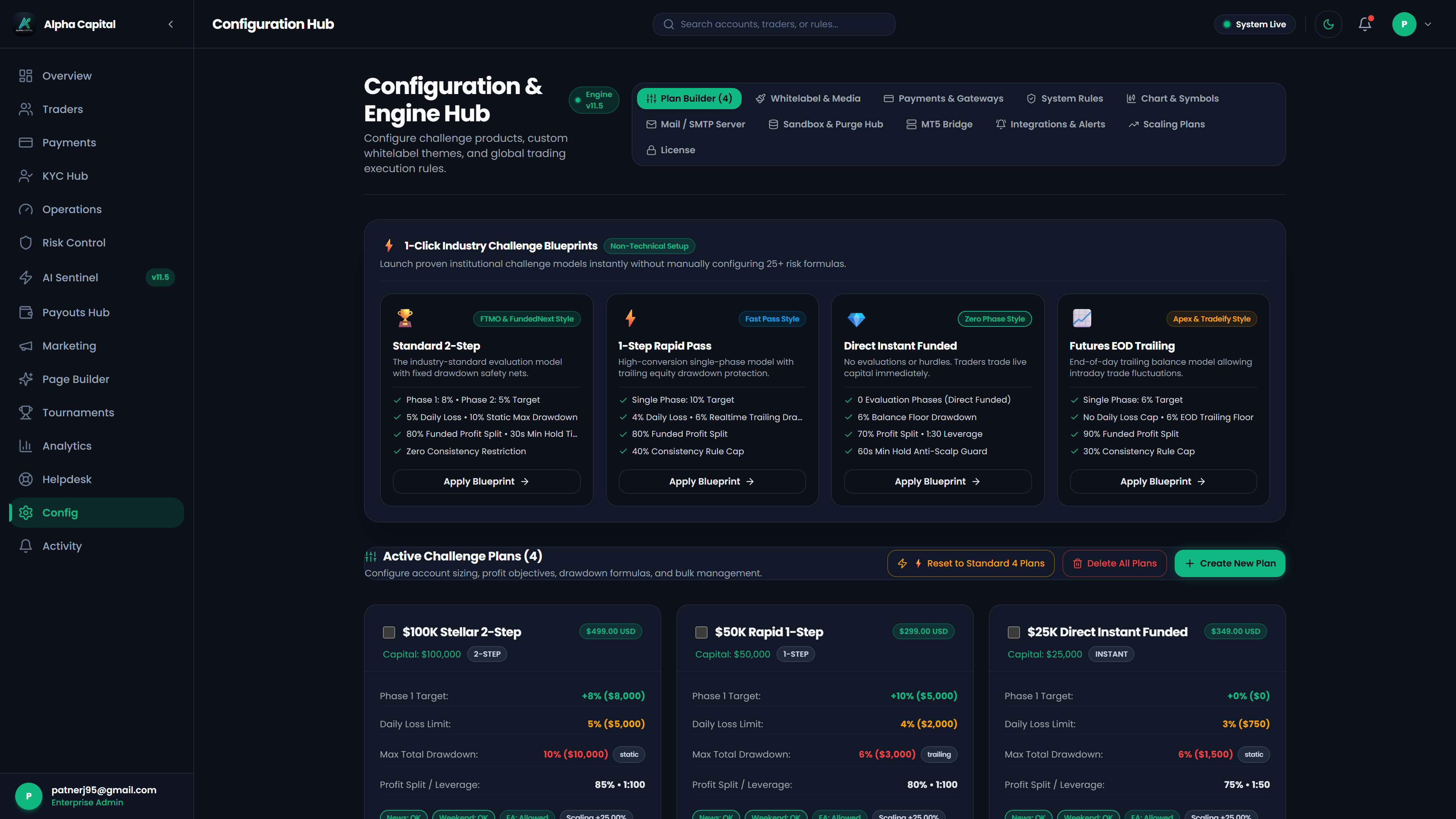
- Configure US-Friendly Challenge Blueprints: In the Admin Setup Wizard, select standard 2-step evaluation rules, static balance-floor drawdowns, and 80% to 90% profit split ladders.
- Connect Payment & Payout Rails: Connect Stripe for credit card payments alongside Cryptomus or NOWPayments for automated USDT and Bitcoin challenge checkouts and contractor payouts.
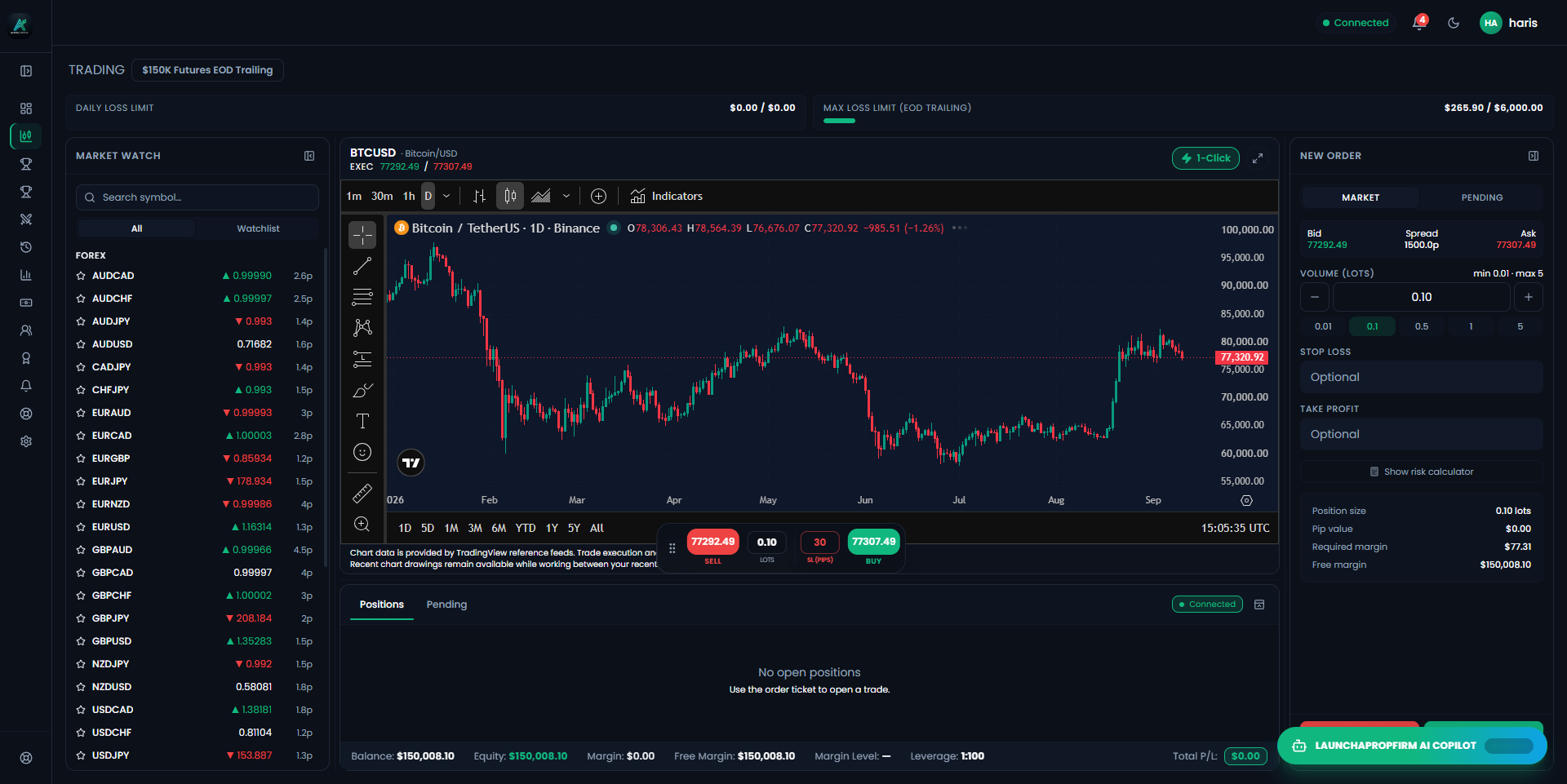
To test the complete administrative backend and explore the live WebGL TradingView trader terminal firsthand, access our live dual-credential demo.
Frequently Asked Questions
Are prop firms legal for US residents in 2026?
Yes. Participating in proprietary trading firm evaluations is completely legal for United States citizens. Because prop challenges operate in closed, simulated demo environments without accepting customer margin deposits or providing broker-dealer services, they operate under educational evaluation and contest law rather than retail broker regulations.
Why did MT5 prop firms stop accepting US clients?
In early 2024, MetaQuotes cracked down on offshore brokers that licensed MetaTrader 4 and 5 servers to prop firms accepting US residents without domestic CFTC or NFA broker-dealer registration. To avoid server license cancellation, brokers and prop firms were forced to restrict US IP addresses.
What trading platform is best for US prop traders?
Browser-based TradingView terminals and Devexperts DXtrade represent the most reliable platforms for US prop traders in 2026. Native WebGL TradingView platforms offer professional charting, sub-second simulated execution, and full mobile compatibility without requiring third-party desktop installations.
How are prop firm payouts taxed in the United States?
Funded prop firm payouts are classified by the IRS as ordinary self-employment income, not capital gains. American traders report earnings on IRS Form 1099-NEC and Schedule C. Legitimate business expenses, such as challenge fees and trading tools, can be deducted from gross earnings.
Evaluate Your Prop Firm Readiness Score (0-100)
Answer 5 quick operational questions about your acquisition channels, runway, and engine tech to get a personalized launch roadmap.
Prop Firm Monthly Profit Simulator
Simulate your challenge revenue, payout liability, and net monthly take-home profit.
$20,000
From upfront challenge fees-$2,800
~10 funded payouts budgeted$0 / month
Saves $3,000/mo vs SaaS$17,200/mo
Run-rate: $206,400/yr
M.Haris
Founder & Platform ArchitectBuilding open prop trading software infrastructure for operators worldwide
I built LaunchPropFirm to give forex educators, trading communities, and fintech operators complete ownership of their platform with full source code and zero monthly SaaS rent. Every article on this blog is drawn from hands-on platform development, live MT5 risk bridge mechanics, and real operator economics.
All content, financial models, ROI estimates, and architecture guides on LaunchPropFirm are published strictly for educational and informational purposes. LaunchPropFirm provides institutional prop trading software and technology infrastructure; it does not operate as a broker, custodian, or registered investment advisor.
Evaluation challenges and funded trader accounts referenced in this guide operate in simulated demo trading environments using real-time market data feeds. Simulated trading results do not represent actual trading performance or financial advice.
Recommended Next Reads
Hand-picked operator guides to scale your prop trading platform.
Funding Pips Account Sizes and Prices 2026: Evaluation Tiers, Rules, and Scaling Plan
Complete 2026 Funding Pips account sizes and prices guide. Compare challenge fees ($5k to $100k), 2-step evaluation rules, drawdown limits, and the $2M scaling plan.
List of Prop Trading Firms (2026 Directory): Best Evaluated and Instant Funding Programs
Complete 2026 list of prop trading firms. Compare the top 6 evaluated prop firms across platforms (MT5, cTrader), drawdown rules, profit splits, and entry fees.
Skip the monthly fees
Own your prop firm platform outright. One time purchase.
Full source code. Live in 7 days. No revenue share. No monthly SaaS bill. See the exact platform before paying anything.
Demo login: haris / asdf1122. No signup needed