What Is a Funding Account? How Funded Trading Accounts Work in 2026
Discover what a funding account is, how prop firm funded trading accounts operate behind the scenes, evaluation rules, profit splits, and the economics between trading funded capital vs launching your own prop firm.
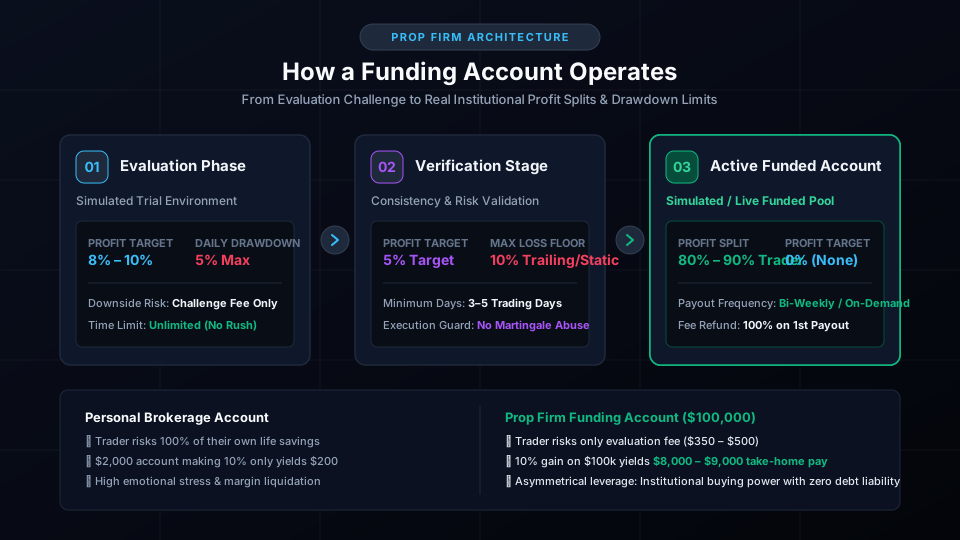
A funding account—commonly referred to in modern proprietary trading as a funded account—is a corporate trading account provided to an independent retail trader after they demonstrate risk discipline and profitability in a structured evaluation challenge. Unlike trading a personal brokerage account where you risk 100% of your personal life savings, a funding account grants you access to institutional purchasing power ranging from $10,000 to $400,000 while legally capping your downside exposure strictly to the cost of the initial evaluation fee.
In this breakdown, we examine the operational mechanics of funding accounts from both sides of the desk: how retail traders qualify for capital allocations, how prop firm operators manage risk and liquidity routing behind the scenes, and the mathematical trade-offs between trading someone else's balance sheet versus running your own self-hosted proprietary trading firm.
What Is a Funding Account? The Operator's Grounded Definition
At its core, a modern funding account operates under a performance-contingent contract. The proprietary trading firm provides access to a high-balance simulated or live trading sub-account connected to an institutional liquidity bridge or broker feed (such as MetaTrader 5, cTrader, DXtrade, or browser-native TradingView terminals).
The operating model centers on three structural pillars:
- Asymmetric Risk Profile: As a trader, if you suffer a severe losing streak and breach the account drawdown floor, your account is liquidated and closed. However, you are never held personally liable for trading losses beyond your upfront evaluation fee. The firm absorbs the market variance.
- Institutional Profit Sharing: When you generate profits while adhering to strict risk management protocols, the firm distributes between 80% and 90% of those net gains directly to you on scheduled payout cycles (typically bi-weekly or monthly).
- Strict Parameter Governance: Every funded account is governed by algorithmic risk filters—primarily daily loss limits (typically 5%) and maximum total drawdown thresholds (typically 10%).
The Three Phases of a Prop Firm Funding Account
Achieving and maintaining a funded status is rarely an instantaneous transaction. Reputable proprietary trading platforms deploy a structured 2-step evaluation lifecycle designed to filter out high-risk gamblers and identify systematically profitable market operators. Alternatively, traders who wish to bypass testing phases entirely can purchase direct instant access through a prop firm with no evaluation accounts, paying a higher upfront fee in exchange for immediate profit-split eligibility and strict trailing drawdown floors. To compare how these evaluation criteria translate into exact dollar costs across micro to standard tiers, see our breakdown of funding pips account sizes and prices 2026.
Phase 1: The Evaluation Challenge
The initial benchmark tests your ability to generate returns within defined risk boundaries.
- Profit Target: Typically 8% to 10% on the starting account balance (e.g., $8,000 on a $100,000 account).
- Daily Drawdown Limit: 5% calculated from the previous day's closing equity.
- Maximum Loss Limit: 10% static or trailing drawdown.
- Duration: Most modern 2026 prop firms offer unlimited trading days, allowing traders to wait patiently for high-probability setups without artificial time pressure.
Phase 2: The Verification Stage
Once Phase 1 is cleared, the trader advances to Phase 2, which validates that the initial success was not a statistical anomaly or the result of uncontrolled leverage.
- Profit Target: Lowered to 5% (e.g., $5,000 on a $100,000 account).
- Risk Limits: Mirror Phase 1 precisely (5% daily, 10% maximum total drawdown).
- Minimum Trading Days: Typically 3 to 5 distinct trading sessions to confirm consistent position sizing and systematic trade distribution.
Phase 3: The Active Funded Account
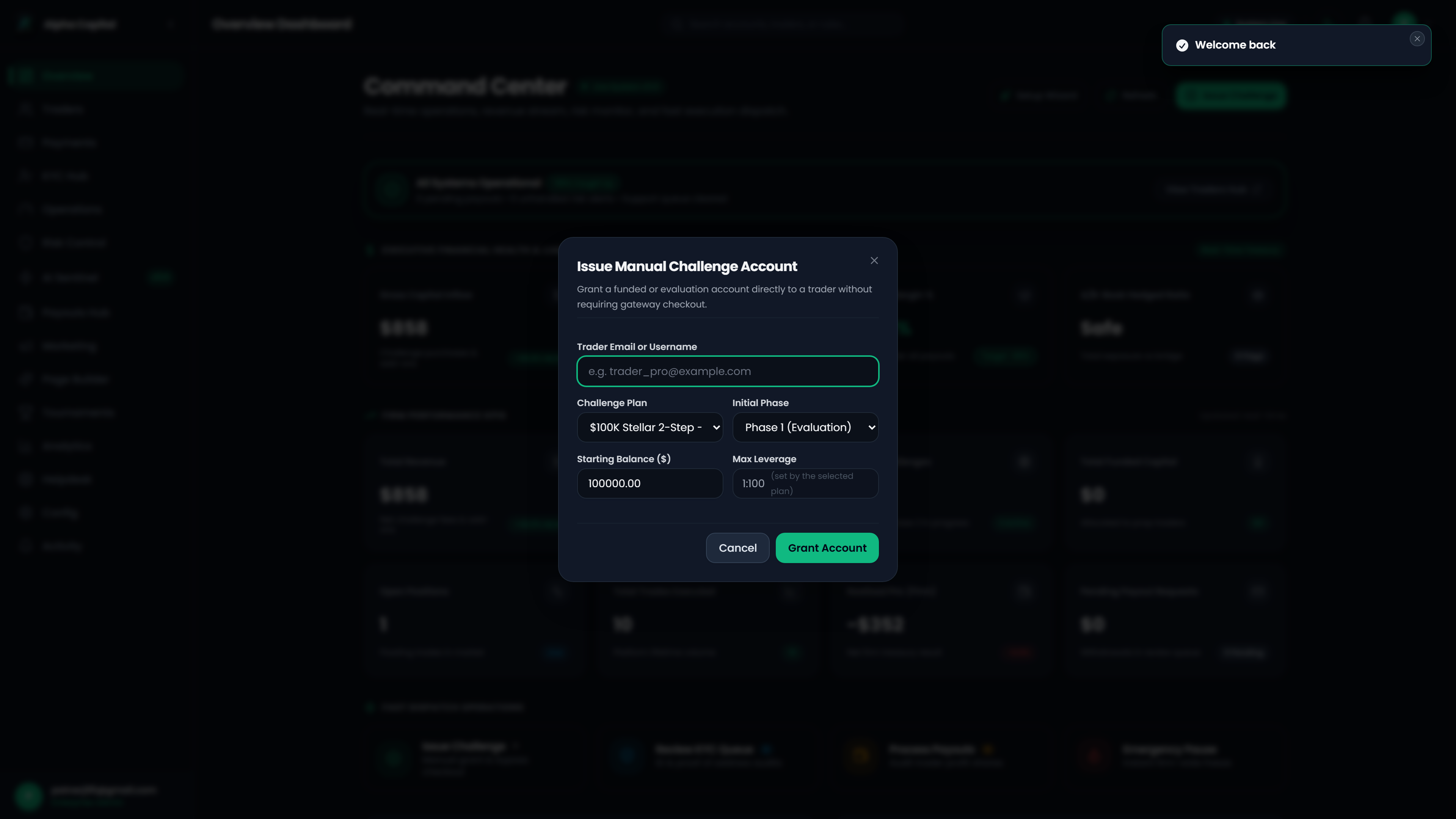
Clearing Phase 2 triggers institutional account creation. The trader completes automated KYC verification, signs an independent contractor agreement, and receives active funded credentials.
In Phase 3, the dynamics change fundamentally:
- Profit Target Removed: There is no profit milestone required. Any net profit generated above the initial starting balance is eligible for cash withdrawal.
- Profit Split Activated: Net gains are split according to the firm's schedule, with 80% to 90% credited to the trader.
- Evaluation Fee Refund: On the trader's first successful payout cycle, premier prop firms refund 100% of the initial evaluation fee, making the capital access functionally zero-cost.
Behind the Scenes: Real Capital vs. Simulated Liquidity
A common misconception among beginner traders is that passing a prop firm challenge immediately gives them direct access to millions of dollars in live institutional cash sitting in a tier-1 bank custody account.
In institutional reality, modern proprietary trading firms operate a hybrid risk-routing architecture:
1. The Simulated B-Book Execution Environment
Over 90% of retail prop firm funded accounts operate in a high-performance simulated demo liquidity environment. The quotes, execution latency, and spreads mirror live interbank conditions via TradingView or MT5 server feeds, but trades are not routed directly into interbank liquidity pools.
Prop firms finance trader payouts from a combined pool of challenge entry fees, resetting fees, and corporate reserves. Because retail failure rates historically hover between 88% and 92%, the mathematical surplus from challenge purchases comfortably covers legitimate payouts to disciplined traders.
2. A-Book Direct Copy Routing
When a funded trader demonstrates exceptional consistency, low drawdowns, and high Sharpe ratios over multiple months, the prop firm's automated risk engine flags the account. The platform's bridge software (such as LaunchPropFirm's native MT5/cTrader bridge) silently copies the trader's positions in real-time to a live institutional prime brokerage account (A-Book). In this tier, the firm offsets its payout liability through live market profits generated by the copied order flow.
Skip the monthly fees
Own your prop firm platform outright. One time purchase.
Full source code. Live in 7 days. No revenue share. No monthly SaaS bill. See the exact platform before paying anything.
Demo login: haris / asdf1122. No signup needed
Funding Account Economics: Personal Capital vs. Funded vs. Prop Firm Founder
To understand why funding accounts have dominated the retail trading landscape, consider the stark financial comparison between trading personal capital, trading a $100,000 funding account, and launching your own proprietary trading brand:
| Operating Dimension | Personal Retail Account | Prop Firm Funded Account ($100k) | Self-Hosted Prop Firm Operator |
|---|---|---|---|
| Upfront Capital Required | $2,000 - $10,000 personal cash | $350 - $550 evaluation fee | $2,495 one-time platform purchase |
| Downside Loss Liability | 100% of personal balance | Capped at challenge fee ($350) | VPS hosting ($50/mo) + bridge |
| Maximum Purchasing Power | $2,000 - $10,000 balance | $100,000 institutional allocation | Unlimited trader pool equity |
| Return on 10% Profit Gain | $200 - $1,000 gain | $8,000 - $9,000 payout (80-90%) | Retains 10-20% split + challenge fees |
| Platform Independence | High (direct broker account) | Low (firm controls rule breaches) | 100% database & brand sovereignty |
| Revenue Scalability | Linear (scales with personal savings) | Capped at scaling ceilings ($2M) | Exponential (thousands of active traders) |
Key Funding Account Rules Every Trader Must Understand
Every funding account operates within rigid algorithmic guardrails. Violating any of these parameters results in an automated breach and immediate credential revocation.
1. Equity-Based vs. Balance-Based Daily Drawdown
The daily loss limit (typically 5%) is the most common reason traders fail funded accounts.
- Balance-Based: The limit is calculated strictly on starting daily balance at 00:00 server time. Floating open profits do not affect the breach line.
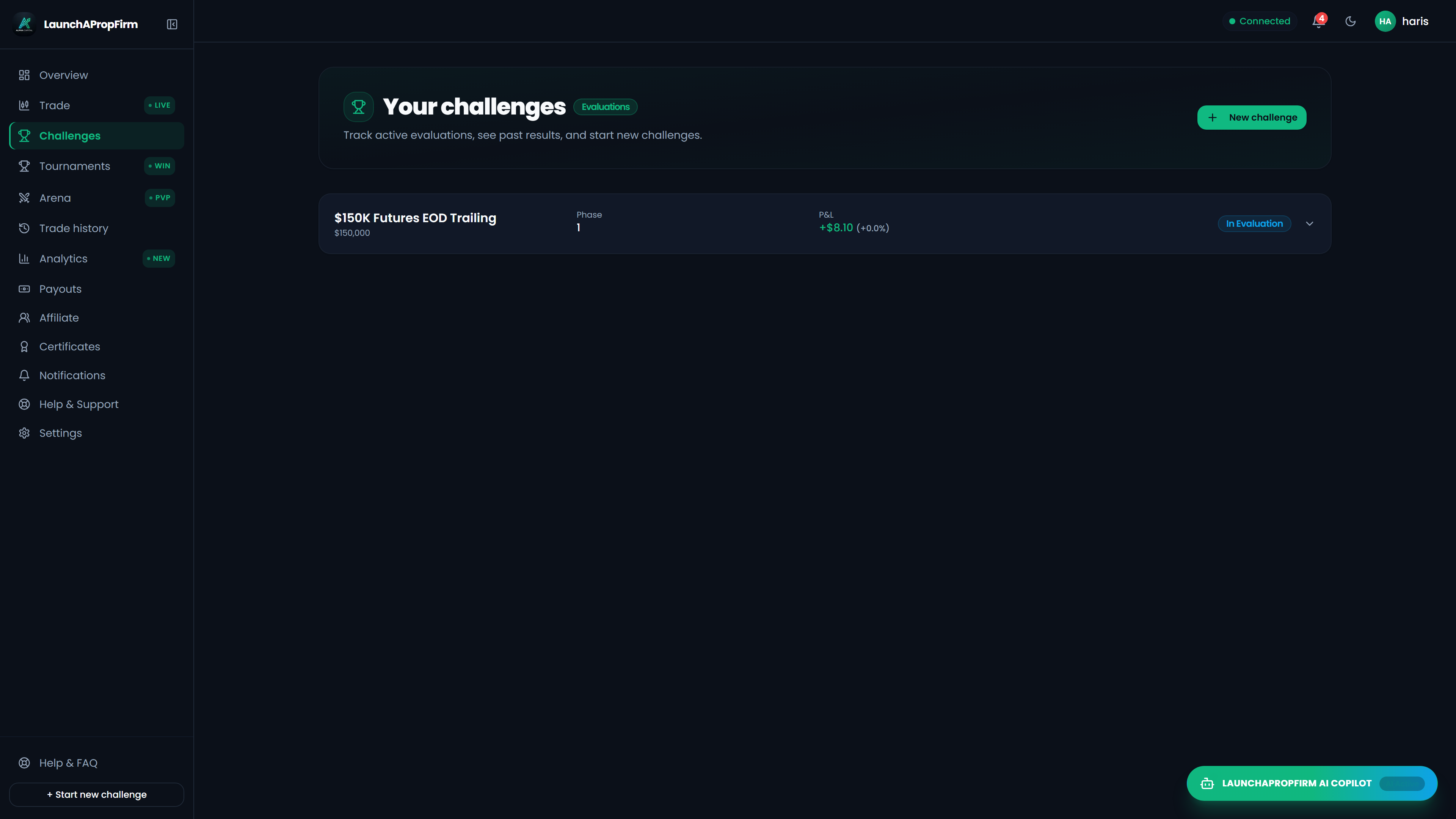
- Equity-Based (Trailing Intraday): If you are up $3,000 intraday on floating positions, the daily loss threshold trails upward behind your highest unrealized equity. If price pulls back 5% from that peak, the account breaches—even if you are still profitable on the day. Institutional platforms like LaunchPropFirm clearly display these risk parameters in the trader dashboard.
2. Static vs. Trailing Overall Drawdown
- Static Drawdown: The maximum loss floor remains locked at 10% of the initial account size (e.g., $90,000 on a $100,000 account) regardless of how much profit is accumulated.
- Trailing Drawdown: The maximum loss floor moves upward as your account balance increases, locking in unrealized gains and requiring disciplined profit taking.
3. Prohibited Execution Strategies
Firms actively filter out abusive or toxic flow that cannot be replicated in live liquidity pools:
- Latency Arbitrage: Exploiting delayed pricing feeds between different broker servers.
- HFT & Reverse Hedging: Opening opposing positions across multiple linked accounts to guarantee one pass while sacrificing the other.
- Account Sharing & Passing Services: Deploying third-party automated challenge-passing scripts.
How Payouts and Profit Splits Work
Once funded, a trader's primary focus shifts from passing rules to executing clean payout requests.
Payout Schedules
- Bi-Weekly Cycles: The industry standard allows traders to submit withdrawal requests every 14 calendar days, provided the account balance remains in net profit and all open positions are closed.
- On-Demand Payouts: High-tier programs offer on-demand withdrawal requests after the initial 30 days of active funded trading.
Payment Rails
Modern prop firms process payouts through multi-rail financial gateways:
- Direct Crypto Settlement: Instant payments via USDT (TRC-20 / ERC-20), Bitcoin, or Ethereum, offering global accessibility with zero international banking friction.
- Direct Bank Wires: Domestic ACH or international SWIFT wire transfers handled through institutional fintech payment partners.
- Fintech Wallets: Digital settlement through Rise, Deel, or Wise for compliant corporate invoicing and cross-border contractor payouts.
The Strategic Shift: From Funded Trader to Prop Firm Founder
While obtaining a $100,000 or $200,000 funding account offers asymmetric upside compared to risking personal life savings, experienced operators recognize that the highest-margin business model in modern finance is owning the proprietary trading firm itself.
Consider the mathematical reality:
- An exceptional trader might earn $10,000 to $20,000 per quarter on a funded account while navigating strict drawdown rules and execution parameters.
- A boutique proprietary trading firm onboarding 300 to 500 traders per month generates $80,000 to $150,000 in monthly challenge revenues, retaining 100% of failed challenge fees, 10% to 20% of funded payout splits, and entry fees from automated gamified tournaments.
Historically, launching a prop firm required $50,000+ in enterprise SaaS contracts and monthly licensing fees from vendors like FPFX Tech ($4,000/mo) or Propriotec ($3,000/mo). With LaunchPropFirm's turn-key, self-hosted white-label engine ($2,495 one-time), ambitious traders and entrepreneurs can deploy their own institutional evaluation platform—complete with automated challenge issuance, TradingView browser terminals, MT5 bridges, and automated risk sentinels—in under 48 hours with zero monthly platform subscriptions.
Test your firm's revenue projections using our SaaS vs Self-Hosted Profit Calculator or inspect the operational engine directly on our Live Dual-Credential Demo.
Frequently Asked Questions (FAQ)
What happens if I fail a funding account challenge?
If you breach a daily loss limit or overall drawdown floor, the account is immediately deactivated. You do not owe any money to the firm; your financial liability is strictly capped at the evaluation challenge fee you paid upfront. You can purchase a discounted reset or enter a new challenge at any time.
Can I withdraw the initial capital in a funding account?
No. The core account balance (e.g., $100,000) represents virtual simulated capital or corporate operational margin. You cannot withdraw the underlying principal. You can only withdraw the net profits generated above the initial starting balance according to the 80% to 90% profit-sharing ratio.
Are prop firm funding accounts legal?
Yes. Prop firms offering simulated evaluation accounts operate completely legally as educational and performance evaluation platforms. Because they do not solicit or accept retail customer deposits for brokerage execution, they operate outside traditional retail broker-dealer licensing requirements. Traders operate as independent performance contractors.
How many funding accounts can one trader hold?
Most major prop firms allow traders to manage up to $400,000 to $600,000 in active capital allocations across multiple individual accounts. Top-tier platforms also provide automated account scaling plans, doubling account balances every 3 months for consistent traders who achieve 10% net gains.
Evaluate Your Prop Firm Readiness Score (0-100)
Answer 5 quick operational questions about your acquisition channels, runway, and engine tech to get a personalized launch roadmap.
Prop Firm Monthly Profit Simulator
Simulate your challenge revenue, payout liability, and net monthly take-home profit.
$20,000
From upfront challenge fees-$2,800
~10 funded payouts budgeted$0 / month
Saves $3,000/mo vs SaaS$17,200/mo
Run-rate: $206,400/yr
M.Haris
Founder & Platform ArchitectBuilding open prop trading software infrastructure for operators worldwide
I built LaunchPropFirm to give forex educators, trading communities, and fintech operators complete ownership of their platform with full source code and zero monthly SaaS rent. Every article on this blog is drawn from hands-on platform development, live MT5 risk bridge mechanics, and real operator economics.
All content, financial models, ROI estimates, and architecture guides on LaunchPropFirm are published strictly for educational and informational purposes. LaunchPropFirm provides institutional prop trading software and technology infrastructure; it does not operate as a broker, custodian, or registered investment advisor.
Evaluation challenges and funded trader accounts referenced in this guide operate in simulated demo trading environments using real-time market data feeds. Simulated trading results do not represent actual trading performance or financial advice.
Recommended Next Reads
Hand-picked operator guides to scale your prop trading platform.
Funding Pips Account Sizes and Prices 2026: Evaluation Tiers, Rules, and Scaling Plan
Complete 2026 Funding Pips account sizes and prices guide. Compare challenge fees ($5k to $100k), 2-step evaluation rules, drawdown limits, and the $2M scaling plan.
List of Prop Trading Firms (2026 Directory): Best Evaluated and Instant Funding Programs
Complete 2026 list of prop trading firms. Compare the top 6 evaluated prop firms across platforms (MT5, cTrader), drawdown rules, profit splits, and entry fees.
Skip the monthly fees
Own your prop firm platform outright. One time purchase.
Full source code. Live in 7 days. No revenue share. No monthly SaaS bill. See the exact platform before paying anything.
Demo login: haris / asdf1122. No signup needed