White Label Futures Prop Firm: Platform Setup Guide
Launch a white label futures prop firm like Apex Trader Funding. Understand Rithmic data feeds, Tradovate bridges, CME fees, and turnkey software costs.
Deploying a white label futures prop firm has emerged as one of the most profitable opportunities in proprietary trading. Following the explosive growth of firms like Apex Trader Funding, Topstep, and MyFundedFutures, retail traders have migrated heavily from off-exchange CFD models toward standardized, centralized exchange contracts on the Chicago Mercantile Exchange (CME).
However, launching an institutional futures brand traditionally required overcoming immense technical and financial hurdles: clearing relationships, Rithmic gateway integrations, and punishing monthly SaaS software leases.
Understanding the underlying mechanics of futures infrastructure enables founders to launch a high-margin evaluation firm with full software ownership and zero recurring rent.
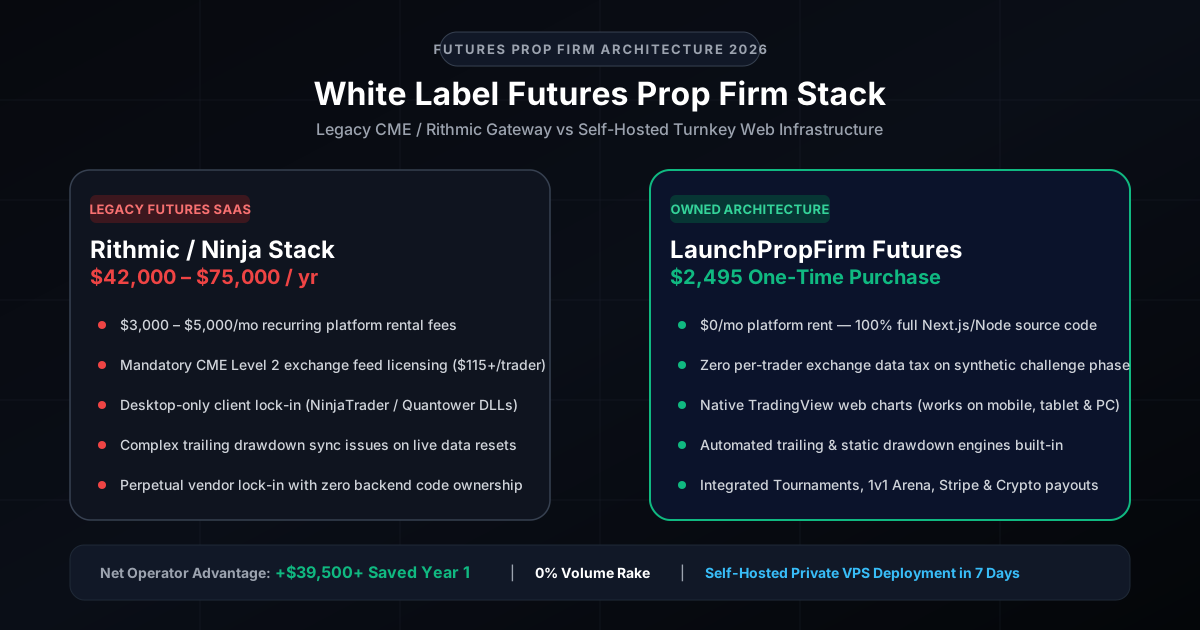
The Core Economics: Why Futures Prop Firms Print Cash
Retail futures prop firms operate fundamentally different unit economics than legacy spot forex brokers. In forex and crypto, operators battle offshore banking friction, high merchant processing fees (often 7% to 12% on high-risk card rails), and continuous regulatory headwinds.
Futures evaluation programs, by contrast, enjoy three major operational advantages:
- Mainstream Payment Processing Acceptance: Because futures evaluation challenges take place on simulated market environments with centralized exchange pricing, domestic payment processors (including Stripe and standard acquiring banks) categorize evaluations under digital educational services. Blended card processing drops to 2.9% plus $0.30 per checkout.
- Extreme Challenge Volume & High Rebuy Velocity: Futures traders trade volatile contracts like the E-mini S&P 500 (ES), Micro E-mini (MES), and Nasdaq 100 (NQ). Due to intraday trailing drawdowns, challenge fail rates exceed 92%. Active traders routinely purchase 5 to 15 resets per month during market volatility.
- Activation Fees Create Pure Margin: Unlike forex firms that charge a single upfront fee, futures firms typically charge an initial discounted evaluation fee ($16 to $35 during promotions) followed by a mandatory $85 to $150 "Funded Account Activation Fee" once the trader passes. This back-end fee is pure operator profit before the trader executes a single funded contract.
See the platform before reading further
The Legacy Futures Tech Stack vs Turnkey Web Infrastructure
To understand why traditional futures firm setups cost $50,000+ to launch, consider the legacy desktop architecture:
| Component | Legacy Futures Architecture (Apex/Topstep Model) | Modern Turnkey Web Stack (LaunchPropFirm) |
|---|---|---|
| Front-End Interface | Desktop DLLs (NinjaTrader 8, Quantower, Sierra Chart) | Native Web TradingView Terminal (Browser + Mobile PWA) |
| Market Data Routing | Direct Rithmic / CQG / Tradovate Data Gateways | Live CME Level 2 Websocket Feeds + Built-in Feed Engine |
| CME Exchange Data Fees | $115 to $135/mo per active trader paid to CME Group | $0/mo per trader during simulated evaluation phase |
| Software Platform Cost | $3,500 – $5,000/month recurring SaaS licensing | $2,495 One-Time Purchase (100% Source Code Ownership) |
| Drawdown Enforcement | Desktop client polling / delayed batch account liquidation | Sub-millisecond server-side risk monitor with automated breach |
| Trader Onboarding | Manual license key distribution & Rithmic connection guides | Instant automated dashboard provisioning in The Traders Room |
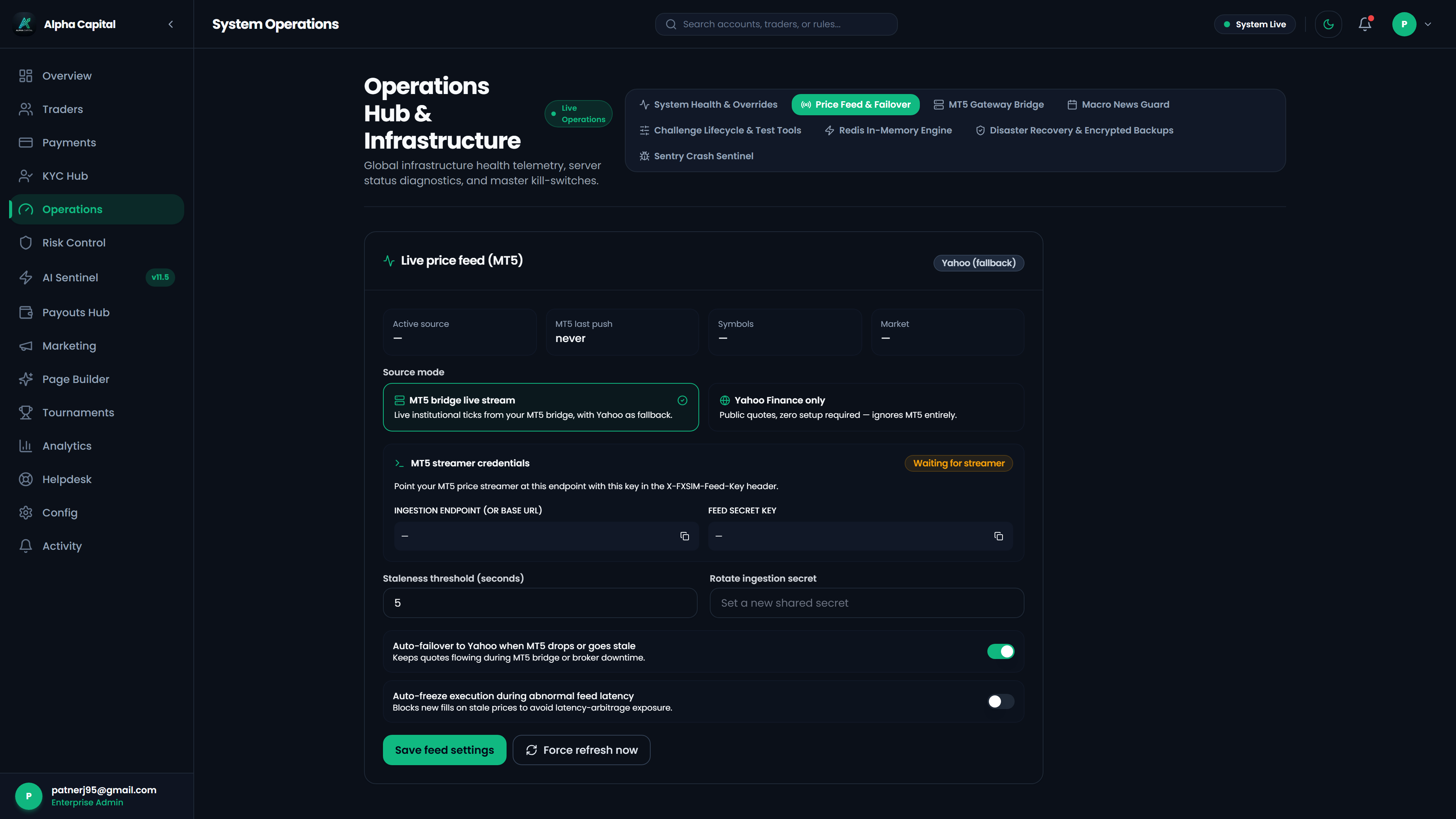
The CME Market Data Problem Explained
In live futures trading, CME Group strictly polices Non-Professional vs Professional market data classification. Every trader connected to a live Rithmic or Tradovate feed incurs monthly exchange fees:
- CME (S&P, Nasdaq): $35/month
- CBOT (Dow, Treasuries): $35/month
- NYMEX (Crude Oil, Natural Gas): $35/month
- COMEX (Gold, Silver): $35/month
When an operator launches with a legacy broker bridge, they are forced to pass these data charges onto challenge participants or absorb them internally, destroying front-end gross margins on entry-tier accounts.
The solution utilized by modern high-margin firms is synthetic exchange routing during Phase 1 evaluations. By ingesting an institutional centralized feed and executing simulated fills server-side inside your own risk engine, traders experience exact tick-by-tick Level 2 price movement without triggering per-user CME subscriber taxes. Once a trader reaches funded status and demonstrates consistent profitability, their order flow can be routed directly into a regulated clearing broker per standard A-Book vs B-Book risk allocation.
Trailing Drawdown Mechanics: Peak Threshold vs End-of-Day
The defining operational rule of any futures prop firm is its drawdown calculation engine. Unlike forex firms that primarily calculate drawdowns relative to midnight account equity (balance-based daily drawdown), futures platforms rely on two specific variations:
1. Intraday Trailing Drawdown (The High-Turnover Engine)
Under the intraday trailing threshold (popularized by Apex Trader Funding), the maximum loss buffer trails the trader's unrealized peak equity in real time.
- If a trader begins a $50,000 challenge with a $2,500 trailing drawdown, their liquidation threshold is $47,500.
- If the trader opens a long Nasdaq position that spikes unrealized profit to $52,000, their liquidation floor immediately trails up to $49,500 ($52,000 - $2,500).
- If the trade pulls back and closes at $50,500, the trailing threshold does not reset down. It remains locked at $49,500.
This rule causes frequent technical liquidations during high-volatility sessions, driving rapid reset purchases while protecting the firm's capital base.
2. End-of-Day (EOD) Trailing Drawdown
EOD drawdown only recalculates the trailing stop at the 5:00 PM EST market close based on closed account balance. While easier for retail traders to pass, it yields lower reset volume. Many operators offer both modes as distinct tier pricing: charging higher entry fees for EOD challenges and discounted fees for intraday trailing challenges.
Both evaluation algorithms are configurable out-of-the-box in the LaunchPropFirm admin settings, detailed in our guide on prop firm challenge rules.
Skip the monthly fees
Own your prop firm platform outright. One time purchase.
Full source code. Live in 7 days. No revenue share. No monthly SaaS bill. See the exact platform before paying anything.
Demo login: haris / asdf1122. No signup needed
Total Cost of Ownership: Turnkey Source Code vs Monthly SaaS
When evaluating a white label futures prop firm software vendor, calculating the 1-year and 3-year Total Cost of Ownership (TCO) is essential:
| Expense Category | Enterprise SaaS Provider | LaunchPropFirm Self-Hosted |
|---|---|---|
| Upfront Setup / Integration Fee | $7,500 – $15,000 | $2,495 (Fixed flat fee) |
| Monthly Software Maintenance | $3,500 / month ($42,000/yr) | $0 / month ($0/yr) |
| Per-Account Surcharges | $2.00 – $5.00 per challenge sold | $0 (Unlimited challenges) |
| TradingView Terminal Integration | $1,500/mo add-on module | Included natively in client portal |
| Database & Server Hosting | Hosted on vendor's shared cloud | Your private dedicated VPS ($45/mo) |
| Year 1 Total Expenditure | $49,500 – $72,000 | $3,035 (License + 12mo hosting) |
| First-Year Operator Savings | Baseline | +$46,465 Net Profit Kept |
To model out your expected challenge sales volume against monthly server expenses, run your projections through our interactive SaaS vs Self-Hosted Calculator.
Step-by-Step Deployment Roadmap for a Futures Prop Firm
Launching your futures evaluation brand requires five practical stages:
- Establish Legal Entity & Commercial Banking: Incorporate an operating entity (popular jurisdictions include the United States, United Kingdom, UAE, and Wyoming/Delaware LLCs) and establish payment gateway accounts for Stripe, checkout credit card rails, and crypto merchant gateways (USDT TRC20/BEP20).
- Deploy Self-Hosted Core Architecture: Deploy LaunchPropFirm to your dedicated Linux VPS in under 48 hours. Connect your branding, custom domain, email SMTP relay, and pricing challenge tiers.
- Configure Risk Parameters & Challenge Pricing: Define your evaluation catalog ($25k, $50k, $100k, and $150k accounts), trailing drawdown buffers (typically 4% to 6%), daily loss limits, and pass targets (typically 6% to 8%).
- Acquisition & Affiliate Funnel Launch: Recruit futures trading influencers, YouTube day traders, and Discord trading communities by offering attractive recurring affiliate tiers (15% to 25%) via your integrated affiliate partner portal.
- Automated Payout Operations: Process funded trader payout requests through your admin panel, verifying performance metrics and identity before releasing profit splits via crypto or bank wire.
To understand server bridge infrastructure and connection fees, read our comprehensive prop firm MT5 server cost and bridge guide and explore realistic white label prop firm costs.
Frequently Asked Questions
What is a white label futures prop firm?
A white label futures prop firm is a turnkey software platform that provides aspiring firm operators with complete client management, trading terminals, automated challenge evaluations, and administrative risk controls to launch a proprietary trading business under their own brand without engineering software from scratch.
How much does it cost to start a white label futures prop firm?
With LaunchPropFirm, an operator can launch a complete white label futures prop firm for a one-time purchase of $2,495, requiring only standard private VPS hosting ($40 to $60/month) and zero recurring SaaS platform fees.
Do I need to be licensed to operate a futures evaluation firm?
Retail prop firms evaluating traders on simulated demo market data with virtual capital do not require clearing broker-dealer licenses in most jurisdictions, as they provide evaluation services and award performance rewards rather than managing retail client deposits. Always consult local corporate legal counsel regarding regional regulatory standards.
Does LaunchPropFirm include TradingView charting for futures?
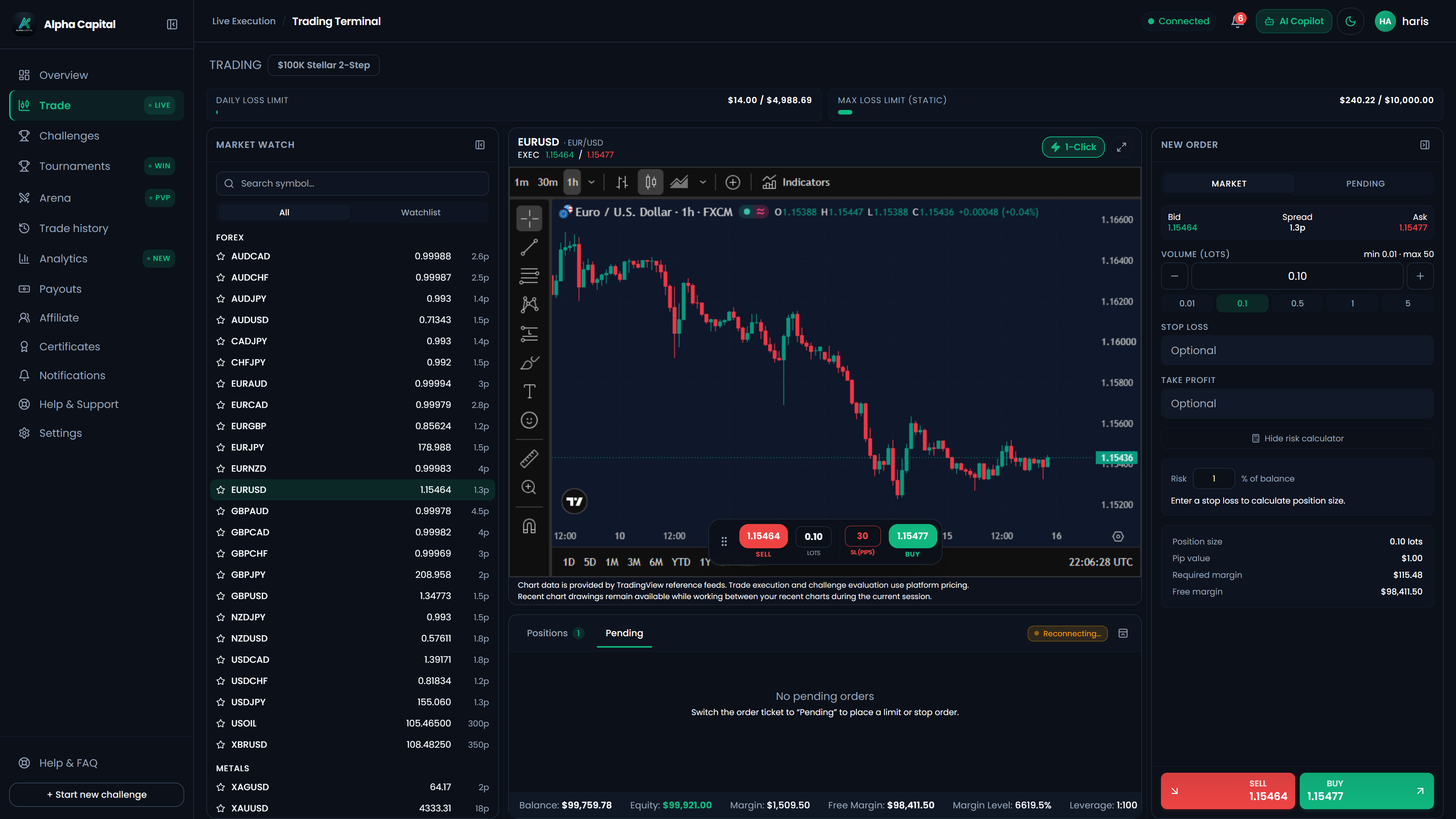
Yes. The platform includes a native, high-performance TradingView web charting terminal running directly in the browser, allowing traders to execute trades instantly on desktop, tablet, and mobile devices without downloading third-party desktop platforms.
Evaluate Your Prop Firm Readiness Score (0-100)
Answer 5 quick operational questions about your acquisition channels, runway, and engine tech to get a personalized launch roadmap.
Prop Firm Monthly Profit Simulator
Simulate your challenge revenue, payout liability, and net monthly take-home profit.
$20,000
From upfront challenge fees-$2,800
~10 funded payouts budgeted$0 / month
Saves $3,000/mo vs SaaS$17,200/mo
Run-rate: $206,400/yr
M.Haris
Founder & Platform ArchitectBuilding open prop trading software infrastructure for operators worldwide
I built LaunchPropFirm to give forex educators, trading communities, and fintech operators complete ownership of their platform with full source code and zero monthly SaaS rent. Every article on this blog is drawn from hands-on platform development, live MT5 risk bridge mechanics, and real operator economics.
All content, financial models, ROI estimates, and architecture guides on LaunchPropFirm are published strictly for educational and informational purposes. LaunchPropFirm provides institutional prop trading software and technology infrastructure; it does not operate as a broker, custodian, or registered investment advisor.
Evaluation challenges and funded trader accounts referenced in this guide operate in simulated demo trading environments using real-time market data feeds. Simulated trading results do not represent actual trading performance or financial advice.
Recommended Next Reads
Hand-picked operator guides to scale your prop trading platform.
TradingView Prop Firms (2026): Best Web Terminals
Complete 2026 guide to TradingView prop firms. Compare top firms offering browser TradingView charts, execution latency, and funded account rules.
Leverate Alternative: SiRiX Prop vs Self-Hosted Code
Looking for a Leverate alternative? Compare SiRiX Prop SaaS costs, turnover volume fees, and LXCRM against 100% source code ownership for $2,495.
Skip the monthly fees
Own your prop firm platform outright. One time purchase.
Full source code. Live in 7 days. No revenue share. No monthly SaaS bill. See the exact platform before paying anything.
Demo login: haris / asdf1122. No signup needed