Prop Firm Challenge Rules: Drawdown Limits & Inactivity
Master prop firm challenge rules in 2026. Deep dive into static vs trailing drawdown, daily loss resets, profit split criteria, and trader consistency rules.
The Rules Are the Product
I have seen operators launch with rules copied from FTMO and wonder why nobody passed (for a comprehensive head-to-head breakdown, examine our FTMO vs Funding Pips comparison). The rules you set are the actual product you are selling.
When a trader buys your prop firm challenge, they are not buying access to a trading account. They are buying a set of rules they believe they can beat.
Get the rules wrong and two things happen. Either too many traders pass and your payout reserve gets drained. Or the rules are too strict and nobody buys a second challenge.
Getting them right is the most important operational decision you make before launch.
See the platform before reading further
The Standard Two Phase Structure
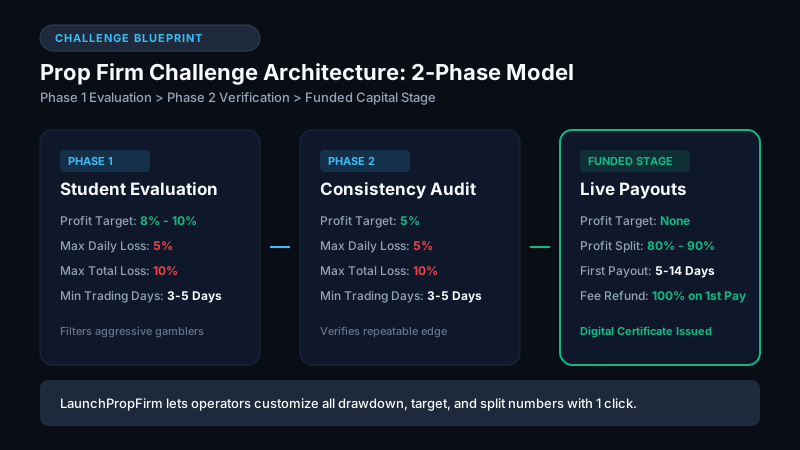
Most prop firms in 2026 use a two phase evaluation. Phase 1 tests whether the trader can hit a profit target. Phase 2 confirms consistency. Funded status comes after both phases pass.
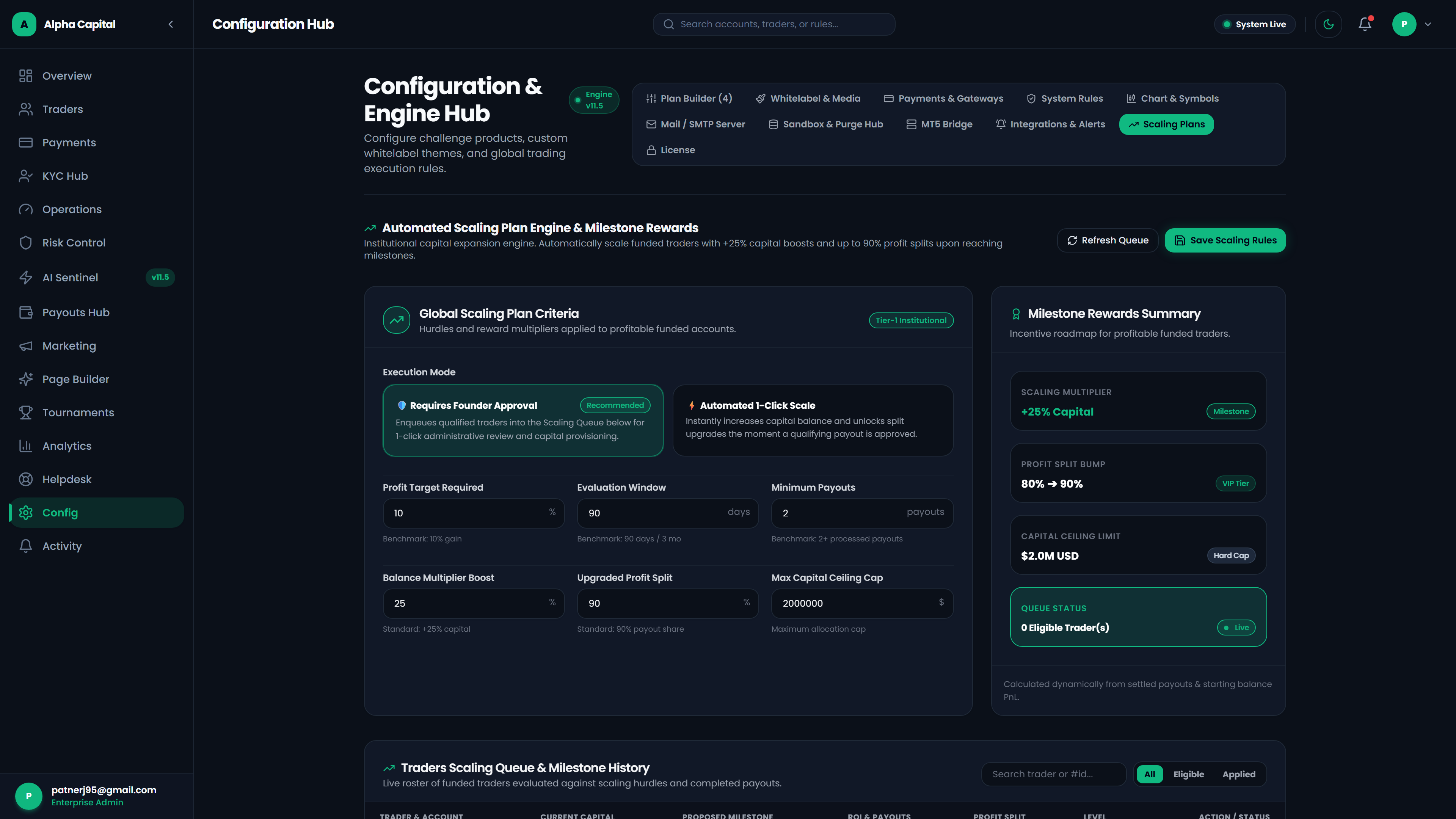
Real-time trader management portal tracking account phases, credentials, and trader performance across all active challenges.
This structure works because it filters out lucky traders who spike profits in a single week without consistent risk management.
Phase 1 parameters
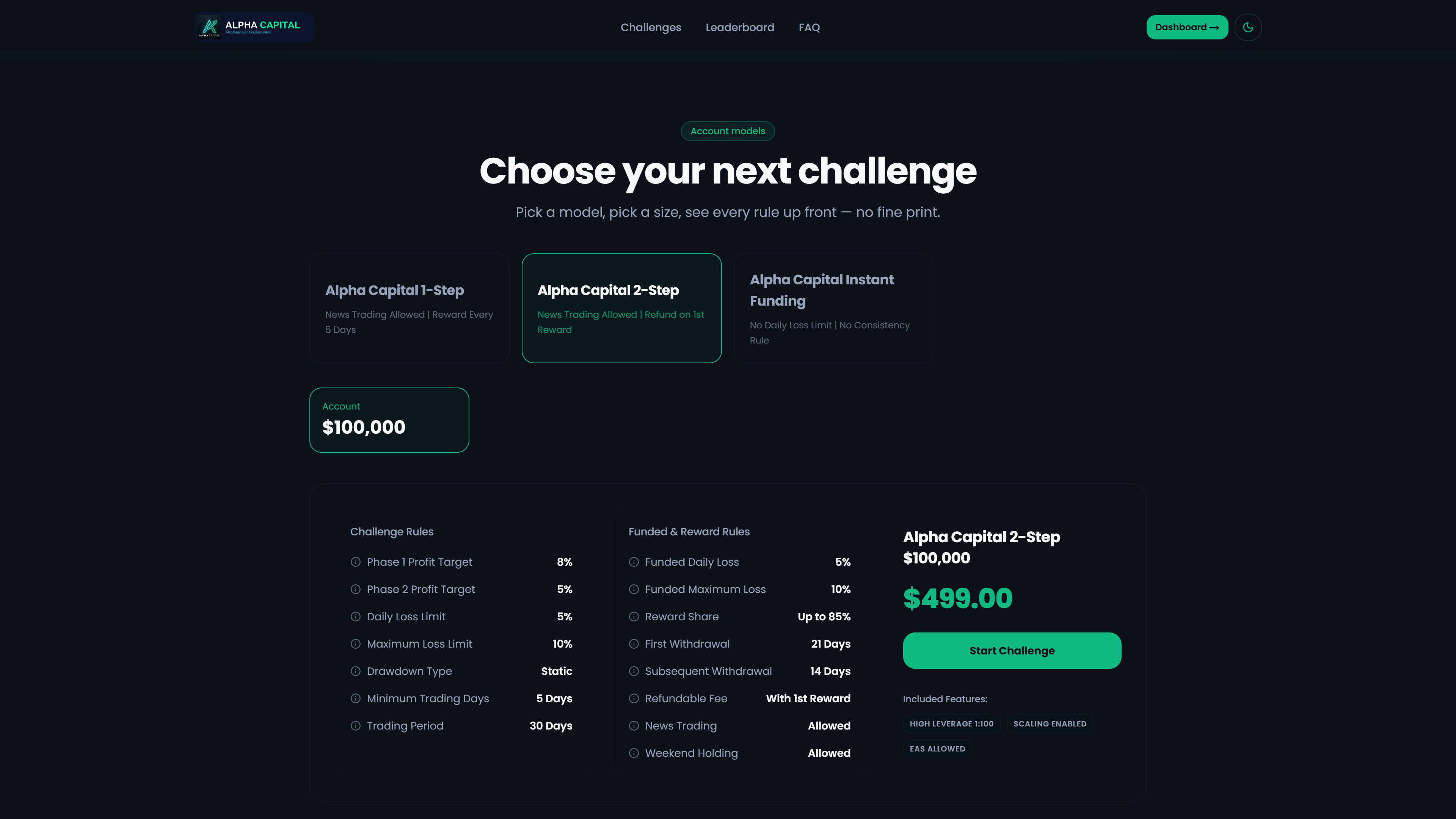
8% profit target. 10% max drawdown. 5% daily loss limit.
Minimum 5 trading days. 30 day time limit.
Phase 2 parameters
5% profit target. Same drawdown and daily loss rules.
Same minimum trading days. 60 day time limit.
These are the industry defaults. FTMO, MyForexFunds before its closure, and most funded trader programs used variations of these numbers. They are the benchmark traders compare against.
What Each Rule Actually Does
The profit target is how much the trader needs to make to pass. 8% is the standard for Phase 1. Too low and nearly everyone passes, which drains your payout reserve. Too high and traders give up, which kills rebuys.
8% is the right number. Achievable for a skilled trader over 30 days. Not achievable for someone gambling.
In contrast to forex models, white label futures prop firm platforms frequently utilize intraday trailing threshold mechanics. The maximum drawdown is the total loss limit. Once a trader loses 10% from their starting balance, the account closes automatically.
There are two versions of this rule. Static drawdown measures from the starting balance always. Trailing drawdown measures from the highest balance the account ever reached.
Trailing drawdown is harder for traders and generates more breaches. Static drawdown is more trader-friendly and drives more positive word of mouth. Start with static for your first launch.
Daily loss limit
This is the maximum a trader can lose in a single calendar day. 5% is standard.
The daily limit stops traders from blowing their entire drawdown buffer in one bad session. Without it, a trader could lose 10% in one day and breach immediately. The daily limit forces them to manage sessions, not just overall balance.
Minimum trading days
This prevents traders from getting lucky on one massive trade and claiming a funded account. A trader must trade on at least 5 separate days.
Without this rule, someone could open one position, hit 8% profit in a day, and pass Phase 1. That is not a trader you want to fund.
Time limit
30 days for Phase 1 and 60 days for Phase 2 is standard. Some firms have removed time limits entirely as a marketing angle: "no time pressure" is a selling point.
Removing the time limit increases your challenge completion rate but also increases the number of funded traders you need to manage simultaneously. Start with a time limit and remove it once you have operational capacity.
Skip the monthly fees
Own your prop firm platform outright. One time purchase.
Full source code. Live in 7 days. No revenue share. No monthly SaaS bill. See the exact platform before paying anything.
Demo login: haris / asdf1122. No signup needed
Account Sizes and Pricing
The standard account size ladder in 2026:
| Account Size | Typical Price |
|---|---|
| $5,000 | $49 to $79 |
| $10,000 | $99 to $149 |
| $25,000 | $199 to $249 |
| $50,000 | $299 to $399 |
| $100,000 | $499 to $649 |
| $200,000 | $999 to $1,299 |
Price your challenges at or slightly below the market rate when starting out. You need volume in your first 60 days more than you need margin.
Profit Split
The funded trader keeps a percentage of what they earn. You keep the rest.
Standard splits in 2026:
- 80% to trader, 20% to firm (market standard)
- 85% to trader, 15% to firm (competitive positioning)
- 90% to trader, 10% to firm (aggressive, used as marketing)
Start at 80/20. You can increase the trader share later as a promotional offer. Going the other direction is much harder.
What Happens When a Trader Breaches
A breach occurs when a trader hits their maximum drawdown or daily loss limit.
Your platform closes the account automatically. The trader receives a notification. They have the option to rebuy the same challenge at full price.
The rebuy is where a significant portion of your revenue comes from. A trader who is close to passing but breaches on day 28 is highly motivated to try again. Make the rebuy process as frictionless as possible. One click from their dashboard back to checkout.
Rules to Avoid at Launch
Unrestricted copy trading syndicates
While personal account replication is standard, commercial signal syndicates can rapidly drain capital pools. Review our prop firm copy trading rules guide for how operators detect and prevent coordinated account farming.
Consistency rules
Some firms add a rule that no single trading day can account for more than 30% or 40% of total profits (use our free prop firm consistency rule calculator to simulate single-day caps and dilution math). This is designed to prevent lucky day traders from passing.
The problem is that consistency rules are complex to explain, create customer support issues, and cause disputes. Avoid them at launch. Add them later if your pass rate becomes a problem.
Mandatory stop loss rules
Requiring traders to place a stop loss on every trade sounds risk-managed but is nearly impossible to enforce on all instruments and brokers. It creates disputes and bad reviews. Leave it out.
Weekend holding restrictions
Some firms ban holding trades over the weekend. This eliminates a category of legitimate trading strategies and reduces your addressable market. Unless you have a specific reason, allow weekend holds.
Adjusting Rules After Launch
Your first 90 days will show you whether your rules are calibrated correctly.
If your pass rate is above 15%, your rules are too easy. Tighten the profit target or reduce the time limit.
If your rebuy rate drops below 30%, your rules feel unfair to traders. Loosen the daily loss limit or increase the time limit.
Watch your Search Console data too. Queries like "prop firm challenge rules" and "challenge drawdown" tell you what traders are researching about your firm specifically.
Every rule is adjustable from your admin panel without touching any code. Test, measure, and refine.
Quick Reference: Standard Challenge Parameters
What is the standard profit target for a prop firm challenge?
Phase 1 is typically 8% of the starting account balance. Phase 2 is typically 5%. These are the industry standard numbers used by most funded trader programs in 2026.
What is a prop firm daily loss limit?
The daily loss limit is the maximum amount a trader can lose in a single calendar day. The standard is 5% of the starting balance. Once hit, trading stops for that day automatically.
What is the standard drawdown limit for a prop firm?
The maximum drawdown is typically 10% from the starting balance. Some firms use trailing drawdown, which measures from the highest balance reached rather than the starting balance.
How long does a prop firm challenge take?
Phase 1 typically has a 30-day time limit. Phase 2 has a 60-day time limit. Some firms have removed time limits entirely as a competitive differentiator.
What profit split do prop firms offer?
The standard in 2026 is 80% to the trader and 20% to the firm. Some firms offer 85% or 90% to attract traders.
See how the challenge system works in the live demo
The platform that enforces all these rules automatically starts at $2,495 one time. See pricing.
Operator Tip: Ambiguous challenge rules are the leading cause of trader disputes. Before publishing any rule, write a worked numeric example alongside it. If your rule says "daily loss limit is 5%," add: "On a $100,000 account, this means your account cannot drop below $95,000 in a single trading day." Specificity prevents disputes.
Frequently Asked Questions
What challenge rules should every prop firm have at minimum?
Maximum drawdown, daily loss limit, minimum profit target, and minimum trading days are the four core rules. These four parameters define the challenge and determine your pass rate. Every funded evaluation firm needs all four clearly stated before a trader purchases.
Should operators include a consistency rule?
A consistency rule (no single day exceeding a percentage of total profits) prevents traders from gaming the challenge with one large lucky trade. It produces more genuinely skilled funded traders and reduces payout risk from traders who cannot replicate their challenge performance. It does add rule complexity.
How do you prevent traders from gaming your challenge rules?
Automated breach detection that runs in real time prevents retroactive disputes. Trailing drawdown makes early profit-locking strategies less effective. A minimum trading day requirement prevents traders from risking everything on a single large trade. These three mechanisms together close most gaming attempts.
Can operators change challenge rules after launch?
Yes, for new challenges. Never change rules mid-challenge for an active trader. Retroactive rule changes are fraud regardless of your terms and conditions. Update your published rules for future challenge purchases, apply them to new signups only, and grandfather existing challenge holders under the rules they purchased under.
What should the funded account rules include beyond the challenge rules?
Funded account maximum drawdown (often tighter than challenge drawdown), profit split percentage, payout schedule, maximum position size, and any instrument restrictions. These should be published on your website before a trader purchases a challenge, not revealed only after passing.
Calculate Prop Firm Drawdown & Daily Stop Floors
Verify your exact liquidation level, remaining daily loss buffer, and maximum safe position sizes before taking your next trade.
Prop Firm Monthly Profit Simulator
Simulate your challenge revenue, payout liability, and net monthly take-home profit.
$20,000
From upfront challenge fees-$2,800
~10 funded payouts budgeted$0 / month
Saves $3,000/mo vs SaaS$17,200/mo
Run-rate: $206,400/yr
M.Haris
Founder & Platform ArchitectBuilding open prop trading software infrastructure for operators worldwide
I built LaunchPropFirm to give forex educators, trading communities, and fintech operators complete ownership of their platform with full source code and zero monthly SaaS rent. Every article on this blog is drawn from hands-on platform development, live MT5 risk bridge mechanics, and real operator economics.
All content, financial models, ROI estimates, and architecture guides on LaunchPropFirm are published strictly for educational and informational purposes. LaunchPropFirm provides institutional prop trading software and technology infrastructure; it does not operate as a broker, custodian, or registered investment advisor.
Evaluation challenges and funded trader accounts referenced in this guide operate in simulated demo trading environments using real-time market data feeds. Simulated trading results do not represent actual trading performance or financial advice.
Recommended Next Reads
Hand-picked operator guides to scale your prop trading platform.
Wise Prop Firms: Payouts, Risks and Rails
Explore why direct Wise prop firms payouts trigger account freezes, how Rise compliance bridges protect funds, and why multi-rail payouts guarantee cash flow.
Prop Firm Capital: Requirements, Reserve Buffers and Risk Architecture
Unpack the financial reality of prop firm capital: synthetic exposure vs liquid reserves, challenge fee pool economics, A-Book STP hedging, and exact startup blueprints.
Skip the monthly fees
Own your prop firm platform outright. One time purchase.
Full source code. Live in 7 days. No revenue share. No monthly SaaS bill. See the exact platform before paying anything.
Demo login: haris / asdf1122. No signup needed