Prop Firm Crypto Gateway Setup Guide
Learn how to build a prop firm crypto payment gateway setup, accept automated USDT payments, eliminate Stripe bans, and deploy self-hosted rails without fees.
Processing trader challenge purchases securely without merchant freezes represents the lifeblood of an independent proprietary trading firm. Traditional card processors frequently classify prop firm challenge fees as high-risk digital evaluation products, leading to sudden account freezes, rolling reserve holds, or outright payment gateway terminations.
Crypto payment rails solve these processing vulnerabilities by enabling direct, irreversible payments from traders worldwide. Accepting cryptocurrency guarantees that funds reach your company treasury instantly without dispute risks or intermediary interference.
Prop firm operators gain financial independence by deploying automated crypto payment gateways directly into their checkout workflows. This architecture eliminates third-party payment vendor dependencies and provides frictionless global checkout options for retail participants.
Why Traditional Payment Processors Freeze Prop Firms
Traditional card acquirers and merchant aggregators operate under strict banking underwriting models designed for conventional physical commerce. When a retail trader fails a simulated evaluation challenge and files an unauthorized chargeback claim, card networks penalize the prop firm.
Payment processors view high chargeback dispute ratios as excessive risk exposure. You can examine our analysis on prop firm chargeback prevention to inspect how dispute patterns trigger automated banking reviews.
Card aggregators often respond to volume spikes by holding 10% to 20% of gross revenue in rolling reserves for up to 180 days. In worst-case scenarios, traditional processors terminate merchant accounts with zero prior notice, cutting off company cash flow instantly.
Deploying crypto rails alongside card checkout ensures that trading operations remain completely functional even during legacy merchant reviews.
Designing an Automated Crypto Checkout Architecture
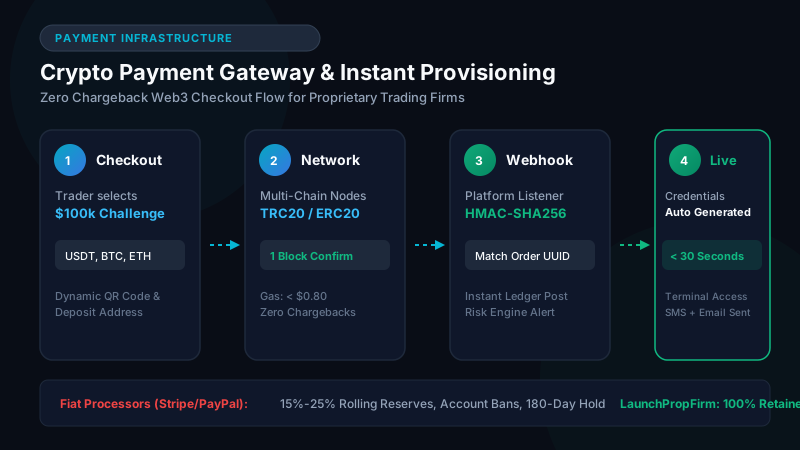
Automated cryptocurrency processing requires three technical elements working in continuous coordination. The platform must generate unique deposit addresses, monitor blockchain network confirmations, and provision trading challenge accounts upon transaction verification.
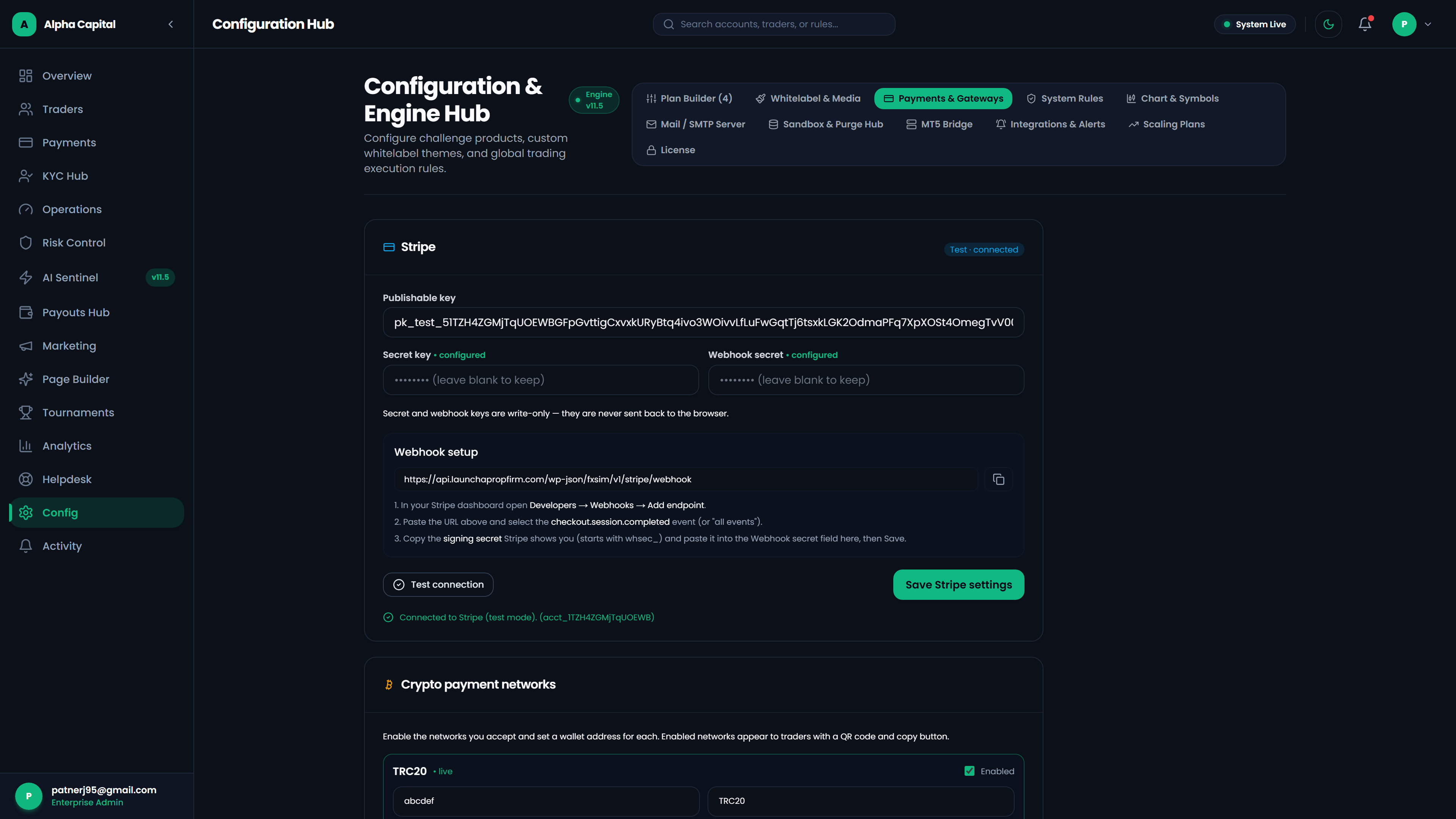
Integrated payments ledger managing USDT, crypto gateway transactions, and automated account provisioning.
When a trader selects cryptocurrency at checkout, the backend creates an order record tied to a specific temporary wallet address or unique payment transaction hash. Tether on Tron (USDT-TRC20) and Tether on BNB Chain (USDT-BEP20) serve as the primary industry standards due to negligible network gas fees and sub-second confirmation finality.
A background worker daemon scans incoming blockchain transactions using dedicated RPC node endpoints or webhook listener services. Review our prop firm MT5 bridge setup guide to see how automated order provisioning connects directly to simulated trading servers.
Once the blockchain confirms the exact order amount, the payment worker triggers account provisioning, generates trader credentials, and issues an automated welcome email in milliseconds.
| Payment Dimension | Legacy Card Processors (Stripe) | Self-Hosted Crypto Gateway (USDT) |
|---|---|---|
| Settlement Speed | 2 to 7 business days rolling | Instant blockchain confirmation (1-2 mins) |
| Chargeback Dispute Risk | High (friendly fraud & bank disputes) | Zero (cryptographic transactions are final) |
| Rolling Reserve Holds | 10% to 20% held for 90-180 days | 0% reserves (funds land in private wallet) |
| Global Geographic Reach | Limited by local banking regulations | Worldwide borderless payments |
| Processing Surcharges | 2.9% to 4.5% + $0.30 per checkout | Sub-cent network gas fees ($0.05 to $0.80) |
| Account Freeze Exposure | High (frequent merchant termination) | Zero (decentralized non-custodial custody) |
| Setup Timeline | Multi-week corporate underwriting | Instant programmatic activation |
Choosing Between Custodial Processors and Self-Hosted Daemons
Prop firm founders generally choose between third-party custodial crypto processors and self-hosted non-custodial payment engines. Custodial crypto services handle address generation and fiat conversions through external dashboard interfaces.
Third-party processors introduce vendor risk by requiring merchant compliance documents, charging percentage markups on every transaction, and holding customer deposits on centralized servers. If a third-party crypto vendor freezes your payout wallet, your firm faces the exact same vulnerabilities as legacy card processing.
Operator Tip: Never store operational treasury reserves on third-party payment processor balances. Configure automated sweeping scripts that forward received challenge payments directly to cold multi-signature wallets every twelve hours.
Self-hosted payment daemons interact directly with blockchain networks without intermediary custody. Check our breakdown on how much does it cost to start a prop firm to evaluate how self-hosted rails protect operating margins.
Owning your payment infrastructure ensures that challenge fee revenues remain under your exclusive private key authorization at all times.
Skip the monthly fees
Own your prop firm platform outright. One time purchase.
Full source code. Live in 7 days. No revenue share. No monthly SaaS bill. See the exact platform before paying anything.
Demo login: haris / asdf1122. No signup needed
Managing Blockchain Gas Fees and Settlement Networks
Transaction network selection directly impacts trader checkout conversion rates and operational accounting overhead. Directing retail traders to send ERC-20 tokens on the Ethereum mainnet frequently results in abandoned carts due to fluctuating gas fee spikes.
TRC-20 on the Tron blockchain and BEP-20 on the BNB Chain represent over 85% of retail prop challenge transactions. Both networks offer predictable gas costs below one dollar and confirm blocks within seconds.
Operators should also implement automated slippage tolerance parameters for volatile crypto assets like Bitcoin and Ethereum. If a trader submits payment in BTC during rapid market fluctuations, the payment listener must recognize partial payments and prompt the user to complete the minor balance.
Configuring multi-chain USDT acceptance delivers the optimal balance of speed, cost efficiency, and straightforward user experience for retail participants.
LaunchPropFirm Integrated Crypto Architecture
Building custom blockchain listeners, sweeping scripts, and automated account provisioning routines from scratch requires substantial engineering investment. Many white label software vendors charge expensive add-on fees to enable basic crypto payment modules.
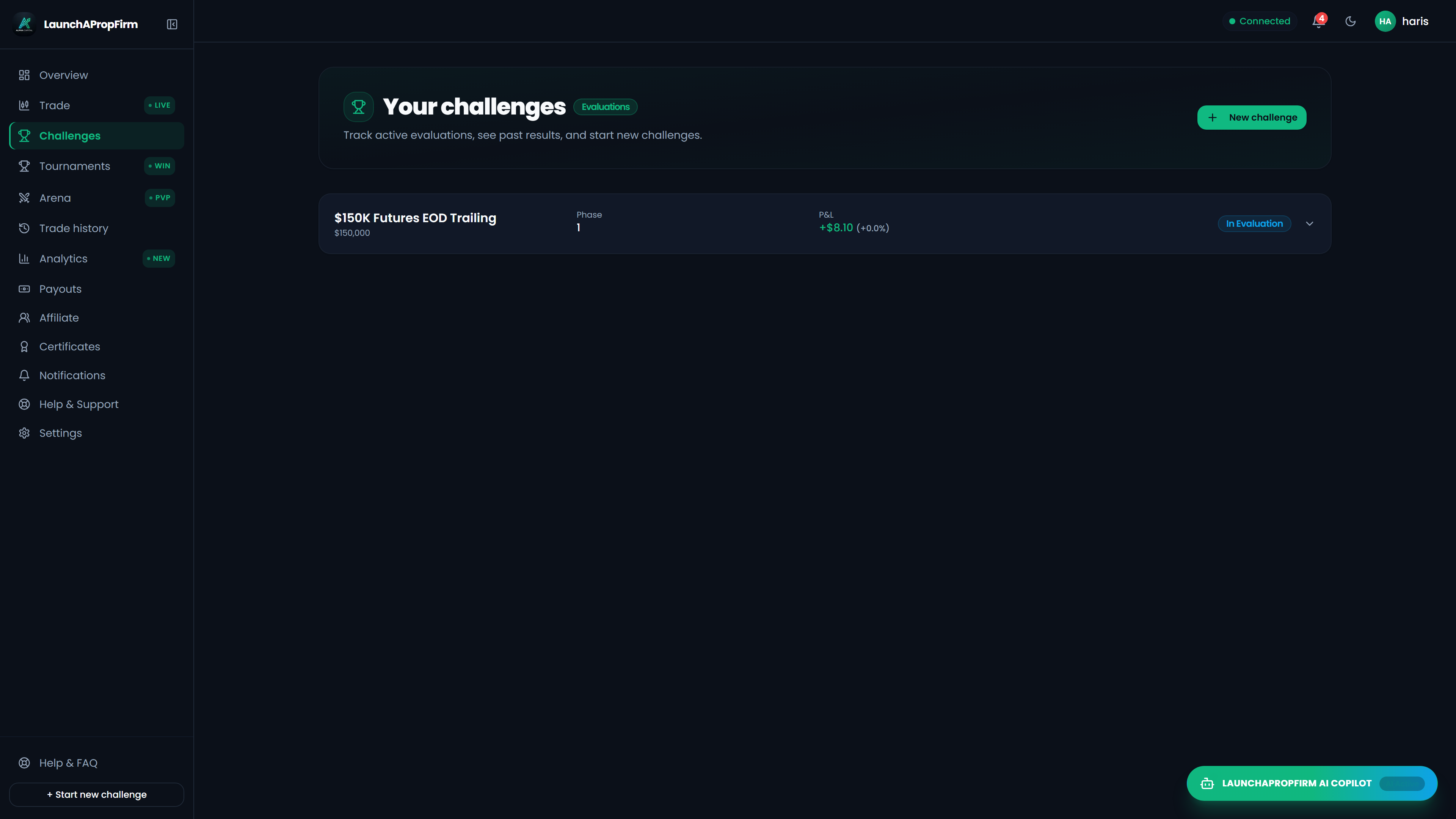
Trader evaluation checkout portal with automated crypto clearing for 1-step, 2-step, and instant funding accounts.
LaunchPropFirm includes native, automated cryptocurrency checkout directly within the core production platform. The system supports direct Stripe card processing alongside automated USDT payments on TRC-20 and BEP-20 networks out of the box.
Incoming crypto transactions trigger automated PostgreSQL ledger updates, generate challenge login details, and activate MT5 price feeder access without manual administrator intervention.
Operators can test the complete trader checkout flow, payment simulator, and risk control room directly at launchapropfirm.com with complete transparency.
FAQ
Why do prop firms prefer cryptocurrency payments?
Cryptocurrency payments eliminate chargeback fraud, provide instant settlement, and allow international traders to purchase evaluation challenges without credit card declines.
Which crypto tokens are most popular for prop firm checkout?
Tether (USDT) on Tron (TRC-20) and BNB Chain (BEP-20) are the most popular options due to near-zero network transaction fees and fast block confirmations.
Can a prop firm operate entirely on crypto payments?
Yes, many international prop trading firms operate exclusively on cryptocurrency payments to avoid merchant banking delays and serve global traders frictionlessly.
How does the automated crypto gateway provision trader accounts?
A background listener monitors the blockchain for transaction confirmations matching the order invoice, then automatically creates trading credentials and dispatches welcome emails.
Does LaunchPropFirm support crypto payments out of the box?
Yes, LaunchPropFirm includes integrated, automated USDT crypto checkout alongside direct Stripe processing with complete source code ownership at launchapropfirm.com.
Evaluate Your Prop Firm Readiness Score (0-100)
Answer 5 quick operational questions about your acquisition channels, runway, and engine tech to get a personalized launch roadmap.
Prop Firm Monthly Profit Simulator
Simulate your challenge revenue, payout liability, and net monthly take-home profit.
$20,000
From upfront challenge fees-$2,800
~10 funded payouts budgeted$0 / month
Saves $3,000/mo vs SaaS$17,200/mo
Run-rate: $206,400/yr
M.Haris
Founder & Platform ArchitectBuilding open prop trading software infrastructure for operators worldwide
I built LaunchPropFirm to give forex educators, trading communities, and fintech operators complete ownership of their platform with full source code and zero monthly SaaS rent. Every article on this blog is drawn from hands-on platform development, live MT5 risk bridge mechanics, and real operator economics.
All content, financial models, ROI estimates, and architecture guides on LaunchPropFirm are published strictly for educational and informational purposes. LaunchPropFirm provides institutional prop trading software and technology infrastructure; it does not operate as a broker, custodian, or registered investment advisor.
Evaluation challenges and funded trader accounts referenced in this guide operate in simulated demo trading environments using real-time market data feeds. Simulated trading results do not represent actual trading performance or financial advice.
Recommended Next Reads
Hand-picked operator guides to scale your prop trading platform.
Wise Prop Firms: Payouts, Risks and Rails
Explore why direct Wise prop firms payouts trigger account freezes, how Rise compliance bridges protect funds, and why multi-rail payouts guarantee cash flow.
Prop Firm Capital: Requirements, Reserve Buffers and Risk Architecture
Unpack the financial reality of prop firm capital: synthetic exposure vs liquid reserves, challenge fee pool economics, A-Book STP hedging, and exact startup blueprints.
Skip the monthly fees
Own your prop firm platform outright. One time purchase.
Full source code. Live in 7 days. No revenue share. No monthly SaaS bill. See the exact platform before paying anything.
Demo login: haris / asdf1122. No signup needed