Prop Firm with No Evaluation Accounts: The Reality of Instant Funding Models
Explore prop firms with no evaluation accounts. Compare instant direct funding vs 2-step challenges, trailing drawdown floors, fee structures, and operator architecture.
Retail traders looking for a prop firm with no evaluation accounts are almost always motivated by one painful reality: the traditional 2-step challenge gauntlet is designed to filter out 92% to 95% of participants before they ever qualify for a single dollar of payout. Between hitting an 8% Phase 1 profit target, repeating with a 5% Phase 2 benchmark, dodging daily equity reset traps, and suffering psychological fatigue, thousands of traders spend months stuck in a costly cycle of challenge resets and retakes.
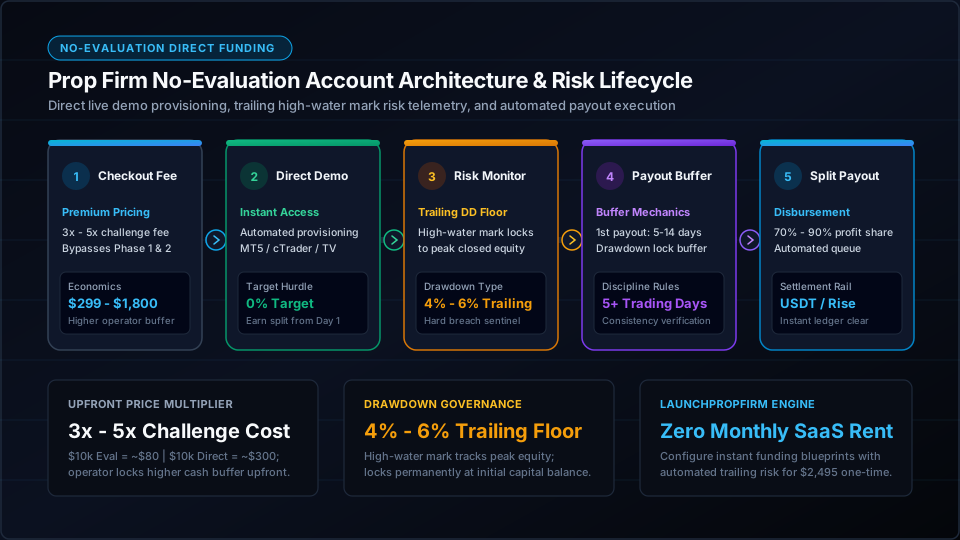
Purchasing an instant funding prop firm without challenge promises to eliminate that friction completely. You pay an upfront fee, skip simulated evaluation exams, receive institutional credentials on MetaTrader 5, cTrader, or TradingView, and become eligible to earn profit splits from your very first profitable trade. For traders evaluating top prop firms with no evaluation, understanding the trade-off between higher entry pricing and tight trailing loss limits is essential.
However, in institutional proprietary trading, there is no such thing as free leverage. When an operator removes the 30-to-60-day performance evaluation filter, they absorb massive adverse selection risk. To protect their liquid capital reserves, firms offering no evaluation accounts charge 3x to 5x higher upfront fees, impose tighter trailing high-water mark drawdown floors (typically 4% to 6%), reduce leverage allocations (often 1:10 to 1:30), and enforce mandatory buffer milestones before approving your first payout withdrawal.
Understanding the cold mathematical mechanics of instant direct funding versus traditional evaluations is essential whether you are an active trader seeking the most capital-efficient path to payouts, or an emerging founder designing your firm's challenge catalog. For a broader comparison of traditional and instant evaluation models across all major operators, see our complete list of prop trading firms.
Evaluation vs No Evaluation Accounts: The Mathematical Breakdown
To understand why a prop firm with no evaluation accounts prices its products so differently from standard challenge firms, you must examine the risk profile of each model across nominal balance tiers ($5,000 to $100,000).
In a traditional 2-step challenge, the operator collects a small fee ($32 to $499) because 9 out of 10 traders will breach their daily or maximum static drawdown limit during the evaluation phases. For an exact breakdown of entry pricing and drawdown limits across micro to six-figure tiers, see our guide on funding pips account sizes and prices 2026. The challenge fees from unsuccessful applicants subsidize the payout disbursements of the disciplined 5% who reach funded status.
With instant direct funding, that evaluation revenue buffer disappears. Every trader who pays checkout immediately receives an active account with live profit-split eligibility. To balance this financial exposure, the operator must charge a substantial upfront premium and contract the drawdown cushion.
The following matrix compares standard 2-step challenge parameters against no-evaluation direct funding accounts across the five core capital tiers:
| Account Size Tier | Standard 2-Step Challenge Fee | No-Evaluation Direct Funding Price | Upfront Price Multiplier | Evaluation Drawdown Limit | No-Evaluation Drawdown Limit | Leverage Ratio Comparison | First Payout Milestone |
|---|---|---|---|---|---|---|---|
| $5,000 Account | $32 to $45 | $145 to $190 | 4.2x to 4.5x | 10% Static ($500 buffer) | 5% Trailing ($250 buffer) | 1:100 vs 1:30 | Pass Phase 1 + 2 vs 5 Trading Days |
| $10,000 Account | $65 to $89 | $290 to $360 | 4.0x to 4.4x | 10% Static ($1,000 buffer) | 5% Trailing ($500 buffer) | 1:100 vs 1:30 | Pass Phase 1 + 2 vs 5 Trading Days |
| $25,000 Account | $145 to $199 | $580 to $720 | 3.6x to 4.0x | 10% Static ($2,500 buffer) | 5% Trailing ($1,250 buffer) | 1:100 vs 1:20 | Pass Phase 1 + 2 vs 7 Trading Days |
| $50,000 Account | $260 to $340 | $990 to $1,250 | 3.7x to 3.8x | 10% Static ($5,000 buffer) | 5% Trailing ($2,500 buffer) | 1:60 vs 1:20 | Pass Phase 1 + 2 vs 10 Trading Days |
| $100,000 Account | $440 to $540 | $1,750 to $2,200 | 3.9x to 4.1x | 10% Static ($10,000 buffer) | 4% to 5% Trailing ($4,000 buffer) | 1:60 vs 1:10 | Pass Phase 1 + 2 vs 14 Trading Days |
Notice the trade-offs: on a $100,000 instant direct account, you pay roughly $1,750 to $2,200 upfront, but your actual maximum capital risk buffer is only $4,000 to $5,000 before the account liquidates. If you pay $2,000 to trade a $4,000 risk cushion, you are effectively paying 50 cents of cash for every dollar of risk capital provided by the firm.
For traders who can consistently manage risk within a tight 5% trailing envelope, skipping 60 days of arbitrary profit target pressure is worth every penny. But for reckless traders who rely on high leverage and wild equity swings, an instant account will blow up within 48 hours, leaving them with a steep upfront loss.
Review our breakdown of cheapest prop firm challenges to compare budget evaluation tiers against direct funding entry pricing.
How No Evaluation Prop Firms Actually Operate Behind the Scenes
Retail traders frequently assume that when they buy a $100,000 no evaluation account, the proprietary firm deposits $100,000 of liquid cash into a prime broker sub-account.
In institutional operations, that assumption is entirely fictional. No legitimate prop firm deposits $100,000 of unhedged liquid capital into the hands of an anonymous trader on the internet who simply swiped a credit card.
Instead, direct funding accounts operate on synthetic demo infrastructure managed via MetaTrader 5, cTrader, or browser-based TradingView terminals. The operator connects the trader's order feed to an institutional risk management engine. Here is the exact operational lifecycle:
- Automated Order Execution & B-Book Internalization: The trader executes orders inside an institutional demo server environment. The firm's risk engine monitors execution speed, order holding duration, and position correlation. Over 85% of retail direct funding accounts fail to survive beyond their first 30 days due to aggressive sizing and trailing drawdown contraction.
- Trailing High-Water Mark Risk Governance: Unlike evaluation accounts that use static drawdown calculated from initial balance, direct funding programs almost universally employ trailing drawdown. The liquidation floor moves up dollar-for-dollar as your closed account equity increases, locking in your peak gains.
- Hybrid STP Hedging on High-Alpha Outliers: When the platform identifies a trader demonstrating disciplined position sizing, multi-day holding periods, and consistent positive expectancy, the internal order router copies their signals directly onto Prime of Prime liquidity bridges (A-Book execution). The external market profits generated by the broker hedge fund the trader's cash profit split.
- Reserve Treasury Payout Clearing: When a trader submits a payout request, the funds do not magically come from an MT5 terminal. The firm clears the 70% to 90% profit split from its liquid reserve treasury, disbursing funds via crypto rails (USDT/USDC) or compliant payroll contractor networks.
The Trailing High-Water Mark Trap
The single biggest reason traders breach a prop firm with no evaluation accounts is failing to understand how trailing drawdown operates.
Consider a $50,000 instant funding account with a 5% trailing drawdown ($2,500 maximum loss limit):
- Day 1 (Starting Balance: $50,000): Your liquidation floor is set at $47,500. If your equity touches $47,500, your account is immediately terminated.
- Day 3 (You make $2,000 profit; Balance: $52,000): Because the drawdown trails your high-water mark, your liquidation floor climbs to $49,500 ($52,000 minus $2,500).
- Day 5 (Market retraces; Balance drops to $50,500): Your liquidation floor does not drop. It remains permanently anchored at $49,500. Even though your balance is still above your initial $50,000 starting capital, your remaining loss buffer is now only $1,000 ($50,500 minus $49,500).
- Day 6 (Further loss of $1,001; Balance: $49,499): The account breaches and closes automatically—even though you are only down $501 from your starting balance!
In some firm models, once your trailing drawdown reaches the starting capital ($50,000), the floor locks permanently at $50,000 and stops trailing higher. Understanding whether a firm locks the floor at balance or continues trailing forever is the most critical question to ask before buying any instant funding account.
Read our in-depth guide on prop firm drawdown rules for a deep dive into equity-based versus balance-based drawdown calculations.
Top Prop Firms Offering No-Evaluation Accounts in 2026
If you are an active trader looking for reputable prop firms with no evaluation accounts, three established firms dominate the direct funding prop trading sector in 2026 across synthetic Forex, CFD, and Crypto instruments:
1. The5ers (Bootcamp & Hyper-Growth Programs)
The5ers is widely regarded as the pioneer of direct funding. Founded in 2016, they provide instant funded options under their Hyper-Growth program:
- Starting Account Sizes: $10,000, $20,000, and $40,000 instant accounts.
- Drawdown Rules: 6% maximum trailing drawdown based on high-water mark equity. No daily drawdown limit.
- Leverage: Conservative 1:30 leverage on forex majors, accommodating disciplined swing and day traders.
- Profit Split & Scaling: 50% starting profit split that scales up to 100% as you hit 10% milestone targets, doubling account size up to $4,000,000.
- Payout Frequency: First payout eligible upon reaching a 10% profit milestone; subsequent payouts processed bi-weekly.
2. Funded Trading Plus (Master Trader Program)
Funded Trading Plus is a UK-based prop firm known for simple, institutional rules with no artificial time constraints:
- Starting Account Sizes: $5,000, $10,000, $25,000, $50,000, and $100,000.
- Drawdown Rules: 5% relative trailing drawdown. No daily loss limit on the Master Trader program.
- Leverage: 1:30 on forex pairs, 1:20 on indices, and 1:2 on cryptocurrency CFDs.
- Profit Split: Begins at 80% and can be scaled to 90% or 100% via performance upgrades.
- Payout Frequency: First payout eligible after 14 days; weekly payouts available after the initial withdrawal cycle.
3. Maven Trading (Instant Funding Program)
Maven Trading provides budget-friendly CFD instant accounts tailored for retail traders who want high scaling caps:
- Starting Account Sizes: $2,000 micro tiers up to $100,000 direct accounts.
- Drawdown Rules: 5% or 6% trailing drawdown options with an optional add-on to expand to static drawdown.
- Leverage: Up to 1:30 on FX pairs, 1:10 on commodities.
- Profit Split: 80% standard profit split across all funded tiers.
- Payout Frequency: First payout eligible after just 5 trading days, offering one of the fastest payout turnaround cycles in the industry.
The following table summarizes the operational rules across top no-evaluation firms:
| Prop Firm | Direct Funding Program | Account Size Range | Upfront Price Range | Drawdown Architecture | Profit Split Ladder | Payout Eligibility Window |
|---|---|---|---|---|---|---|
| The5ers | Hyper-Growth Direct | $10k to $40k | $260 to $850 | 6% Trailing High-Water Mark | 50% to 100% with doubling | First payout at 10% profit milestone |
| Funded Trading Plus | Master Trader | $5k to $100k | $190 to $2,100 | 5% Relative Trailing DD | 80% to 100% split | 14 calendar days from first trade |
| Maven Trading | Instant Funding CFD | $2k to $100k | $89 to $1,850 | 5% to 6% Trailing DD | 80% fixed split | 5 active trading days buffer |
Before purchasing any instant account, verify how your firm handles weekend holding, news trading spikes, and overnight swap fees. For a macro view of funded accounts, read our guide on what is a funding account.
Skip the monthly fees
Own your prop firm platform outright. One time purchase.
Full source code. Live in 7 days. No revenue share. No monthly SaaS bill. See the exact platform before paying anything.
Demo login: haris / asdf1122. No signup needed
2-Step Challenge vs No-Evaluation: Which Model Fits Your Trading Style?
Choosing between an evaluation challenge and an instant funding account is not a question of which program is "better"—it is an objective calculation of your trading strategy, risk profile, and bankroll.
Choose a 2-Step Evaluation Challenge If:
- You Have Limited Startup Capital: If you only have $50 to $150 to invest, buying a $5k or $10k instant account takes your entire bankroll. A $10k 2-step challenge only costs $60 to $80, leaving you with cash reserves to retake if an unexpected drawdown hits.
- You Rely on Higher Leverage: Challenge models typically grant 1:60 to 1:100 leverage. If you trade high-frequency scalping strategies requiring rapid lot turnover, the 1:10 or 1:30 leverage of instant accounts will severely restrict your position sizing.
- You Need Static Drawdown Cushion: Traditional evaluations give you an 8% to 10% static drawdown buffer that stays anchored at your starting capital ($90,000 floor on a $100k account). If your strategy experiences deep pullbacks before running to target, static drawdown is far more forgiving than trailing floors.
- You Can Patiently Handle 30 to 60 Days of Testing: If you are confident in your edge and don't mind demonstrating discipline over two phases, challenges offer the highest nominal capital per dollar spent. Read our detailed guide on how to pass a prop firm challenge for actionable execution frameworks.
Choose a No-Evaluation Account If:
- You Have a Proven, Consistent Track Record: In professional direct funding prop trading, having an audited live trading history with low drawdown (under 3%) allows you to bypass 60 days of evaluation hoops and monetize your edge from Day 1.
- You Suffer from "Evaluation Anxiety": Many profitable traders trade flawlessly on personal capital but choke under artificial profit targets. When you must hit 8% or 10% within a rigid deadline, you over-leverage. Direct funding removes profit target hurdles entirely.
- You Trade Conservative Swing Setups: Swing traders who risk 0.25% to 0.50% per trade and aim for 1:2 or 1:3 risk-reward setups thrive under trailing drawdown. They rarely hit a 5% high-water mark floor because their position sizing is strictly controlled.
- You Value Speed to First Payout: Instant accounts allow you to request a payout after 5 to 14 active trading days. If you make $1,500 on a $25,000 account during your first week, you can withdraw your 80% split ($1,200) almost immediately, recovering your entire upfront fee on your first withdrawal.
The Operator Architecture: How Founders Build and Monetize No-Evaluation Tiers
From the perspective of a prop firm founder, offering a no evaluation prop firm tier is one of the most powerful strategies to maximize Average Order Value (AOV) and generate immediate operational cash flow.
When an operator launches a firm with only standard $100k 2-step challenges priced at $499, cash flow builds incrementally. But when that same operator introduces a $50k instant funding tier priced at $1,100, their gross checkout revenue spikes dramatically.
However, operating instant accounts requires robust back-office software architecture:
1. Automated Trailing Drawdown Engine
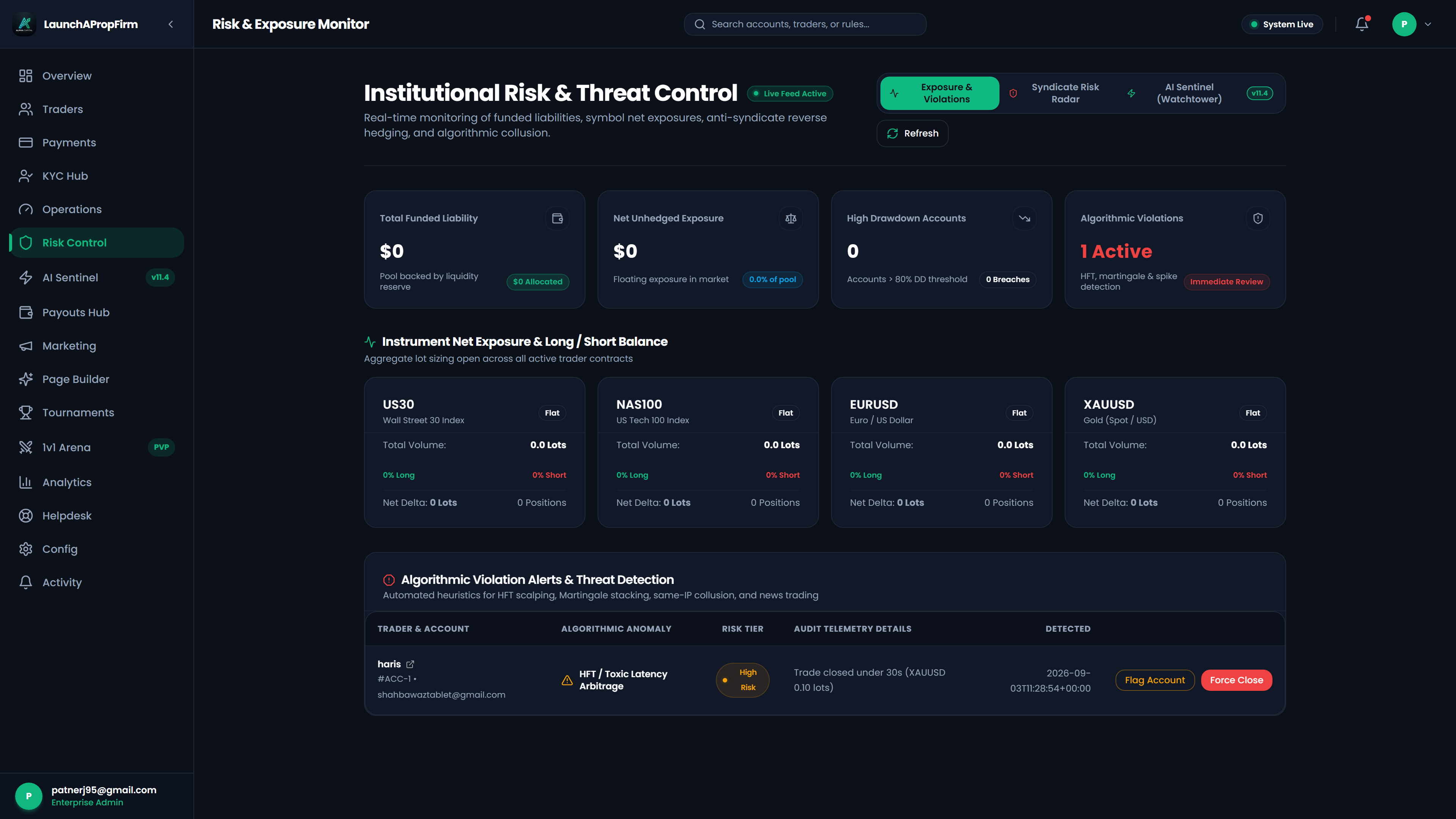
You cannot manually track high-water mark equity across hundreds of active traders. The trading platform must feature automated risk telemetry that calculates peak closed equity on every tick, locking the trailing drawdown floor in real time. If a trader's open equity breaches the trailing floor by $0.01, the server must automatically close open positions, revoke MT5/cTrader API keys, and update the trader cabinet status to "Breached."
2. High-Frequency News and Latency Arbitrage Filters
Because instant accounts have no evaluation buffer, malicious traders will attempt latency arbitrage, toxic tick scalping, or toxic straddle trading during high-impact news events (CPI, NFP). LaunchPropFirm's integrated risk sentinel automatically flags trades held for under 15 seconds or orders executed within 2 minutes of major news releases.
3. Segregated Reserve Fund Allocation
Disciplined operators allocate 40% to 50% of gross checkout fees from no-evaluation sales directly into a segregated liquid payout reserve treasury. This guarantees that when a skilled trader requests a $3,000 payout on Day 14, the firm disburses the withdrawal instantly without cash-flow friction. Learn how to structure institutional treasury reserves in our comprehensive guide on prop firm capital requirements. To explore how to configure turnkey challenge-free models in your trading platform, review our guide on instant funding prop firm infrastructure.
Total Cost of Ownership: Legacy SaaS Rent vs LaunchPropFirm Infrastructure
If you are an entrepreneur planning to launch a prop firm with no evaluation accounts, your single greatest financial decision is choosing your technology platform.
Legacy prop firm SaaS vendors (such as FPFX Tech, Propriotec, Leverate, and DXtrade) operate on predatory rental models. They charge exorbitant upfront setup fees, lock you into steep monthly minimums, and bill per-account user fees that drain your cash reserves as you scale.
A cold, hard look at Year 1 Total Cost of Ownership (TCO) proves the mathematical contrast:
| Infrastructure Cost Item | Legacy SaaS Providers (FPFX / Propriotec / DXtrade) | LaunchPropFirm Self-Hosted Architecture | Operator Financial Advantage |
|---|---|---|---|
| Platform Setup Fee | $5,000 to $15,000 upfront | $2,495 one-time fee | Save $2,505 to $12,505 upfront |
| Monthly Software Licensing | $3,000 to $5,000 per month ($36,000 to $60,000/yr) | $0 per month (Zero recurring SaaS rent) | Save $36,000 to $60,000 annually |
| Per-Account Active User Fees | $1.00 to $3.50 per active trader account | $0 (Unlimited accounts on private VPS) | Retain 100% of checkout margins |
| Source Code Ownership | Closed cloud SaaS (Zero code ownership) | Full Next.js & Node.js TypeScript source code | Complete database & IP sovereignty |
| Platform Deployment Speed | 4 to 8 weeks underwriting & onboarding | Fully deployed & live in 48 hours | Rapid market entry & instant revenue |
| Year 1 Total Cost of Ownership | $41,000 to $75,000+ per year | $2,495 one-time fixed | Net Operator Savings: +$38,500 to +$72,500 |
By choosing LaunchPropFirm, you eliminate up to $72,500 in Year 1 technology debt. Instead of paying monthly rent to a third-party software landlord, that capital stays in your operating treasury to fund your liquid payout reserve, sponsor high-visibility trading tournaments, and scale your marketing reach.
Calculate your exact operational margins and multi-year savings using our interactive SaaS vs Self-Hosted Calculator. Test drive the institutional admin risk console and gamified client portal directly on our Live Dual-Credential Demo. Explore our full turn-key software architecture at LaunchPropFirm.
Frequently Asked Questions
What is a prop firm with no evaluation accounts?
A prop firm with no evaluation accounts—also called an instant funding or direct funding prop firm—is a proprietary trading platform where traders bypass Phase 1 and Phase 2 testing challenges. Traders pay a one-time upfront fee to receive immediate access to a funded trading account and become eligible to earn profit splits from their very first profitable trade, subject to strict trailing drawdown rules.
Why are no evaluation prop firm accounts so much more expensive than challenges?
Instant funding accounts cost 3x to 5x more than 2-step evaluation challenges because the operator absorbs immediate adverse selection risk. In traditional challenges, the 92% to 95% non-passing rate provides a substantial revenue buffer to subsidize winning trader payouts. In direct funding, there is no evaluation gate; therefore, the operator must charge higher upfront fees ($290 to $2,200) to build an adequate payout reserve treasury.
How does trailing drawdown work on an instant funding account?
Trailing drawdown tracks your peak closed equity (the high-water mark) rather than your starting balance. For example, on a $50,000 account with a 5% ($2,500) trailing drawdown, your initial liquidation level is $47,500. If your equity climbs to $52,000, your liquidation level automatically climbs to $49,500. If your equity drops back to $50,000, your liquidation level remains fixed at $49,500, leaving you with only $500 of remaining loss buffer.
Can I get a payout on day one with a no evaluation prop firm?
No. While instant funding accounts eliminate profit target requirements, virtually all reputable prop firms enforce a minimum holding period before processing your first withdrawal (typically 5 to 14 active trading days). This rule prevents high-frequency gambling and ensures the trader demonstrates risk consistency. Subsequent payouts are usually processed bi-weekly or weekly.
What trading platforms do no evaluation prop firms use?
Reputable no evaluation prop firms provide synthetic trading access across MetaTrader 5 (MT5), cTrader, DXtrade, and browser-based TradingView terminals. Orders are executed in high-speed demo environments connected to institutional bridge software that mirrors live interbank pricing for Forex, CFDs, commodities, and cryptocurrencies.
How can an entrepreneur launch an instant funding prop firm without high software costs?
Rather than renting closed SaaS platforms that charge $5,000/month plus per-trader volume markups, operators can launch with LaunchPropFirm for a single one-time payment of $2,495. This grants complete ownership of clean Next.js and Node.js source code, integrated automated trailing drawdown sentinels, multi-rail crypto payout hubs, and native TradingView charts, deployed onto a private VPS in under 48 hours.
Written by the LaunchPropFirm Engineering & Risk Architecture Desk.
Evaluate Your Prop Firm Readiness Score (0-100)
Answer 5 quick operational questions about your acquisition channels, runway, and engine tech to get a personalized launch roadmap.
Prop Firm Monthly Profit Simulator
Simulate your challenge revenue, payout liability, and net monthly take-home profit.
$20,000
From upfront challenge fees-$2,800
~10 funded payouts budgeted$0 / month
Saves $3,000/mo vs SaaS$17,200/mo
Run-rate: $206,400/yr
M.Haris
Founder & Platform ArchitectBuilding open prop trading software infrastructure for operators worldwide
I built LaunchPropFirm to give forex educators, trading communities, and fintech operators complete ownership of their platform with full source code and zero monthly SaaS rent. Every article on this blog is drawn from hands-on platform development, live MT5 risk bridge mechanics, and real operator economics.
All content, financial models, ROI estimates, and architecture guides on LaunchPropFirm are published strictly for educational and informational purposes. LaunchPropFirm provides institutional prop trading software and technology infrastructure; it does not operate as a broker, custodian, or registered investment advisor.
Evaluation challenges and funded trader accounts referenced in this guide operate in simulated demo trading environments using real-time market data feeds. Simulated trading results do not represent actual trading performance or financial advice.
Recommended Next Reads
Hand-picked operator guides to scale your prop trading platform.
Funding Pips Account Sizes and Prices 2026: Evaluation Tiers, Rules, and Scaling Plan
Complete 2026 Funding Pips account sizes and prices guide. Compare challenge fees ($5k to $100k), 2-step evaluation rules, drawdown limits, and the $2M scaling plan.
List of Prop Trading Firms (2026 Directory): Best Evaluated and Instant Funding Programs
Complete 2026 list of prop trading firms. Compare the top 6 evaluated prop firms across platforms (MT5, cTrader), drawdown rules, profit splits, and entry fees.
Skip the monthly fees
Own your prop firm platform outright. One time purchase.
Full source code. Live in 7 days. No revenue share. No monthly SaaS bill. See the exact platform before paying anything.
Demo login: haris / asdf1122. No signup needed