Prop Firm Capital: Requirements, Reserve Buffers and Risk Architecture
Unpack the financial reality of prop firm capital: synthetic exposure vs liquid reserves, challenge fee pool economics, A-Book STP hedging, and exact startup blueprints.
Retail traders looking at funded challenge tiers assume that proprietary trading firms keep millions of dollars in liquid cash backing every trader. When a trader passes an evaluation and receives credentials for a $100,000 account, they imagine that the operator moved $100,000 of liquid company equity into a live brokerage sub-account.
In institutional operations, that assumption is completely detached from reality. Proprietary trading firms operating synthetic evaluations across forex, CFD, and cryptocurrency pairs do not hand out six figures of cash. Funded accounts operate on virtual demo infrastructure hosted inside MetaTrader 5, cTrader, or TradingView. The firm's true financial liability is bounded entirely by the maximum drawdown floor.
However, operating a sovereign prop firm requires real, liquid capital. You do not need capital to fund $100,000 demo balances, but you do need liquid cash to absorb winning trader payouts, pay high-performance server hosting, and maintain a segregated payout reserve buffer. If you misunderstand the difference between simulated account capital and operational treasury reserves, your firm will suffer cash-flow insolvency during its first major winning cycle.
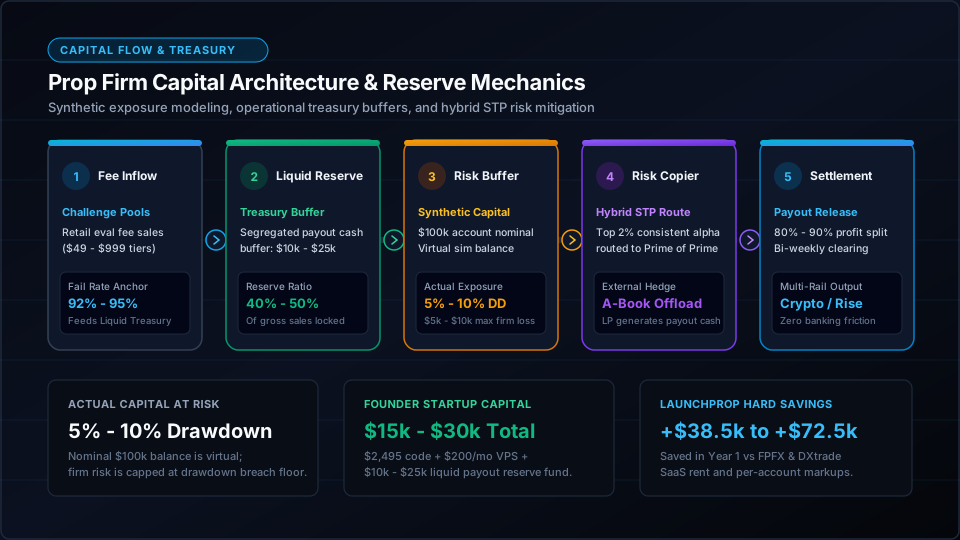
Simulated Capital vs Liquid Cash: The $100k Account Illusion
When calculating institutional prop trading capital requirements, founders must isolate nominal challenge balances from actual liquid liabilities. The central mechanism of modern proprietary evaluation firms is the separation between simulated trading capital and real liquid treasury. Understanding this distinction is the first requirement for any operator calculating prop firm starting capital.
When an operator sells a $100,000 evaluation account for $499, the trader receives demo server credentials. The balance displayed on the terminal is a software ledger entry. If the trader loses $4,000, no real money vanishes from the banking system; the server simply updates the demo account equity.
The firm's actual capital risk is defined by its contract rules:
- Maximum Daily Loss: Typically 4% to 5% of the starting virtual balance ($4,000 to $5,000 on a $100k account).
- Maximum Overall Drawdown: Typically 8% to 10% of the starting virtual balance ($8,000 to $10,000 on a $100k account).
- Maximum Capital Exposure: The firm is never exposed to $100,000. The maximum capital at risk on that specific funded account is exactly $10,000.
If an operator launches a firm with 1,000 active funded traders holding $100,000 accounts, the nominal capital appears to be $100,000,000. But the firm does not need $100,000,000 in a bank account. Because traders are liquidated immediately upon violating the 10% drawdown floor, the aggregate maximum mathematical exposure is $10,000,000. Furthermore, because trading performance across hundreds of independent traders is uncorrelated and non-passing rates remain consistent, the net payout liability is a small fraction of that drawdown buffer.
Where Prop Firm Capital Originates: Challenge Fee Pools and Treasury Economics
If proprietary firms do not deposit $100,000 into broker accounts, where does the capital to pay winning traders come from? It originates from challenge fee pools and institutional treasury reserves.
Every prop firm operating synthetic evaluations relies on statistical mathematical realities. Across the entire retail trading sector, between 92% and 95% of traders fail their evaluation challenges during Phase 1 or Phase 2. Impatience, excessive lot sizing, emotional revenge trading, and poor risk-to-reward ratios cause the overwhelming majority of evaluation accounts to breach daily loss limits or trailing drawdown thresholds within 30 days.
Treasury Inflow Formula: Total Inflow = (Number of Challenge Sales) x (Average Order Value)
Net Operational Inflow: Net Treasury Inflow = Total Inflow - Payment Processing and KYC Costs
For an operational prop firm, challenge purchases ($49 to $999 across synthetic tiers) feed directly into the firm's operating treasury. A disciplined operator allocates incoming challenge capital according to strict treasury ratios:
- Liquid Payout Reserve Buffer (40% to 50%): Segregated funds held in liquid cash or stablecoins (USDT/USDC) dedicated exclusively to clearing trader profit split requests.
- Infrastructure & Technology Overhead (15% to 20%): Server hosting, high-throughput VPS nodes, bridge connectors, TradingView chart feeds, and KYC verification pipelines.
- Marketing, Tournaments & Affiliate Rakes (15% to 20%): Trader acquisition spend, community leaderboard prizes, and tiered affiliate commissions.
- Retained Net Profit (15% to 25%): Founder equity distributions and emergency working capital.
Because the non-passing rate remains steady between 92% and 95%, the capital inflow from challenge purchases consistently exceeds the net profit split disbursements required by the 5% to 8% of traders who achieve funded status and request withdrawals.
Capital Risk Models: Pure Synthetic B-Book vs Hybrid STP A-Book
How an operator manages trading flow dictates the capital reserves required to keep the firm solvent. Proprietary trading firms utilize two primary execution architectures: pure synthetic internal netting (B-Book) and hybrid Straight-Through Processing (A-Book).
Pure Synthetic B-Book (Internal Risk Netting)
Under a pure B-Book model, the prop firm internalizes 100% of trader orders on a virtual execution bridge. Trades never leave the firm's private trading server. If a trader loses money or breaches drawdown, the firm retains 100% of their challenge entry fee. If a funded trader generates a $5,000 profit and requests an 80% split ($4,000), the firm pays that $4,000 directly out of its liquid payout reserve treasury.
The advantage of pure B-Book is operational simplicity:
- Zero broker liquidity relationships or Prime of Prime credit lines required.
- Zero execution slippage between simulated fills and external liquidity pools.
- Maximum profit margins from challenge fee pools.
The fatal vulnerability of pure B-Book is fat-tail performance risk. If a disciplined swing trader or algorithmic momentum trader passes an evaluation and generates an exceptional $40,000 return on a $200,000 account, the firm must absorb that entire $32,000 profit split from its liquid cash buffer. If several high-alpha traders hit hot streaks simultaneously during a trending market cycle, an undercapitalized B-Book firm faces rapid reserve depletion.
Hybrid STP A-Book (Institutional Copy-Trading)
Professional operators eliminate fat-tail payout risk by deploying a hybrid STP model. In this architecture, 95% of incoming traders remain on the synthetic B-Book because their trading metrics exhibit retail churn characteristics.
However, the operator's automated risk engine flags the top 2% to 5% of traders who demonstrate institutional risk habits: consistent positive expectancy, tight stop-losses, disciplined position sizing, and absence of toxic latency arbitrage. When an account is flagged for A-Book routing, the platform's backend copy engine automatically mirrors their trades onto an external institutional liquidity provider or Prime of Prime brokerage account.
When an A-Booked trader makes $20,000 in profit:
- The external broker account generates real $20,000 cash profit.
- The prop firm withdraws the $20,000 from the broker.
- The firm pays the trader their 80% split ($16,000) and keeps the 20% institutional desk split ($4,000).
- The firm's internal payout reserve buffer is completely untouched.
Discover the structural mechanics of execution routing in our detailed analysis of prop firm liquidity A-Book vs B-Book.
Skip the monthly fees
Own your prop firm platform outright. One time purchase.
Full source code. Live in 7 days. No revenue share. No monthly SaaS bill. See the exact platform before paying anything.
Demo login: haris / asdf1122. No signup needed
How Operators Protect Firm Capital: Risk Controls and Allocation Caps
Protecting your liquid payout reserve fund requires strict platform risk rules enforced programmatically at the trading engine level. Relying on manual risk reviews guarantees capital leakage. Unlike traditional financial brokerage models, prop trading capital requirements in the synthetic evaluation sector are dictated by drawdown floor containment and payout velocity rather than central bank balance-sheet reserves.
A sovereign prop firm platform enforces capital defense through five core automated mechanisms:
1. Static vs Trailing Drawdown Engines
The configuration of your drawdown engine directly impacts your reserve buffer exposure. A static drawdown rule calculates maximum loss relative to the initial starting balance ($100k account with 10% DD breaches at $90,000 equity, regardless of how high the account grows). A trailing drawdown engine recalculates the liquidation floor as equity reaches new peaks. If the trader grows the account to $105,000, a 10% trailing floor locks liquidation at $95,000. Trailing drawdown limits the firm's unrealized liability and encourages traders to bank profits regularly. Read our breakdown on prop firm drawdown explained.
2. High-Frequency and Latency Arbitrage Guards
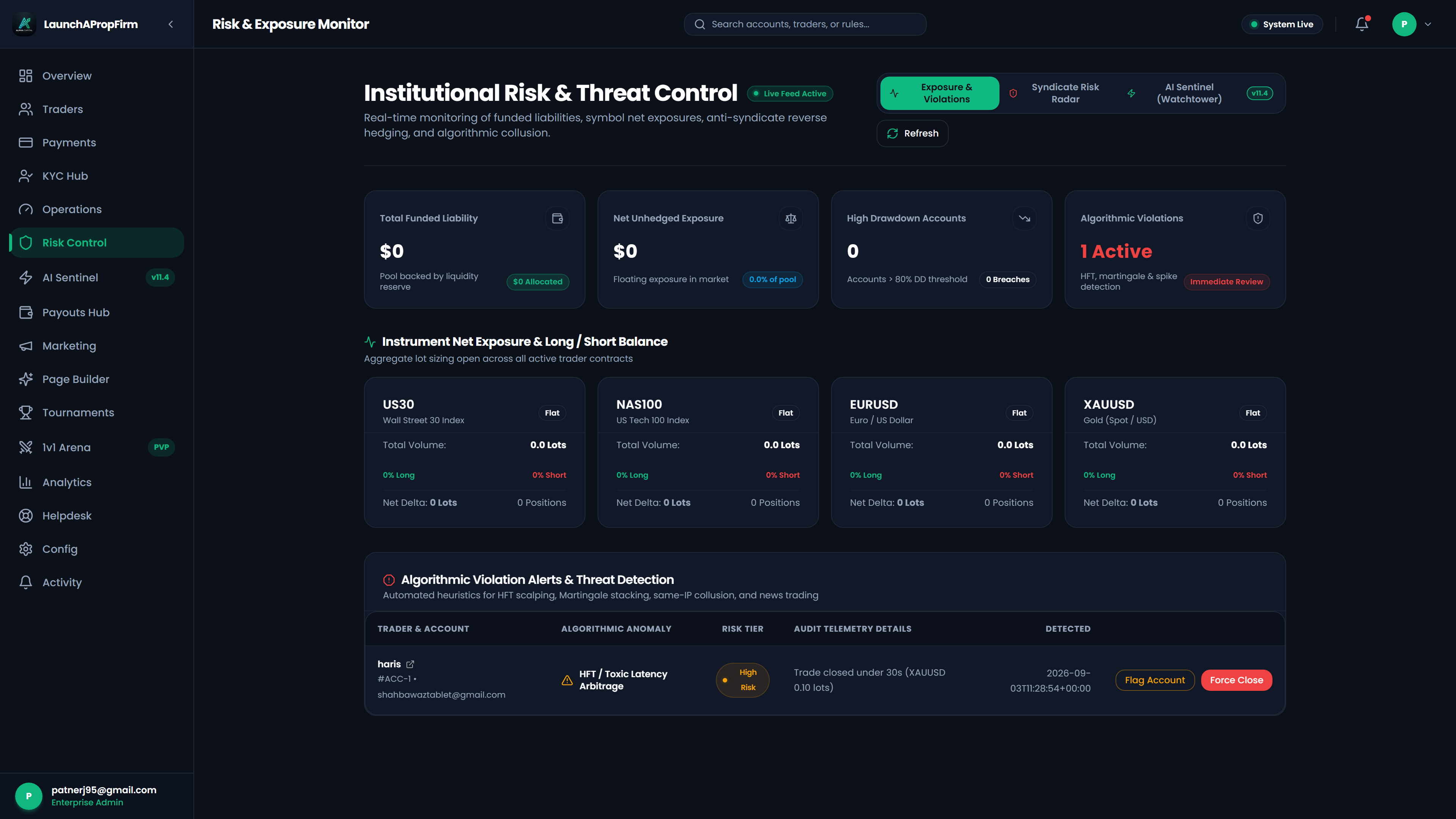
Unscrupulous traders deploy latency arbitrage bots that exploit microsecond price discrepancies between retail data feeds and bridge execution speeds. These bots execute riskless arbitrage trades that appear profitable on demo servers but cannot be replicated in real markets. LaunchPropFirm includes built-in AI Sentinel detection that identifies tick-scalping holding times under 3 seconds and freezes toxic order flow before it generates phantom payout liabilities.
3. News Event Execution Buffers
During high-impact macroeconomic data releases (such as US Non-Farm Payrolls or CPI announcements), liquidity spreads widen dramatically. Traders attempting to gamble on news spikes can create massive artificial gains on simulated execution feeds that lack realistic slippage. Automated news guards restrict execution 2 to 5 minutes before and after Tier-1 economic releases.
4. Maximum Allocation Caps ($400k to $600k)
To prevent a single trader or syndicated trading group from threatening the firm's solvency, operators establish maximum capital allocation limits. A standard policy caps individual trader allocation at $400,000 or $600,000 across all active challenge tiers. Even if an exceptional trader passes six $100k challenges, their aggregate risk exposure to the firm remains strictly contained.
Dive deeper into platform risk configuration in our guide on prop firm risk management.
The Lean Founder Startup Capital Blueprint
How much capital to start a prop firm is the foundational question facing every emerging operator. Unrealistic enterprise consultants claim you need $250,000 to $500,000 to launch. Conversely, naive founders think they can start with $1,000 and immediately run out of cash when their first trader passes an evaluation.
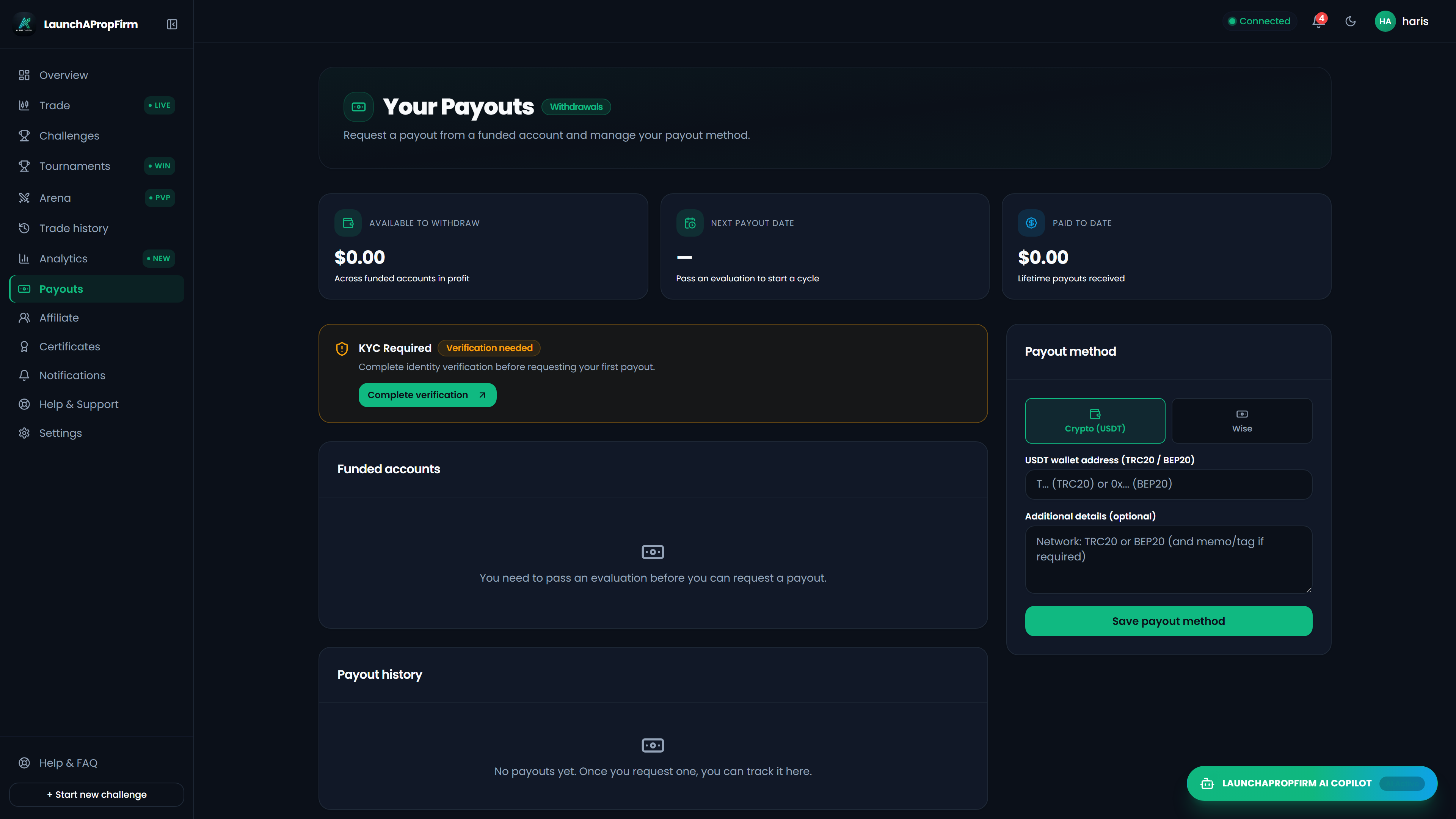
The reality for a lean, disciplined founder using sovereign self-hosted infrastructure is between $15,000 and $30,000 in total startup capital. Realistic prop firm starting capital models demonstrate that self-hosting removes the catastrophic burden of monthly recurring tech debt.
The following table breaks down the capital requirements for a lean launch using self-hosted infrastructure compared to legacy SaaS rental models:
| Capital Allocation Category | Legacy SaaS Model (FPFX / DXtrade) | LaunchPropFirm Self-Hosted Model | Operational Purpose |
|---|---|---|---|
| Core Trading Software | $10,000 to $15,000 setup fee | $2,495 one-time purchase | Complete Next.js & Node.js trading engine |
| Platform Hosting & Server Ops | $3,500 to $8,000 per month | $200 per month (Private VPS) | Ultra-low-latency order execution |
| Per-Account Volume Rakes | $1 to $3 per active trader | $0 (Zero volume fees forever) | Retain 100% of challenge sales revenue |
| Liquid Payout Reserve Buffer | $20,000 minimum cash | $10,000 to $20,000 liquid buffer | Segregated cash to clear trader payouts |
| Legal Setup & Banking Rails | $5,000 to $10,000 offshore | $2,500 to $5,000 entity setup | Corporate incorporation and crypto rails |
| Initial Marketing & Tournaments | $5,000 to $10,000 | $2,000 to $5,000 (PvP Arena & Ads) | Viral trader acquisition and seed challenges |
| Total Starting Capital Required | $45,000 to $65,000+ upfront | $17,195 to $29,695 total | Fully launched, funded, and solvent prop firm |
By eliminating the $5,000/month SaaS rent of legacy vendors, an operator frees up $60,000 in Year 1 cash flow. That capital can be placed directly into the liquid payout reserve fund, providing total financial security against unexpected winning streaks.
For an extensive analysis of startup expenses, review our guide on how much does it cost to start a prop firm in 2026 and our step-by-step roadmap on how to start a prop firm in 2026.
Total Cost of Ownership: Legacy SaaS vs Self-Hosted Capital Efficiency
The single largest drain on prop firm capital is recurring software rent. When founders rent proprietary technology from legacy SaaS providers like FPFX Tech, Propriotec, Leverate, or DXtrade, they surrender significant operational cash flow every 30 days.
A mathematical look at Year 1 Total Cost of Ownership demonstrates the stark difference:
- Competitor Year 1: Setup ($5,000 to $15,000) plus monthly SaaS rent ($3,000 to $5,000 x 12) equals $41,000 to $75,000 annually.
- LaunchPropFirm Year 1: Complete one-time platform purchase of $2,495 fixed. Net operator cash savings range from +$38,500 to +$72,500 in Year 1 alone.
Legacy SaaS vendors also hold your trader database, order ledgers, and KYC records inside closed cloud infrastructure. If an operator struggles during a slow marketing month and misses a SaaS subscription payment, the vendor shuts down the platform, terminating trader accounts and destroying the firm's brand overnight.
With LaunchPropFirm, you receive full source code ownership in TypeScript, Next.js, and Node.js. Your platform runs on your own dedicated VPS. You control your databases, your user accounts, and your private crypto treasury keys. You pay zero monthly licensing rakes, zero per-account fees, and zero profit-sharing royalties.
Calculate your exact capital requirements and savings using the interactive SaaS vs Self-Hosted Calculator. Inspect the live trader risk dashboard and institutional admin controls on our Live Dual-Credential Demo. Explore our comprehensive turn-key trading infrastructure at LaunchPropFirm.
Discover additional infrastructure insights in our breakdown of the prop firm software cost problem and our comparative analysis of LaunchPropFirm vs monthly SaaS platforms.
Treasury Management and Payout Execution
Once challenge fees enter your operating treasury, managing payout execution determines whether your firm maintains a pristine market reputation or collapses under payment friction.
To preserve liquid reserves and ensure smooth withdrawals:
- Enforce Bi-Weekly Payout Cycles: Daily payouts create chaotic treasury friction and encourage high-frequency gambling. Bi-weekly or 14-day payout intervals allow operators to forecast cash liabilities, review trading logs for execution breaches, and batch transactions efficiently.
- Deploy Multi-Rail Payout Gateways: Never rely solely on traditional bank wires. Direct fiat transfers from offshore prop entities to personal bank accounts frequently trigger freezes. Deploy automated crypto disbursement rails using USDT TRC-20 and ERC-20 alongside compliant contractor payroll solutions like Rise Works.
- Automate Profit Split Calculations: Ensure your trading platform calculates exact profit splits (typically 80% trader / 20% firm) upon payout request submission, automatically deducting the split balance from the trader's active evaluation account to prevent double-dipping.
Read our complete breakdown of treasury workflows in our guide on prop firm payout systems and our analysis of prop firm payment methods.
Frequently Asked Questions
How much capital to start a prop firm is actually required?
Determining how much capital to start a prop firm depends primarily on your software delivery model. A lean founder using self-hosted software like LaunchPropFirm can launch a solvent, professional prop firm with $15,000 to $30,000 in starting capital. This includes $2,495 for complete source code ownership, $200/month for high-performance VPS hosting, $2,500 to $5,000 for legal incorporation and payment rails, and a $10,000 to $20,000 liquid payout reserve buffer. In contrast, legacy SaaS rental models inflate prop trading capital requirements to $45,000 to $75,000+ due to heavy upfront setup fees and monthly software rent.
Do prop firms provide traders with real capital?
No. Proprietary evaluation firms provide traders with simulated demo accounts on platforms such as MetaTrader 5, cTrader, and TradingView. The displayed balance ($100k, $200k) is virtual credit. The firm's actual capital risk is restricted strictly to the maximum drawdown limit (usually 8% to 10%, or $8,000 to $10,000 on a $100k account). Real capital is only disbursed when a funded trader achieves a net profit split, which is paid from the firm's liquid reserve treasury or generated through A-Book broker copy-trading.
What is a prop firm reserve fund?
A prop firm reserve fund is a segregated pool of liquid cash or stablecoins maintained by the operator specifically to honor funded trader payout requests. Disciplined operators allocate 40% to 50% of gross challenge fee revenues into this reserve fund. This buffer guarantees that the firm remains solvent and capable of processing large payout withdrawals even during market cycles where funded traders achieve higher-than-average win rates.
Can a prop firm operate entirely on a B-Book model without a broker?
Yes. Over 90% of retail proprietary evaluation firms operate primarily on an internalized B-Book model. Because retail evaluation non-passing rates consistently range between 92% and 95%, challenge fee inflows comfortably cover payout requests from the small percentage of winning traders. However, smart operators implement hybrid A-Book copy-trading engines to route exceptional high-alpha traders onto Prime of Prime brokers, protecting the firm against extreme fat-tail payout liabilities.
How do prop firms protect their capital from trading abuse?
Proprietary trading platforms protect operator capital through automated risk management features: static and trailing drawdown liquidation floors, daily equity loss monitors, latency arbitrage filters that flag microsecond order holding times, news trading restrictions, and maximum individual capital allocation caps ($400,000 to $600,000 per trader).
What happens if a prop firm runs out of liquid capital?
When an undercapitalized prop firm fails to maintain an adequate payout reserve buffer or spends challenge fees on lavish lifestyle expenses, a single influx of winning trader payouts can cause a liquidity crisis. When a firm delays or denies legitimate payouts, traders report the issue on Trustpilot and social media, halting new challenge sales and forcing the firm into liquidation. Maintaining a dedicated 40% to 50% reserve buffer prevents this failure mode completely.
Written by the LaunchPropFirm Engineering & Risk Architecture Desk.
Model Challenge Pricing & 3.0x Payout Reserves
Calculate break-even challenge fees across $10k-$200k tiers and simulate pass-rate payout liabilities to prevent firm insolvency.
Prop Firm Monthly Profit Simulator
Simulate your challenge revenue, payout liability, and net monthly take-home profit.
$20,000
From upfront challenge fees-$2,800
~10 funded payouts budgeted$0 / month
Saves $3,000/mo vs SaaS$17,200/mo
Run-rate: $206,400/yr
M.Haris
Founder & Platform ArchitectBuilding open prop trading software infrastructure for operators worldwide
I built LaunchPropFirm to give forex educators, trading communities, and fintech operators complete ownership of their platform with full source code and zero monthly SaaS rent. Every article on this blog is drawn from hands-on platform development, live MT5 risk bridge mechanics, and real operator economics.
All content, financial models, ROI estimates, and architecture guides on LaunchPropFirm are published strictly for educational and informational purposes. LaunchPropFirm provides institutional prop trading software and technology infrastructure; it does not operate as a broker, custodian, or registered investment advisor.
Evaluation challenges and funded trader accounts referenced in this guide operate in simulated demo trading environments using real-time market data feeds. Simulated trading results do not represent actual trading performance or financial advice.
Recommended Next Reads
Hand-picked operator guides to scale your prop trading platform.
Wise Prop Firms: Payouts, Risks and Rails
Explore why direct Wise prop firms payouts trigger account freezes, how Rise compliance bridges protect funds, and why multi-rail payouts guarantee cash flow.
Prop Firm Crypto Gateway Setup Guide
Learn how to build a prop firm crypto payment gateway setup, accept automated USDT payments, eliminate Stripe bans, and deploy self-hosted rails without fees.
Skip the monthly fees
Own your prop firm platform outright. One time purchase.
Full source code. Live in 7 days. No revenue share. No monthly SaaS bill. See the exact platform before paying anything.
Demo login: haris / asdf1122. No signup needed