Prop Firm Liquidity: A-Book vs B-Book Routing Guide
Setup prop firm liquidity with hybrid A/B-Book routing. Learn when to internalize trade risk and when to pass orders to institutional liquidity providers.
Proprietary trading firms operate under fundamentally different financial plumbing than conventional retail brokerage firms. While retail brokers charge trading commissions and send customer orders to interbank clearing houses, evaluation firms manage simulated challenges where traders prove their risk discipline before accessing capital allocations. Understanding how liquidity works across A-Book STP routing and B-Book internal matching engines determines whether an operator builds a resilient, cash-flow positive enterprise or drowns under unexpected counterparty costs.
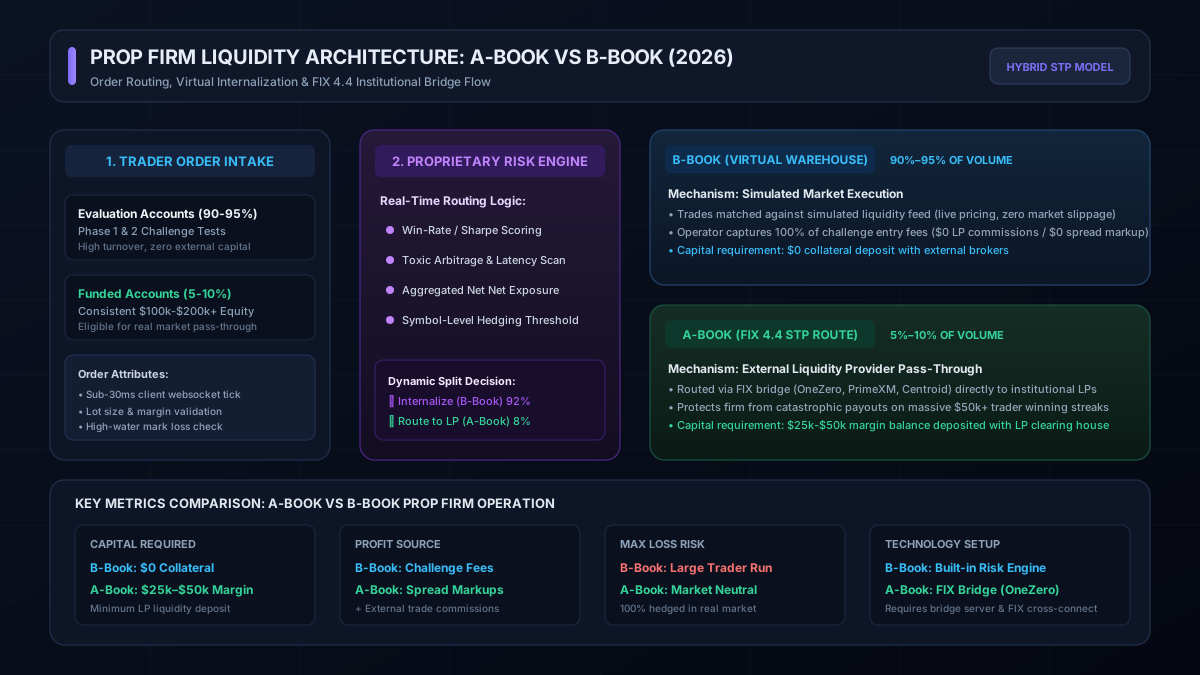
Mechanics of Modern Prop Firm Liquidity
Proprietary trading firms operate under different financial plumbing than conventional retail brokerage firms. In a standard brokerage environment, every trade executed on the platform incurs clearing fees, swap markups, and liquidity provider commissions. In contrast, modern prop trading evaluation platforms run order flow through internal risk management engines that evaluate performance against strict drawdown rules.
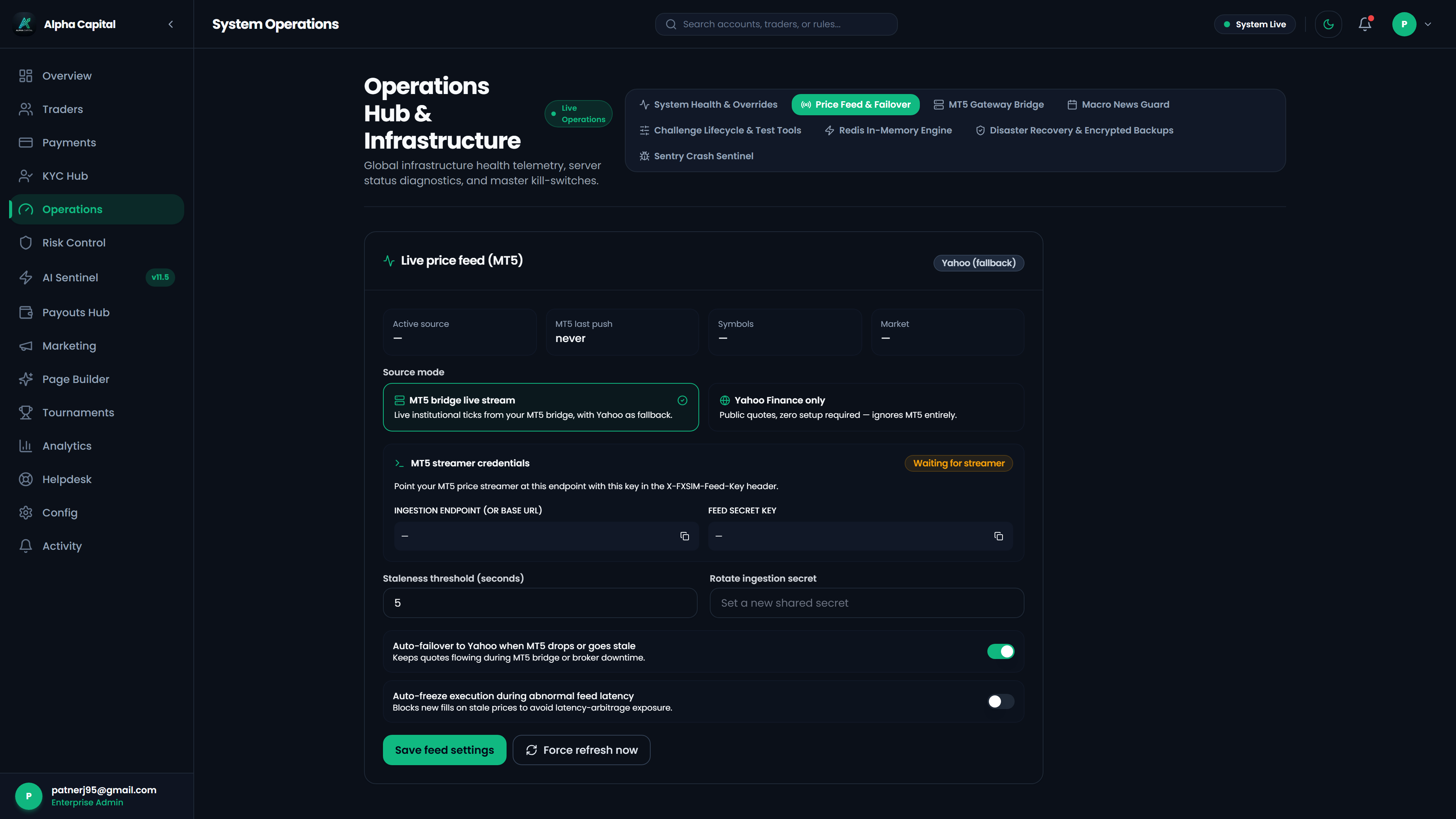
Live operational control room routing funded trade volume, monitoring execution latency, and managing server infrastructure.
When a trader purchases an evaluation challenge, their orders execute against simulated price feeds. The operator does not need an external liquidity provider for challenge accounts because the trader is taking an educational and diagnostic evaluation test. The capital at risk during this phase belongs exclusively to the trader in the form of their challenge fee.
The liquidity question becomes relevant only when successful traders graduate to funded status. At that point, the firm must decide whether to warehouse the risk internally or route positions through a FIX 4.4 bridge to external institutional market makers. Modern firms employ a hybrid risk model that combines the best characteristics of both execution paths.
When to Route Orders to B-Book Internalization
Challenge evaluations run on simulated price feeds where order internalization protects operator capital. Over 90 percent of retail challenge participants breach daily loss limits or maximum drawdown thresholds before qualifying for a payout. Routing these evaluation trades to external liquidity providers would generate massive unnecessary clearing costs, spread markups, and liquidity deposit overhead.
Internalizing challenge volume allows the operator to retain 100 percent of challenge purchase fees without paying brokerage pass-through charges. The internal risk engine matches simulated buy and sell orders, calculates real-time floating equity, and triggers automated account terminations whenever a trader breaches predetermined risk thresholds.
B-Book execution also prevents toxic latency arbitrage. High-frequency algorithmic traders frequently attempt to exploit slight timing discrepancies between retail platform feeds and institutional pricing. By running simulated execution with integrated price slippage buffers, the prop firm neutralizes latency exploitation without exposing real capital to external counterparties. Learn more about effective risk parameters in our prop firm risk management architecture guide.
Operator Tip: Never deposit high capital into an external LP until your funded trader pool exceeds $500,000 in open aggregate risk exposure.
When to Deploy A-Book STP Execution to Liquidity Providers
Funded traders generating consistent monthly payouts require external market hedging to mitigate catastrophic operator drawdown. When a top trader manages a $200,000 funded account and achieves consistent 8 percent monthly returns, the firm owes that trader $12,800 to $14,400 per month based on their profit split agreement. If the firm warehouses that trader completely on B-Book, the entire payout must come directly out of the firm cash flow reserves.
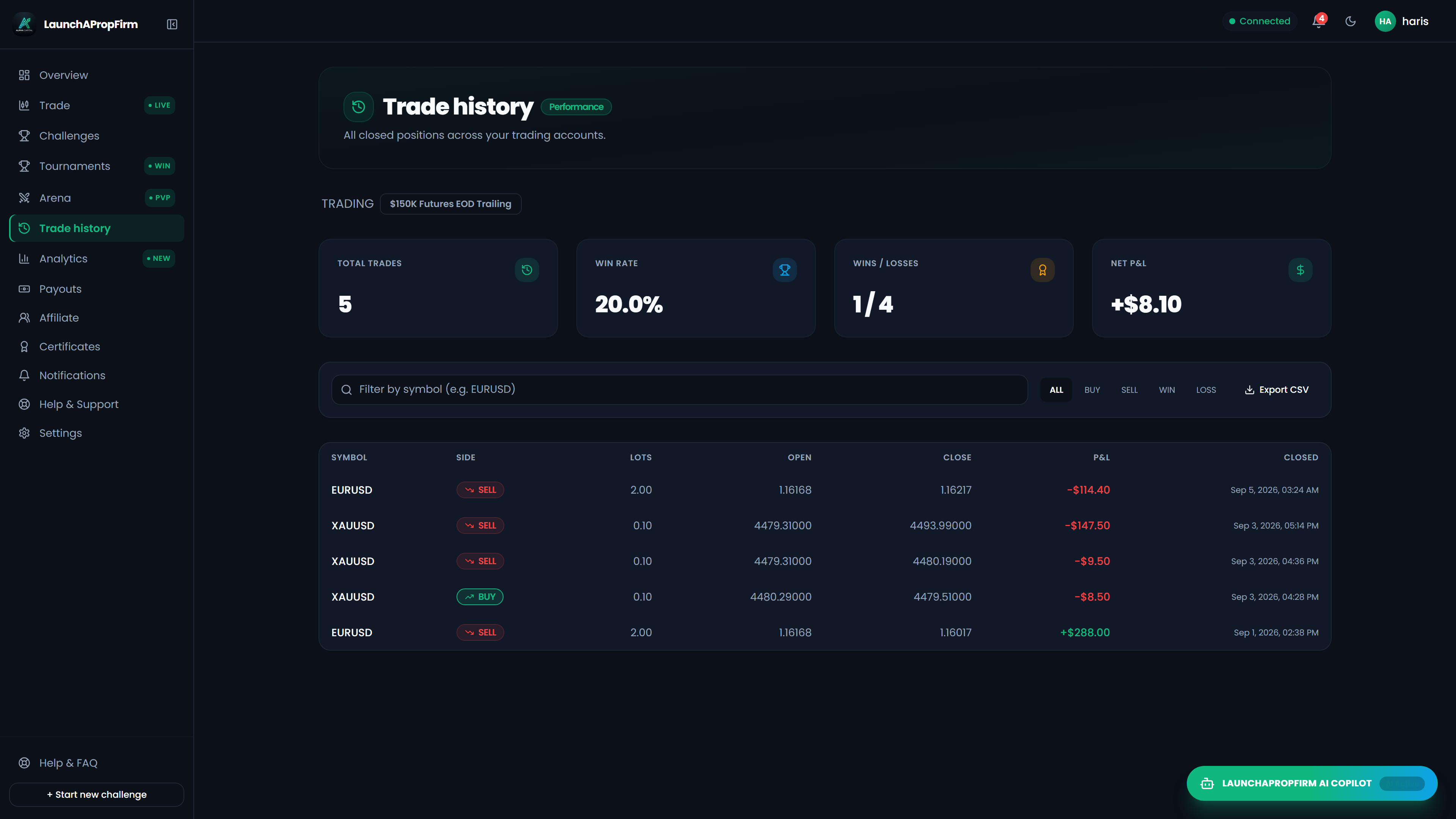
Detailed trade journal tracking execution timestamps, position sizes, and consistency rule compliance.
By routing high-performing funded accounts to an external liquidity provider via Straight-Through Processing (STP), the prop firm offloads market directional risk. When the trader places a 10-lot long EUR/USD position, the FIX bridge replicates that position with an institutional prime broker such as LMAX, Finalto, or Saxo Bank.
When the trade hits profit, the external liquidity provider pays the profit into the firm clearing account, which is then used to fund the trader payout. The firm captures its share of the profit split alongside spread markups without taking directional market exposure against its most profitable traders. For a broader perspective on sustainable operational modeling, review our prop trading firm business model breakdown.
Skip the monthly fees
Own your prop firm platform outright. One time purchase.
Full source code. Live in 7 days. No revenue share. No monthly SaaS bill. See the exact platform before paying anything.
Demo login: haris / asdf1122. No signup needed
Technology Comparison: A-Book vs B-Book Execution
Operating a hybrid risk desk demands specific software infrastructure and capital allocation. The following breakdown highlights the structural differences between both execution models across capital requirements, technology requirements, and revenue generation.
| Execution Metric | B-Book Internalization | A-Book STP Pass-Through | Hybrid Prop Model |
|---|---|---|---|
| Capital Required | $0 Collateral Deposit | $25,000 - $50,000 LP Margin | $10,000 Standby Buffer |
| Technology Stack | Native Simulated Risk Engine | Enterprise FIX 4.4 Bridge | Dual-Route Smart Engine |
| Spread Costs | $0 Pass-Through Fees | Interbank Spread + Markup | Zero on 90% of Volume |
| Profit Engine | Challenge Entry Fees | Spread Markup + Split Share | Dual Diversified Streams |
| Toxic Flow Risk | Absorbed by Virtual Rules | Rejected by LP Gateway | Filtered by Pre-Trade Engine |
| Latency Tolerance | Standard Web Sockets (<50ms) | Optical Cross-Connect (<5ms) | Tiered Execution Profiles |
| Regulatory Barrier | Unregulated Tech Simulation | Brokerage License or Partner | Lean Prop Entity Model |
Deploying a hybrid model gives prop firm founders the financial safety of B-Book evaluation margins combined with the balance sheet protection of A-Book hedging. You can explore how turnkey platforms configure these matching engines with LaunchPropFirm.
Capital Requirements and FIX Bridge Setup
Connecting an institutional liquidity provider requires an enterprise FIX 4.4 bridge and segregated collateral accounts. Most Tier-1 liquidity providers require a minimum margin deposit between $25,000 and $50,000 before activating live price feeds and market execution lines. Bridge providers such as OneZero or PrimeXM charge monthly software connectivity fees ranging from $2,000 to $4,500.
For new and bootstrapping firms, committing $50,000 to an LP margin account before generating substantial challenge revenue creates unnecessary cash flow friction. The most prudent operational path is launching with a specialized prop firm technology provider that handles evaluation orders internally while maintaining ready-to-activate STP bridge pathways for mature funded accounts.
Modern platforms built by LaunchPropFirm deliver self-hosted simulated risk environments with zero monthly software licensing fees. Operators maintain complete control over challenge rules, payout thresholds, and risk scoring without paying perpetual platform rents or unnecessary liquidity overhead. Schedule a live demonstration and review platform specifications at launchapropfirm.com.
FAQ
Common questions about prop firm liquidity models, execution bridges, and broker setups.
Do prop firms need a liquidity provider to launch?
Prop firms do not need an external liquidity provider during their initial launch phase. Evaluation challenges run on simulated price feeds with internal matching, eliminating the need for expensive LP margin deposits.
What is the difference between A-Book and B-Book in a prop firm?
B-Book internalizes simulated orders within the firm platform risk engine, while A-Book routes funded trader orders through a FIX bridge to live market liquidity providers for external execution.
How much capital is required to open an LP margin account?
Institutional prime brokers typically require a minimum collateral balance of $25,000 to $50,000 to establish active execution clearing lines and FIX protocol connectivity.
Can a prop firm operate 100% on B-Book execution?
Yes, many retail prop firms operate entirely on simulated B-Book models. They pay funded trader rewards from accumulated evaluation challenge fees while using tight risk rules to cap exposure.
Which FIX bridges connect to prop firm trading platforms?
Industry standard bridge middleware includes OneZero, PrimeXM, Gold-i, and Centroid Solutions, which interface with trading platforms via FIX 4.4 protocol for sub-5ms order routing.
Model Challenge Pricing & 3.0x Payout Reserves
Calculate break-even challenge fees across $10k-$200k tiers and simulate pass-rate payout liabilities to prevent firm insolvency.
Prop Firm Monthly Profit Simulator
Simulate your challenge revenue, payout liability, and net monthly take-home profit.
$20,000
From upfront challenge fees-$2,800
~10 funded payouts budgeted$0 / month
Saves $3,000/mo vs SaaS$17,200/mo
Run-rate: $206,400/yr
M.Haris
Founder & Platform ArchitectBuilding open prop trading software infrastructure for operators worldwide
I built LaunchPropFirm to give forex educators, trading communities, and fintech operators complete ownership of their platform with full source code and zero monthly SaaS rent. Every article on this blog is drawn from hands-on platform development, live MT5 risk bridge mechanics, and real operator economics.
All content, financial models, ROI estimates, and architecture guides on LaunchPropFirm are published strictly for educational and informational purposes. LaunchPropFirm provides institutional prop trading software and technology infrastructure; it does not operate as a broker, custodian, or registered investment advisor.
Evaluation challenges and funded trader accounts referenced in this guide operate in simulated demo trading environments using real-time market data feeds. Simulated trading results do not represent actual trading performance or financial advice.
Recommended Next Reads
Hand-picked operator guides to scale your prop trading platform.
TradingView Prop Firms (2026): Best Web Terminals
Complete 2026 guide to TradingView prop firms. Compare top firms offering browser TradingView charts, execution latency, and funded account rules.
White Label Futures Prop Firm: Platform Setup Guide
Launch a white label futures prop firm like Apex Trader Funding. Understand Rithmic data feeds, Tradovate bridges, CME fees, and turnkey software costs.
Skip the monthly fees
Own your prop firm platform outright. One time purchase.
Full source code. Live in 7 days. No revenue share. No monthly SaaS bill. See the exact platform before paying anything.
Demo login: haris / asdf1122. No signup needed