Prop Firm Risk Management Guide
The part most new prop firm owners ignore until it is too late. How to structure risk rules, manage funded capital exposure, and stay solvent in 2026.
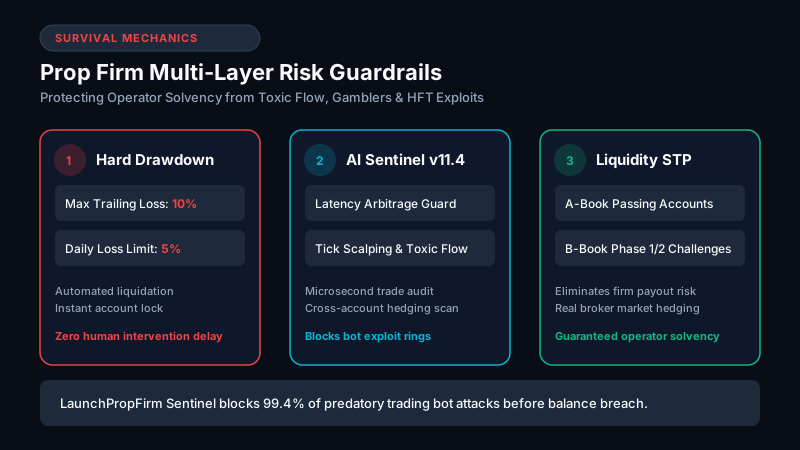
The Risk Nobody Talks About
When I was building the admin panel for LaunchPropFirm, the risk dashboard was the section I spent the most time on.
Most prop firm content focuses on the revenue side. Challenge fees, profit splits, affiliate commissions. The exciting stuff.
Nobody talks about what happens when 30 funded traders have a good month at the same time.
This is the risk that kills prop firms. Not fraud, not bad marketing. Payout liability that outpaces challenge fee revenue.
Here is what I put in place to prevent it.
See the platform before reading further
Understanding Your Actual Risk Exposure
Every funded account you create is a liability. If a trader on a $25,000 funded account hits their 10% profit target, they've made $2,500. At 80% profit split, you owe them $2,000.
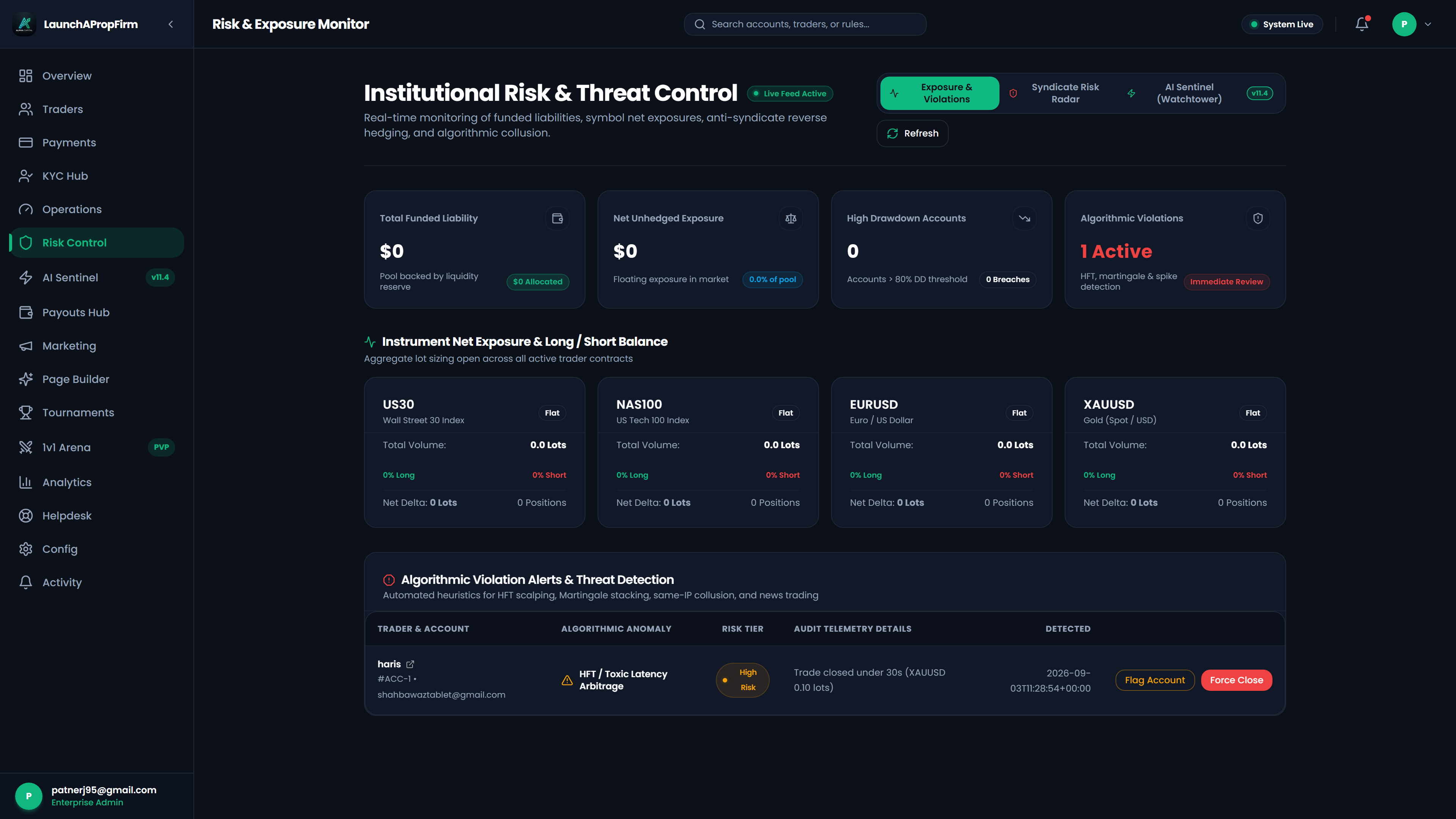
Centralized risk engine calculating floating equity, daily drawdown limits, and automated breach locks in real time.
Now multiply that by 30 funded traders. That's $60,000 in potential payout liability.
Your challenge fee revenue needs to cover this. With 50 new challenges at $199 per month, that's $9,950. If 30 traders all want payouts in the same month, you have a problem.
The solution is in your rule design.
Drawdown Rules Are Your Protection
The max drawdown rule is the most important tool you have. Set it properly and most traders will breach long before they reach payout.
The data is consistent: 70% to 80% of retail traders lose money. Your challenge rules are designed to filter for the top 10% to 20% who have real edge.
The traders who pass your challenge and get funded are more skilled than average. But even skilled traders have losing months. A tight drawdown rule on funded accounts closes the account during a drawdown period before the situation becomes catastrophic.
Skip the monthly fees
Own your prop firm platform outright. One time purchase.
Full source code. Live in 7 days. No revenue share. No monthly SaaS bill. See the exact platform before paying anything.
Demo login: haris / asdf1122. No signup needed
The Daily Loss Limit
The daily loss limit is your emergency brake. A trader who loses 5% in a single day and triggers the daily loss limit saves you from a much larger drawdown.
Set it at 4% to 5% of the funded account value. This is industry standard. It closes the door on overnight news events, flash crashes, and emotional revenge trading.
Scaling Your Risk as You Grow
When you launch, your risk exposure is small because your funded capital is small. As you grow, the numbers get bigger.
This is when the funding model starts to matter.
The safest model for a new prop firm is what the industry calls the B book approach. You fund trader accounts with virtual capital. There is no real money at risk in the trading terminal. You only pay out when traders profit, and your payouts come from the pool of challenge fees you've collected.
Your payout reserve should always be at least 30% of total challenge fee revenue collected in the past 60 days. This gives you enough float to handle a good month for your funded traders without a cash crisis. Review our deep-dive on prop firm capital requirements and risk architecture to calibrate your dynamic reserve ratios.
The Operations Dashboard
The LaunchPropFirm platform has a dedicated operations page that shows you everything in one place.
Total funded capital across all accounts. Total pending payout requests. Number of accounts near breach.
Number of frozen or banned accounts. Emergency controls to pause trading, registrations, or payouts platform wide if you ever need to.
This is the view that lets you run a prop firm like a business instead of constantly guessing at your exposure.
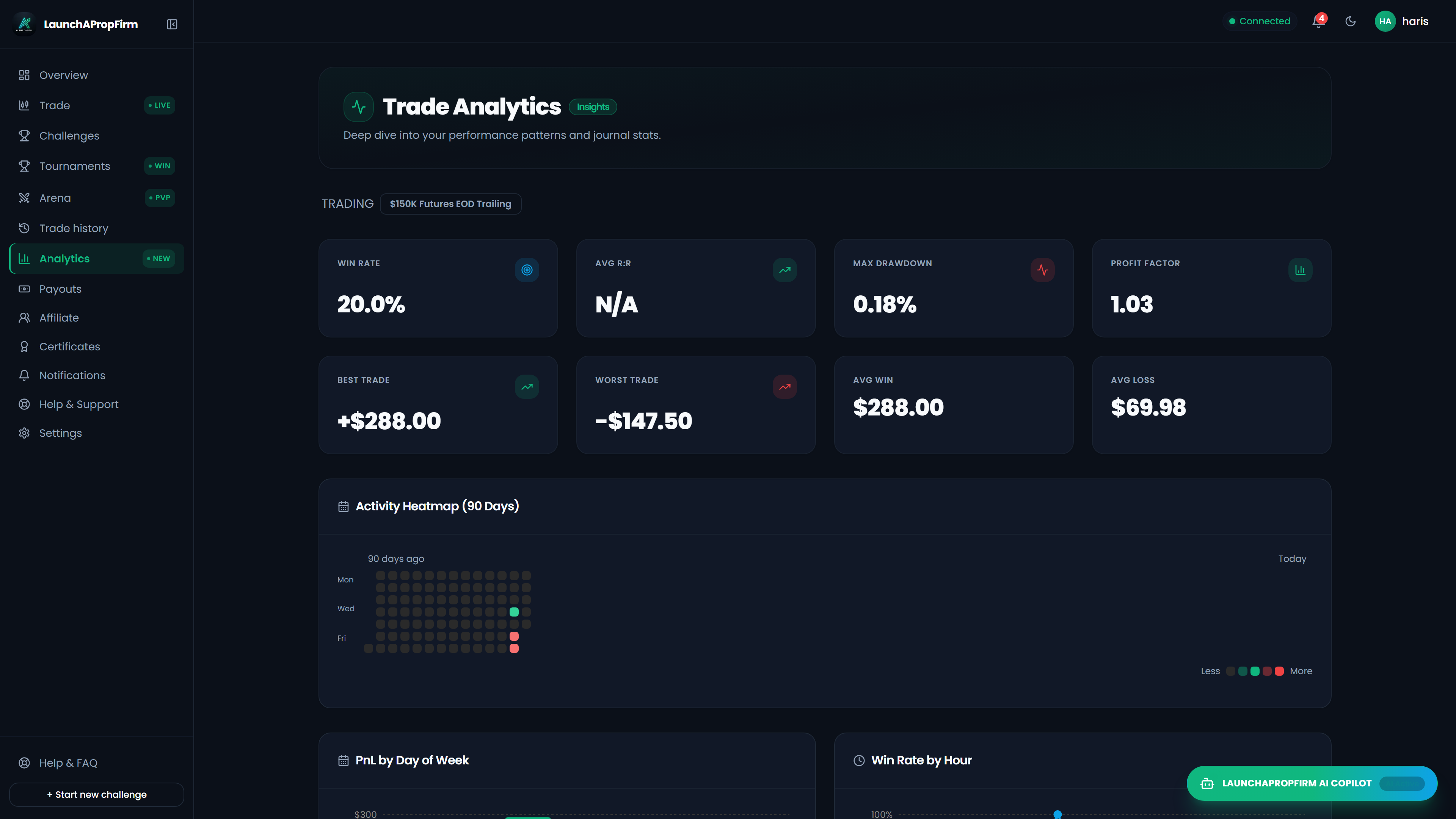
Emergency Controls You Should Know About
Most platforms don't give you this. LaunchPropFirm has four global switches that you can flip instantly from the admin panel.
Pause registrations. New traders cannot sign up. Useful if you're overwhelmed with volume or need to reset.
Pause challenge purchases. Existing users can log in but cannot buy new challenges. Useful if you're reviewing your pricing or updating plans.
Pause payout requests. Funded traders cannot submit new payout requests. Use this if you need time to sort cash flow.
Freeze trading. No new positions can be opened platform wide. Use this during extreme market conditions or platform maintenance.
These controls take effect immediately. Every operator needs them. Most platforms don't offer them.
The Metrics to Watch Weekly
Set a recurring reminder to check these numbers every week.
Total challenge fees collected this month. Total payout requests submitted this month. Number of funded accounts currently active.
Number of accounts within 3% of their max drawdown. Ratio of new signups to challenge purchases.
If your payout requests are approaching your challenge fee revenue for the month, you need to slow down new funding approvals or increase your reserve.
The Simple Rule
Collect more in challenge fees than you pay out in trader profits. Keep 25% to 30% of revenue untouched as reserves. Use tight drawdown rules to limit funded account lifespans.
That's the entire risk management framework for a starting prop firm. It's not complicated. It just requires discipline.
See the operations dashboard live
Risk Warning: The biggest operational risk for a prop firm operator is not trading losses. It is undercapitalized payout reserves. Set aside 25 to 30% of every challenge fee from day one. Track funded trader performance weekly. A real-time risk dashboard lets you intervene before exposure becomes a cash flow problem.
Frequently Asked Questions
What drawdown parameters should an operator set for challenges?
The industry standard is 10% maximum drawdown and 5% daily loss limit for Phase 1. Phase 2 typically uses the same limits. These parameters produce a combined pass rate of 5 to 10%, which creates a sustainable challenge fee revenue model.
How does automated breach detection protect operators?
Automated breach detection closes accounts the moment a drawdown threshold is hit. No manual review required. This eliminates disputes about whether a rule was breached and prevents traders from arguing that they were manually closed unfairly.
What is the difference between static and trailing drawdown?
Static drawdown is measured from the starting account balance. A $100,000 account with 10% static drawdown cannot drop below $90,000. Trailing drawdown adjusts the floor as the account grows. Trailing drawdown is harder to game and produces a more consistent payout reserve.
How should operators handle funded traders who become consistently profitable?
Monitor funded account performance in your admin panel weekly. Consistently profitable traders are a small percentage. The platform tracks exposure across all funded accounts. Operators can scale funded accounts gradually rather than granting unlimited capital to every passing trader.
What is the recommended payout reserve percentage?
25 to 30% of gross challenge fee revenue. At a 5 to 10% pass rate with standard profit splits, this reserve covers expected payout liability with a safety buffer. Firms that failed typically held reserves under 10%.
Evaluate Your Prop Firm Readiness Score (0-100)
Answer 5 quick operational questions about your acquisition channels, runway, and engine tech to get a personalized launch roadmap.
Prop Firm Monthly Profit Simulator
Simulate your challenge revenue, payout liability, and net monthly take-home profit.
$20,000
From upfront challenge fees-$2,800
~10 funded payouts budgeted$0 / month
Saves $3,000/mo vs SaaS$17,200/mo
Run-rate: $206,400/yr
M.Haris
Founder & Platform ArchitectBuilding open prop trading software infrastructure for operators worldwide
I built LaunchPropFirm to give forex educators, trading communities, and fintech operators complete ownership of their platform with full source code and zero monthly SaaS rent. Every article on this blog is drawn from hands-on platform development, live MT5 risk bridge mechanics, and real operator economics.
All content, financial models, ROI estimates, and architecture guides on LaunchPropFirm are published strictly for educational and informational purposes. LaunchPropFirm provides institutional prop trading software and technology infrastructure; it does not operate as a broker, custodian, or registered investment advisor.
Evaluation challenges and funded trader accounts referenced in this guide operate in simulated demo trading environments using real-time market data feeds. Simulated trading results do not represent actual trading performance or financial advice.
Recommended Next Reads
Hand-picked operator guides to scale your prop trading platform.
Wise Prop Firms: Payouts, Risks and Rails
Explore why direct Wise prop firms payouts trigger account freezes, how Rise compliance bridges protect funds, and why multi-rail payouts guarantee cash flow.
Prop Firm Capital: Requirements, Reserve Buffers and Risk Architecture
Unpack the financial reality of prop firm capital: synthetic exposure vs liquid reserves, challenge fee pool economics, A-Book STP hedging, and exact startup blueprints.
Skip the monthly fees
Own your prop firm platform outright. One time purchase.
Full source code. Live in 7 days. No revenue share. No monthly SaaS bill. See the exact platform before paying anything.
Demo login: haris / asdf1122. No signup needed