Prop Firm Challenge System: 1-Step, 2-Step & Instant Rules
Guide to prop firm challenge systems. Understand evaluation phases, profit target milestones, drawdown buffers, and instant funding mechanics in 2026.
What a Prop Firm Challenge Actually Is
A prop firm challenge is an evaluation. A trader pays a fee to trade a demo account under strict rules. If they hit the profit target without violating the drawdown limits, they receive a funded account and start splitting real profits with the firm.
That is the complete model. Everything else is details.
The challenge is the core product. When I built the challenge system in LaunchPropFirm, I studied how every major firm structured theirs. The rules look simple on the surface. The mechanics underneath are what determine whether a firm makes money or folds after six months.
See a live prop firm challenge system
The Two-Phase Structure: How Most Firms Do It
The industry standard is two evaluation phases before a funded account.
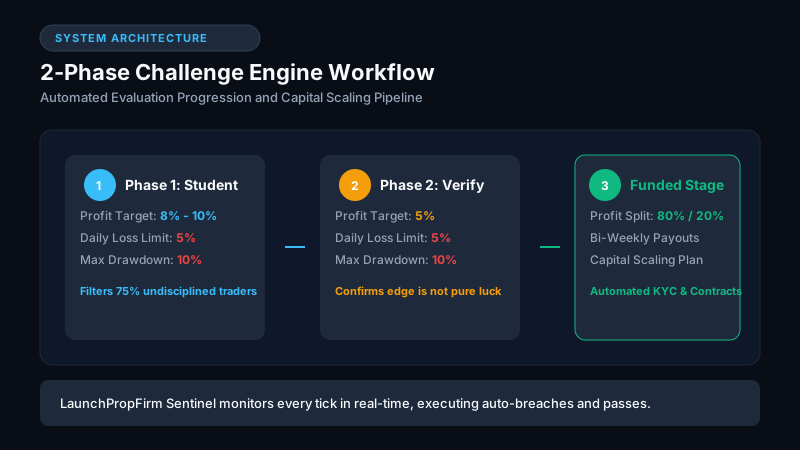
Phase 1 is the initial screen. The trader must hit an 8% profit target without losing more than 10% of the account (max drawdown) and without losing more than 5% in a single day (daily loss limit). Most firms allow 30 days to complete Phase 1 and require a minimum of 4 to 5 trading days.
Phase 2 is the consistency check. The same drawdown and daily loss rules apply. The profit target drops to 5%.
The purpose is to confirm that Phase 1 was not luck. Minimum trading days the same. Most firms allow 60 days.
Funded account starts at Phase 3. Trader keeps 70 to 85% of profits. Payouts happen every 14 to 30 days.
The same drawdown rules from evaluation now apply to real money. Breach the drawdown and the funded account closes.
Real Pass Rates: What the Numbers Say
Industry-wide, the combined pass rate across both phases is 5 to 10%.
That means 90 to 95% of traders who buy a challenge never receive a funded account. They fail Phase 1, or they pass Phase 1 and fail Phase 2, or they pass both phases but breach the funded account drawdown.
This is not hidden. Traders know the odds. They buy anyway because they believe they are in the 5 to 10%.
For an operator, this is the primary revenue model. A $200 challenge fee with a 7% pass rate means for every 100 traders, 93 pay $200 and receive nothing. Seven receive a funded account and begin profit sharing.
The math only works if your drawdown rules are enforced exactly and consistently. Any ambiguity creates disputes. Disputes destroy trust. Lost trust kills a prop firm faster than anything else.
Skip the monthly fees
Own your prop firm platform outright. One time purchase.
Full source code. Live in 7 days. No revenue share. No monthly SaaS bill. See the exact platform before paying anything.
Demo login: haris / asdf1122. No signup needed
The Drawdown Rules in Detail
Max drawdown and daily loss limit are two separate rules. They work differently and most traders confuse them.
Max drawdown (also called trailing drawdown at many firms): the maximum total loss allowed from the initial account balance or from the account peak, depending on how you set it up. At 10%, a $100,000 account closes if the balance ever touches $90,000.
Daily loss limit: the maximum loss allowed within a single calendar day, typically reset at midnight UTC. At 5%, a $100,000 account cannot drop more than $5,000 on any single day. Open positions count toward this limit at many firms.
Trailing drawdown adds a harder version: the drawdown threshold follows the account peak upward but never comes down. If a trader on a $100,000 account grows to $110,000, the max drawdown now means the account closes at $99,000, not $90,000.
As an operator, trailing drawdown protects you from funding traders who blow up after making initial gains.
Account Sizes and Fees: Current Market Rates
| Account Size | Standard Fee | One-Phase Fee | Profit Split |
|---|---|---|---|
| $5,000 | $49 | $79 | 70 to 80% |
| $10,000 | $89 to $99 | $149 | 75 to 80% |
| $25,000 | $179 to $199 | $299 | 75 to 85% |
| $50,000 | $279 to $299 | $449 | 80 to 85% |
| $100,000 | $449 to $549 | $699 | 80 to 90% |
| $200,000 | $799 to $999 | not standard | 80 to 90% |
These are what competitors charge in mid-2026. Price to the middle of this range unless you have a specific reason to go higher or lower.
Offering 80% and 85% profit splits has become table stakes. Firms still offering 70% are losing traders to competitors. The higher the funded account size, the higher the expected split.
Challenge Variations: What Works in 2026
The standard two-phase model still dominates, but three variations are growing.
One-phase challenges: trader only does one evaluation before funded account. Higher fee, faster outcome. Popular with experienced traders who have time limitations. Conversion rates are slightly lower because of the higher price point, but the traders who buy tend to be more serious.
No-time-limit challenges: trader has unlimited calendar days to complete the evaluation. They just have to meet the minimum trading days. This removes the biggest source of trader anxiety, which is the clock running out. Conversion rates on no-time-limit challenges run 15 to 25% higher in A/B tests I've seen reported by operators.
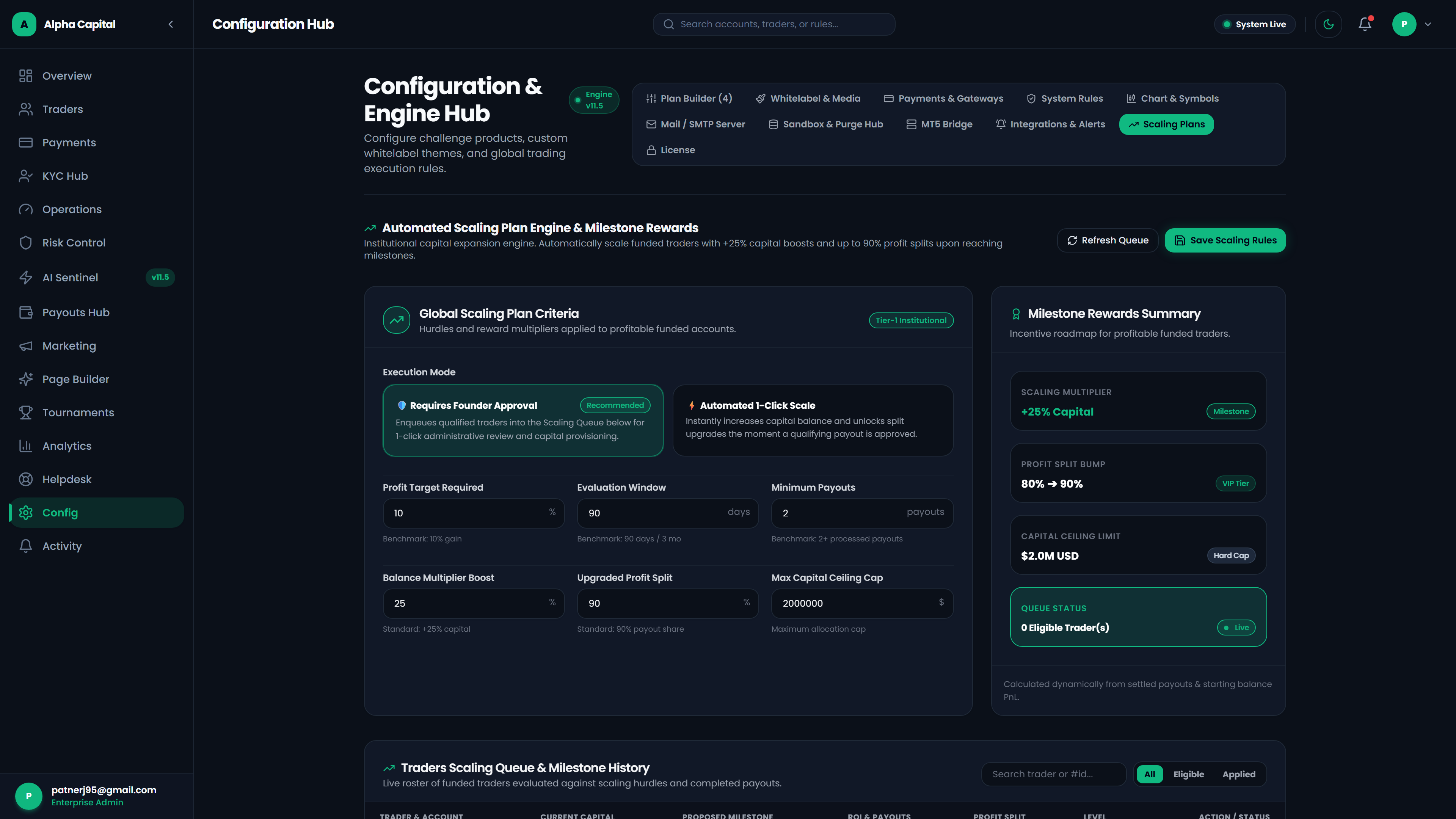
Scaling plans: funded traders start at $25K and grow to $50K to $100K as they hit profit targets over multiple months. This extends trader lifetime value and creates strong retention. The firm's risk scales with the account size, so you need solid risk monitoring before implementing this.
Instruments: What Traders Expect
Traders expect forex majors: EURUSD, GBPUSD, USDJPY, USDCAD, AUDUSD.
Gold (XAUUSD) is now considered a must-have. Many traders only trade gold. Excluding it costs you a meaningful segment of the market.
Indices: NAS100, US30, SPX500, GER40, UK100. US and European traders specifically look for index access. Not offering NAS100 is a visible gap.
Crypto is split. BTCUSD and ETHUSD satisfy most demand. Be careful with crypto on funded accounts: the volatility makes drawdown breaches much more likely, which either creates payout issues or complaint volumes you don't want.
Consistency Rules: Optional but Common
A consistency rule limits what percentage of total profits can come from a single trading day. A 40% consistency rule on Phase 1 means if a trader makes $2,000 total, no single day can account for more than $800 of that.
The purpose is to prevent traders from making one lucky trade, gaming the phase completion, and receiving a funded account they cannot maintain.
About 40% of operators use consistency rules. Traders generally dislike them. If you add one, make the math explicit in your challenge terms. "No single day can account for more than 40% of your total Phase 1 profits" with a worked numeric example prevents most disputes.
How to Configure Your Challenge System
From the LaunchPropFirm admin panel, you create challenge plans with any parameters you want. Set the profit targets for each phase.
Set the max drawdown, daily loss limit, whether trailing drawdown is enabled or disabled. Set minimum trading days. Toggle time limits on or off.
You create as many plans as you want. A $10,000 standard plan, a $10,000 one-phase plan, a $25,000 plan, a $100,000 plan. Each has its own configuration and price.
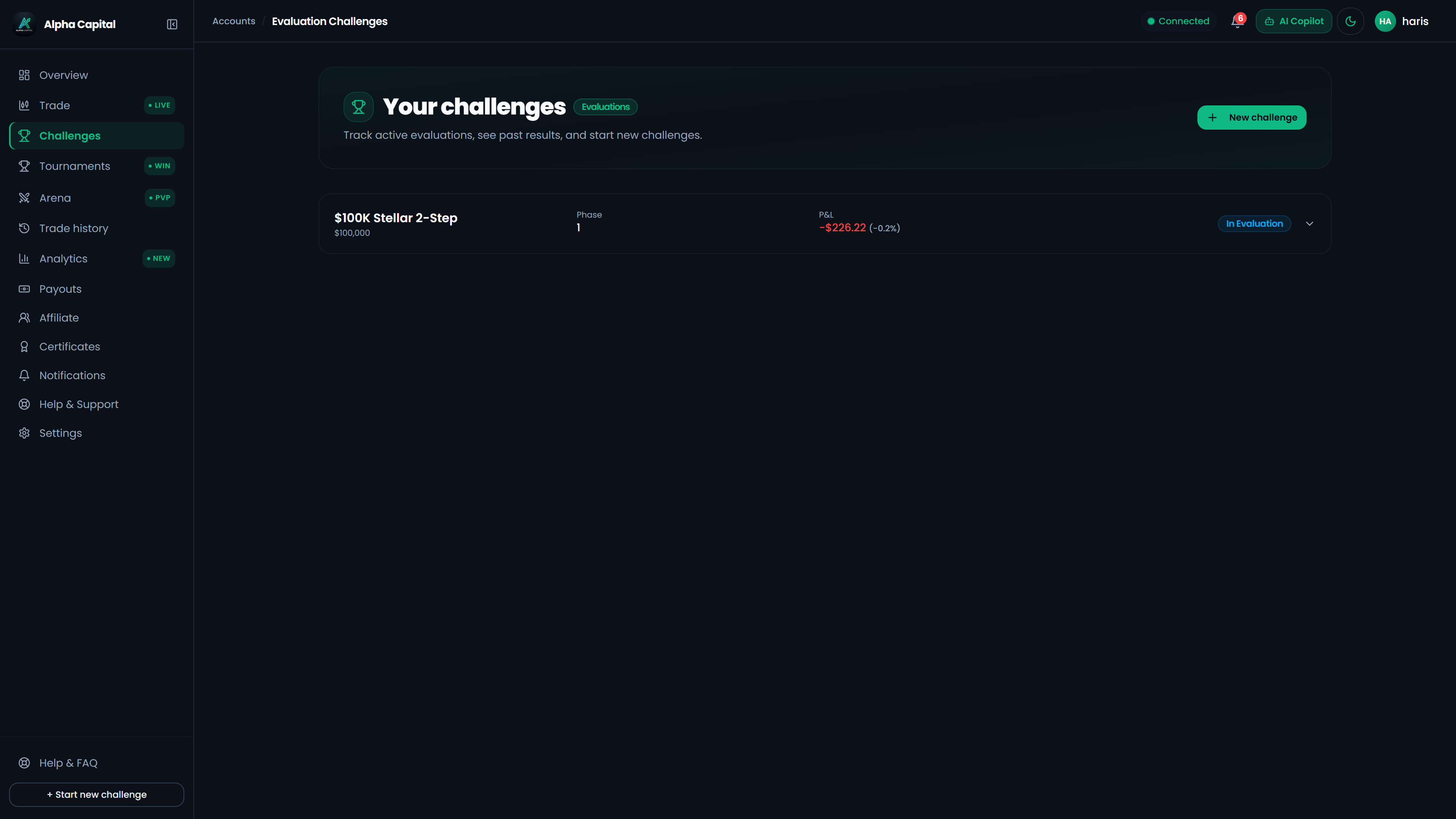
The admin panel monitors every active challenge in real time. You see every trader, their current P&L, how close they are to their profit target, how close they are to their drawdown limit. You can manually pass or fail a challenge or investigate a specific account before processing.
See the challenge configuration panel in the live demo. The platform is $2,495 one time. See what is included.
Common Configuration Mistakes
Setting daily loss limits that are too tight relative to the instruments offered. A 2% daily loss limit on a $10,000 account with XAUUSD access means a 20-pip move on 0.5 lots can trigger a breach. Traders get frustrated.
They dispute. Support volume increases. Keep the daily loss limit at 4 to 5% minimum if you offer gold or indices.
Not specifying whether the drawdown is calculated from the initial balance or from the trailing peak. This is the number one source of trader complaints. State it explicitly in your challenge rules with a worked example.
Offering too many plan variations at launch. Three plans maximum when you start. Standard two-phase at $10K, $25K, and $100K. Add variations once you know what traders actually want.
Operator Tip: The two-phase challenge is not one-size-fits-all. Track which plan sizes sell best in your first 30 days and which have the highest rebuy rate after failure. The highest rebuy rate tells you which plans have the right difficulty balance: hard enough that most fail, easy enough that failure feels overcomeable.
FAQ
What is the standard two-phase challenge structure?
Phase 1 requires traders to hit an 8% profit target without breaching a 10% max drawdown or 5% daily loss limit, within 30 days minimum. Phase 2 repeats with a 5% profit target in 60 days. Traders who pass both phases receive a funded account. Every parameter is adjustable by the operator.
What is the typical pass rate for prop firm challenges?
Industry-wide, the combined pass rate across both phases is 5 to 10%. This means 90 to 95% of traders pay the fee and do not receive a funded account. Challenge fee revenue from failed and repeating traders is the primary income model for most prop firms.
What is the difference between max drawdown and trailing drawdown?
Max drawdown is calculated from the initial balance and stays fixed: 10% on a $100K account means the close level is always $90,000. Trailing drawdown follows the account's highest peak upward, making the close level move higher as the trader earns profits. Trailing drawdown is more protective for operators but harder for traders to track.
How do operators set challenge prices?
Benchmark against current competitors. $89 to $99 for a $10,000 account is standard in mid-2026. Go lower only if you have a specific reason. Go higher only if you offer something differentiated: larger profit splits, no time limits, scaling plans. Price matching competitors and differentiating on service quality is the standard entry approach.
What is the consistency rule and should operators use it?
The consistency rule requires no single trading day to account for more than a percentage of total profits, typically 30 to 50%. It prevents traders from gaming challenges with single large wins. About 40% of operators use it. If you implement one, include a worked numeric example in your challenge terms or expect support requests.
How do funded accounts work after a trader passes?
Funded traders receive a live account. They trade on live pricing with real spread and execution. Profit splits are paid on the operator's schedule, typically every 14 to 30 days. The operator sets the max drawdown for funded accounts, typically matching the evaluation phase limits. Breach of drawdown on a funded account closes the account.
Can I offer one-phase challenges instead of two-phase?
Yes. One-phase challenges are one evaluation period with a single profit target, typically 10%, at a higher fee than a two-phase plan. They convert at slightly lower rates because of the higher price, but they attract more serious traders. Most operators who offer one-phase plans do so alongside their standard two-phase plans, not as a replacement.
Evaluate Your Prop Firm Readiness Score (0-100)
Answer 5 quick operational questions about your acquisition channels, runway, and engine tech to get a personalized launch roadmap.
Prop Firm Monthly Profit Simulator
Simulate your challenge revenue, payout liability, and net monthly take-home profit.
$20,000
From upfront challenge fees-$2,800
~10 funded payouts budgeted$0 / month
Saves $3,000/mo vs SaaS$17,200/mo
Run-rate: $206,400/yr
M.Haris
Founder & Platform ArchitectBuilding open prop trading software infrastructure for operators worldwide
I built LaunchPropFirm to give forex educators, trading communities, and fintech operators complete ownership of their platform with full source code and zero monthly SaaS rent. Every article on this blog is drawn from hands-on platform development, live MT5 risk bridge mechanics, and real operator economics.
All content, financial models, ROI estimates, and architecture guides on LaunchPropFirm are published strictly for educational and informational purposes. LaunchPropFirm provides institutional prop trading software and technology infrastructure; it does not operate as a broker, custodian, or registered investment advisor.
Evaluation challenges and funded trader accounts referenced in this guide operate in simulated demo trading environments using real-time market data feeds. Simulated trading results do not represent actual trading performance or financial advice.
Recommended Next Reads
Hand-picked operator guides to scale your prop trading platform.
TradingView Prop Firms (2026): Best Web Terminals
Complete 2026 guide to TradingView prop firms. Compare top firms offering browser TradingView charts, execution latency, and funded account rules.
Funding Pips Account Sizes and Prices 2026: Evaluation Tiers, Rules, and Scaling Plan
Complete 2026 Funding Pips account sizes and prices guide. Compare challenge fees ($5k to $100k), 2-step evaluation rules, drawdown limits, and the $2M scaling plan.
Skip the monthly fees
Own your prop firm platform outright. One time purchase.
Full source code. Live in 7 days. No revenue share. No monthly SaaS bill. See the exact platform before paying anything.
Demo login: haris / asdf1122. No signup needed