Prop Firm Funded Trader Program: 2026 Rules, Pricing & Setup
How to structure, price, and launch a profitable funded trader program in 2026. Real profit split economics, drawdown rules, and automated risk engine setup.
What a Funded Trader Program Actually Is
A funded trader program is the structured evaluation system that sits at the heart of every prop firm.
When I designed the program for LaunchPropFirm, I spent more time on this than any other part of the business. The challenge structure determines your revenue, your payout exposure, and whether traders recommend you or warn people away.
The Core Structure
Every funded trader program has the same fundamental shape.
Phase 1 evaluates whether the trader can hit a profit target under loss constraints. Phase 2 confirms that Phase 1 performance was not a fluke. After passing both, the trader gets a funded account with real profit splits.
Standard parameters that traders recognize and expect:
Phase 1: 8% profit target, 10% max drawdown, 5% daily loss limit, 30 days
Phase 2: 5% profit target, 10% max drawdown, 5% daily loss limit, 60 days
Funded: 80% profit split, same drawdown rules
Starting within these parameters is sensible. Traders know what they are buying. Deviation from the standard requires clear explanation.
How to Price Your Challenges
Challenge pricing is a balance between accessible entry and sustainable margins.
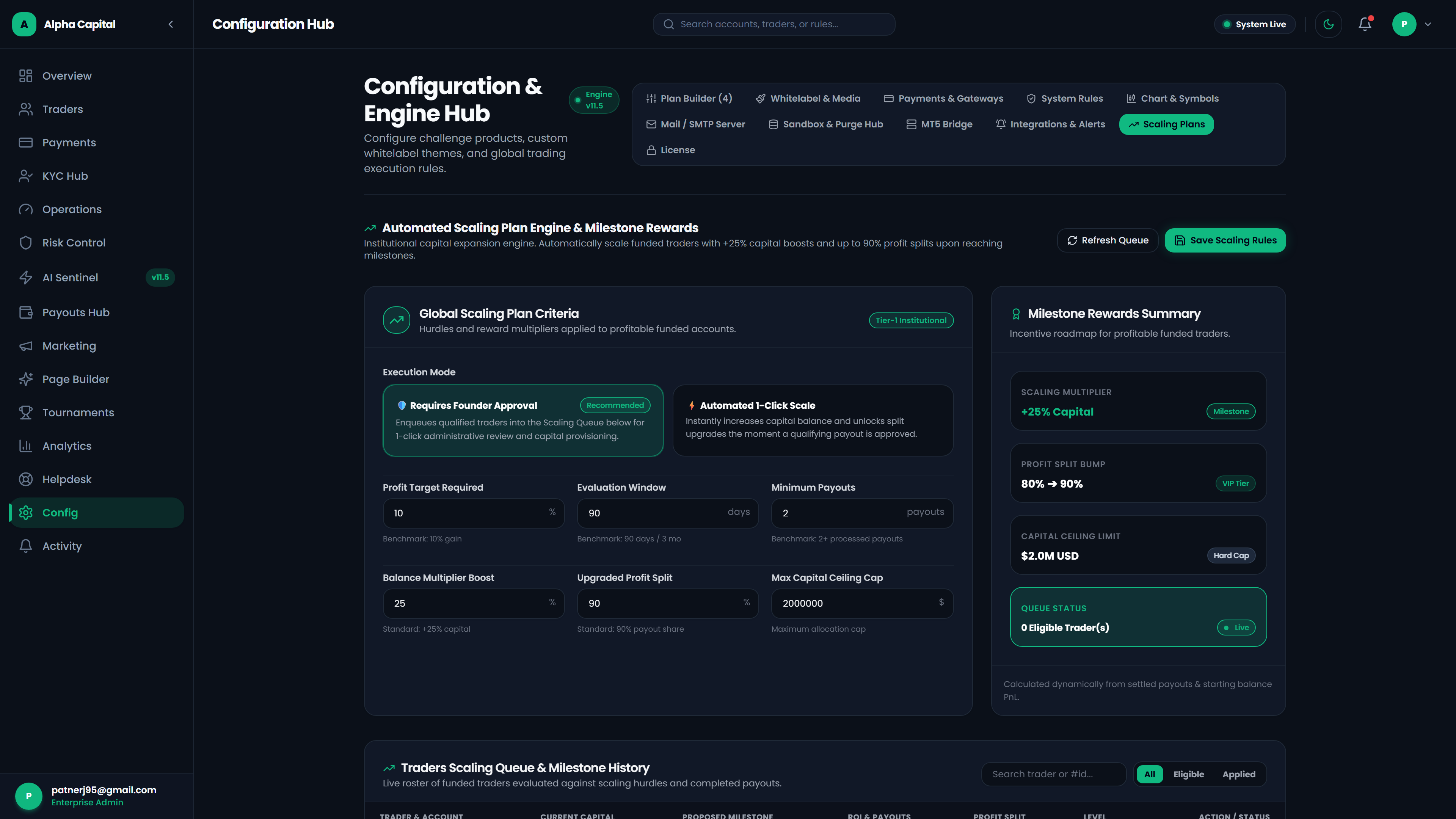
Real-time trader management portal tracking account phases, credentials, and trader performance across all active challenges.
Industry pricing in 2026 by account size:
$10,000 account: $99 to $149
$25,000 account: $179 to $249
$50,000 account: $279 to $349
$100,000 account: $449 to $649
$200,000 account: $899 to $1,199
Launch at the lower end of these ranges. You need volume and social proof more than you need margin in the first 60 days.
At $199 for a $25,000 challenge with a 5 to 10% pass rate, 90 to 95 traders fund your payout reserve for every 5 to 10 who reach funded status. The math works at almost any reasonable pricing level.
Skip the monthly fees
Own your prop firm platform outright. One time purchase.
Full source code. Live in 7 days. No revenue share. No monthly SaaS bill. See the exact platform before paying anything.
Demo login: haris / asdf1122. No signup needed
The Rebuy Structure
The rebuy is one of the most overlooked revenue elements in a funded trader program.
When a trader fails Phase 1 or Phase 2, they can buy the challenge again at full price. Rebuy rates of 30 to 50% are common, particularly from traders who failed late in Phase 2.
Make the rebuy frictionless. One click from the breach notification back to the checkout page. Do not make traders navigate back to your pricing page.
Some firms offer a 10 to 15% rebuy discount for returning traders. This increases rebuy rate and creates goodwill. The math still works at a 15% discount when 30% of failed traders rebuy.
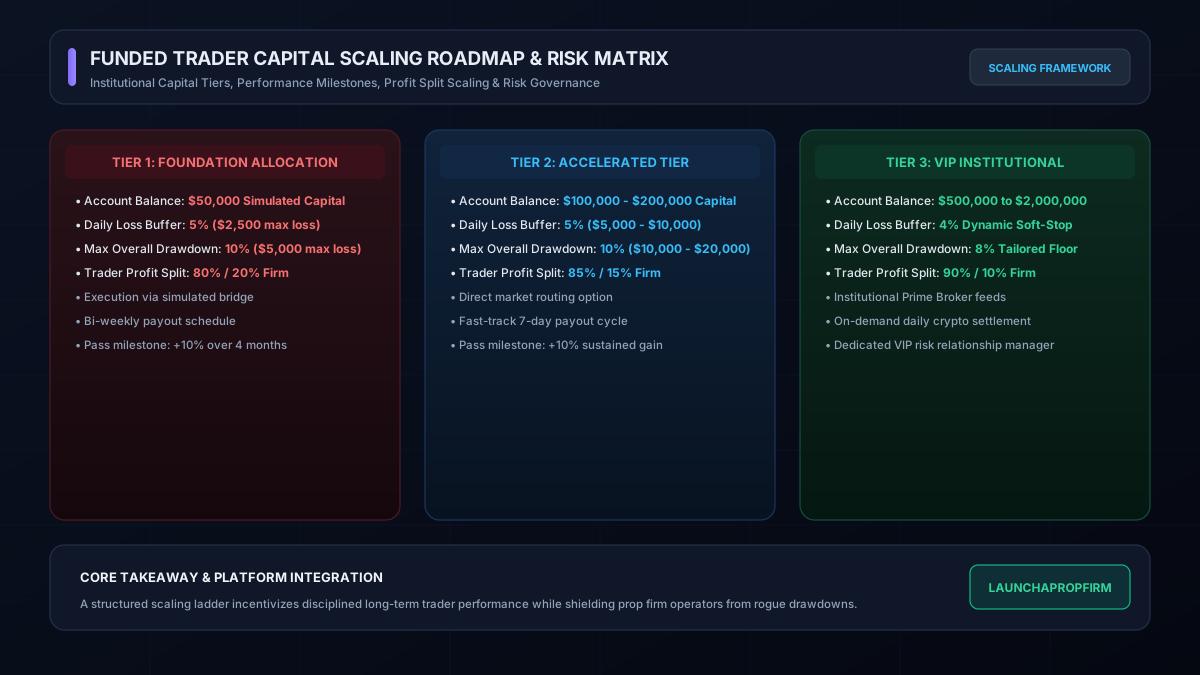
The Scaling Structure
After a trader gets funded and performs consistently, give them a path to scale their account.
Standard structure: a funded trader who achieves X% profit over Y months qualifies for a larger funded account. The new account is funded by the firm at no additional cost to the trader.
This is a retention tool. A trader who knows they can scale to $200,000 stays with your firm instead of looking for a new challenge somewhere else.
It is also a marketing tool. Scaling certificates and announcements drive social proof.
Setting Up Your Payout Reserve
The payout reserve is not optional. I set mine up before taking the first challenge fee.
Take 25 to 30% of every challenge fee received and move it to a separate account immediately. Do not touch it. This is the fund that pays out funded traders when they earn profits.
At small scale, the reserve feels unnecessarily large. By month 3, when funded traders start requesting payouts, you will understand exactly why it matters.
The firms that stopped paying traders almost universally made the same mistake: they treated challenge fee revenue as profit before accounting for payout liability.
Launch Sequence
Day 1: platform installed, payments connected, challenge rules set.
Day 2: branding applied, domain live, test purchases done.
Day 3: announce to your network.
Day 7 to 30: first traders in Phase 1. Gather feedback. Watch breach points.
Day 30 to 60: first Phase 1 completions. Second wave from social proof.
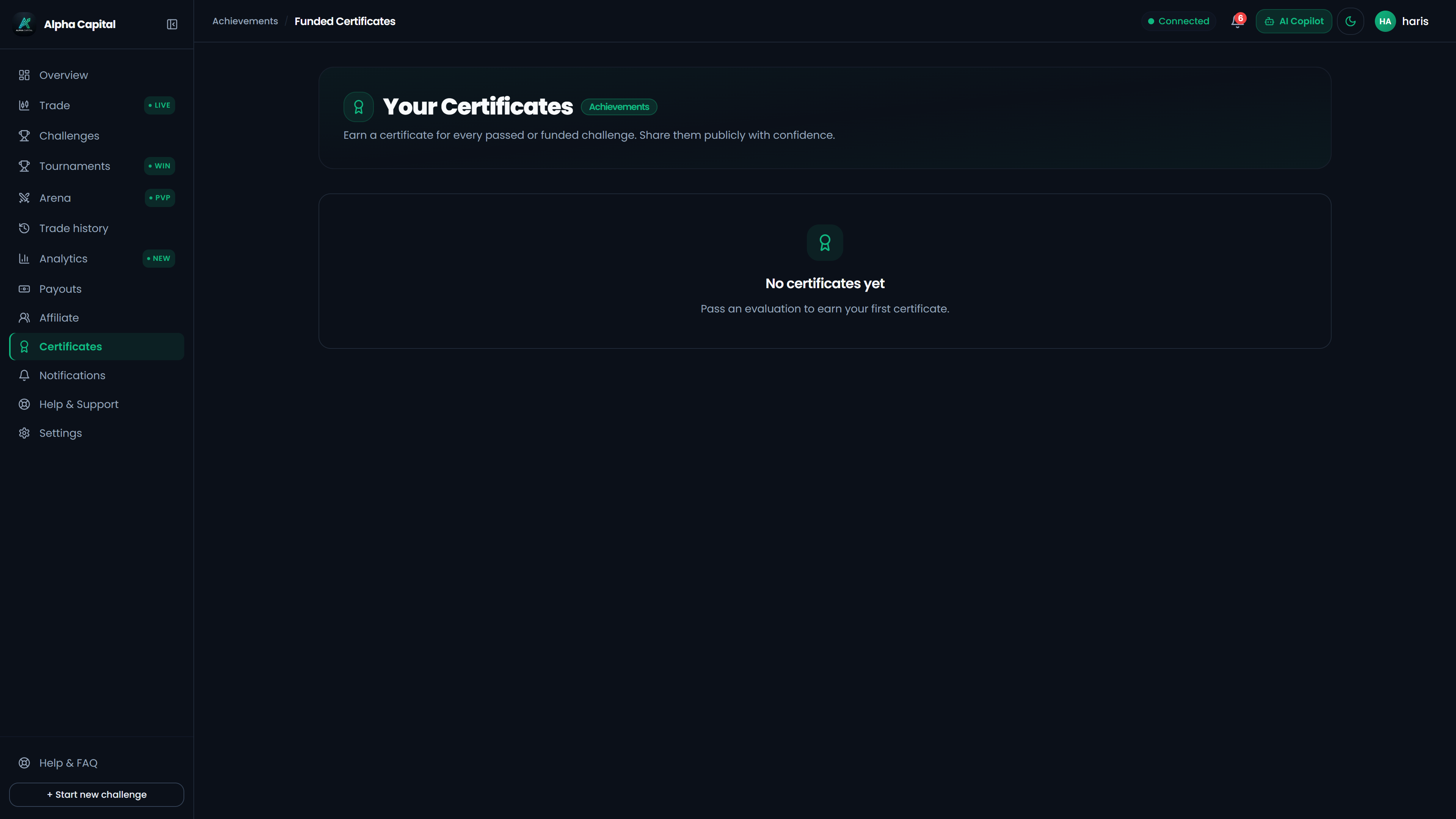
Day 60 to 90: first funded accounts, first payouts, first certificates shared.
The first 90 days are about proof of concept and social proof accumulation. Revenue is secondary to trust-building.
See the full platform setup process
Operator Tip: Your funded trader program is not just an operational function. It is a marketing asset. Every funded trader who receives a payout and posts about it is an advertisement for your firm. Design the funded trader experience, from the certificate to the payout notification, to be something traders genuinely want to share.
Frequently Asked Questions
How should operators structure their funded trader program?
Define the profit split percentage (typically 80% to trader), the payout schedule (bi-weekly is standard), the funded account drawdown limit (often tighter than the challenge drawdown), and the maximum account size. Publish all of these clearly before traders purchase a challenge.
What profit split percentage is competitive in 2026?
80% to the trader is the baseline across most funded evaluation firms. Some firms offer 90% to differentiate. Offering above 80% at launch is viable if challenge fees are priced to cover the higher payout ratio. Lower splits below 75% are competitively difficult to justify.
How do you scale funded accounts for consistently profitable traders?
Define a scaling plan upfront. A common structure: start at the challenge account size, scale to double after 3 consecutive profitable months, scale again at 6 months. Publish the scaling criteria before traders join. Traders who see a path to $500,000 funded accounts stay engaged longer.
What KYC documentation should funded traders provide before their first payout?
Government-issued photo ID and proof of address (utility bill or bank statement) are the standard minimum. Some operators also require a selfie with the ID document. KYC protects against fraud and is required by most payment processors for payouts above threshold amounts.
How do you handle a funded trader who requests a payout during an open drawdown period?
Payouts are processed during the payout window, not on demand. Traders with open positions are typically required to close them or reach the payout date with the account above the drawdown floor. Automate the payout eligibility check in your platform so the process is consistent across all funded traders.
Model Challenge Pricing & 3.0x Payout Reserves
Calculate break-even challenge fees across $10k-$200k tiers and simulate pass-rate payout liabilities to prevent firm insolvency.
Prop Firm Monthly Profit Simulator
Simulate your challenge revenue, payout liability, and net monthly take-home profit.
$20,000
From upfront challenge fees-$2,800
~10 funded payouts budgeted$0 / month
Saves $3,000/mo vs SaaS$17,200/mo
Run-rate: $206,400/yr
M.Haris
Founder & Platform ArchitectBuilding open prop trading software infrastructure for operators worldwide
I built LaunchPropFirm to give forex educators, trading communities, and fintech operators complete ownership of their platform with full source code and zero monthly SaaS rent. Every article on this blog is drawn from hands-on platform development, live MT5 risk bridge mechanics, and real operator economics.
All content, financial models, ROI estimates, and architecture guides on LaunchPropFirm are published strictly for educational and informational purposes. LaunchPropFirm provides institutional prop trading software and technology infrastructure; it does not operate as a broker, custodian, or registered investment advisor.
Evaluation challenges and funded trader accounts referenced in this guide operate in simulated demo trading environments using real-time market data feeds. Simulated trading results do not represent actual trading performance or financial advice.
Recommended Next Reads
Hand-picked operator guides to scale your prop trading platform.
Instant Funding Prop Firm: Launch in 7 Days
Instant funding prop firms skip the challenge phase. Here is how to launch the model, protect your capital with hard risk limits, and go live in 7 days.
What Is a Prop Firm? Beginner's Guide & Overview
What is a proprietary trading firm? A beginner's guide explaining funded accounts, evaluation models, profit splits, and how retail prop firms operate in 2026.
Skip the monthly fees
Own your prop firm platform outright. One time purchase.
Full source code. Live in 7 days. No revenue share. No monthly SaaS bill. See the exact platform before paying anything.
Demo login: haris / asdf1122. No signup needed