Prop Firm Scaling Plan: How to Set It Up
A scaling plan lets funded traders grow their account after hitting targets. Here is how to structure one for your prop firm and what terms to offer traders.
What a Prop Firm Scaling Plan Actually Is
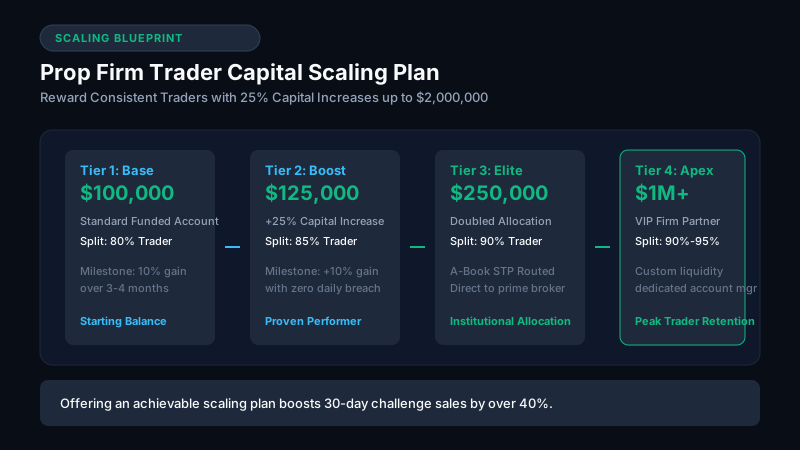
A scaling plan is a structured rule that lets funded traders increase their account size after hitting defined profit targets. If a trader starts on a $50,000 funded account and earns 10% profit over 3 months, the scaling plan might bump them to $75,000 on the next cycle.
From the trader's side, it is a retention hook: a reason to stay at your firm instead of rebilling at a competitor. From the operator's side, it is a way to reward traders who are consistently profitable without handing out larger allocations indiscriminately.
Why Operators Offer Scaling Plans
Scaling plans appeared as a marketing differentiator around 2022 when larger firms like The5ers and E8 Funding started advertising "up to $4M funded" accounts as the endpoint of their growth tracks.
The actual risk to the operator is often lower than it appears. Most prop firms use simulated trading environments with virtual capital. Scaling a trader from $50k to $100k does not double your real-money exposure. It doubles the virtual account limit within a risk system that is already managing the downside.
The business case for a scaling plan: traders who believe they are building toward something stay subscribed longer, buy more challenges, and refer other traders. Churn from your funded pool drops when traders have a visible growth path.
How to Structure a Scaling Plan
There are two common structures operators use.
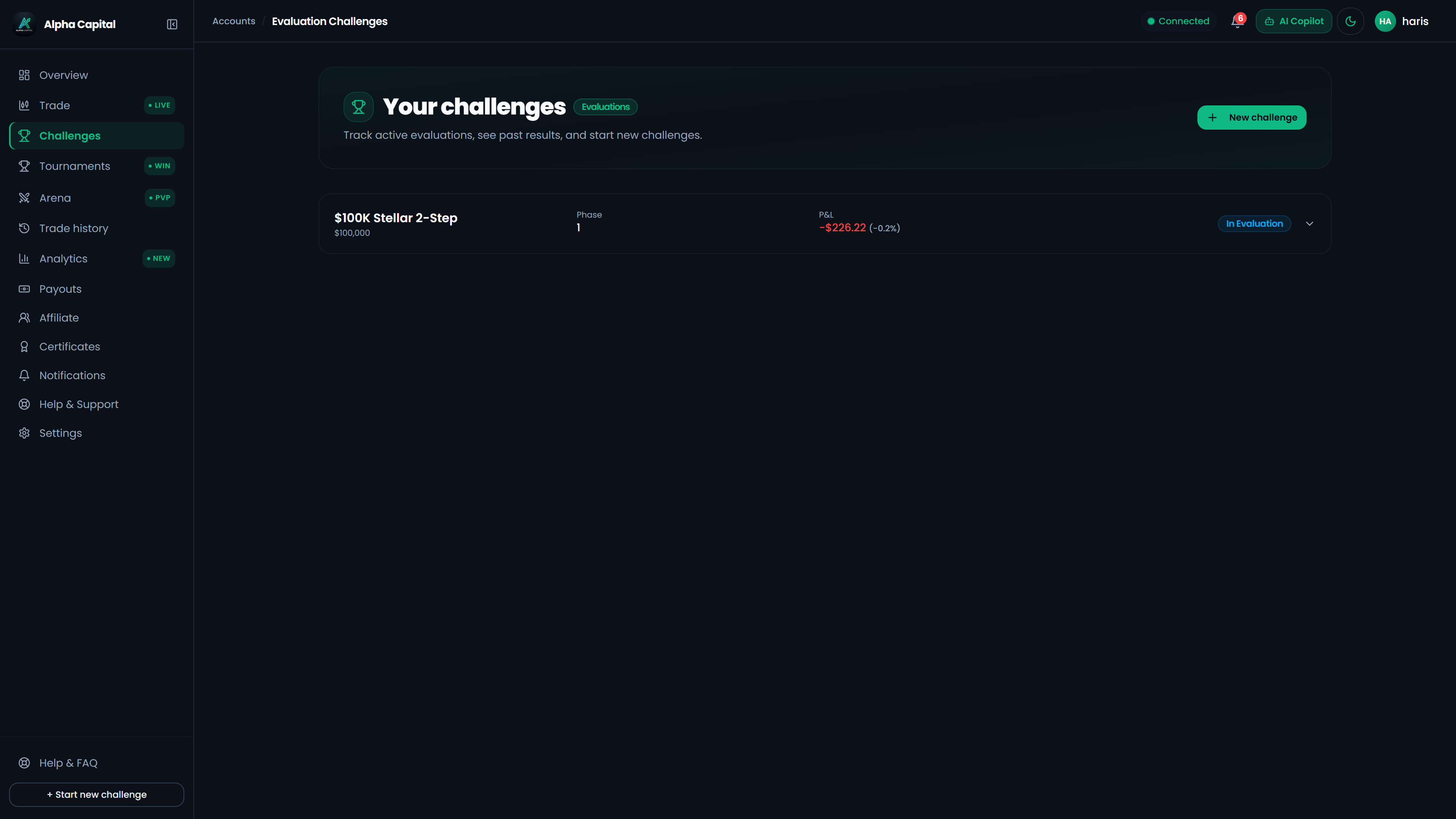
White-label trader dashboard displaying real-time evaluation metrics, equity curves, and active challenge milestones.
Percentage-based scaling. After a trader hits X% profit over Y months, their account size increases by Z%. The5ers uses roughly this model: consistent 6% gains over quarterly review periods trigger account size bumps.
Fixed-step scaling. The account increases by a fixed amount at each milestone regardless of percentage. A trader moves from $25k to $50k to $100k to $200k as they hit each step, with required monthly profit minimums at each level.
Most operators start with fixed-step because it is easier to explain in marketing ("you can grow to $200k") and easier to enforce operationally.
| Structure | Complexity | Marketing Clarity | Operator Risk |
|---|---|---|---|
| Percentage-based | High | Medium | Lower (scales with performance) |
| Fixed-step | Low | High | Low (fixed milestones) |
| Hybrid (both) | High | Medium | Low |
| None (no scaling) | None | N/A | None |
Skip the monthly fees
Own your prop firm platform outright. One time purchase.
Full source code. Live in 7 days. No revenue share. No monthly SaaS bill. See the exact platform before paying anything.
Demo login: haris / asdf1122. No signup needed
Scaling Plan Terms to Set
When you configure a scaling plan, you need to define four things.
Trigger metric. What percentage profit must the trader earn to qualify? Common range is 8-12% over a defined period (monthly or quarterly). Too low and you are scaling unprofitable traders; too high and nobody reaches it.
Review period. How long does the trader need to hold the metric? One month is standard for smaller accounts. Quarterly reviews are used for larger accounts above $100k.
Scale amount. How much does the account grow? Most firms increase by 25-50% per milestone. Going from $50k to $100k in one step is aggressive; $50k to $62.5k (25% increase) is more conservative.
Maximum size. Set a ceiling. Advertising "up to $4M funded" sounds impressive but your risk and operations team need to handle the case where a trader actually gets there. Most operators cap at $400k-$500k for practical reasons.
Competitor Scaling Plans in 2026
Understanding what the market offers helps you position yours.
The5ers: Starts at $100k, scales to $4M over many growth steps. Each step requires consistent profitability over a set review period. Their headline "$4M funded trader" is a major part of their marketing.
E8 Funding: Offers a scaling plan tied to quarterly profit targets. Account sizes go from $25k to $300k. They require no losing months in the review period, which filters for consistent performers.
Topstep: Uses a performance-based model where scaling is less formulaic. Trader accounts can increase based on review by the risk team rather than automatic triggers.
FTMO: Does not offer a traditional scaling plan on their standard challenge model. Scaling at FTMO happens through applying for new, larger challenges.
If you want to compete with The5ers and E8 Funding on marketing, you need a defined scaling plan with a clear maximum number you can advertise.
How LaunchPropFirm Handles Scaling
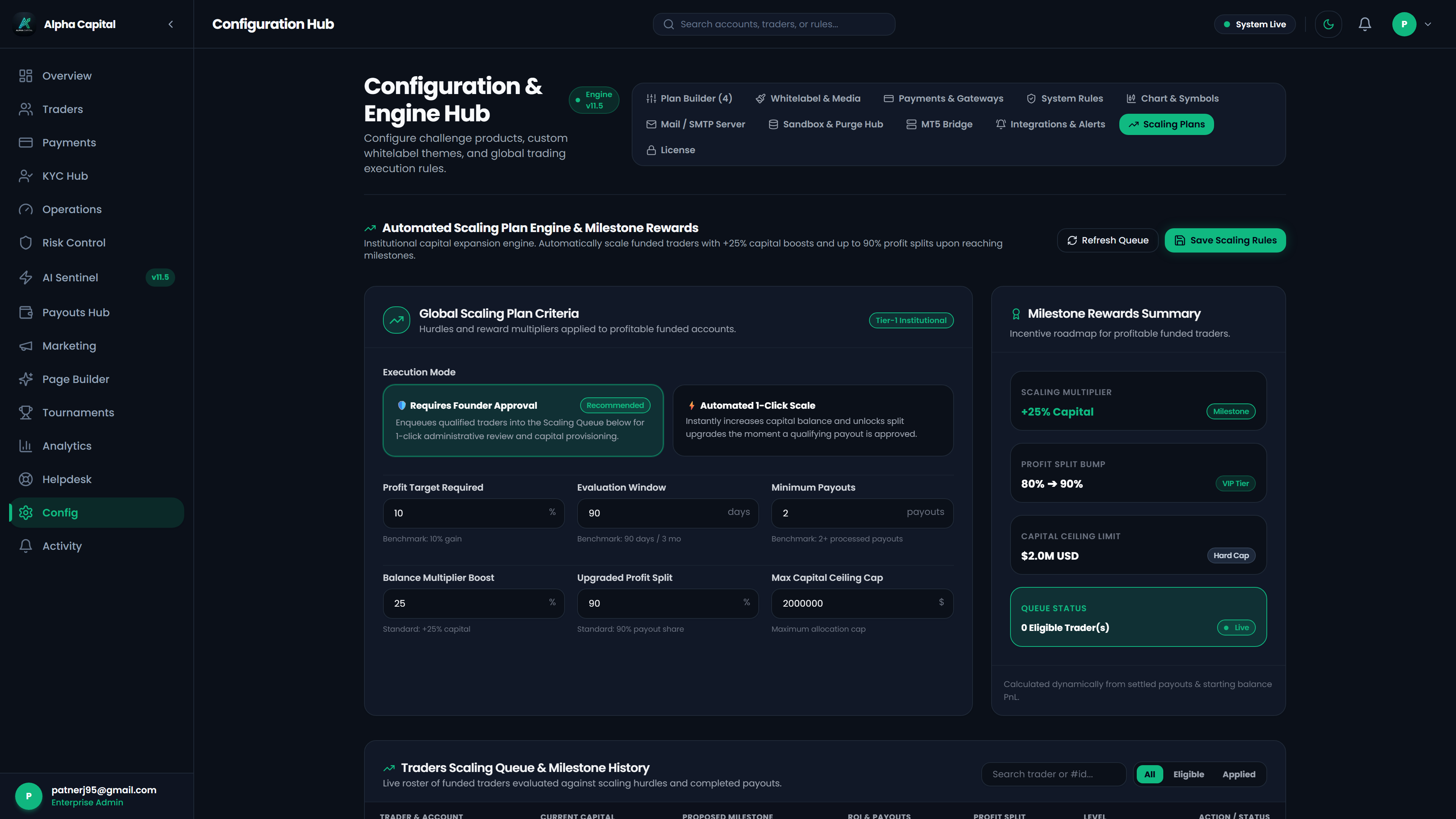
LaunchPropFirm's platform includes account scaling configuration in the operator dashboard. You set the trigger profit percentage, review period, scale increment, and maximum account size once. The system applies it automatically when traders qualify.
Traders see their current level, their progress toward the next level, and the account size they are working toward, all from within their trader dashboard. This creates the retention behavior you want without manual review work on your end.
The scaling module is included in the Launch Ready plan ($4,500 one-time) and Source Code plan ($2,500 one-time). See it in action at demo.launchapropfirm.com.
Related reading: Prop Firm Challenge Rules Explained: Profit Targets, Drawdown, and Pass Rates
Operator Tip: Publish your scaling plan terms publicly on your website with a clear "maximum account size" headline. The number becomes your most effective marketing hook and filters for traders who are serious about growth.
FAQ
Do I need a scaling plan to launch a prop firm?
No. Many successful prop firms have no scaling plan. It is a marketing and retention feature, not a requirement. Add one once your core operations are stable and you have traders to retain.
Does a scaling plan mean I give traders more real money?
In most prop firm models, no. You are increasing the virtual account limit within your simulated environment. The trader trades a larger notional size on paper; your actual capital exposure depends on how your risk system is configured and whether you hedge on the back end.
What is the most common scaling trigger?
10% profit over one calendar month is the most common trigger for accounts under $100k. For larger accounts, quarterly reviews with an 8-10% profit target are standard.
Can traders game a scaling plan?
Yes, and some will try. Common gaming patterns include high-risk trading at end of review period to hit the trigger, then reverting to normal behavior. Requiring consistency across the entire period (not just hitting a number at month end) prevents this.
Should I advertise my maximum funded account size?
Yes, if it is a legitimate ceiling you can actually deliver. "Up to $500k funded" is a strong marketing claim that drives challenge purchases from traders who are thinking long-term. Make sure your operations can actually service accounts at that size before advertising it.
Model Your Firm's Monthly Cash Flow & Profit
Simulate challenger intake, pass rate payout reserves, and net operator margins with our free real-time economic calculator.
Prop Firm Monthly Profit Simulator
Simulate your challenge revenue, payout liability, and net monthly take-home profit.
$20,000
From upfront challenge fees-$2,800
~10 funded payouts budgeted$0 / month
Saves $3,000/mo vs SaaS$17,200/mo
Run-rate: $206,400/yr
M.Haris
Founder & Platform ArchitectBuilding open prop trading software infrastructure for operators worldwide
I built LaunchPropFirm to give forex educators, trading communities, and fintech operators complete ownership of their platform with full source code and zero monthly SaaS rent. Every article on this blog is drawn from hands-on platform development, live MT5 risk bridge mechanics, and real operator economics.
All content, financial models, ROI estimates, and architecture guides on LaunchPropFirm are published strictly for educational and informational purposes. LaunchPropFirm provides institutional prop trading software and technology infrastructure; it does not operate as a broker, custodian, or registered investment advisor.
Evaluation challenges and funded trader accounts referenced in this guide operate in simulated demo trading environments using real-time market data feeds. Simulated trading results do not represent actual trading performance or financial advice.
Recommended Next Reads
Hand-picked operator guides to scale your prop trading platform.
Wise Prop Firms: Payouts, Risks and Rails
Explore why direct Wise prop firms payouts trigger account freezes, how Rise compliance bridges protect funds, and why multi-rail payouts guarantee cash flow.
Prop Firm Capital: Requirements, Reserve Buffers and Risk Architecture
Unpack the financial reality of prop firm capital: synthetic exposure vs liquid reserves, challenge fee pool economics, A-Book STP hedging, and exact startup blueprints.
Skip the monthly fees
Own your prop firm platform outright. One time purchase.
Full source code. Live in 7 days. No revenue share. No monthly SaaS bill. See the exact platform before paying anything.
Demo login: haris / asdf1122. No signup needed