Why Prop Firm Software Is So Expensive
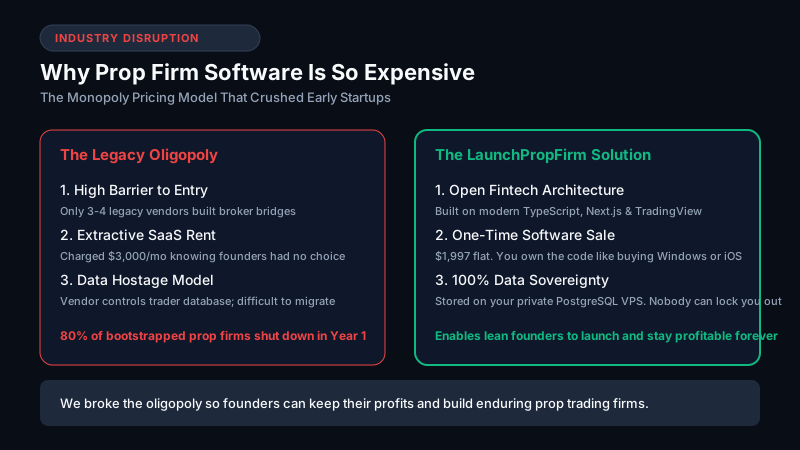
Prop firm software costs $1,000 to $5,000 per month. Here is why it is priced this way, what each fee covers, and how to get the same platform for one price.
The Pricing That Stops Most People
This was the first thing I noticed when I started researching the industry. Everyone was charging monthly, and the numbers were hard to justify for someone just starting out.
You research prop firm platforms. You find something that looks right. Then you see the pricing.
$2,500 per month. $3,000 per month. $5,000 per month.
Before deciding that is too much, it helps to understand why the pricing is what it is. and whether there is a different model that avoids it entirely.
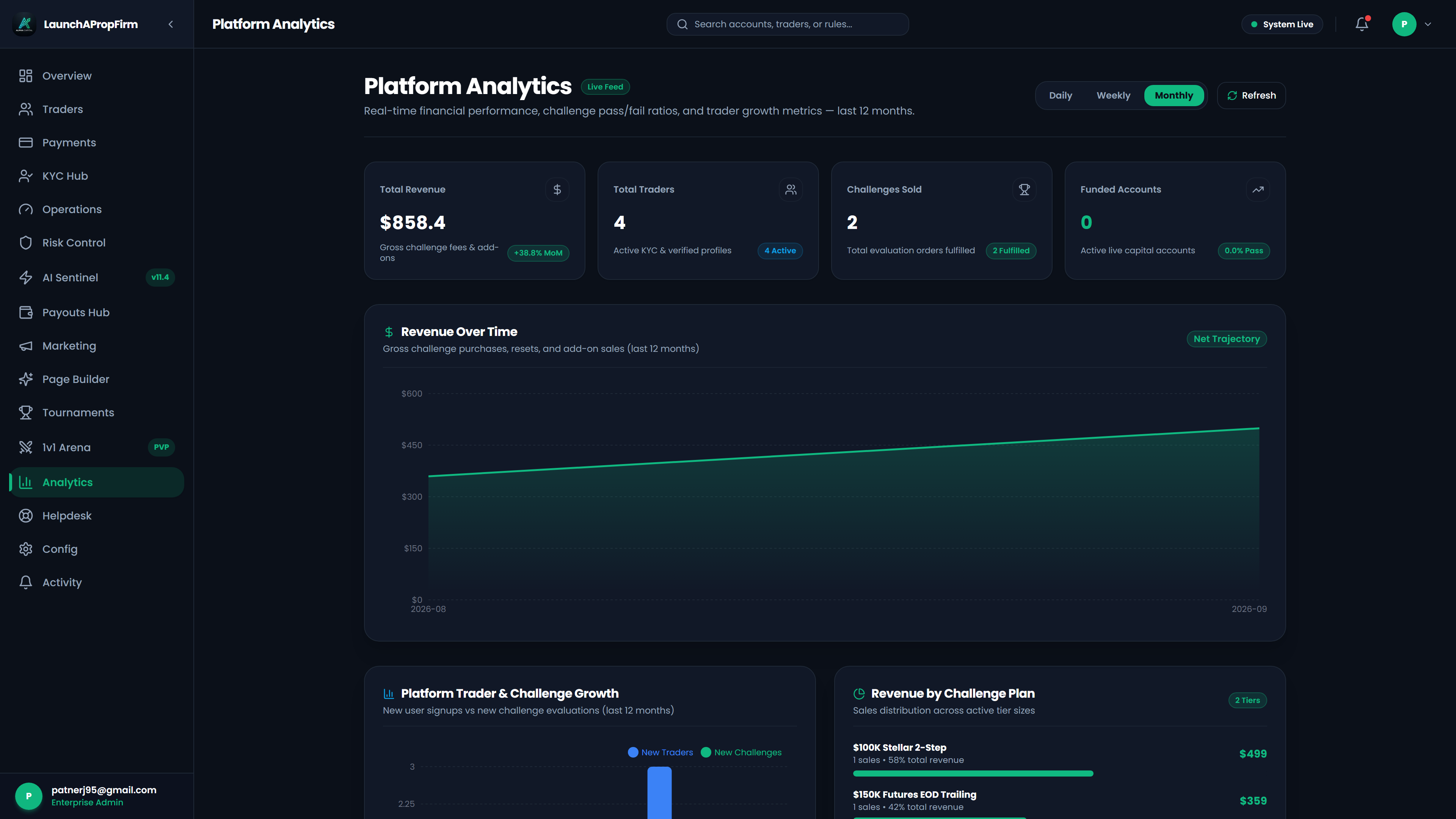
See the platform before reading further
Why Monthly SaaS Prop Firm Software Is Expensive
Development cost recovery: building this from scratch costs $150,000 to $500,000. SaaS vendors recover that across their customer base. A vendor with 50 clients at $2,000 per month generates $100,000 monthly. covering development, support, servers, and profit.
Ongoing infrastructure: reliable servers, live market data feeds, automated risk monitoring, 24-hour uptime. These are real costs.
Support and updates: bug fixes, new features, customer support. All bundled into the monthly fee.
Market positioning: high prices filter out uncommitted operators. Vendors prefer serious clients over people testing an idea for 60 days.
What You Are Actually Getting For $2,500 Per Month
At the mid tier price point you get access to a functioning platform. not ownership. Challenge system, trading terminal, admin panel, payout management, hosting on their servers, software updates, limited support hours.
What you do not get: source code, ability to modify anything, or any asset to show for the money if you stop paying.
Skip the monthly fees
Own your prop firm platform outright. One time purchase.
Full source code. Live in 7 days. No revenue share. No monthly SaaS bill. See the exact platform before paying anything.
Demo login: haris / asdf1122. No signup needed
The Problem With This Model at Small Scale
A new prop firm doing 30 challenge sales per month at $199 generates $5,970 in revenue.
A platform fee of $2,500 per month consumes 42% of that revenue before you pay out a single funded trader or spend a dollar on marketing.
At that ratio, the business cannot build momentum. The platform fee extracts too much margin from early-stage revenue.
The One Time License Alternative
Some platforms charge once and own nothing ongoing beyond hosting.
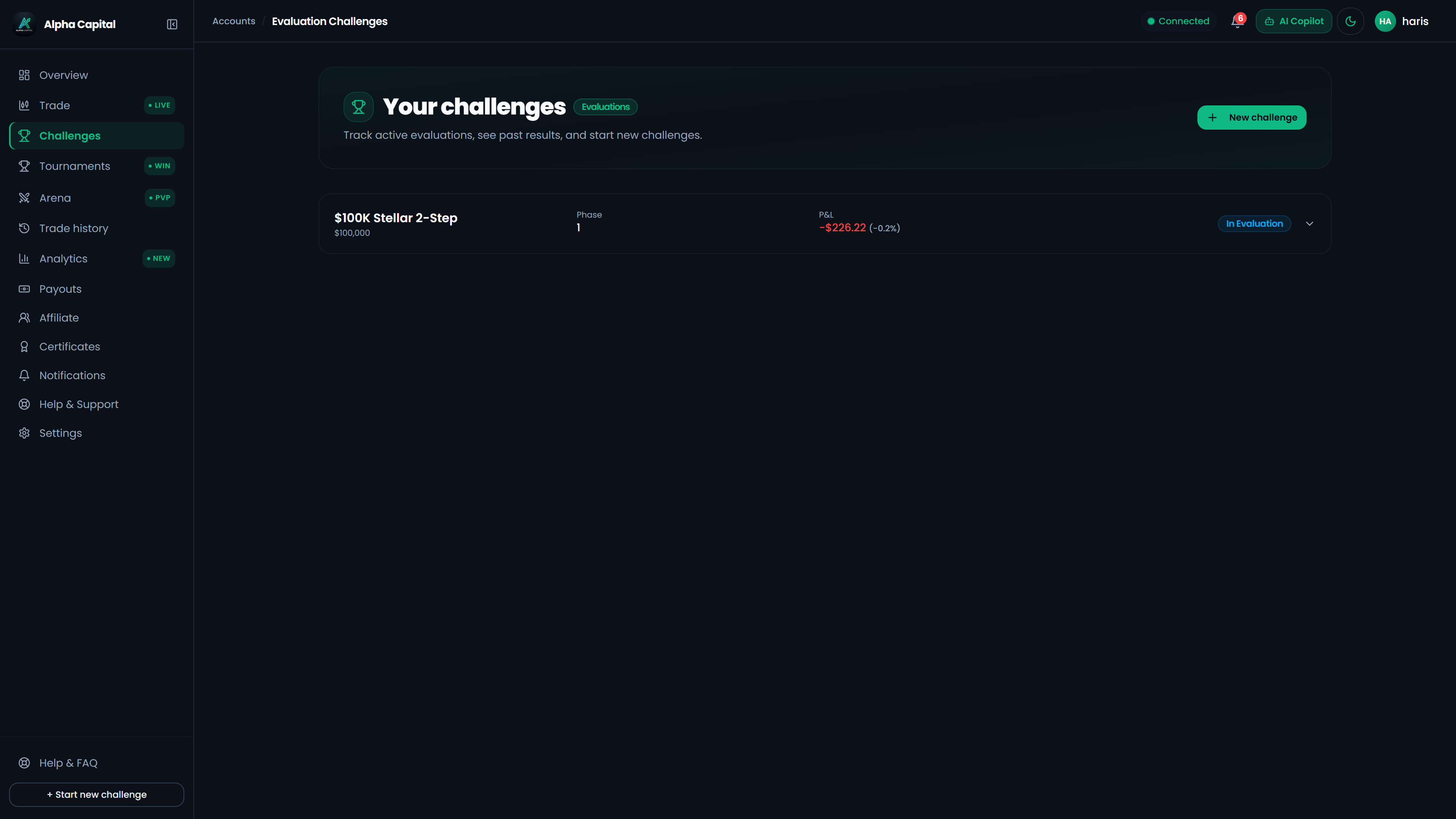
White-label trader dashboard displaying real-time evaluation metrics, equity curves, and active challenge milestones.
You pay $2,495 to $7,400 for the platform license. You receive the source code. You host it yourself on a $15 to $20 VPS. You pay $30 to $50 per month for an MT5 price feed.
Total ongoing cost after the license: under $70 per month.
At 30 challenge sales per month at $199 generating $5,970:
Monthly SaaS at $2,500: You keep $3,470 before payouts. Platform takes 42%.
One time license at $70/month: You keep $5,900 before payouts. Infrastructure takes 1.2%.
The difference compounds significantly over 12 months.
Is Expensive Software Worth It at Scale?
At significant enterprise scale—with 1,000+ active concurrent challengers and 200+ funded accounts—high-cost infrastructure offers dedicated server clustering and tier-3 support teams. However, for a bootstrap firm, that level of capacity is unnecessary overhead. Paying $3,000/month upfront means paying for capacity you cannot yet monetize.
The financially sound path is to start with a self-hosted one-time license, eliminate ongoing software debt, and deploy your savings directly into paid trader acquisition, prize tournaments, and payout reserve funds.
4 Hidden Costs in Legacy Turnkey SaaS Contracts
When evaluating turnkey prop firm software, the headline monthly subscription is rarely your only software expense. Operators frequently discover hidden line items after signing 12-month commitments:
- Per-Account Creation Taxes: Many vendors charge between $1.50 and $4.00 every time a trader registers for a challenge, regardless of whether the trader passes or fails on Day 1.
- Mandatory Liquidity & Brokerage Markups: SaaS vendors often force firms to route demo and live flow through partnered white-label brokers, charging inflated B-Book volume fees (often $2.00 to $4.50 per standard lot).
- Setup and Customization Retainers: Basic CSS skinning is often included, but connecting custom CRM webhooks, local payout rails, or unique tournament brackets frequently requires professional service fees ranging from $2,500 to $10,000.
- Proprietary Data Lock-in: The most dangerous hidden cost is data hostage clauses. If you decide to cancel your subscription, legacy SaaS vendors rarely provide full SQL dumps of trader accounts, KYC verification records, and transaction logs, forcing operators to rebuild their database from scratch.
12-Month Economics: SaaS Rental vs One-Time Self-Hosted License
The following table contrasts the 12-month balance sheet of a mid-sized prop firm averaging 150 challenge sales per month ($199 average fee, generating $29,850/mo in gross revenue):
| Cost Category | Legacy SaaS Provider ($3,000/mo + Rev-Share) | LaunchPropFirm Self-Hosted License ($3,499 One-Time) |
|---|---|---|
| Upfront Software Cost | $5,000 Setup Fee | $3,499 One-Time Purchase |
| 12-Month Platform Rent | $36,000 ($3,000/month) | $0 (No monthly licensing fees) |
| Revenue Share (10%) | $35,820 ($2,985/month) | $0 (100% revenue retained by operator) |
| VPS & Cloud Hosting | Bundled in SaaS | $480 ($40/month Ubuntu VPS) |
| Live MT5 Price Feeds | Bundled / Marked Up | $600 ($50/month bridge stream) |
| Total 12-Month Tech Expenditure | $76,820 | $4,579 |
| 12-Month Cash Savings | Baseline Expense | +$72,241 Retained Capital |
Retaining over $72,000 in your first operating year provides the financial runway needed to guarantee on-time trader payouts, sponsor influencer trading competitions, and maintain institutional solvency through unexpected market volatility.
The Self-Hosted Tech Stack: What You Actually Need
Operating your own prop firm platform does not require an enterprise engineering department. A modern self-hosted tech stack consists of four lightweight, containerized modules:
- Next.js & Tailwind Trader Dashboard: Fast, mobile-responsive web app with embedded TradingView charts, real-time equity metrics, daily loss indicators, and automated payout request forms.
- Node.js Automated Risk Sentinel: Microservice connecting directly to your price feed websocket, checking floating drawdowns every 50ms and locking accounts automatically upon breach.
- Multi-Gateway Payment Controller: Direct checkout processing supporting Stripe credit cards and automated non-custodial crypto payments (USDT/USDC on TRON, Arbitrum, and Ethereum).
- PostgreSQL & Redis Core: Relational database storing immutable trade tickets, challenge milestones, affiliate referral cookies, and KYC audit trails under your direct ownership.
Frequently Asked Questions
Why do most prop firm tech providers charge recurring monthly fees?
Legacy software vendors rely on multi-tenant SaaS business models where high monthly retainers and revenue splits cover their sales staff, corporate overhead, and profit margins. Because building proprietary trading software historically cost upwards of $200,000, vendors capitalized on early-stage operators by offering software leases rather than outright ownership.
Can an operator customize challenge rules with a self-hosted platform?
Yes. Because self-hosted platforms provide complete source code access, operators have 100% control over profit targets (e.g., 6%, 8%, or 10%), maximum static or trailing drawdowns, minimum trading days, consistency limits, and weekend holding policies without waiting for third-party vendor permission.
How much technical knowledge is required to maintain self-hosted prop firm software?
Modern platforms deploy using automated Docker containers on standard Linux servers (such as Ubuntu on DigitalOcean, Hetzner, or AWS). Basic familiarity with server management or working with a freelance DevOps engineer for 2 hours per month is typically sufficient to handle software updates and database backups.
What happens to my traders if my software provider goes out of business?
With a SaaS turnkey lease, if your vendor shuts down or faces regulatory scrutiny, your website, trader database, and customer balances vanish immediately. With self-hosted source code, your platform runs on your own isolated servers, meaning third-party vendor failures can never disrupt your firm's live operations.
Model Challenge Pricing & 3.0x Payout Reserves
Calculate break-even challenge fees across $10k-$200k tiers and simulate pass-rate payout liabilities to prevent firm insolvency.
Prop Firm Monthly Profit Simulator
Simulate your challenge revenue, payout liability, and net monthly take-home profit.
$20,000
From upfront challenge fees-$2,800
~10 funded payouts budgeted$0 / month
Saves $3,000/mo vs SaaS$17,200/mo
Run-rate: $206,400/yr
M.Haris
Founder & Platform ArchitectBuilding open prop trading software infrastructure for operators worldwide
I built LaunchPropFirm to give forex educators, trading communities, and fintech operators complete ownership of their platform with full source code and zero monthly SaaS rent. Every article on this blog is drawn from hands-on platform development, live MT5 risk bridge mechanics, and real operator economics.
All content, financial models, ROI estimates, and architecture guides on LaunchPropFirm are published strictly for educational and informational purposes. LaunchPropFirm provides institutional prop trading software and technology infrastructure; it does not operate as a broker, custodian, or registered investment advisor.
Evaluation challenges and funded trader accounts referenced in this guide operate in simulated demo trading environments using real-time market data feeds. Simulated trading results do not represent actual trading performance or financial advice.
Recommended Next Reads
Hand-picked operator guides to scale your prop trading platform.
Prop Firm Platform Monthly Fees
Monthly prop firm platform fees range from $500 to $5,000. Here is what each fee actually covers, which ones you can avoid, and how a one-time license compares.
Prop Firm Cost Breakdown: Itemized Operating Budget
Itemized prop firm cost breakdown for 2026. Explore server bridge fees, CRM costs, liquidity provider retainers, and the true cost of starting a brokerage firm.
Skip the monthly fees
Own your prop firm platform outright. One time purchase.
Full source code. Live in 7 days. No revenue share. No monthly SaaS bill. See the exact platform before paying anything.
Demo login: haris / asdf1122. No signup needed