Advantages of Forex Trading: 2026 Benefits & Risk Guide
Explore the core advantages of forex trading in 2026. Master 24/5 liquidity, leverage mechanics, major currency pairs, and the risk reality.
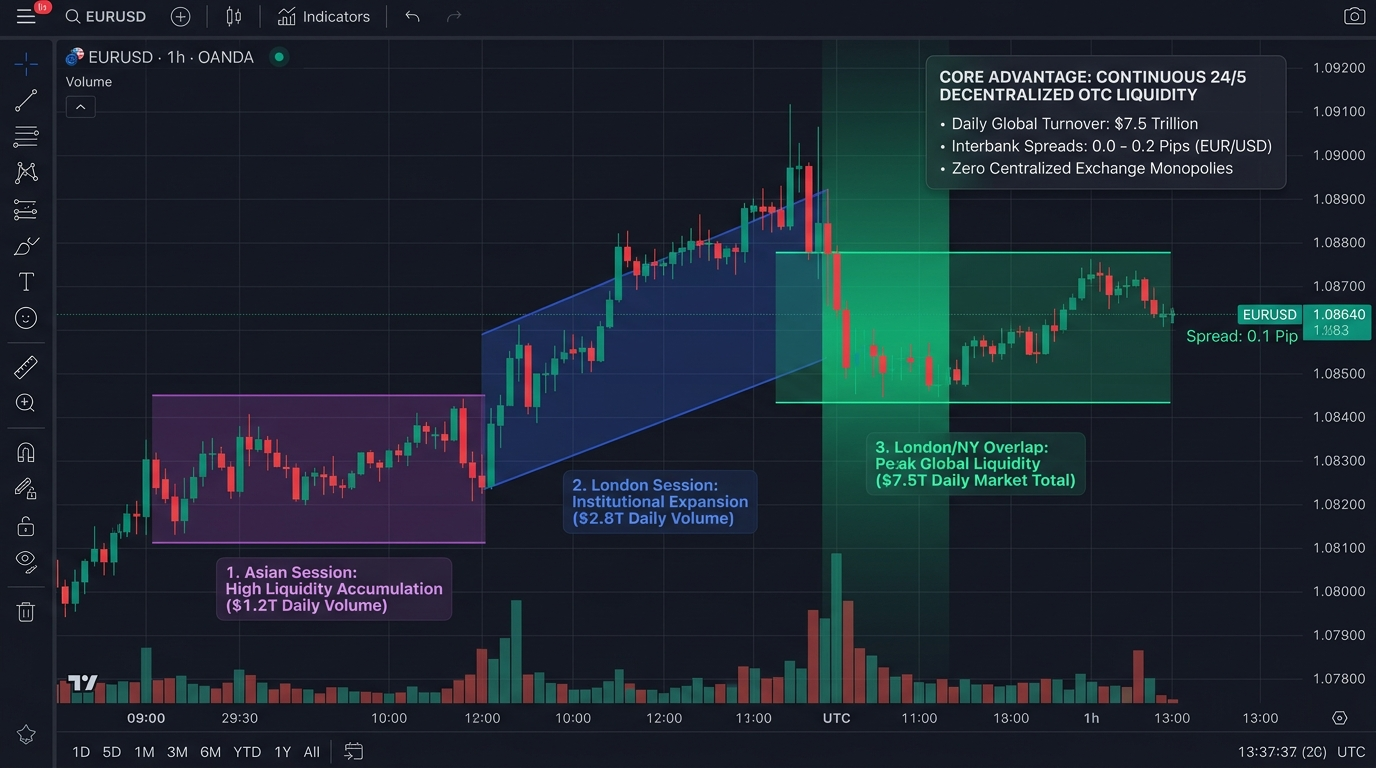
Behind every candlestick chart, late-night session, and evaluation attempt lies a simple human truth: traders enter currency markets to fulfill life-changing dreams. Whether that dream is achieving financial freedom, providing for family, or escaping the grind of a 9-to-5 job, trading represents an open meritocracy.
However, in traditional markets, those dreams collide with a brutal reality: capital scarcity. A trader with 500 dollars cannot achieve financial freedom making 5% a month (25 dollars). In desperation, retail traders over-leverage personal savings and destroy their accounts.
This is why the structural benefits of foreign exchange trading matter so profoundly. Modern forex markets bridge the gap between retail aspirations and institutional reality through capital efficiency, continuous 24/5 liquidity, and direct access to scaled proprietary funding.
The Trader's Dream vs The Market Reality
The following matrix illustrates how the structural design of foreign exchange directly empowers traders to overcome traditional capital barriers and fulfill their financial goals:
| The Trader's Aspiration | The Traditional Stock Trap | The Forex Market Advantage | How It Fulfills Your Dream |
|---|---|---|---|
| Financial Independence | Needs $25,000 under PDT rules to day trade | Zero PDT rules; trade micro-lots from $50 | Build wealth without risking family savings |
| Schedule Flexibility | Locked to 9:30 AM - 4:00 PM EST session | Continuous 24/5 multi-session liquidity | Trade around your existing job or family hours |
| Living Income Scale | $500 account makes $25/mo (unlivable) | Qualify for $100k prop funding ($4k+ payouts) | Transform skill into life-changing income |
| Bear Market Security | Borrow fees and restrictive short bans | Seamless two-way long and short execution | Profit in recessions with identical speed and zero fees |
1. What Is Forex Trading and Why Does It Dominate Global Finance?
The foreign exchange (forex or FX) market is the global decentralized over-the-counter (OTC) financial arena for pricing national currencies. Central banks, hedge funds, multinational corporations, and retail participants trade currencies continuously across electronic communication networks (ECNs).
Without centralized clearinghouse bottlenecks, electronic pricing streams directly between tier-1 liquidity providers. This decentralized framework eliminates single points of failure, routing uninterrupted liquidity from Tokyo through London to New York.
Before entering live market positions, test your risk allocation using our institutional Prop Firm Lot Size Calculator to guarantee your stop loss does not exceed 1% of total equity.
2. The 7 Core Advantages of Forex Trading in 2026
Professional proprietary desks allocate substantial balance sheets to currency markets due to superior structural market design. Here are the seven primary benefits that define modern forex trading:
1. Massive 24/5 Continuous Liquidity and Minimal Slippage
With daily trading volume exceeding 7.5 trillion dollars, major pairs like EUR/USD and GBP/USD possess deep order book depth. Large market orders execute instantly at quoted prices without disruptive price gaps.
Because trading follows the sun across global financial centers, participants avoid overnight session gap risk. Learn how volume shifts across sessions in our detailed guide on the best time to trade forex.
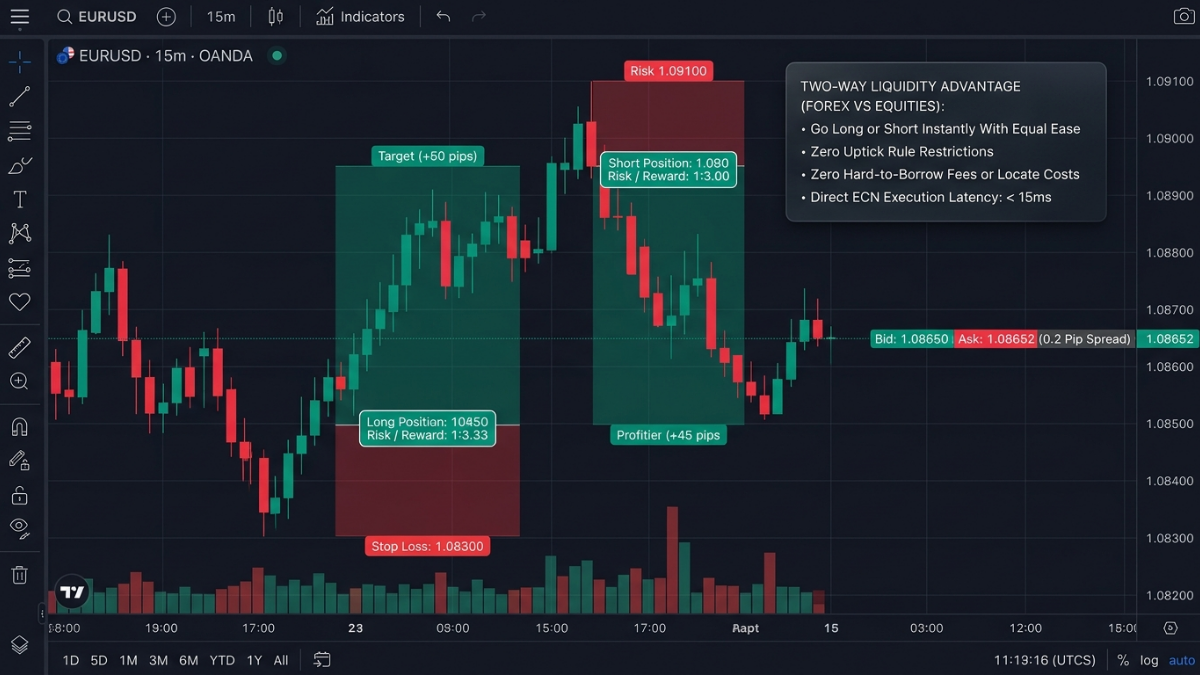
2. Equal Opportunity for Two-Way Market Execution
In equity markets, taking a short position requires borrowing physical shares from a prime broker, paying daily borrow fees, and navigating restrictive circuit breakers.
In forex, every transaction represents the simultaneous purchase of one currency and sale of another. When you execute a short trade on EUR/USD, you are simply buying US Dollars while selling Euros without locate fees or uptick rules.
3. Capital Efficiency Through Flexible Margin and Prop Funding
Traditional equity day trading requires maintaining at least 25,000 dollars under the Pattern Day Trader (PDT) rule. Under-capitalized stock traders face account freezing if they exceed day-trading limits.
Forex trading operates under margin parameters that welcome small retail balances starting from micro-lots. Disciplined operators can access funded accounts up to 200,000 dollars through prop firm evaluations.
Verify your statistical passing probability using our Prop Firm Pass Probability Calculator before committing evaluation fees.
4. Low Frictional Costs and Fractional Pip Pricing
Equity brokers layer exchange clearing fees and platform routing charges onto filled contracts.
Modern ECN forex brokers offer raw interbank spreads starting at 0.0 to 0.2 pips on major pairs with modest round-turn commissions. For day traders scalping intraday charts, low frictional overhead dramatically lowers the breakeven threshold.
To master how institutional algorithms exploit these tight spreads, study our price action blueprint on order block trading strategy.
5. Independence From Corporate Accounting Scandals and Earnings Manipulation
Stock pickers face idiosyncratic risk where individual shares can collapse 30% on CEO resignations or earnings misses.
Currencies represent the sovereign economic output of entire nations. A country's exchange rate reflects broad macroeconomic drivers like central bank interest rate differentials, GDP growth, and inflation prints that evolve transparently through scheduled economic calendar releases.
6. Granular Position Sizing Down to Micro and Nano Units
Unlike futures contracts where single ticks carry fixed dollar values, spot forex allows granular sizing. Traders can calibrate exposure in increments of 1,000 units (micro-lots) or even 100 units (nano-lots).
Traders can risk an exact dollar figure, such as 25 or 100 dollars, regardless of stop-loss width. Review pair volatility in our breakdown of the best forex pairs to trade for beginners.
7. Global Macro Trend Persistence and Technical Cleanliness
Because currency values reflect institutional capital flows between central banks, foreign exchange pairs frequently produce sustained multi-month technical trends. Quantitative funds ride these multi-thousand pip structural cycles.
Technical patterns like structural breaks, fair value gaps, and liquidity sweeps repeat with high statistical fidelity on currency charts. Build your foundation with our free Forex Trading for Beginners PDF.
3. Forex Trading Advantages and Disadvantages: The Operational Reality
Every financial market advantage carries a corresponding operational risk. Professional operators never evaluate benefits in a vacuum without analyzing potential hazards.
Below is an institutional breakdown comparing the advertised benefits of currency trading with operational realities every retail trader must manage:
| Core Benefit | Operational Reality & Hazard | Institutional Risk Rule |
|---|---|---|
| High Leverage | Amplifies losses; causes rapid stop-outs | Cap risk at 0.50% to 1.0% per trade with hard stops |
| 24/5 Operating Hours | Off-peak sessions suffer wide spreads | Focus execution during London and New York overlap |
| Two-Way Execution | Shorting against macro trend blows accounts | Require higher timeframe structural trend alignment |
| Low Capital Barrier | Tiny accounts trigger reckless overleveraging | Trade micro-lots or qualify for scaled prop funding |
To safeguard your evaluation buffer against compounding drawdown errors, utilize our Prop Firm Drawdown Calculator to project your maximum consecutive losing trade threshold.
4. Asset Class Benchmark: Forex vs Stocks vs Crypto vs Futures
Selecting the optimal asset class depends on your capitalization, daily schedule, and execution style. Foreign exchange provides distinct advantages for active intraday and swing traders.
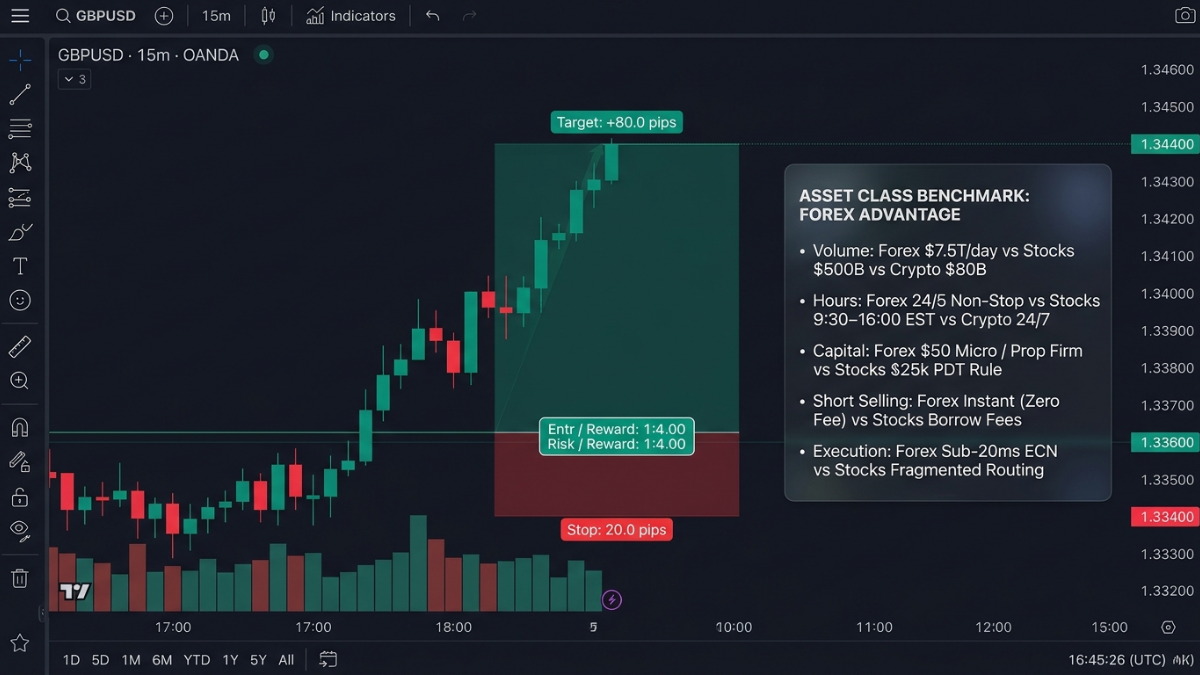
The following benchmark matrix compares the operational parameters of spot forex against US equities, cryptocurrencies, and exchange-traded futures:
| Feature | Spot Forex | US Equities (Stocks) | Cryptocurrencies |
|---|---|---|---|
| Daily Turnover | Over $7.5 Trillion | Approx $500 Billion | Approx $80-$120 Billion |
| Market Access | 24 Hours / 5 Days | 9:30 AM to 4:00 PM EST | 24 Hours / 7 Days |
| PDT Restriction | Zero PDT rule (Micro-lots) | $25,000 day trading minimum | No minimum balance |
| Short Selling | Seamless two-way execution | Borrow fees; locate required | Funding rate fees apply |
| Transaction Drag | Raw spreads from 0.0 pips | Broker and exchange fees | Variable exchange fees |
| Max Leverage | 1:30 to 1:100 (Prop) | 1:2 overnight, 1:4 intraday | Up to 1:20 on apps |
While offshore retail brokers offer speculative leverage up to 1:500, serious prop firm operators enforce institutional risk parameters. Review the catastrophic impact of unregulated leverage in our post on high leverage forex brokers.
5. Strategic Execution: How to Exploit Forex Advantages Responsibly
Capitalizing on the structural strengths of currency markets requires disciplined operational rules. Follow these three golden execution principles:
Master Session Timing and Volume Cycles
Focus execution during the London open (07:00 to 10:00 UTC) or London/New York overlap (12:00 to 16:00 UTC). These peak sessions deliver tight spreads and low slippage.
Combine session timing with structural setups like our breaker block trading strategy. Monitor reset windows with our Prop Firm Reset Clock Tracker.
Guard Against Rollover Spread Blowouts
At 5:00 PM EST (22:00 UTC), global desks settle positions during rollover, temporarily widening spreads on minor pairs. Maintain sufficient stop-loss buffers to prevent accidental liquidation, and review rollover tracking in our guide on prop firm daily drawdown reset time.
Explore Institutional Technology Solutions
Working with modern institutional infrastructure elevates performance. Inspect platform features on our compare page or explore our free trader tools.
6. Frequently Asked Questions (FAQ)
What is the biggest advantage of trading forex over stocks?
The primary advantage is superior 24/5 liquidity with zero Pattern Day Trader (PDT) restrictions. Traders can execute long or short positions instantly without paying stock borrow fees or locating inventory.
Can beginners start forex trading with a small account?
Yes. Spot forex supports micro-lots (0.01 standard lots), enabling beginners to start with 50 to 100 dollars while risking strictly 1.00 to 2.00 dollars per trade.
What are the main disadvantages or risks of forex trading?
The main risks stem from excessive leverage and rollover spread expansion. Traders risking over 1% per setup face rapid margin calls during high-impact news releases.
Is forex trading open on weekends?
Forex markets close Friday at 5:00 PM EST and reopen Sunday at 5:00 PM EST. Interbank fiat liquidity requires traditional banking clearing systems to be open.
7. Institutional Infrastructure for Trading Leaders
If you run a trading community, signal channel, or fund, harness these advantages directly. Discover how LaunchPropFirm empowers founders with turnkey client portals, MT5 bridges, and gamified trading arenas.
Explore platform benchmarks in our educational blog archives or test risk metrics with our free trading calculators.
Evaluate Your Prop Firm Readiness Score (0-100)
Answer 5 quick operational questions about your acquisition channels, runway, and engine tech to get a personalized launch roadmap.

M.Haris
Founder & Platform ArchitectBuilding open prop trading software infrastructure for operators worldwide
I built LaunchPropFirm to give forex educators, trading communities, and fintech operators complete ownership of their platform with full source code and zero monthly SaaS rent. Every article on this blog is drawn from hands-on platform development, live MT5 risk bridge mechanics, and real operator economics.
All content, financial models, ROI estimates, and architecture guides on LaunchPropFirm are published strictly for educational and informational purposes. LaunchPropFirm provides institutional prop trading software and technology infrastructure; it does not operate as a broker, custodian, or registered investment advisor.
Evaluation challenges and funded trader accounts referenced in this guide operate in simulated demo trading environments using real-time market data feeds. Simulated trading results do not represent actual trading performance or financial advice.
Recommended Next Reads
Hand-picked operator guides to scale your prop trading platform.
Breaker Block Trading Strategy: How to Trade Block Failures
Master the breaker block trading strategy. Learn how failed order blocks create high-probability liquidity retests with exact entry, stop loss, and RR rules.
Order Block Trading Strategy: 2026 SMC & Breaker Guide
Master order block trading strategy in 2026. Learn HTF liquidity zones, bullish vs bearish order blocks, breaker blocks, and precision execution rules.
Community Monetization & Platform Ownership
Run a Trading Discord, Telegram, or Signal Group? Launch Your Own Prop Firm in 7 Days.
Stop sending your community to third-party prop firms. Own our complete white-label prop firm platform with all automated risk engines, live TradingView charts, MT5 bridge, and paid tournament engine from just $995 down under 50% milestone escrow. Zero monthly SaaS fees.