Order Block Trading Strategy: 2026 SMC & Breaker Guide
Master order block trading strategy in 2026. Learn HTF liquidity zones, bullish vs bearish order blocks, breaker blocks, and precision execution rules.
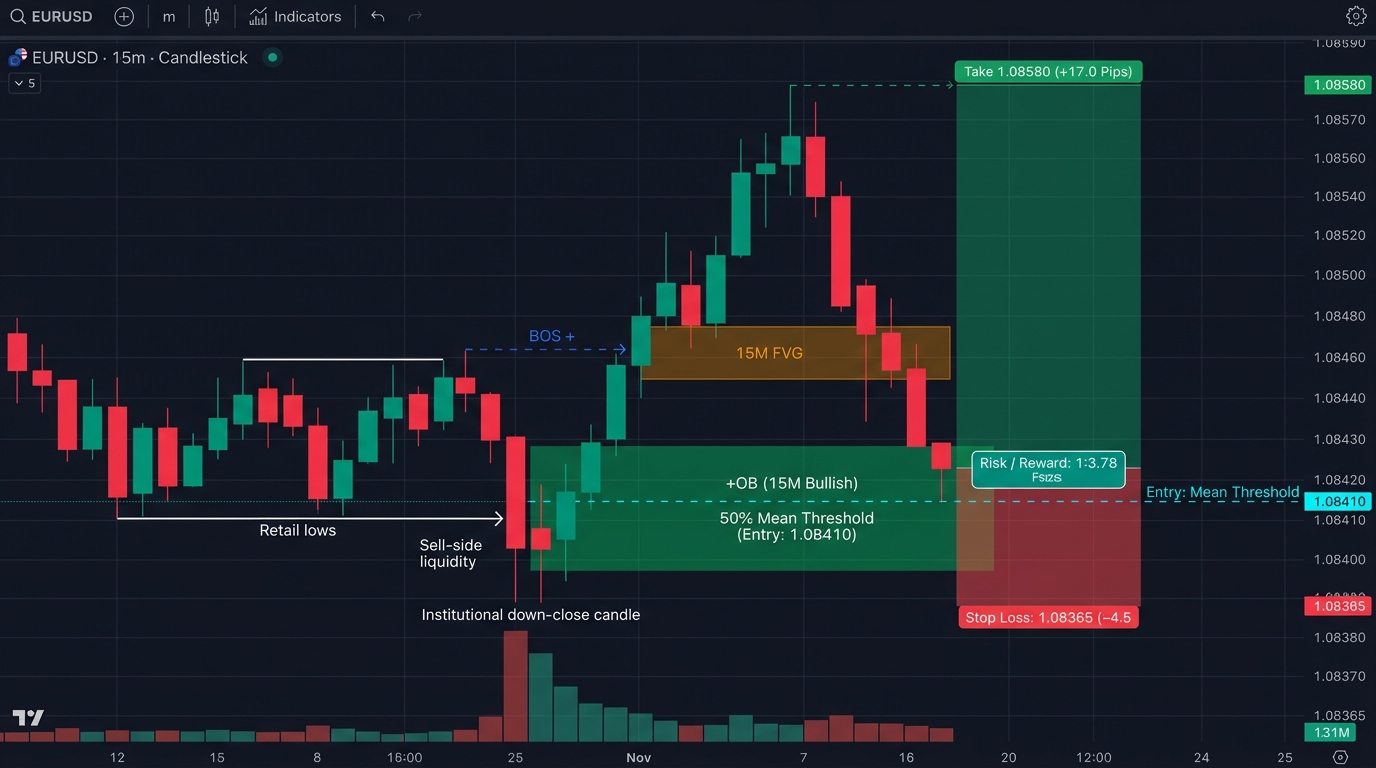
An order block is not an ordinary support or resistance level drawn across price wicks. In modern market structure, an order block represents the footprint of centralized liquidity left behind by institutional desks before engineering an aggressive price expansion.
Retail traders frequently lose evaluation capital by drawing horizontal boxes across every swing high and swing low. Institutional algorithms execute massive orders across interbank liquidity pools.
To accumulate inventory without slippage, institutions absorb retail liquidity at key higher-timeframe boundaries. Understanding how to identify, validate, and execute these institutional footprints is the foundation of high-probability Smart Money Concepts (SMC) day trading.
1. What is an Order Block? (Institutional Footprint vs Retail Support & Resistance)
Retail technical analysis teaches that support and resistance form whenever price bounces off a horizontal level. In institutional reality, equal highs and equal lows represent liquidity pools where retail stop-loss orders accumulate waiting to be harvested.
An authentic order block forms when an institution injects heavy volume to absorb that resting liquidity. This capital injection creates a temporary imbalance, forcing price to displace rapidly away from the accumulation zone.
As price explodes outward, interbank algorithms leave unfulfilled limit orders behind at the origin candle. When price retraces back to this zone, institutions defend their resting orders, triggering clean price rejection without breaching the block's invalidation point.
Every valid order block must originate from a Higher-Timeframe (HTF) liquidity zone such as an Asian range extreme or London session pool. Attempting to trade order blocks that form in mid-range consolidation guarantees false breakouts and drawdown breaches.
2. Anatomy of Valid Bullish and Bearish Order Blocks
To trade order blocks profitably in prop firm challenges, you must isolate valid institutional blocks from consolidation candles. A valid order block possesses three mandatory structural components confirming algorithmic participation.
First, the block must be the final counter-trend candle before aggressive displacement. Second, the subsequent expansion move must break market structure. Third, the displacement candle must leave a clean Fair Value Gap (FVG).
Anatomy of a Valid Bullish Order Block
A bullish order block is the lowest down-close (bearish) candle formed immediately prior to an explosive upward displacement breaking a previous swing high.
Before this candle forms, price sweeps resting sell-side liquidity beneath an established low. The subsequent upward candle must possess a thick body closing completely above the high of the bearish order block candle. If the upward move fails to create an imbalance, the zone is invalid.
Anatomy of a Valid Bearish Order Block
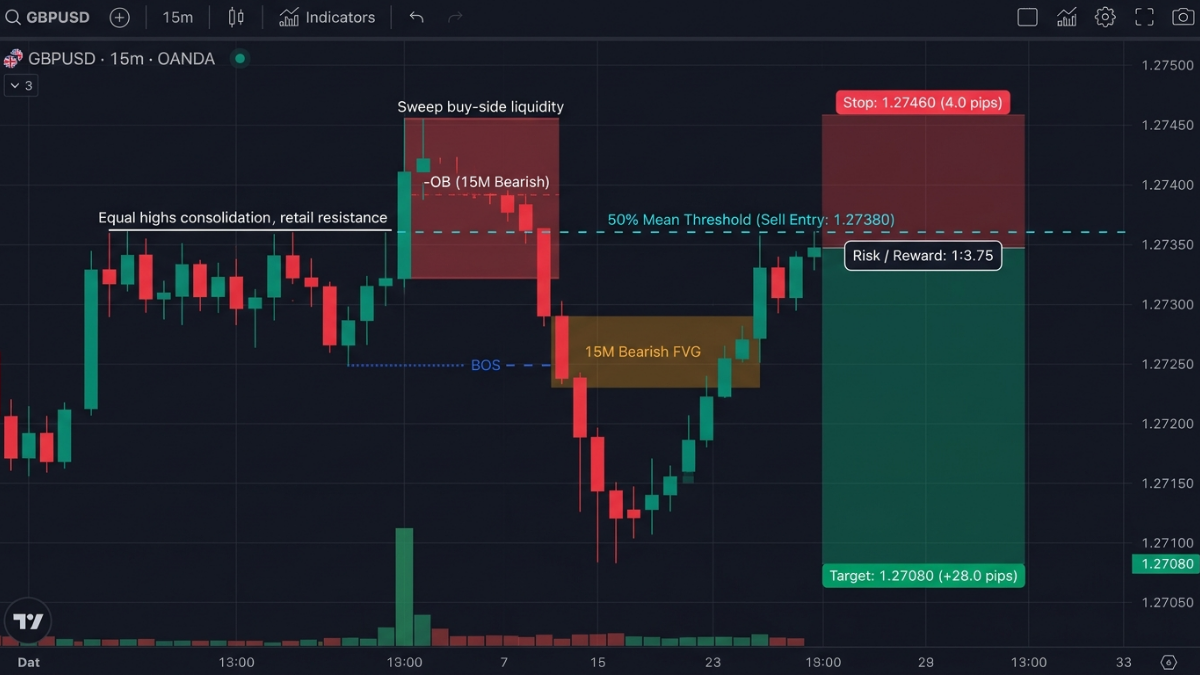
A bearish order block is the highest up-close (bullish) candle formed immediately prior to an aggressive downward displacement breaking an established swing low.
The wick of this up-close candle sweeps buy-side liquidity resting above equal highs before closing red. The following downward candle must displace with high velocity, creating a clear three-candle Fair Value Gap directly below the block's low. This displacement confirms that institutional sell programs are active.
3. Order Block vs Breaker Block vs Mitigation Block (The Invalidation Matrix)
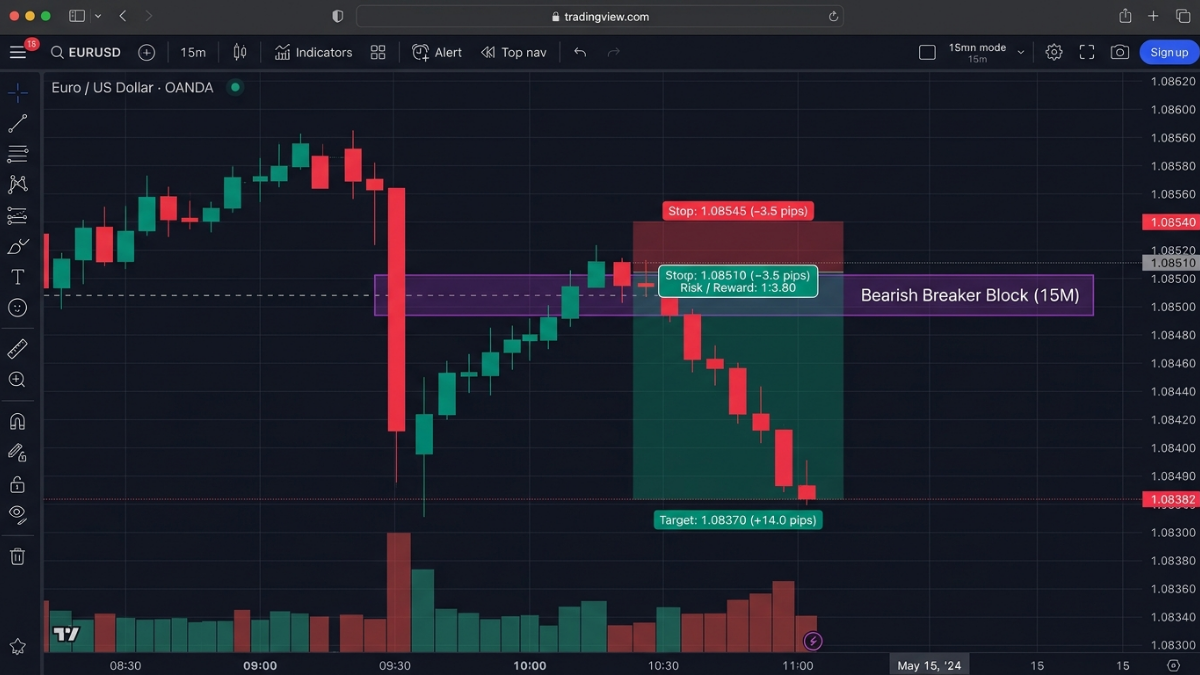
When macroeconomic data pushes through an established order block, novice traders panic. Professional operators understand that a failed order block transforms into an even more powerful structural pattern: a breaker block trading strategy.
To navigate market structure shifts cleanly, traders must distinguish between standard order blocks, breaker blocks, and mitigation blocks:
| Setup Tier | Liquidity Sweep | Structural Trigger | Status Upon Failure | Entry Calibration | Win Expectancy |
|---|---|---|---|---|---|
| Standard OB | Must sweep HTF liquidity | Origin candle before displacement | Flips into Breaker Block | 50% Mean Threshold or open | 72% to 78% (1:3+ R:R) |
| Breaker Block (BB) | Swept liquidity BEFORE violation | Violated OB after MSS shift | Traps retail breakout volume | Retest of broken OB zone | 68% to 75% (1:2.5+ R:R) |
| Mitigation Block (MB) | Did NOT sweep liquidity | Failure swing in order flow | Closes institutional loss | Limit entry on candle open | 55% to 62% (1:1.5 to 1:2 R:R) |
A Breaker Block occurs when an order block that previously swept liquidity is aggressively broken by an opposite market structure shift. Because retail breakout traders bought the initial sweep and institutions sold through it, a retest of this violated block traps retail volume and provides high-velocity continuation entries.
In contrast, a Mitigation Block forms when an order block fails to take out the previous swing high or low before breaking structure. Because no major external liquidity pool was purged, mitigation blocks carry lower institutional conviction and require reduced position sizing.
4. The 4-Step Institutional Order Block Execution Blueprint
Executing order blocks on synthetic forex pairs like EUR/USD or GBP/USD requires aligning multiple confluence factors rather than blindly placing limit orders at every rectangular box.
Follow this systematic 4-step execution framework to ensure trade setups align with institutional order flow and strict prop firm evaluation rules.
Step 1: Establish Higher-Timeframe Session Bias
Begin your trading day by marking key liquidity benchmarks on the 1-hour and 4-hour charts. Identify the Asian session high and low, the previous daily high and low, and any unfilled higher-timeframe Fair Value Gaps.
Timing is critical for execution quality. As outlined in our detailed breakdown of gold trading hours, the highest probability setups form during major market session overlaps between 12:00 UTC and 16:00 UTC. Avoid trading during illiquid bank rollover periods when interbank spreads widen unpredictably.
Step 2: Confirm the Liquidity Sweep and Displacement
Drop down to the 5-minute or 15-minute execution timeframe and wait for price to sweep an established liquidity pool. Do not enter on the sweep itself, as price can trend further into external imbalances.
Wait for an aggressive displacement candle creating an energetic Fair Value Gap. This displacement must result in a clean break of structure in forex by closing past the opposing swing point. The presence of both an FVG and a market structure shift confirms that institutional algorithms have reversed directional flow.
Step 3: Identify the Mean Threshold (50% Retest)
Once the market structure shift is confirmed, identify the exact origin candle that initiated the move. This candle is your verified order block.
Measure the distance from the candle open to the candle close using the Fibonacci tool set to the 50% level. In institutional terminology, this 50% midpoint is known as the Mean Threshold. Institutional algorithms routinely balance inventory by retesting the Mean Threshold rather than touching the extreme boundary of the wick.
Step 4: Calibrate Limit Orders and Defensive Risk Brackets
Place a limit order directly at the open or the 50% Mean Threshold of the order block. Position your defensive hard Stop Loss 2 to 3 pips beyond the invalidation wick of the block to prevent accidental stop-outs caused by brief spread expansions.
Target resting liquidity at the opposing swing high or an unmitigated higher-timeframe Fair Value Gap. Never enter an order block setup that offers less than a 1:3 risk-to-reward ratio. This asymmetric payoff ensures that even a 40% win rate generates steady profits across your trading journey.
5. Prop Firm Challenge Math: Lot Sizing & Drawdown Preservation
Mastering order block theory is meaningless if your trade sizing violates prop firm daily loss limits. When trading a $100,000 funded evaluation account on an institutional trading platform, position sizing must be calculated from your exact stop-loss distance in pips.
Novice day traders frequently use arbitrary lot sizes like 5.0 or 10.0 lots on EUR/USD regardless of stop width. If your order block requires an 18-pip stop loss, trading 5 standard lots produces a $900 loss if stopped out, instantly consuming nearly 20% of your maximum daily drawdown allowance.
To maintain strict risk control, risk no more than 0.5% ($500) of your total account balance on any single order block execution. For beginner traders exploring the best forex pairs for beginners, currency pairs like EUR/USD and GBP/USD offer the cleanest algorithmic delivery and tightest raw spreads.
If your order block entry on EUR/USD features an 8-pip stop loss, input your parameters into our free prop firm lot size calculator. The calculator indicates an exact position size of 6.25 lots, keeping your maximum potential loss locked at $500.
Monitoring open equity against daily rollover reset clocks is equally essential. By utilizing our live daily reset clock tracker and testing trailing limits on the drawdown calculator, you avoid accidental account liquidations during evening spread spikes.
For entrepreneurs interested in how proprietary trading firms engineer automated server risk rules, explore our complete white label prop firm software architecture to understand how institutional platforms safeguard capital.
6. Frequently Asked Questions (FAQ)
What is the difference between an order block and a supply and demand zone?
Traditional supply and demand zones are broad price areas identified by sharp departures. An order block is a precise structural candle formed specifically after sweeping external liquidity and engineering a documented market structure shift with an accompanying Fair Value Gap.
Which timeframe is best for identifying and trading order blocks?
The most reliable framework pairs higher-timeframe direction with lower-timeframe execution. Use the 4-hour and 1-hour charts to identify primary liquidity sweeps and major order blocks, then refine your entry on the 5-minute or 15-minute chart to minimize stop-loss distance and maximize your risk-to-reward ratio.
What is the Mean Threshold of an order block?
The Mean Threshold is the exact 50% mathematical midpoint of an order block candle body. In Smart Money Concepts, institutional algorithms frequently retest this 50% level before initiating aggressive trend continuation. A full candle close beyond the Mean Threshold serves as an early warning of setup invalidation.
Where can traders download an ICT order block strategy PDF?
Traders looking for comprehensive Smart Money documentation can save our complete online guide or access our free downloadable trading curriculum and risk management templates directly through our trading desk resources.
Why do order blocks fail during high-impact news releases?
During major economic releases like US Non-Farm Payrolls (NFP), interbank liquidity providers pull resting limit orders. This sudden removal of liquidity creates extreme volatility spikes that blow through unmitigated order blocks until deep liquidity pools are cleared.
Evaluate Your Prop Firm Readiness Score (0-100)
Answer 5 quick operational questions about your acquisition channels, runway, and engine tech to get a personalized launch roadmap.

M.Haris
Founder & Platform ArchitectBuilding open prop trading software infrastructure for operators worldwide
I built LaunchPropFirm to give forex educators, trading communities, and fintech operators complete ownership of their platform with full source code and zero monthly SaaS rent. Every article on this blog is drawn from hands-on platform development, live MT5 risk bridge mechanics, and real operator economics.
All content, financial models, ROI estimates, and architecture guides on LaunchPropFirm are published strictly for educational and informational purposes. LaunchPropFirm provides institutional prop trading software and technology infrastructure; it does not operate as a broker, custodian, or registered investment advisor.
Evaluation challenges and funded trader accounts referenced in this guide operate in simulated demo trading environments using real-time market data feeds. Simulated trading results do not represent actual trading performance or financial advice.
Recommended Next Reads
Hand-picked operator guides to scale your prop trading platform.
Breaker Block Trading Strategy: How to Trade Block Failures
Master the breaker block trading strategy. Learn how failed order blocks create high-probability liquidity retests with exact entry, stop loss, and RR rules.
Advantages of Forex Trading: 2026 Benefits & Risk Guide
Explore the core advantages of forex trading in 2026. Master 24/5 liquidity, leverage mechanics, major currency pairs, and the risk reality.
Community Monetization & Platform Ownership
Run a Trading Discord, Telegram, or Signal Group? Launch Your Own Prop Firm in 7 Days.
Stop sending your community to third-party prop firms. Own our complete white-label prop firm platform with all automated risk engines, live TradingView charts, MT5 bridge, and paid tournament engine from just $995 down under 50% milestone escrow. Zero monthly SaaS fees.