How Much Do Day Traders Make? (2026 Salary & Reality Math)
Discover how much day traders actually make in 2026. Explore average salary stats, the 90-90-90 rule, personal risk math, and funded account payouts.

Scroll through financial social media and you will see claims of making $10,000 every morning from a beach cafe. These promotional videos present day trading as a guaranteed shortcut to rapid wealth.
The audited mathematical reality is completely different. Regulatory filings from ESMA, the SEC, and major brokerages show that between 70% and 95% of retail day traders lose money over a 12-month horizon.
Understanding how much day traders actually make requires stripping away marketing hype and examining real capital math. Whether you trade personal savings or institutional prop capital changes your probability of long-term survival.
Before exploring income calculations, test your capital scaling assumptions using our interactive Personal Account vs Prop Firm Calculator. It demonstrates how account size directly impacts your monthly risk profile.
1. The Statistical Reality: Average Day Trader Salary vs 90-90-90 Rule
Recruitment portals like Glassdoor report average day trader salaries ranging from $74,000 to over $115,000 per year. These figures mislead beginner traders into false expectations.
Those reported salary averages represent salaried desk traders and quantitative analysts employed by institutional hedge funds. They receive corporate base salaries, prime broker execution, and multi-million-dollar risk capital.
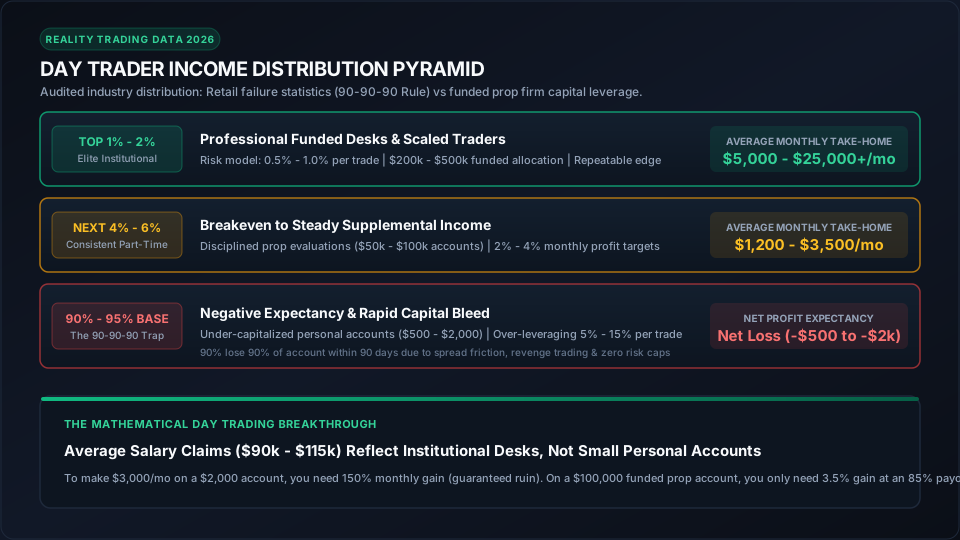
Independent retail traders at home do not receive a corporate salary. Instead, retail market participants face the notorious 90-90-90 rule: 90% of retail day traders lose 90% of their deposited capital within 90 days of starting.
A study tracking 20,000 equity day traders over two years revealed that only 1.1% earned more than the local minimum wage. Less than 0.5% earned more than a junior bank teller salary.
The gap between winners and losers comes down to capitalization and disciplined risk tolerance. Understanding is day trading hard starts by recognizing that under-capitalized traders face an almost insurmountable statistical hurdle.
2. Personal Account Capital Drag: Why a $2,000 Account Cannot Pay Your Rent
The primary reason novice day traders blow up their accounts is capital deficiency. Most beginners open an account with $500 to $2,000 of personal savings and expect that balance to replace their monthly job income.
If your household living expenses are $3,000 per month, generating that income from a $2,000 account requires a 150% monthly return. Even the greatest hedge funds in human history average 35% to 60% per year.
Expecting 150% every thirty days forces catastrophic risk. Instead of risking a prudent 0.5% or 1% per setup, beginners risk 5% to 15% on every position.
At a 10% risk per trade, a normal five-trade losing streak wipes out 41% of your portfolio. Once an account drops by 50%, you need a 100% gain just to break even.
Small personal retail accounts also face continuous friction from broker bid-ask spreads, overnight financing swap drag, and commissions. These friction costs steadily bleed small balances even when your technical strategy is break-even.
To see how much capital is realistically necessary to cover living expenses, review our guide on how much money do you need to start day trading. You can also run scenarios through our free Prop Firm Calculator.
3. The Funded Prop Firm Income Shift: Scaling $50k and $100k Accounts (2% to 4% Return Model)
Proprietary trading firms have fundamentally changed retail trader unit economics. Instead of risking personal savings to make modest returns, funded evaluations allow disciplined operators to control $50,000 to $100,000 in simulated institutional capital.
Under a funded account model, you do not need unrealistic 50% monthly returns to generate substantial take-home pay. A conservative, repeatable 2% to 4% monthly gain produces dependable income while keeping risk under 1% per trade. Capturing these steady returns requires focusing on high-probability liquidity windows; review our breakdown of gold trading hours to see how volume peaks during session overlaps.
On a $100,000 funded account, a 3% net gain equals $3,000 in gross profit. Under an industry-standard 80% to 90% profit split, your take-home payout is $2,400 to $2,700 for that month.
Your total capital at personal risk was only the upfront evaluation fee of approximately $490, which is fully refunded on your first payout. If the market turns volatile and you hit a maximum drawdown breach, your personal savings remain completely safe in your bank.
| Account Type | Account Size | Monthly Return Target | Gross Profit | Trader Profit Split | Net Take-Home Pay | Maximum Capital at Risk |
|---|---|---|---|---|---|---|
| Personal Broker | $2,000 | 3.0% (Disciplined) | $60.00 | 100% Retained | $60.00 / mo | $2,000 Personal Savings |
| Personal Broker | $2,000 | 50.0% (Extreme Risk) | $1,000.00 | 100% Retained | $1,000.00 / mo | High Risk of Total Ruin |
| Funded Prop Firm | $50,000 | 3.0% (Disciplined) | $1,500.00 | 80% to 90% Split | $1,200 - $1,350 / mo | ~$250 Evaluation Fee |
| Funded Prop Firm | $100,000 | 3.0% (Disciplined) | $3,000.00 | 80% to 90% Split | $2,400 - $2,700 / mo | ~$490 Evaluation Fee |
| Funded Prop Firm | $200,000 | 3.0% (Disciplined) | $6,000.00 | 80% to 90% Split | $4,800 - $5,400 / mo | ~$950 Evaluation Fee |
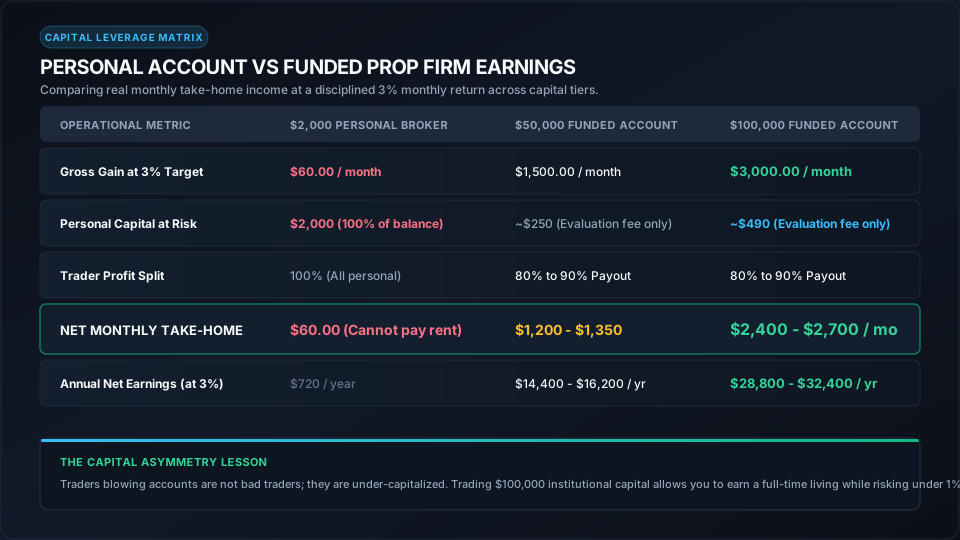
Notice how the mathematics invert in your favor. Achieving a 3% monthly return on a $100,000 account produces 40 times more monthly take-home cash than achieving the identical 3% return on a $2,000 personal account.
Capital leverage allows you to trade with relaxed emotional discipline. You no longer need to over-trade or force subpar setups during low-volatility market sessions.
To calculate your exact profit distribution across custom payout splits and fee refunds, model your numbers in our Prop Firm Payout Calculator. To verify your safety buffers, analyze your stop-losses with our Prop Firm Drawdown Calculator.
4. Net Take-Home Pay: Payout Rails, Crypto Fees & Consistency Rules
Gross trading profits on your dashboard do not equal the exact cash that lands in your checking account. Calculating realistic take-home pay requires factoring in third-party payment rail fees, currency conversions, and prop firm risk rules.
Most modern proprietary trading firms disburse trader payouts through Rise Works or decentralized cryptocurrency wallets using Tether (USDT). Each withdrawal rail carries distinct fee structures and clearing timelines.
When using Rise, international bank transfers generally incur modest $0 to $5 transaction fees. Non-USD local settlements often encounter a 1.5% to 2.0% currency conversion markup from intermediary banks.
Cryptocurrency payouts sent via USDT TRC20 or BEP20 settle within minutes for $1 to $2 in blockchain gas. Traders must account for secondary crypto exchange off-ramping fees when converting stablecoins into local fiat.
Beyond withdrawal rail fees, prop firms enforce strict consistency rules to ensure traders demonstrate repeatable methodology rather than gambling on economic news events. A common rule is a 40% single-day profit cap.
If you generate $4,000 of total profit during a payout cycle, no single trading day can account for more than $1,600 of that total. Any excess profit above the consistency cap is held back until subsequent cycles.
For a complete walkthrough on payout tiers, scaling programs, and refund timing, inspect our detailed prop firm payout calculator profit split guide.
5. How Prop Firm Operators Fund Consistent Trader Payouts
Traders often wonder where the money comes from to pay five-figure monthly payouts. Understanding the backend liquidity architecture clarifies why the prop trading business model is sustainable.
Proprietary trading firms do not pay winning traders out of thin air. Operator balance sheets are backed by substantial evaluation challenge revenue pools and statistical pass rates.
Across the retail industry, data shows that only 8% to 12% of traders pass multi-stage evaluations and reach funded status. Challenge entry fees paid by unsuccessful attempts create massive liquidity buffers.
Top-tier operators also maintain A-Book risk desks that automatically mirror the executions of their top 2% consistent traders directly onto institutional liquidity providers. The firm earns institutional clearing spread alongside the trader.
Trading educators and Discord community owners are increasingly launching their own prop desks to fund their members. Instead of sending their audience to external firms for small affiliate cuts, they retain the entire house spread.
To examine founder economics and platform profitability, read our breakdown on how much do prop firm owners make.
With turnkey systems like LaunchPropFirm White Label Prop Firm Software, founders launch fully branded evaluation ecosystems for a transparent $2,495 one-time fee. Founders secure full source code ownership and zero monthly volume taxes.
Compare turnkey ownership against legacy SaaS providers using our Prop Firm Platform Comparison to see why independent firms dominate modern retail trading. Explore our full directory of interactive models in the LaunchPropFirm Tools Suite and read operator case studies on the LaunchPropFirm Blog, or discover our turnkey platform on LaunchPropFirm.
Frequently Asked Questions
How much does the average beginner day trader make per month?
Brokerage statistics show that the average beginner day trader operates at a net financial loss of $200 to $1,000 per month. Beginners often lack risk management, over-leverage micro-accounts, and lose capital to spread friction and emotional revenge trading.
Can you realistically make a living day trading with $1,000?
Making a full-time living on a $1,000 personal account is mathematically impossible. Generating $3,000 in monthly living expenses requires a 300% monthly return, which inevitably leads to rapid account ruin within a few trades.
How much do funded prop firm traders make on a $100k account?
A disciplined trader targeting a conservative 2% to 4% monthly return on a $100,000 funded account generates $2,000 to $4,000 in gross profit. After an 80% to 90% profit split, net take-home pay ranges between $1,600 and $3,600 per month.
Do day traders pay taxes on prop firm payouts?
Yes, day traders must report prop payouts to tax authorities. Because prop traders operate as independent contractors rather than corporate employees, firms do not withhold taxes, leaving traders responsible for filing self-employment income taxes.
What percentage of day traders make over $100,000 a year?
Studies indicate that less than 1% to 2% of independent day traders consistently earn over $100,000 per year. Virtually all retail traders who achieve six-figure earnings manage scaled funded accounts of $200,000 or more with strict risk limits.
Evaluate Your Prop Firm Readiness Score (0-100)
Answer 5 quick operational questions about your acquisition channels, runway, and engine tech to get a personalized launch roadmap.

M.Haris
Founder & Platform ArchitectBuilding open prop trading software infrastructure for operators worldwide
I built LaunchPropFirm to give forex educators, trading communities, and fintech operators complete ownership of their platform with full source code and zero monthly SaaS rent. Every article on this blog is drawn from hands-on platform development, live MT5 risk bridge mechanics, and real operator economics.
All content, financial models, ROI estimates, and architecture guides on LaunchPropFirm are published strictly for educational and informational purposes. LaunchPropFirm provides institutional prop trading software and technology infrastructure; it does not operate as a broker, custodian, or registered investment advisor.
Evaluation challenges and funded trader accounts referenced in this guide operate in simulated demo trading environments using real-time market data feeds. Simulated trading results do not represent actual trading performance or financial advice.
Recommended Next Reads
Hand-picked operator guides to scale your prop trading platform.
Breaker Block Trading Strategy: How to Trade Block Failures
Master the breaker block trading strategy. Learn how failed order blocks create high-probability liquidity retests with exact entry, stop loss, and RR rules.
Advantages of Forex Trading: 2026 Benefits & Risk Guide
Explore the core advantages of forex trading in 2026. Master 24/5 liquidity, leverage mechanics, major currency pairs, and the risk reality.
Community Monetization & Platform Ownership
Run a Trading Discord, Telegram, or Signal Group? Launch Your Own Prop Firm in 7 Days.
Stop sending your community to third-party prop firms. Own our complete white-label prop firm platform with all automated risk engines, live TradingView charts, MT5 bridge, and paid tournament engine from just $995 down under 50% milestone escrow. Zero monthly SaaS fees.