Is Day Trading Hard? Why 95% Fail & The Math Explained
Discover why 95% of day traders fail, the mathematical reality of leverage drag, and how funded evaluation accounts cap your personal downside risk.
Ask any seasoned market participant a simple question: is day trading hard?
The immediate, unfiltered answer is an unqualified yes. Day trading is widely recognized by behavioral economists and quantitative analysts as one of the most grueling, psychologically unforgiving professions in modern finance.
Yet, social media feeds portray the exact opposite: teenagers in rental villas claiming anyone with a smartphone, a candlestick indicator, and two hours of spare time can generate $10,000 monthly paydays.
This disconnect between retail marketing and cold statistical reality creates an endless churn of hopeful beginners who deposit personal savings into high-leverage brokers only to blow their accounts within 90 days.
Understanding why day trading is hard requires stripping away emotion and examining the underlying mathematics of probabilistic risk, execution friction, and neurological cognitive biases.
1. What the Academic Data Actually Proves (Beyond Social Media Hype)
Brokers and retail influencers rarely publish the verified profit-and-loss distributions of their user bases. However, independent academic researchers have audited tens of millions of real trading tickets across multiple global exchanges over decades.
The empirical findings are brutal and remarkably consistent across every market regime:
The University of California / Barber & Odean Study
In a landmark multi-year analysis conducted by professors Brad Barber, Yi-Tsung Lee, Yu-Jane Liu, and Terrance Odean (*Do Day Traders Rationalize Their Losses?*), researchers tracked the complete trading records of over 300,000 individual retail day traders on the Taiwan Stock Exchange.
The study revealed that in any given year, less than 1% of day traders persistently earned positive abnormal returns after deducting transaction costs and spreads. Over 80% of active day traders lost money, and approximately 19% hovered near breakeven before commission drag gradually eroded their principal.
The Brazilian Futures Study (Chague, De-Losso, & Giovannetti)
In 2020, financial researchers evaluated 19,684 individuals who began day trading equity mini-futures contracts between 2013 and 2015.
The results were staggering:
- 97.0% of all individuals who traded for more than 300 days lost money.
- Only 1.1% earned more than the local minimum wage.
- Only 0.4% earned more than the equivalent of an entry-level bank teller's salary.
| Dimension | FinTech & Social Media Narrative | Verified Academic Reality |
|---|---|---|
| Success Rate | "Master 3 simple candlestick setups to quit your 9-to-5 job" | 95% to 99% fail to achieve long-term net profitability |
| Capital Requirement | "Start with $250 and compound it to $50,000 in six months" | High probability of mathematical ruin without structured capitalization |
| Primary Skill | Technical indicator memorization and chart pattern spotting | Strict risk management, emotional control, and mathematical expectancy |
| Transaction Costs | "Zero-commission trading makes daily execution virtually free" | Bid-ask spreads, broker markups, and overnight swaps drain 30%+ of alpha |
| Time Horizon | Full financial independence within 30 to 60 days of starting | Minimum 12 to 24 months of deliberate, data-driven screen time |
Before risking a single dollar on live market charts, test whether your trading model has statistical validity using our free Prop Firm Pass Probability Calculator.
2. The 4 Hidden Killers of Retail Day Traders
Why do intelligent, disciplined individuals—engineers, doctors, accountants, software developers—regularly fail at day trading?
The failure is rarely intellectual. Day trading is difficult because financial markets exploit four mathematical and biological vulnerabilities built directly into human psychology:
1. The Asymmetric Mathematics of Capital Loss
In normal life, if you lose 10% of something, you only need to gain 10% back to restore equilibrium. In leveraged financial trading, this intuition is completely false.
The mathematics of portfolio drawdowns is non-linear and severely asymmetric:
- A 10% loss requires an 11.1% gain just to break even.
- A 25% loss requires a 33.3% gain to break even.
- A 50% loss requires a 100.0% gain (doubling your remaining capital) to return to zero.
- An 80% loss requires a 400.0% gain just to get back your starting deposit.
When an undisciplined trader suffers a 30% drawdown over a bad week, their brain panics. To recover that 30%, they must suddenly produce a 42.8% return on reduced capital. Instead of shrinking position sizes, they double their leverage, enter revenge trades, and wipe out the rest of their account.
2. Execution Friction and the Negative Drag
Day trading requires frequent entries and exits throughout active market sessions. Every single round-trip ticket incurs transactional friction:
- Bid-Ask Spread: Entering at the ask and exiting at the bid immediately creates an unrealized negative balance.
- Slippage: During high-volatility events, market orders fill several pips worse than the displayed quote.
- Broker Commissions: Even $3.50 per lot per side adds up to hundreds of dollars over a monthly execution cycle.
If a day trader takes four trades per day (80 trades per month) with an average friction cost of $15 per trade across spreads and fees, they start every month with an automatic -$1,200 financial penalty. The trader must generate $1,200 of pure market edge each month just to maintain a flat zero-dollar P&L.
3. Neurochemical Hijacking (The Dopamine and Cortisol Loop)
When a trader enters a leveraged position, their brain enters a high-arousal state. An open winning trade releases dopamine, generating feelings of invincibility and euphoria. Conversely, an open losing position triggers the amygdala, releasing cortisol and activating fight-or-flight defense mechanisms.
Under cortisol overload, the prefrontal cortex—the part of the brain responsible for logical probability and risk assessment—shuts down. The trader removes their stop-loss, tells themselves "the price will come back," and turns a minor 1% controlled risk into a catastrophic 20% portfolio rupture.
4. The Dollar-Amount Fallacy
Beginner traders look at their trading screen in nominal dollars rather than units of risk (R).
When a trader thinks, *"I just lost $600, that is my monthly car payment,"* emotional distress paralyzes their decision-making. Professional trading firms enforce the exact opposite mindset: trades are measured purely in basis points, risk-reward ratios, and percentage deviation from historical expectancy.
To eliminate guesswork around position sizing and dollar risk, calculate your exact trade size prior to order entry using our institutional Prop Firm Lot Size & Pip Risk Calculator.
3. Why Prop Firm Challenges Protect Retail Traders from Financial Ruin
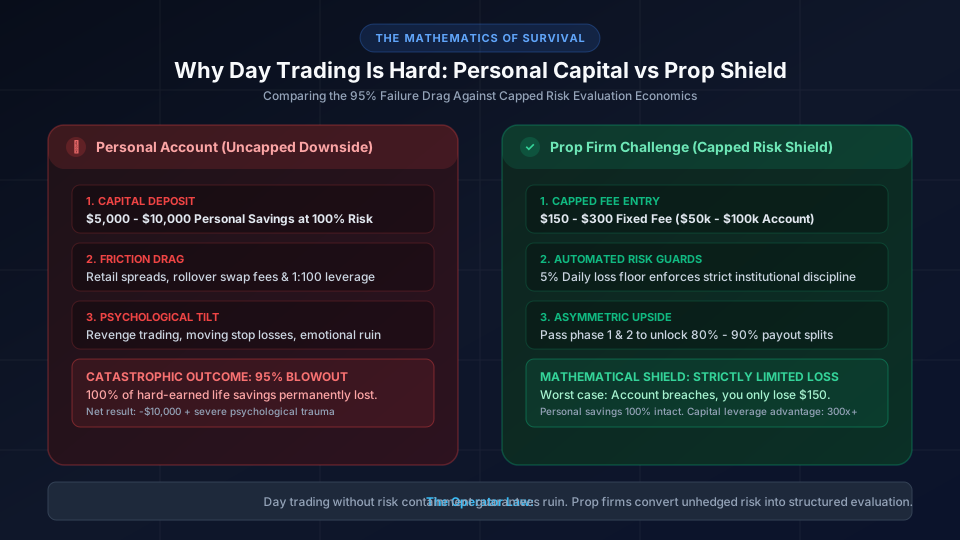
For decades, the only way to day trade was to fund a personal margin account at an offshore retail broker. If a trader deposited $10,000 of personal savings and experienced an emotional tilt, their life savings vanished instantly.
The emergence of modern proprietary trading evaluation firms has fundamentally transformed retail risk architecture.
Instead of risking their own liquid capital, traders purchase an evaluation challenge for a flat upfront fee. If the trader demonstrates disciplined execution and risk control according to clear rules, they unlock access to simulated funded accounts ranging from $10,000 to $200,000+.
| Risk Parameter | Personal Retail Brokerage Account | Prop Firm Evaluation Challenge Account |
|---|---|---|
| Max Personal Downside | 100% of deposited capital (e.g., $10,000 of personal savings lost on a bad week) | Capped at the evaluation entry fee (e.g., $150 to $300 flat one-time cost) |
| Emotional Pressure | Extreme (trading with rent money or retirement savings breeds panic) | Controlled (risk is strictly limited to the challenge purchase price) |
| Risk Enforcement | Self-managed (easy to disable stop loss during emotional drawdowns) | Hard-coded automated daily loss and maximum drawdown circuit breakers |
| Payout Mechanics | Withdraw your own capital after clearing broker spreads and fees | Receive 80% to 90% profit splits while keeping personal savings safe |
| Scaling Capability | Limited by personal salary, savings rate, and deposit capacity | Scalable up to $1M–$2M in funded allocation through automated milestones |
A trader evaluating a $50,000 prop challenge risks only their $150–$250 challenge fee to access a $5,000 operational loss buffer (based on a standard 10% maximum drawdown ceiling).
If they hit that drawdown ceiling, they do not owe the prop firm $5,000; their account simply closes, and their maximum financial loss is strictly limited to their $200 entry ticket.
To see the multi-year difference between compounding a small personal account versus trading funded allocations, model your numbers in our Prop Firm vs Personal Account Compounding Calculator.
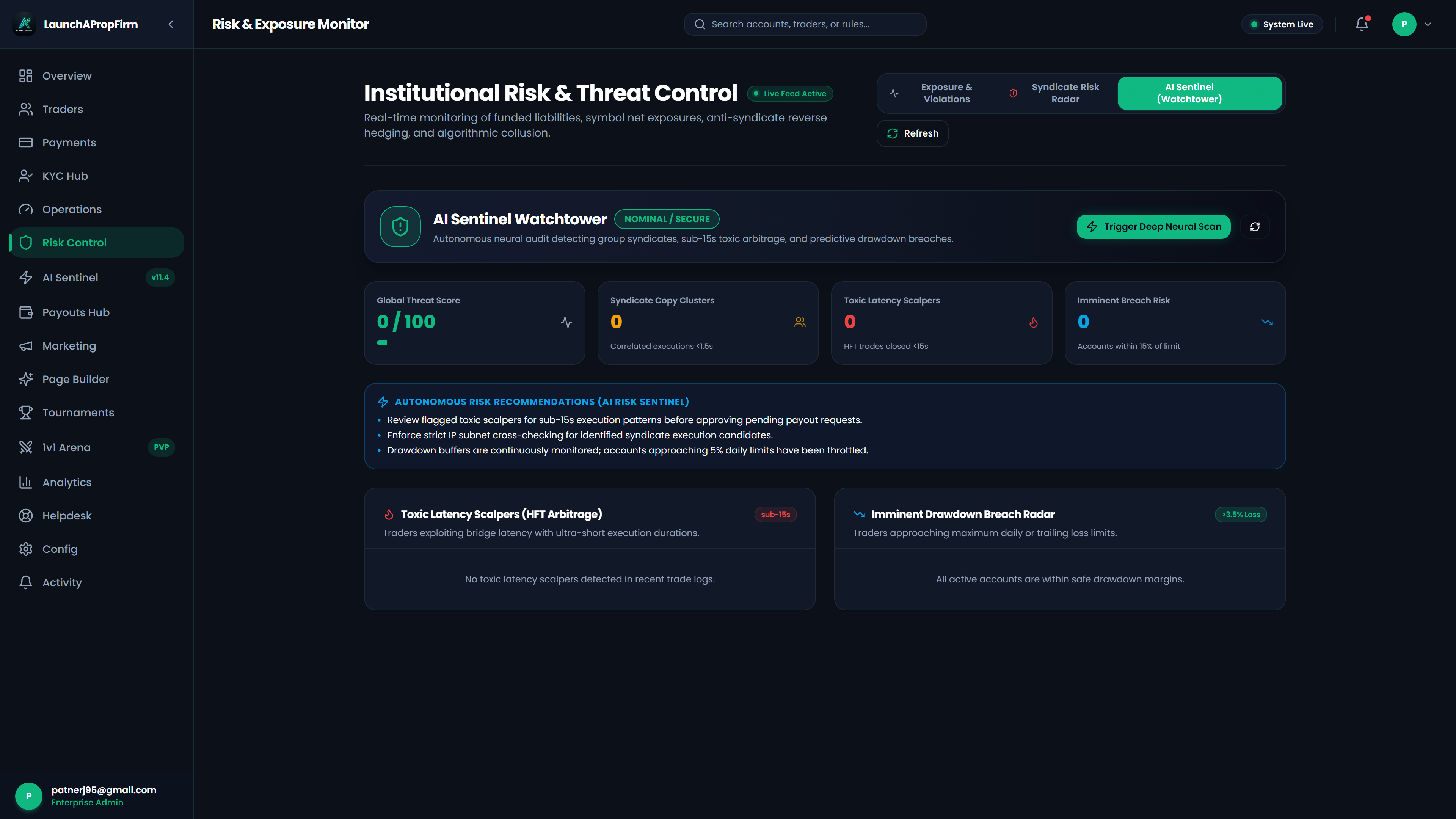
Skip the monthly fees
Own your prop firm platform outright. One time purchase.
Full source code. Live in 7 days. No revenue share. No monthly SaaS bill. See the exact platform before paying anything.
Demo login: haris / asdf1122. No signup needed
4. The 5 Operational Habits of the Profitable 1%
Traders who successfully survive the day trading learning curve and maintain long-term funded accounts do not possess secret charting indicators. Instead, they operate their trading like a rigorous manufacturing business.
Here are the five non-negotiable operational habits practiced by consistently profitable traders:
1. Calculate Mathematical Expectancy Over Win Rate
Amateur traders obsess over achieving an 80% or 90% win rate. Professional traders understand that win rate by itself is completely meaningless without factoring in your Risk-to-Reward Ratio (RRR).
Mathematical expectancy is calculated using the standard institutional formula:
The Mathematical Expectancy Formula:
Expectancy (E) = (Win Rate × Average Win) - (Loss Rate × Average Loss)
Where:
Mathematical Proof (40% Win Rate, 2.5:1 RRR):
E = (0.40 × 2.5R) - (0.60 × 1.0R) = +1.00R - 0.60R = +0.40R per trade
Over 100 trades, this trader generates +40 units of risk in pure net profit despite being wrong 60% of the time.
2. Cap Risk at 0.50% to 1.0% Per Trade Idea
The easiest way to fail a prop evaluation or blow a personal account is over-leveraging. If you risk 2.5% of your account per trade on a prop firm evaluation with a 10% maximum drawdown limit, four consecutive losses will wipe out your entire buffer.
Disciplined traders scale their position size down to 0.50% to 1.0% maximum risk per trade setup. This conservative sizing allows your account to absorb normal market variance and losing streaks without breaching daily loss floors.
Check your drawdown buffers and simulate consecutive losing streaks using our Prop Firm Drawdown Calculator.
3. Maintain a Meticulous Trade Journal
If you do not track your trades, you are gambling, not trading. A professional journal tracks more than entry price, exit price, and dollar profit:
- The exact technical setup (e.g., Break of Structure, Fair Value Gap retest, Liquidity Sweep).
- Market session and time of day (London Open, New York Morning, Asia Session).
- Psychological state before, during, and after execution.
- Execution quality score (Did you follow your written trading plan?).
Free Institutional Tool: Download our free Professional Trading Journal Workbook (Excel) with built-in daily drawdown protection, automated R-multiple expectancy formulas, and consistency trackers.
4. Respect the Prop Firm Consistency Rule
Many traders pass challenge evaluations through a single outsized win during high-impact news, only to have their payouts denied due to consistency violations. Modern prop firms enforce consistency rules requiring that no single trading day accounts for more than 33% to 50% of your total generated profit.
Before requesting a funded withdrawal, audit your daily profit distribution using our institutional Prop Firm Consistency Calculator and read our complete guide on the Prop Firm Consistency Rule Explained.
5. Monitor Midnight Server Rollover and Spread Spikes
Many challenge breaches do not happen during high-volume trading hours; they occur at midnight broker server rollover (00:00 server time). During rollover, institutional interbank liquidity thins dramatically, causing spreads on major currency pairs and indices to widen by 5 to 15 pips.
If an open trade sits close to a stop-loss or daily drawdown floor, widening spreads can instantly trigger an automated breach. Track your broker's rollover schedule using the Prop Firm Daily Drawdown Reset Clock.
5. Behind the Curtain: How Prop Firms Structure the Challenge Ecosystem
Traders often wonder: *"Why do prop firms offer $100,000 challenge accounts for just $300 to $500? Is the entire industry rigged?"*
The reality is not that prop firms are rigged; it is that the mathematical reality of human trading psychology funds the entire ecosystem.
The Economic Engine of Prop Firms
Prop firms operate on clear, sustainable unit economics:
- The 90% Failure Rate on Evaluations: Because day trading is hard and retail traders routinely over-leverage, approximately 90% to 95% of challenge participants fail to pass Phase 1 or Phase 2.
- Liquid Treasury Reserves: The entry fees paid by undisciplined traders fund the firm's operational overhead, liquidity bridges, server infrastructure, and liquid payout reserves.
- Rewarding the Disciplined 5%: When a skilled, disciplined trader passes evaluations and requests bi-weekly payouts, the prop firm pays their 80% to 90% profit splits promptly.
- Hybrid Risk Routing: For consistent, high-alpha traders, advanced prop firm platforms deploy automated trade copiers (A-Book STP bridges) to mirror their trades directly onto institutional liquidity providers, allowing the firm to earn risk-free commissions alongside the trader.
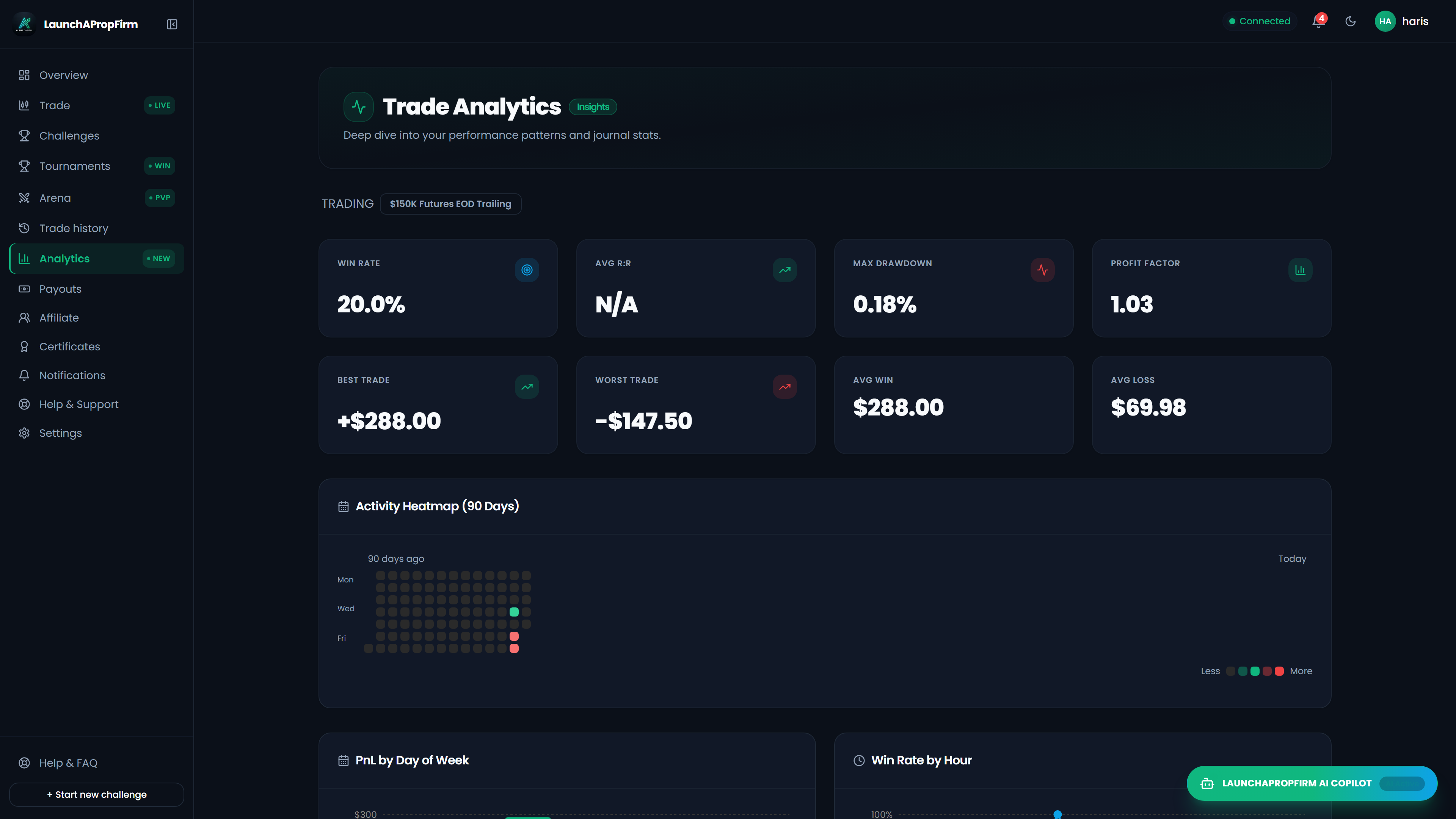
Entrepreneurs and prop firm founders who launch with LaunchPropFirm's turn-key platform deploy this exact institutional infrastructure.
With full Next.js/Node.js source code ownership, native TradingView browser terminals, automated risk monitors, and zero monthly SaaS fees, operators retain 100% of their operational income while providing transparent, institutional-grade evaluation environments to traders globally.
To understand the business economics behind prop firm operations, review our deep breakdown on how much prop firm owners make.
6. Actionable 30-Day Protocol for Aspiring Day Traders
If you are determined to tackle the difficulty of day trading and join the profitable 5%, follow this structured 30-day operational protocol:
- Step 1: Stop Live Trading Immediately (Days 1–7): If you are currently losing money on a personal brokerage account, pause all live execution. Emotional trading during a losing streak only accelerates capital destruction.
- Step 2: Define a Single Setup with Documented Edge (Days 8–14): Pick one specific market (e.g., EUR/USD, GBP/JPY, or Nasdaq futures) and one mechanical setup. Backtest it across at least 100 historical instances to verify its win rate and risk-reward ratio.
- Step 3: Paper Trade and Log 30 Sequential Trades (Days 15–25): Execute your setup on a demo account. Log every execution in the Professional Trading Journal Workbook. If you cannot maintain emotional discipline on virtual paper, you will never survive live capital.
- Step 4: Transition to Micro-Capital Challenges (Days 26–30): Once you prove consistent paper execution, purchase an entry-level micro-challenge ($5,000 or $10,000 account for $16 to $32). Browse our verified breakdown of the cheapest prop firm challenges to find low-cost evaluation tiers with fair rules.
Explore our complete library of trading calculators, risk engines, and challenge simulators in the LaunchPropFirm Tools Directory to construct your professional trading business today.
Frequently Asked Questions
Is day trading harder than a regular 9-to-5 job?
Yes. In a traditional career, input effort correlates directly with income stability. In day trading, effort without strict mathematical risk controls leads to compounding financial losses. Empirical university research across global exchanges demonstrates that over 95% of active day traders fail to achieve net profitability over a 12-month timeframe due to leverage drag and emotional drawdown spirals.
How long does it take to become profitable in day trading?
Most successful market operators require 12 to 24 months of deliberate, data-driven practice. This involves journaling at least 100 to 200 verified executions, mastering a single mechanical edge, and transitioning from paper demo trading to micro-capital evaluation challenges.
Why do prop firm challenges protect traders from financial ruin?
Prop firm evaluations legally cap your downside risk strictly to the upfront challenge fee ($16 to $300). If you experience an emotional tilt or suffer a severe drawdown streak, the account closes automatically without personal liability, keeping your life savings and essential household capital completely safe.
Can you make a living day trading with $500?
Attempting to generate a full-time living from $500 in a personal account forces traders to deploy excessive leverage (50:1 to 100:1), virtually guaranteeing an account blow-up on normal market variance. However, using $500 to purchase a $50,000 or $100,000 funded prop evaluation provides sufficient buying power to earn meaningful payouts while risking only the entry fee.
Written by the LaunchPropFirm Risk & Trading Architecture Desk.
Evaluate Your Prop Firm Readiness Score (0-100)
Answer 5 quick operational questions about your acquisition channels, runway, and engine tech to get a personalized launch roadmap.

M.Haris
Founder & Platform ArchitectBuilding open prop trading software infrastructure for operators worldwide
I built LaunchPropFirm to give forex educators, trading communities, and fintech operators complete ownership of their platform with full source code and zero monthly SaaS rent. Every article on this blog is drawn from hands-on platform development, live MT5 risk bridge mechanics, and real operator economics.
All content, financial models, ROI estimates, and architecture guides on LaunchPropFirm are published strictly for educational and informational purposes. LaunchPropFirm provides institutional prop trading software and technology infrastructure; it does not operate as a broker, custodian, or registered investment advisor.
Evaluation challenges and funded trader accounts referenced in this guide operate in simulated demo trading environments using real-time market data feeds. Simulated trading results do not represent actual trading performance or financial advice.
Recommended Next Reads
Hand-picked operator guides to scale your prop trading platform.
Break of Structure Examples: BOS vs CHoCH Trading Guide
Master break of structure examples with candle closure rules, order block retests, and BOS vs CHoCH frameworks to pass prop firm challenges.
How Much Money to Start Day Trading? 2026 Capital Guide
How much money do you need to start day trading in 2026? Compare $25k PDT rules, $500 personal accounts, and prop firm leverage with real risk math.
Skip the monthly fees
Own your prop firm platform outright. One time purchase.
Full source code. Live in 7 days. No revenue share. No monthly SaaS bill. See the exact platform before paying anything.
Demo login: haris / asdf1122. No signup needed