How Much Do Prop Firm Owners Make? (Real Monthly P&L)
Honest financial breakdown of prop firm owner earnings: monthly challenge revenue, 10%-15% pass rates, payout reserves, and net profit margins in 2026.
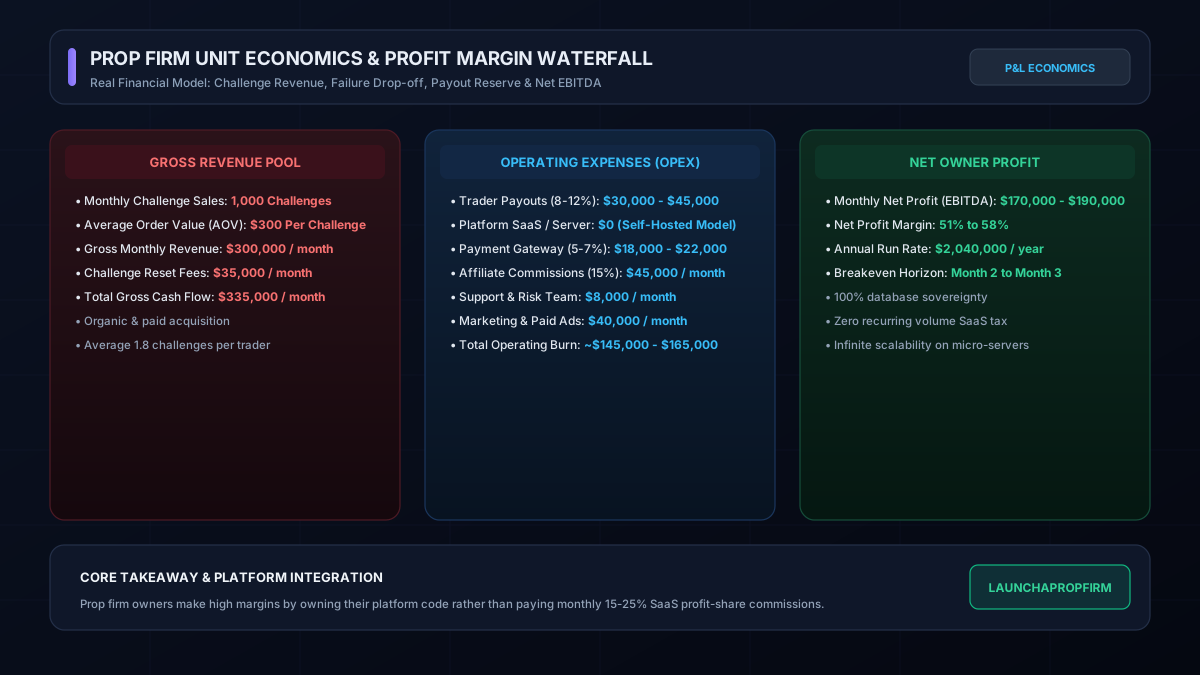
The Question Nobody Answers With Real Numbers
I get this question constantly. How much does a prop firm owner actually make?
Most articles give vague ranges or avoid the question entirely. I am going to give you the real math. challenge fee revenue, payout exposure, platform costs, and what margin actually looks like at different scales.
See the platform before reading further
The Revenue Model First
Prop firm revenue comes from three sources.
Challenge fees are the main engine. A trader pays $199 to attempt Phase 1. Most fail. You keep the fee.
At a 5 to 10% combined pass rate, 90 to 95 out of every 100 traders never reach a funded account.
Rebuy fees come from traders who fail and try again. A motivated trader might buy the same challenge three or four times. Each rebuy is full price with no additional service cost to you.
Profit splits come from the small percentage of traders who pass and get funded. At 80/20 split, a funded trader earning $1,000 generates $200 for the firm.
Small Scale: 30 Challenges Per Month
A realistic first-month number for someone with an existing network of 200 to 500 active traders.
30 challenges at $199 average = $5,970 revenue
Payout reserve (25%) = $1,492
Platform hosting and feed = $70
Net available = $4,408
Funded trader payouts in month 1 are near zero. Most traders who bought in month 1 are still in Phase 1 or Phase 2. Actual cash in hand: close to the full $4,408.
That is a real business from day one if you have the audience.
Skip the monthly fees
Own your prop firm platform outright. One time purchase.
Full source code. Live in 7 days. No revenue share. No monthly SaaS bill. See the exact platform before paying anything.
Demo login: haris / asdf1122. No signup needed
Medium Scale: 100 Challenges Per Month
Achievable within 3 to 6 months with consistent marketing and an affiliate program running.
100 challenges at $199 = $19,900 revenue
Payout reserve (25%) = $4,975
Platform costs = $70
Affiliate commissions at 20% = $3,980
Net available = $10,875
By this stage, funded trader payouts start hitting. Say 5 traders get funded and earn $500 average profit. At 80/20 split you owe $2,000. Net after payouts: roughly $8,875.
Large Scale: 300 Challenges Per Month
Numbers from a firm with a strong affiliate network and 6 to 12 months of operation.
300 challenges at $199 = $59,700 revenue
Payout reserve (25%) = $14,925
Affiliate commissions = $11,940
Customer support (part time) = $800
Platform costs = $70
Net available = $31,965
Funded trader payouts at this scale are meaningful. Say 15 funded traders earn average $600 per month. You owe $1,440 in splits. Net after everything: roughly $30,525.
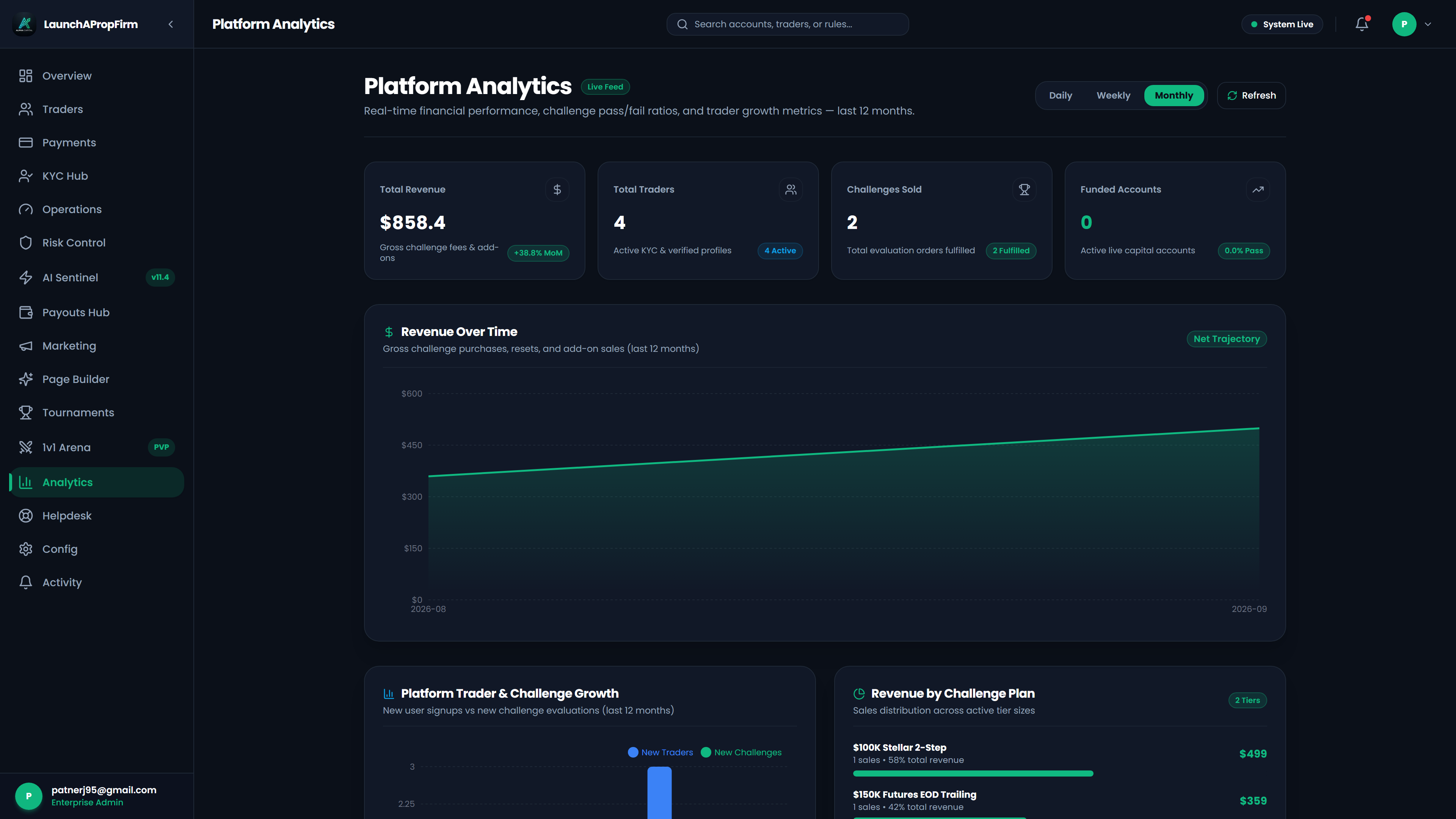
Income at a Glance
| Scale | Monthly Challenges | Gross Revenue | Net After Reserves |
|---|---|---|---|
| Small (month 1) | 30 | $5,970 | ~$4,400 |
| Medium (months 3-6) | 100 | $19,900 | ~$8,875 |
| Large (6-12 months) | 300 | $59,700 | ~$30,525 |
What Actually Determines Your Income
Challenge volume is the main lever. More traders, more revenue. Everything else scales with it.
Your challenge pass rate matters because higher pass rates mean more payout exposure. Most operators target 5 to 10% combined pass rate. Rules that are too easy drain reserves. Rules that are too hard kill rebuys.
Platform costs matter more at small scale. On SaaS at $2,000 per month, a firm doing 30 challenges barely breaks even. On a one time license at $70 per month running costs, a 30-challenge month is profitable.
Affiliate commissions reduce margin but increase volume. A firm paying 20% per sale and doing 100 challenges through affiliates earns more net than a firm doing 60 challenges direct.
The Margins Nobody Talks About
At small scale (30 challenges/month): margin is roughly 70% before payouts.
At medium scale (100 challenges/month): margin is roughly 55% before payouts.
At large scale (300+ challenges/month): margin is roughly 50% before payouts.
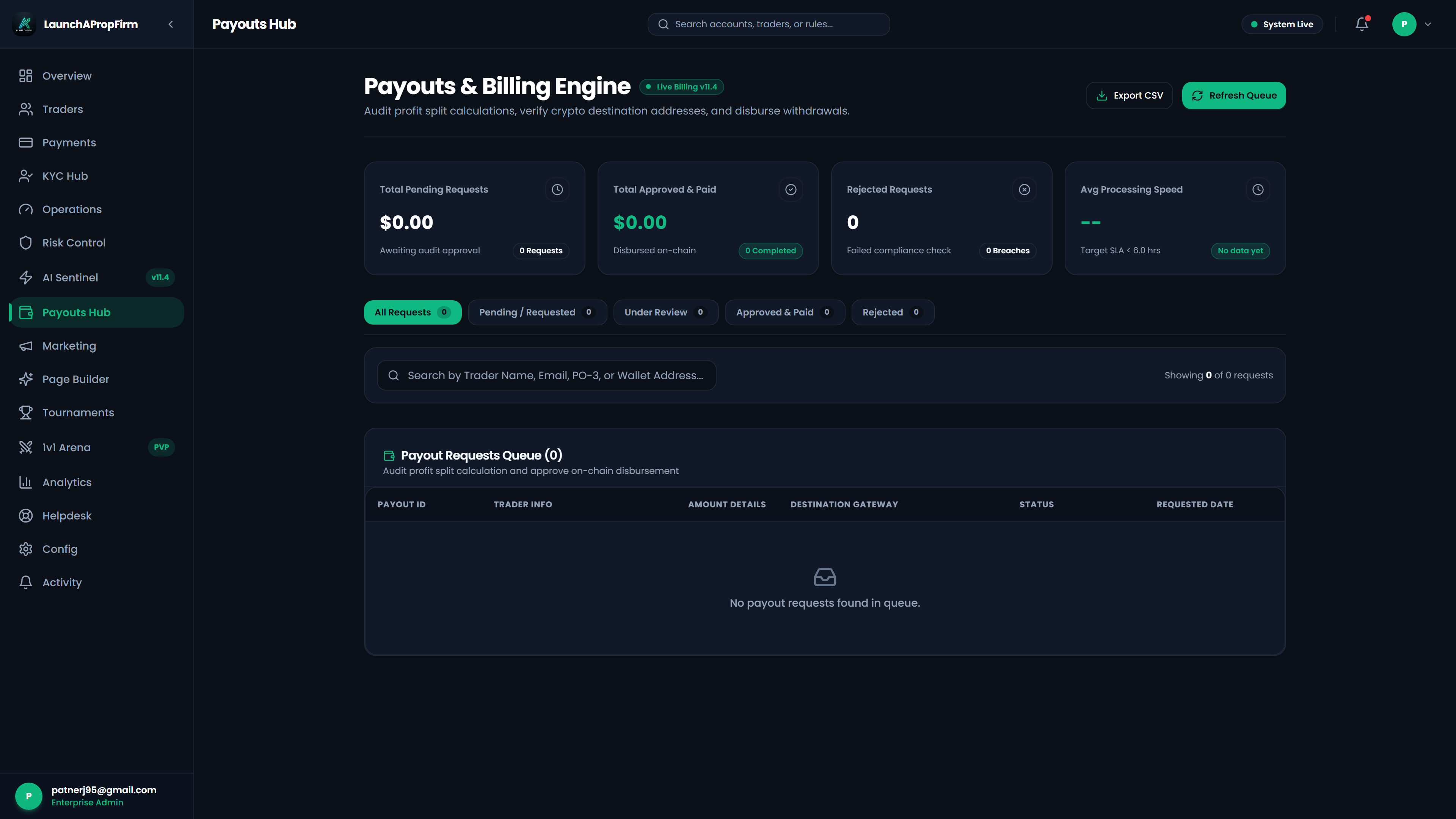
Trader payout dashboard facilitating instant on-demand withdrawal requests and profit share disbursements.
Funded trader payouts reduce this by 5 to 15 percentage points depending on your challenge rules and pass rate.
Net margins of 40 to 60% are realistic for a well-run prop firm. That is exceptionally good for a service business.
How Long to Reach $10,000 Per Month
With an existing audience of 500 active traders: 2 to 4 months.
Starting from zero with consistent content and outreach: 6 to 12 months.
Starting from zero with no marketing effort: indefinitely.
The platform is not the bottleneck. Distribution is.
I built LaunchPropFirm for $2,500 one time. The first month covered the platform cost. The limiting factor was always trader acquisition, not technology or capital.
See the platform and what it costs
Operator Tip: Prop firm owner income is almost entirely a function of challenge volume and pass rate management. At 100 challenges per month at $200 average and a 5% pass rate, your payout liability is manageable and your net margin exceeds 60%. The operators who struggle financially are typically those who underpriced challenges or skipped reserve management.
FAQ
What is the realistic monthly income for a prop firm owner?
At 50 challenge sales per month at $200 average, gross revenue is $10,000. After payout reserves (25%), hosting, and market data, net income runs $6,500 to $7,500. At 200 sales per month, the same math produces $26,000 to $30,000 net. Volume is the primary lever.
What profit margin do prop firms operate at?
Well-run firms operate at 60 to 75% net margin on challenge fee revenue. The primary cost is payout reserves for funded traders. Firms that mismanage reserves operate at much lower margins or incur losses.
How many challenge sales does a firm need to break even?
At a $4,500 one-time platform cost with $100 per month in ongoing costs, a firm breaks even after 25 to 30 challenge sales at $200 average. Most operators break even in the first 30 days if they have an audience.
What factors most affect a prop firm owner's income?
Challenge price, volume, pass rate, and payout reserve discipline. Operators who undercut on pricing, attract too many skilled traders, or mismanage reserves earn significantly less. The business model is sound when these factors are managed correctly.
Does owner income keep growing without additional work?
Not automatically, but the compounding mechanisms (rebuys, referrals, affiliate networks) mean revenue often grows without proportional increases in effort. Operators who set up affiliate programs typically see income growth with minimal additional operational work.
Model Your Firm's Monthly Cash Flow & Profit
Simulate challenger intake, pass rate payout reserves, and net operator margins with our free real-time economic calculator.
Prop Firm Monthly Profit Simulator
Simulate your challenge revenue, payout liability, and net monthly take-home profit.
$20,000
From upfront challenge fees-$2,800
~10 funded payouts budgeted$0 / month
Saves $3,000/mo vs SaaS$17,200/mo
Run-rate: $206,400/yr
M.Haris
Founder & Platform ArchitectBuilding open prop trading software infrastructure for operators worldwide
I built LaunchPropFirm to give forex educators, trading communities, and fintech operators complete ownership of their platform with full source code and zero monthly SaaS rent. Every article on this blog is drawn from hands-on platform development, live MT5 risk bridge mechanics, and real operator economics.
All content, financial models, ROI estimates, and architecture guides on LaunchPropFirm are published strictly for educational and informational purposes. LaunchPropFirm provides institutional prop trading software and technology infrastructure; it does not operate as a broker, custodian, or registered investment advisor.
Evaluation challenges and funded trader accounts referenced in this guide operate in simulated demo trading environments using real-time market data feeds. Simulated trading results do not represent actual trading performance or financial advice.
Recommended Next Reads
Hand-picked operator guides to scale your prop trading platform.
Prop Firm Profit Split: How to Set It
Most prop firms offer 70-90% profit splits. Here is how the split works, what the market standard is in 2026, and how to set yours without hurting margins.
Prop Firm Liquidity Providers: Prime of Prime Directory
Compare the top prop firm liquidity providers and Prime of Prime brokers. Review FIX 4.4 API bridge latency, margin rules, crypto rails, and fee structures.
Skip the monthly fees
Own your prop firm platform outright. One time purchase.
Full source code. Live in 7 days. No revenue share. No monthly SaaS bill. See the exact platform before paying anything.
Demo login: haris / asdf1122. No signup needed