Is It Worth Starting a Prop Firm?
Before you spend anything, here are real numbers on prop firm revenue, startup costs, and what it actually takes to build a funded trader business in 2026.
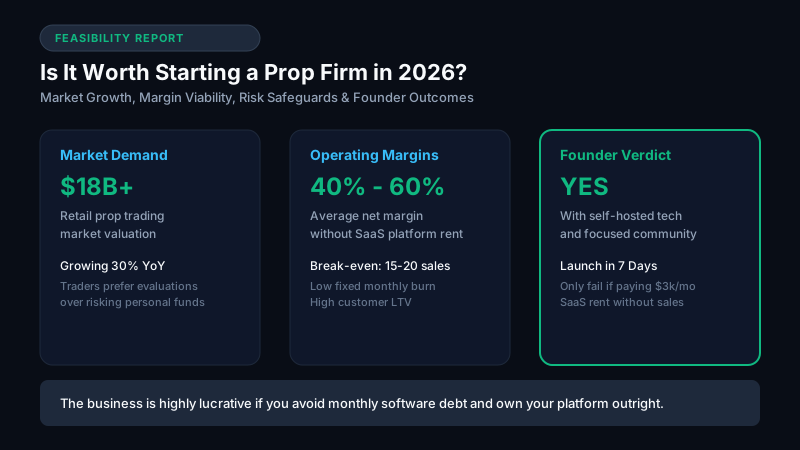
The Question Worth Asking Before Spending Anything
I get this question on WhatsApp multiple times a week. My answer is always the same: it depends on one thing more than anything else.
Is starting a prop firm actually worth it in 2026?
The honest answer depends on your situation. This article gives you the real numbers. not the optimistic version that vendor marketing uses, and not the pessimistic version that assumes you will fail.
See the platform before reading further
The Industry Reality in 2026
The funded trader industry grew from roughly $20 million in 2020 to over $800 million by 2025. That is real growth. Thousands of firms launched during this period.
It is also more competitive than it was in 2021 or 2022. The easy era when any firm could grow just by existing is over. Traders have more options and more information.
This does not mean the opportunity is gone. It means the bar is higher than it used to be.
What It Actually Costs
Platform: $2,495 to $7,400 one time, or $1,000 to $5,000 per month on SaaS. Hosting and price feed adds $70 per month. Marketing is time if organic, budget if paid.
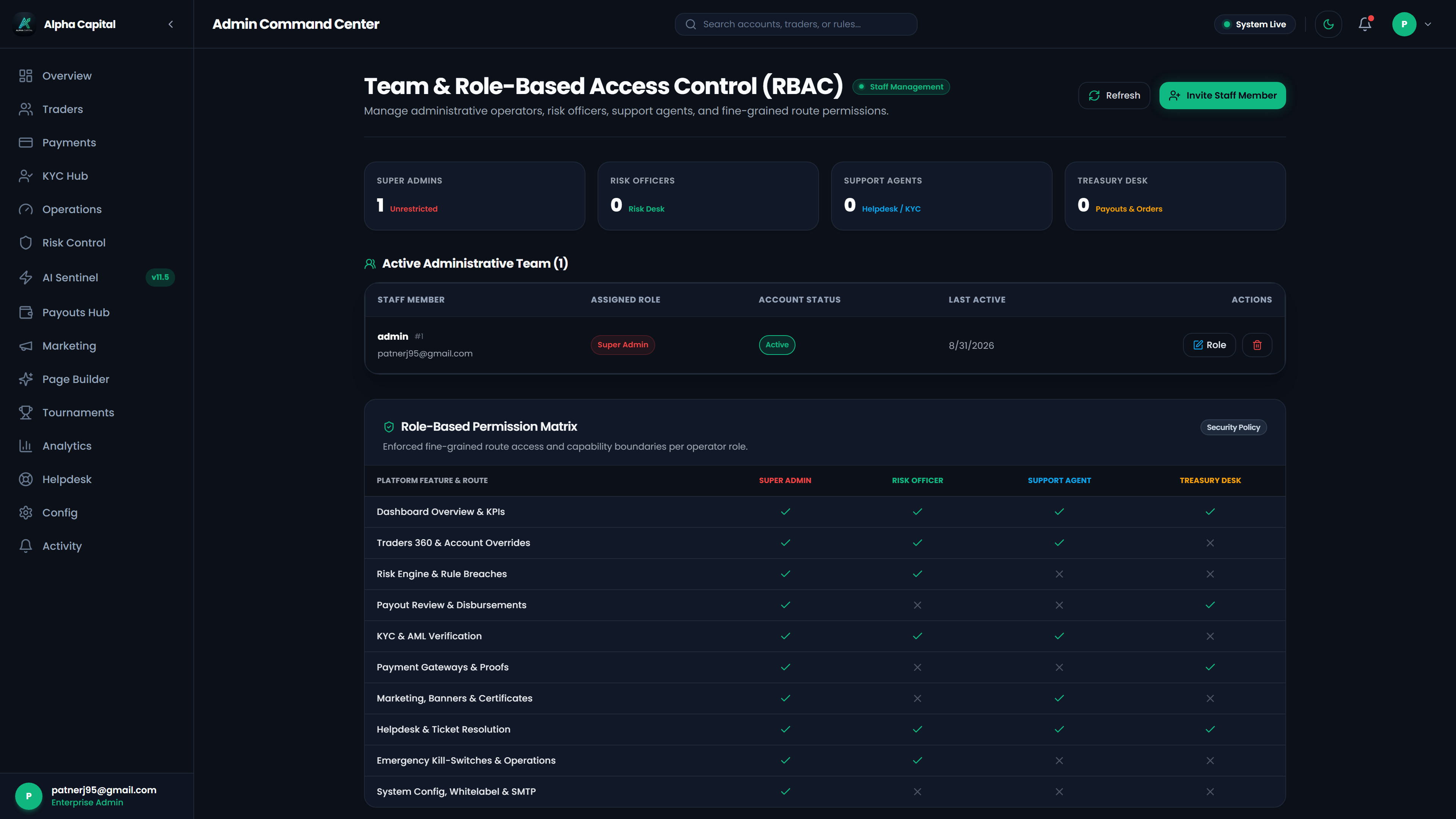
Comprehensive audit log capturing administrative actions, security timestamps, and operational system events.
Payout reserve is not a cost. It is a liability reserve. Set aside 25 to 30% of challenge fees from day one.
No license required in most jurisdictions. No broker registration. No compliance department on day one.
Skip the monthly fees
Own your prop firm platform outright. One time purchase.
Full source code. Live in 7 days. No revenue share. No monthly SaaS bill. See the exact platform before paying anything.
Demo login: haris / asdf1122. No signup needed
What the Revenue Looks Like
Month 1. realistic small launch with existing network:
20 challenge sales at $199 = $3,980
Payout reserve (25%) = $995
Platform hosting = $70
Net available = $2,915
Month 3. with word of mouth and some content:
50 challenge sales at $199 = $9,950
Payout reserve = $2,487
Net available = $7,393
Month 6. with affiliate program and community:
150 challenge sales at $199 = $29,850
Payout reserve = $7,462
Net available = $22,000 before funded trader payouts
These are not guaranteed numbers. They are what a firm with an existing network and consistent marketing can realistically achieve.
What Makes It Work
An existing audience. The firms that launch successfully almost always have a community. Forex educators, signal providers, trading Discord servers. They have traders who already trust them. First month sales come from this group.
Clear challenge rules. Rules that are fair but firm. Not so strict that good traders cannot pass, not so loose that everyone passes and payouts drain your reserves.
Consistent challenge sales. The business model only works with continuous new challengers. Rebuys from failed traders account for 30 to 40% of revenue in a healthy firm.
Payout discipline. Pay out funded traders who earn profits. This sounds obvious but it is where many firms failed. Reputation for reliable payouts drives word of mouth.
What Makes It Not Work
Launching with no audience and no plan to get one. The platform does not bring traders. You do.
Underpricing challenges. If your fee does not account for the percentage who pass, payouts drain faster than challenge fees come in.
Spending the payout reserve. Challenge fee revenue looks like profit until funded traders request payouts. Set aside 25 to 30% from day one. Do not touch it.
Paying monthly SaaS fees. At $2,000 to $5,000 per month, the platform alone can eat most of your early revenue. A one time license changes that math entirely.
Is It Worth It For You Specifically
Yes, if:
- You have an audience of active traders, even a small one
- You can commit 5 to 10 hours per week to operations
- You are buying a one time platform, not paying monthly SaaS
- You have $3,000 to $5,000 to start including reserve
No, if:
- You have zero trading community and no plan to build one
- You expect the platform to generate sales without marketing effort
- You are planning to use monthly SaaS and need immediate profit
The Honest Bottom Line
Starting a prop firm is worth it for the right person in the right situation. It is not passive income. It is a business that requires marketing, operations, and consistent effort.
The financial upside is real. A firm doing 100 challenges per month at $199 generates $20,000 per month before payouts. That is achievable within 6 to 12 months for someone with an audience and a plan.
The risk is also real. Without an audience or marketing plan, the business does not generate sales regardless of how good the platform is.
Try the live platform before deciding anything
Operator Tip: The right question is not whether prop firms are worth starting in general. It is whether you have the three things that determine outcome: an audience or marketing plan to attract traders, the discipline to maintain payout reserves, and the operational consistency to build trust over 6 to 12 months. With those three, the business model works.
Frequently Asked Questions
What is the realistic net margin for a prop trading firm?
60 to 75% net margin on challenge fee revenue is achievable with proper reserve management. The main cost is the payout reserve (25 to 30% of revenue). After hosting and market data, most of what remains is operator income.
How many monthly challenge sales does it take to make a prop firm worth running?
At $200 average challenge fee, 25 sales per month generates $5,000 gross, approximately $3,000 to $3,500 net. Most operators consider this breakeven level. At 100 monthly sales, net income exceeds $12,000. Whether that income level is worth the operational effort depends on the operator.
What are the most common reasons prop firms fail?
Undercapitalized payout reserves, misleading marketing that attracts regulatory attention, and scaling marketing faster than the business can support. Firms that handle these three correctly have a high survival rate.
Is the funded trader evaluation market saturated?
The market has more competition than in 2020 to 2022 but remains far from saturated. Most current firms target the same broad audience with similar challenge structures. Operators who find a specific niche (a particular trading style, geography, or asset class) have clear differentiation opportunities.
What makes the difference between a prop firm that succeeds and one that doesn't?
Consistent payouts, clear rules, and active marketing. The funded trader community talks. Firms that pay reliably and treat traders fairly build word-of-mouth referrals. Firms that delay payments or change rules retroactively lose reputation fast in trading communities.
Evaluate Your Prop Firm Readiness Score (0-100)
Answer 5 quick operational questions about your acquisition channels, runway, and engine tech to get a personalized launch roadmap.
Prop Firm Monthly Profit Simulator
Simulate your challenge revenue, payout liability, and net monthly take-home profit.
$20,000
From upfront challenge fees-$2,800
~10 funded payouts budgeted$0 / month
Saves $3,000/mo vs SaaS$17,200/mo
Run-rate: $206,400/yr
M.Haris
Founder & Platform ArchitectBuilding open prop trading software infrastructure for operators worldwide
I built LaunchPropFirm to give forex educators, trading communities, and fintech operators complete ownership of their platform with full source code and zero monthly SaaS rent. Every article on this blog is drawn from hands-on platform development, live MT5 risk bridge mechanics, and real operator economics.
All content, financial models, ROI estimates, and architecture guides on LaunchPropFirm are published strictly for educational and informational purposes. LaunchPropFirm provides institutional prop trading software and technology infrastructure; it does not operate as a broker, custodian, or registered investment advisor.
Evaluation challenges and funded trader accounts referenced in this guide operate in simulated demo trading environments using real-time market data feeds. Simulated trading results do not represent actual trading performance or financial advice.
Recommended Next Reads
Hand-picked operator guides to scale your prop trading platform.
Prop Firm Profit Split: How to Set It
Most prop firms offer 70-90% profit splits. Here is how the split works, what the market standard is in 2026, and how to set yours without hurting margins.
Prop Firm Liquidity Providers: Prime of Prime Directory
Compare the top prop firm liquidity providers and Prime of Prime brokers. Review FIX 4.4 API bridge latency, margin rules, crypto rails, and fee structures.
Skip the monthly fees
Own your prop firm platform outright. One time purchase.
Full source code. Live in 7 days. No revenue share. No monthly SaaS bill. See the exact platform before paying anything.
Demo login: haris / asdf1122. No signup needed