Prop Firm Taxes: Guide for Operators
Prop firm tax guide for operators: how challenge fee revenue is classified, what expenses are deductible, and how to structure your business to minimize tax.
Most prop firm tax articles are written for traders: how to classify payout income, whether challenge fees are deductible, how to file a 1099. If you are reading this as an operator, those guides are not for you. Operators running a prop firm with LaunchPropFirm are running a business, and the tax treatment of that business is straightforward once you understand the structure.
How Prop Firm Revenue Is Classified
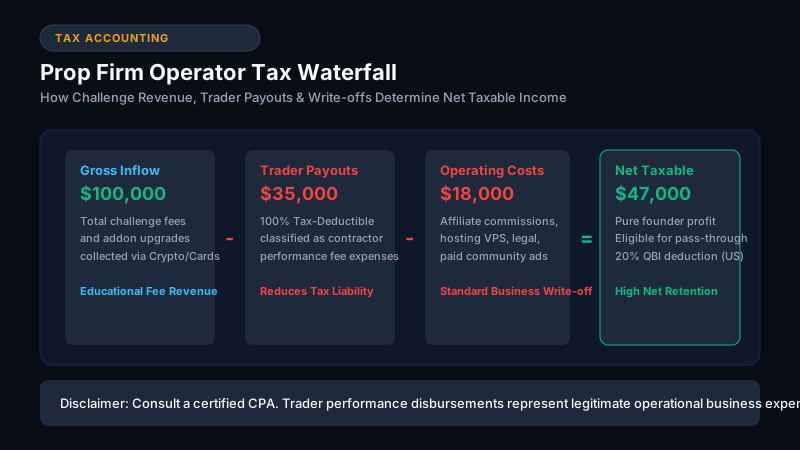
Your primary income as a prop firm owner is challenge fees. When a trader pays to attempt a funded account evaluation, that payment is ordinary business income for your firm. Reset fees, bonus product sales, and any subscription features also count as ordinary business income.
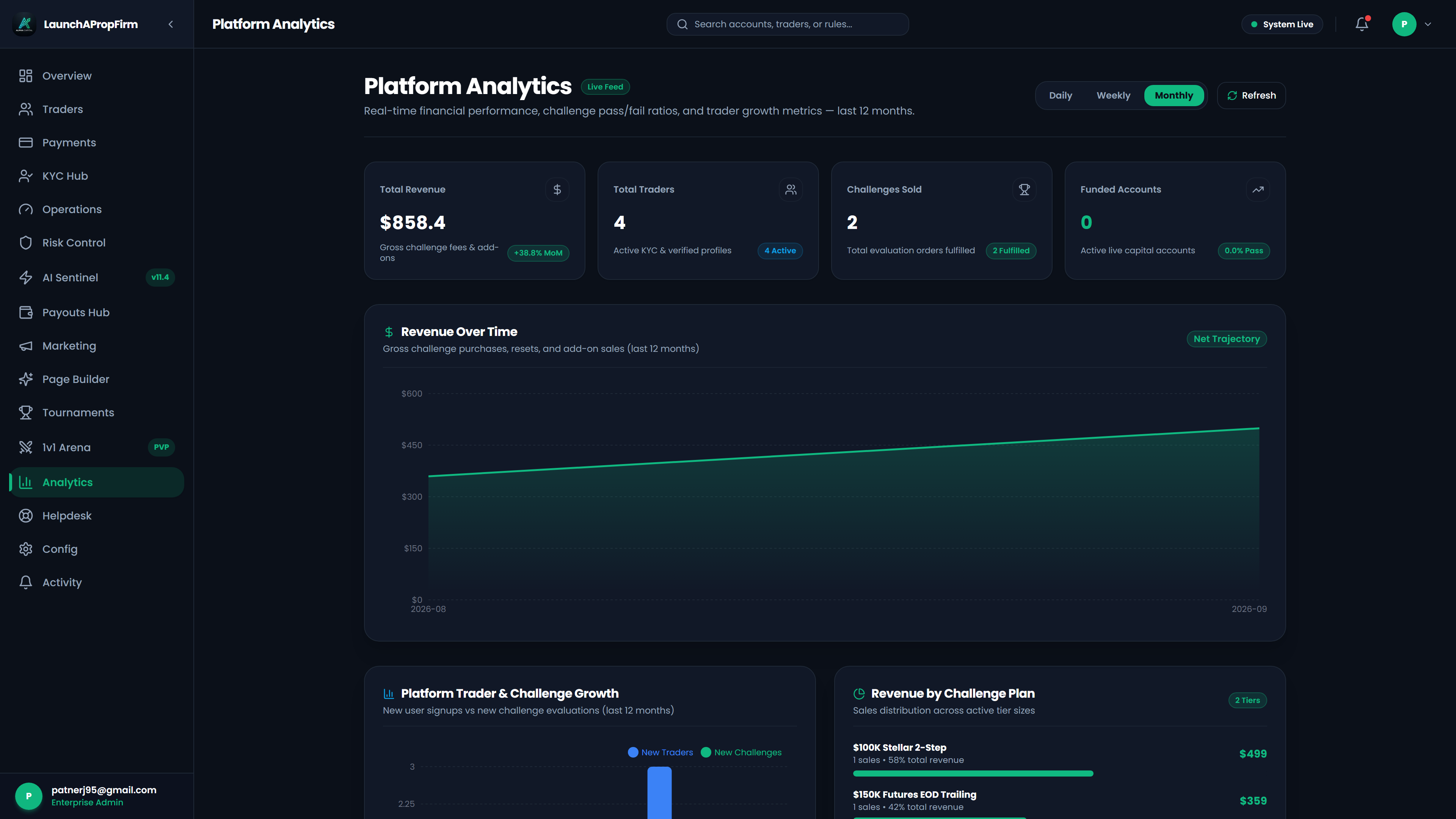
Financial analytics and cohort reporting dashboard providing granular visibility into firm unit economics and revenue retention.
This is not investment income. You are not trading financial markets for your own account, so capital gains rates do not apply to challenge fee revenue. The IRS and equivalent tax authorities in the UK, UAE, and other jurisdictions treat this as service business revenue, the same classification applied to a SaaS company or consulting firm.
The simulated nature of your platform's trading environment simplifies your position further. Since traders work with simulated capital, your firm has no market exposure and no trading gains or losses to report. Your revenue is your fees. That is the full picture.
What Business Structure Works for a Prop Firm
Most LaunchPropFirm operators in the United States register as a single-member LLC. The LLC provides personal liability protection and pass-through taxation, meaning net profits flow to the owner's personal return without a second layer of corporate tax.
An S-Corporation election on an existing LLC can reduce self-employment tax once the firm consistently earns above $80,000 to $100,000 in annual net profit. The S-corp structure lets you pay yourself a reasonable salary and take remaining profits as distributions, which are not subject to self-employment tax.
UK-based LaunchPropFirm operators typically register as a Limited Company (Ltd). UAE operators benefit from zero corporate tax on profits up to AED 375,000 and 9% on profits above that threshold. Pakistan-based operators running a business marketed to international traders often register a UK Ltd or UAE entity as the primary operating company, with local compliance handled separately. Consult a tax professional before choosing your registration country, as the country where you personally reside also affects your tax obligations.
Operator Tip: The country you register your business in matters, but so does where you physically live and work. Most jurisdictions tax business owners based on their country of residence, not the company's country of incorporation. A UAE entity owned by a UK resident is still taxed in the UK on distributions. Get advice from a cross-border accountant before committing to any structure.
What Expenses Are Tax-Deductible
LaunchPropFirm operators can deduct all ordinary and necessary business expenses from their revenue. Here is what qualifies:
| Expense | Examples | Notes |
|---|---|---|
| Platform license | LaunchPropFirm one-time fee | Deductible in full in year of purchase (100% bonus depreciation restored in 2026) |
| Trader payouts | All performance payouts to funded traders | Your largest recurring deductible expense |
| Affiliate commissions | Payments to affiliates who refer traders | Deductible as marketing expense |
| Payment processing | Stripe, crypto gateway fees | Deductible as transaction costs |
| Marketing | Paid ads, SEO tools, content production | Fully deductible |
| Support tools | Helpdesk, live chat, Discord subscriptions | Deductible |
| Legal and compliance | Contract drafting, KYC tools, terms review | Deductible |
| Home office | Portion of home used exclusively for the business | Deductible using square footage or simplified method |
| Professional services | Accountant, bookkeeper | Deductible |
The LaunchPropFirm license fee is often the largest single expense in your first year. Under 2026 IRS rules, the bonus depreciation rate is restored to 100%, meaning you deduct the full cost in the year you pay it rather than spreading it across multiple years. For the full list of what LaunchPropFirm includes, visit launchapropfirm.com.
Skip the monthly fees
Own your prop firm platform outright. One time purchase.
Full source code. Live in 7 days. No revenue share. No monthly SaaS bill. See the exact platform before paying anything.
Demo login: haris / asdf1122. No signup needed
How Trader Payouts Reduce Your Tax Bill
Trader payouts are a business expense and reduce your taxable income directly. A LaunchPropFirm firm that collects $200,000 in challenge fees and pays out $80,000 to funded traders has a gross profit of $120,000 before other deductions.
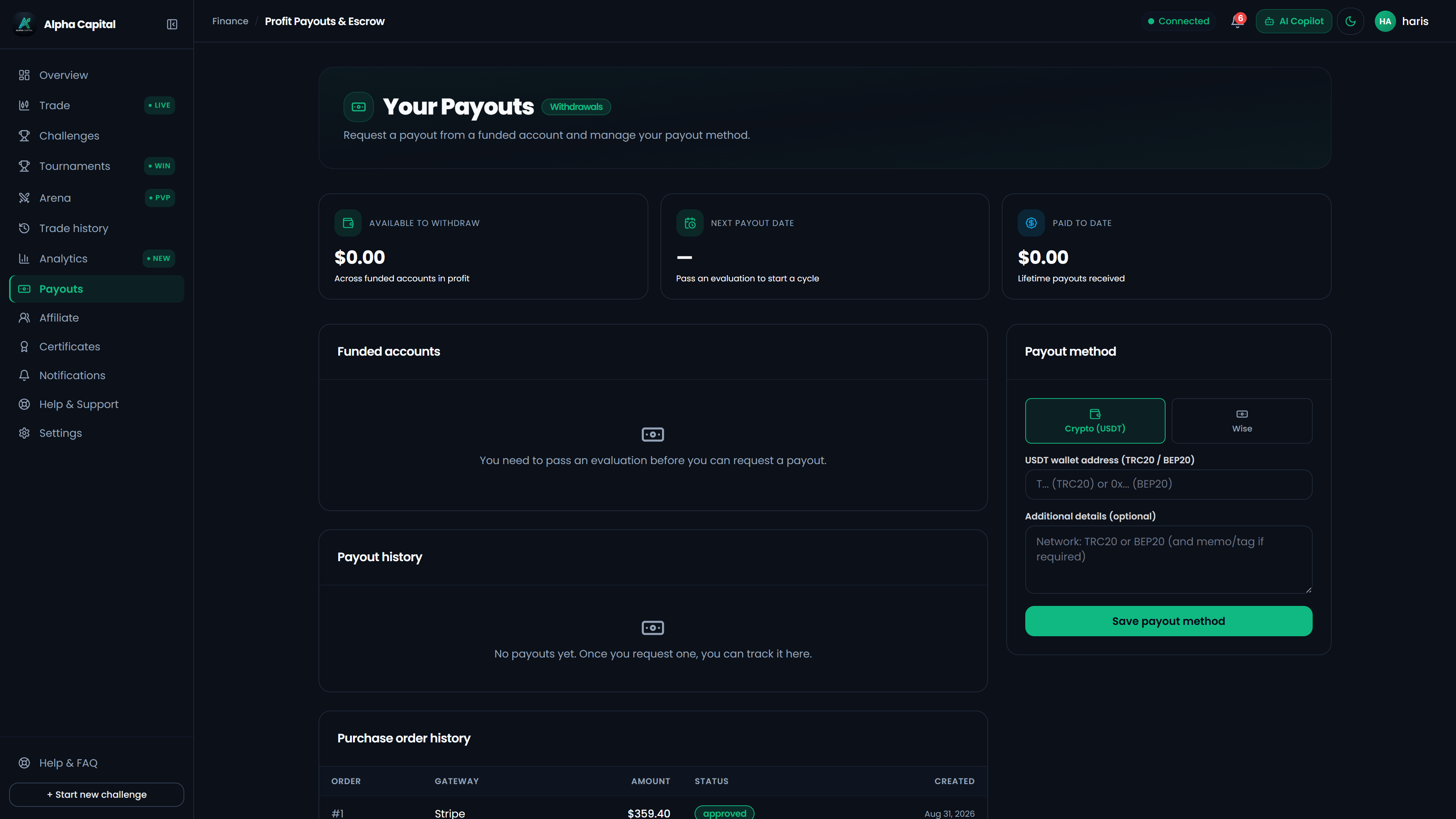
Verifiable digital certificates awarded to traders upon completing evaluation stages and receiving performance payouts.
In the United States, you must issue a 1099-NEC to any trader you pay more than $600 in a calendar year. Collect their Social Security Number or Employer Identification Number before processing any payout above that threshold. LaunchPropFirm's payout management system logs every transaction with date, amount, and recipient, which makes year-end 1099 preparation straightforward.
Traders outside the United States do not require a 1099 form, but keep records regardless. Every payout should run through your platform's logged system rather than informal transfers, because deductions require documentation your accountant can verify.
Operator Tip: Do not pay traders through personal bank transfers or informal apps without records. Informal payouts with no paper trail cannot be deducted, and you will owe tax on gross revenue rather than net profit. LaunchPropFirm's payout system creates the documentation automatically. Visit launchapropfirm.com to see how the payout and affiliate modules work.
The QBI Deduction for US Prop Firm Owners
The Qualified Business Income deduction allows eligible pass-through business owners to deduct up to 20% of their qualified business income from their taxable income. A LaunchPropFirm operator with $100,000 in net profit could potentially reduce taxable income to $80,000 through this deduction alone.
The QBI deduction applies to sole proprietors, partnerships, S-corporations, and LLCs taxed as pass-throughs. It phases out at higher income levels and does not apply to C-corporations. Your accountant calculates the exact figure based on your entity type, income level, and whether your firm qualifies as a specified service trade or business under IRS guidance.
When to Hire a Tax Professional
Handling your own taxes works at very low revenue. Once your LaunchPropFirm firm is regularly collecting challenge fees, the cost of an incorrect structure is higher than the cost of one professional consultation.
Hire a tax professional when your annual revenue passes $30,000, when you start paying out to traders in multiple countries, or when you are weighing an S-corp election. A CPA familiar with online service businesses typically charges $200 to $400 for an initial consultation and identifies deductions that pay for that fee several times over.
You can launch your prop firm and start collecting challenge fees within 7 days using LaunchPropFirm. Get the tax structure in place before revenue scales, not after. See how prop firm revenue models work and what the full startup costs look like for a broader view of the financial picture.
FAQ
Is challenge fee income treated as capital gains or ordinary income?
Challenge fees are ordinary business income in most jurisdictions, not capital gains. You are providing a service, and traders are paying for access to that service. Long-term capital gains rates apply to investment assets held over time, not to fees charged by a service business. Your accountant files this on Schedule C, through your LLC return, or through your corporate filing depending on your entity type.
Can I deduct the LaunchPropFirm platform license as a business expense?
Yes. The LaunchPropFirm license is an ordinary and necessary business expense. Under current US rules, the 2026 bonus depreciation restoration means you deduct the full license cost in the year of purchase. The Source Code tier ($2,500), Launch Ready tier ($4,500), and Launch Partner tier ($7,400) are all fully deductible in the year you pay them.
Do I need to issue 1099s to funded traders I pay out?
In the United States, you must issue a 1099-NEC to any trader paid more than $600 in a calendar year. This requires collecting their tax identification number before processing the payout. Traders outside the United States do not require a 1099, but maintain complete payout records in your LaunchPropFirm dashboard to support your accounting regardless.
What is the best business structure for a prop firm owner?
A single-member LLC is the most common starting point for US-based operators, providing liability protection and pass-through taxation. An S-Corporation election reduces self-employment tax once net profits consistently exceed $80,000 per year. UK operators register as a Limited Company, and UAE-based operators benefit from zero corporate tax under AED 375,000 and 9% above that threshold.
Are payouts to funded traders deductible as a business expense?
Yes. Payouts to funded traders are a business expense that reduces your firm's taxable income dollar for dollar. A firm collecting $200,000 in challenge fees and paying out $80,000 to traders reports $120,000 in gross profit before other deductions. Keep all payout records in your LaunchPropFirm account and reconcile them against your accounting records at year-end.
How does the QBI deduction work for prop firm owners?
The QBI deduction allows eligible pass-through entity owners to deduct up to 20% of their qualified business income from taxable income. A LaunchPropFirm firm with $100,000 in net profit operating as an LLC or sole proprietorship could reduce taxable income to $80,000 through this provision. The deduction phases out at higher income thresholds and your accountant will calculate the exact figure for your entity type and income level. See how prop firms generate revenue for context on how the revenue model feeds into this calculation.
Evaluate Your Prop Firm Readiness Score (0-100)
Answer 5 quick operational questions about your acquisition channels, runway, and engine tech to get a personalized launch roadmap.
Prop Firm Monthly Profit Simulator
Simulate your challenge revenue, payout liability, and net monthly take-home profit.
$20,000
From upfront challenge fees-$2,800
~10 funded payouts budgeted$0 / month
Saves $3,000/mo vs SaaS$17,200/mo
Run-rate: $206,400/yr
M.Haris
Founder & Platform ArchitectBuilding open prop trading software infrastructure for operators worldwide
I built LaunchPropFirm to give forex educators, trading communities, and fintech operators complete ownership of their platform with full source code and zero monthly SaaS rent. Every article on this blog is drawn from hands-on platform development, live MT5 risk bridge mechanics, and real operator economics.
All content, financial models, ROI estimates, and architecture guides on LaunchPropFirm are published strictly for educational and informational purposes. LaunchPropFirm provides institutional prop trading software and technology infrastructure; it does not operate as a broker, custodian, or registered investment advisor.
Evaluation challenges and funded trader accounts referenced in this guide operate in simulated demo trading environments using real-time market data feeds. Simulated trading results do not represent actual trading performance or financial advice.
Recommended Next Reads
Hand-picked operator guides to scale your prop trading platform.
FTMO vs Funding Pips: 2026 Comparison
Compare FTMO vs Funding Pips challenge rules, pricing, drawdown math, and payouts. Discover which prop firm model is best for traders and operators in 2026.
Propriotec Alternative Prop Firm Guide
Looking for a Propriotec alternative? Compare recurring SaaS costs against full source code ownership, zero monthly fees, MT5 bridges, and instant setup.
Skip the monthly fees
Own your prop firm platform outright. One time purchase.
Full source code. Live in 7 days. No revenue share. No monthly SaaS bill. See the exact platform before paying anything.
Demo login: haris / asdf1122. No signup needed