How Do Prop Firms Make Money? Real Revenue & Profit Math
Uncover how prop trading firms make money in 2026: Evaluation challenge fees, trader failure rates, B-Book spread markups, and profit split retainers.
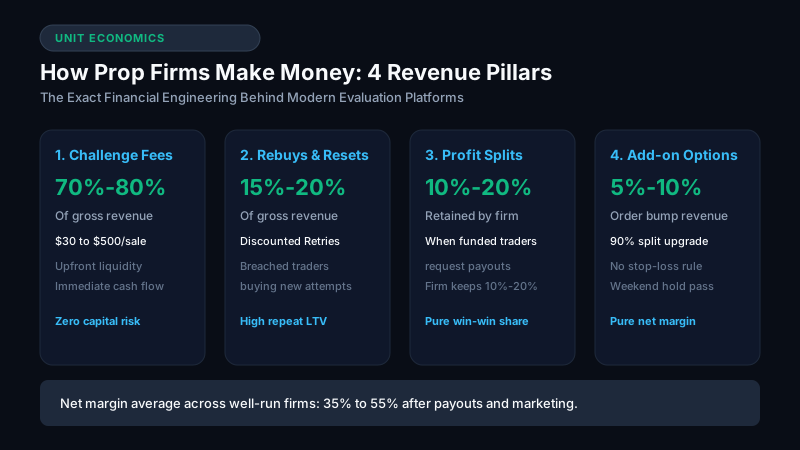
The Question Everyone Gets Wrong
When I explain the prop firm revenue model to people, most of them are surprised. The money flows differently than they expected.
People assume prop firms make money by taking a cut of what funded traders earn.
That is part of it. But it is not where most of the revenue comes from.
The real model is simpler and more predictable than most people expect. Once you understand it, you will see why so many forex educators and trading community owners are launching their own firms right now.
See the platform before reading further
Revenue Stream 1: Challenge Fees
This is the main engine.
A trader pays $199 to attempt a two phase evaluation. They need to hit an 8% profit target in Phase 1, then 5% in Phase 2, while staying within drawdown limits.
Most traders do not pass.
Industry data puts the combined pass rate across both phases at around 5% to 10%. That means for every 100 traders who buy a challenge, 90 to 95 pay the fee and never reach a funded account.
Those fees are yours to keep.
At $199 per challenge and 50 traders per month, that is $9,950 in revenue. Most of it comes with no payout obligation because most traders breach before passing.
The model is not predatory. Traders choose to attempt challenges knowing the rules. The firm sets fair evaluation criteria and pays out those who meet them. But the math heavily favors the firm.
Revenue Stream 2: Challenge Rebuys
When a trader fails, they often try again.
Some traders buy the same challenge 3, 5, or 10 times before passing or giving up. Each rebuy is full price. You do not need to acquire a new customer to generate that revenue.
This is why challenge pass rates being low does not hurt the business. A motivated trader who fails twice and buys again has paid you $597 before they ever reach a funded account.
Skip the monthly fees
Own your prop firm platform outright. One time purchase.
Full source code. Live in 7 days. No revenue share. No monthly SaaS bill. See the exact platform before paying anything.
Demo login: haris / asdf1122. No signup needed
Revenue Stream 3: Profit Splits
When a funded trader makes money, the firm takes a share. How operators cover this payout depends on whether they hedge winning accounts externally—see our A-Book vs B-Book risk guide for the mathematical breakdown of internalizing orders versus routing to prime brokers.
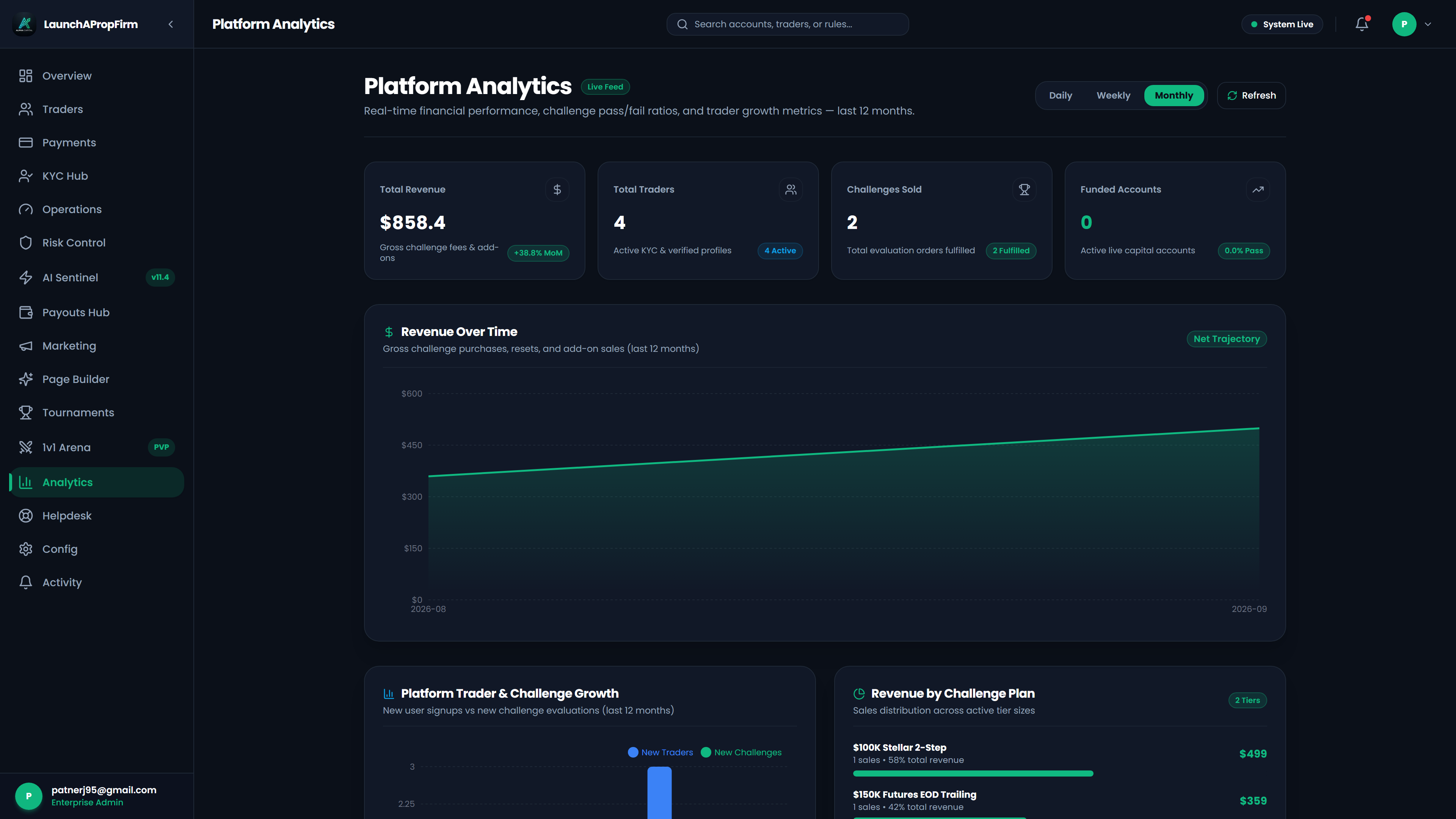
Financial analytics and cohort reporting dashboard providing granular visibility into firm unit economics and revenue retention.
Standard splits in 2026 range from 10% to 20% firm side. At 80% split to the trader, a trader who earns $2,000 in a month generates $400 for the firm.
This revenue stream scales with your funded trader count. 50 active funded traders each earning $1,000 per month at 80% split means $10,000 per month in split revenue on top of challenge fees.
The key word is simulated. Funded accounts use demo accounts against live market pricing. The firm is not taking brokerage risk. Payouts come from challenge fee reserves, not from actual trading gains.
Revenue Stream 4: Account Upgrades
Many firms offer funded traders the option to scale their account.
A trader who passes on a $25,000 account and performs well can pay to upgrade to a $50,000 or $100,000 account. This is additional revenue without a new challenge sale.
Not every platform supports this. It is worth building in from day one if your software allows it.
The Cost Side
Revenue is only half the picture.
Your main variable cost is payouts. Every funded trader who earns profit is a liability. At 80% split, a trader who makes $1,000 means you owe $800.
Most operators set aside 25% to 30% of all challenge fee revenue as a payout reserve. If you bring in $10,000 in challenge fees this month, put $2,500 to $3,000 in a separate account and do not touch it.
Other costs are mostly fixed and low. Hosting runs $15 to $20 per month. An MT5 price feed runs $30 to $50 per month. Payment processing fees are around 3% of transactions.
If you are on a one time platform license, your platform cost is already paid. No monthly SaaS fee eating into margins.
Why the Model Works at Small Scale
A funded trader business does not need 10,000 traders to be profitable.
Here is what month one can look like at small scale.
40 traders buy challenges at $199. Revenue is $7,960.
8 traders pass Phase 1. 3 reach funded status.
Payout reserve set aside: $1,990.
Net after reserve and hosting: roughly $5,900.
Month two, some of those 40 traders rebuy. New traders come from word of mouth. Funded traders start sharing certificates. The business compounds without needing paid ads.
What This Means If You Are Thinking About Starting One
The prop firm model is predictable because most of the revenue does not depend on funded traders performing well.
Challenge fees are collected upfront. Payouts only happen when traders earn profits. The firm controls the evaluation rules, so it controls the pass rate and the payout exposure.
Compared to running a signal service or a coaching business, a prop firm generates more revenue per customer, has built in rebuys, and creates a community of traders who are invested in your platform.
The technology to run one used to cost $150,000 to build and $2,000 to $5,000 per month to rent. A one time license model changes that math completely.
Common Questions About Prop Firm Revenue
Do prop firms make money from funded traders?
Some profit split revenue comes from funded traders, but this is not the primary income source. Most prop firm revenue comes from challenge fees paid by traders attempting the evaluation. The majority of traders do not pass, and their fees are kept by the firm.
What percentage of traders pass a prop firm challenge?
Industry estimates put the combined pass rate across both phases at 5% to 10%. This means 90 to 95 traders out of every 100 who buy a challenge pay the fee without ever reaching a funded account.
How much does a prop firm make per month?
A small prop firm with 50 challenge sales per month at $199 generates roughly $10,000 in monthly revenue before payouts. Payout reserves of 25 to 30% should be set aside, leaving approximately $7,000 in working revenue at small scale.
Operator Tip: The funded evaluation model is a fee-based business, not a trading business. Your revenue does not depend on trader profitability. It depends on challenge volume and rebuy rate. Operators who understand this from day one make better marketing and pricing decisions than those who think of it primarily as a trading operation.
Frequently Asked Questions
What is the primary revenue source for a prop firm?
Challenge fees from traders who do not pass the evaluation. With a 5 to 10% combined pass rate, 90 to 95% of traders pay the challenge fee without receiving a funded account. This fee revenue is the business engine.
How do rebuys contribute to revenue?
Failed traders frequently purchase again, often within days of failing. Rebuy rates of 20 to 35% are common among active trading communities. These rebuys are high-margin because there is no additional marketing cost involved.
What is the role of profit splits in prop firm revenue?
Profit splits from funded traders represent 5 to 15% of total revenue for most firms. This is a secondary income stream. The primary revenue is challenge fees. Funded trader management is operationally necessary but not the main profit driver.
How do operators maximize challenge fee revenue?
Volume and pricing. More challenge sales at well-calibrated prices generate more revenue. Affiliate programs expand reach without proportional cost increases. Multiple challenge tiers capture different trader segments. Rebuying incentives (discounts for failed traders who return) increase rebuy rates.
What is a sustainable profit margin for a prop firm?
60 to 75% net margin on challenge fee revenue is achievable when payout reserves are managed correctly (25 to 30% set aside) and operational costs are controlled. Firms operating below this margin are typically either underpriced or holding insufficient reserves.
Model Your Firm's Monthly Cash Flow & Profit
Simulate challenger intake, pass rate payout reserves, and net operator margins with our free real-time economic calculator.
Prop Firm Monthly Profit Simulator
Simulate your challenge revenue, payout liability, and net monthly take-home profit.
$20,000
From upfront challenge fees-$2,800
~10 funded payouts budgeted$0 / month
Saves $3,000/mo vs SaaS$17,200/mo
Run-rate: $206,400/yr
M.Haris
Founder & Platform ArchitectBuilding open prop trading software infrastructure for operators worldwide
I built LaunchPropFirm to give forex educators, trading communities, and fintech operators complete ownership of their platform with full source code and zero monthly SaaS rent. Every article on this blog is drawn from hands-on platform development, live MT5 risk bridge mechanics, and real operator economics.
All content, financial models, ROI estimates, and architecture guides on LaunchPropFirm are published strictly for educational and informational purposes. LaunchPropFirm provides institutional prop trading software and technology infrastructure; it does not operate as a broker, custodian, or registered investment advisor.
Evaluation challenges and funded trader accounts referenced in this guide operate in simulated demo trading environments using real-time market data feeds. Simulated trading results do not represent actual trading performance or financial advice.
Recommended Next Reads
Hand-picked operator guides to scale your prop trading platform.
Prop Firm Profit Split: How to Set It
Most prop firms offer 70-90% profit splits. Here is how the split works, what the market standard is in 2026, and how to set yours without hurting margins.
Prop Firm Liquidity Providers: Prime of Prime Directory
Compare the top prop firm liquidity providers and Prime of Prime brokers. Review FIX 4.4 API bridge latency, margin rules, crypto rails, and fee structures.
Skip the monthly fees
Own your prop firm platform outright. One time purchase.
Full source code. Live in 7 days. No revenue share. No monthly SaaS bill. See the exact platform before paying anything.
Demo login: haris / asdf1122. No signup needed