Prop Firm vs Hedge Fund: Key Differences
Prop firms and hedge funds both trade capital but are completely different businesses. Here is how the models differ, who they serve, and which you can start.
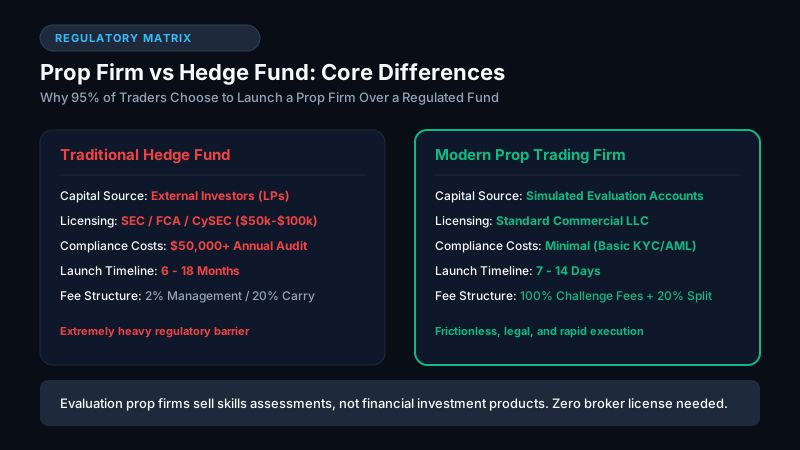
Two Very Different Businesses
I get asked this regularly. What is the difference between a prop firm and a hedge fund?
The short answer: a hedge fund manages other people's money. A prop firm trades its own capital or runs an evaluation model. Completely different regulatory environments, different capital requirements, different customer relationships.
See what a modern prop firm platform looks like
Hedge Funds: Managing Other People's Money
A hedge fund takes capital from outside investors. institutions, high-net-worth individuals. and manages it with the goal of generating returns. Investors share in the profits (typically 20% to the fund) and pay a management fee (typically 2% of assets annually).
Hedge funds are heavily regulated. In the US, they typically register with the SEC. In the UK, with the FCA. They have compliance requirements, investor reporting obligations, and restrictions on who can invest.
Starting a hedge fund requires substantial capital, regulatory approval, compliance infrastructure, and usually an established track record as a portfolio manager.
The minimum realistic setup cost for a legitimate hedge fund is $500,000 to $2,000,000 including legal, compliance, technology, and seed capital.
Prop Firms: Trading Your Own Capital or Running Evaluations
Traditional prop firms trade the firm's own capital. Traders are employees or contractors who receive a salary and a profit split. The firm takes all the risk with its own money.
The funded trader evaluation model is different. The firm sells evaluation challenges to traders. Traders pay a fee, trade a simulated account, and if they pass, receive a funded account where profits are split with the firm.
In this model, the firm is not managing investor capital. The funded accounts use simulated positions against live market pricing. The firm's revenue comes primarily from challenge fees, not trading profits.
Skip the monthly fees
Own your prop firm platform outright. One time purchase.
Full source code. Live in 7 days. No revenue share. No monthly SaaS bill. See the exact platform before paying anything.
Demo login: haris / asdf1122. No signup needed
Regulation: The Key Difference
Hedge funds are investment advisors managing third-party capital. They require registration and ongoing compliance.
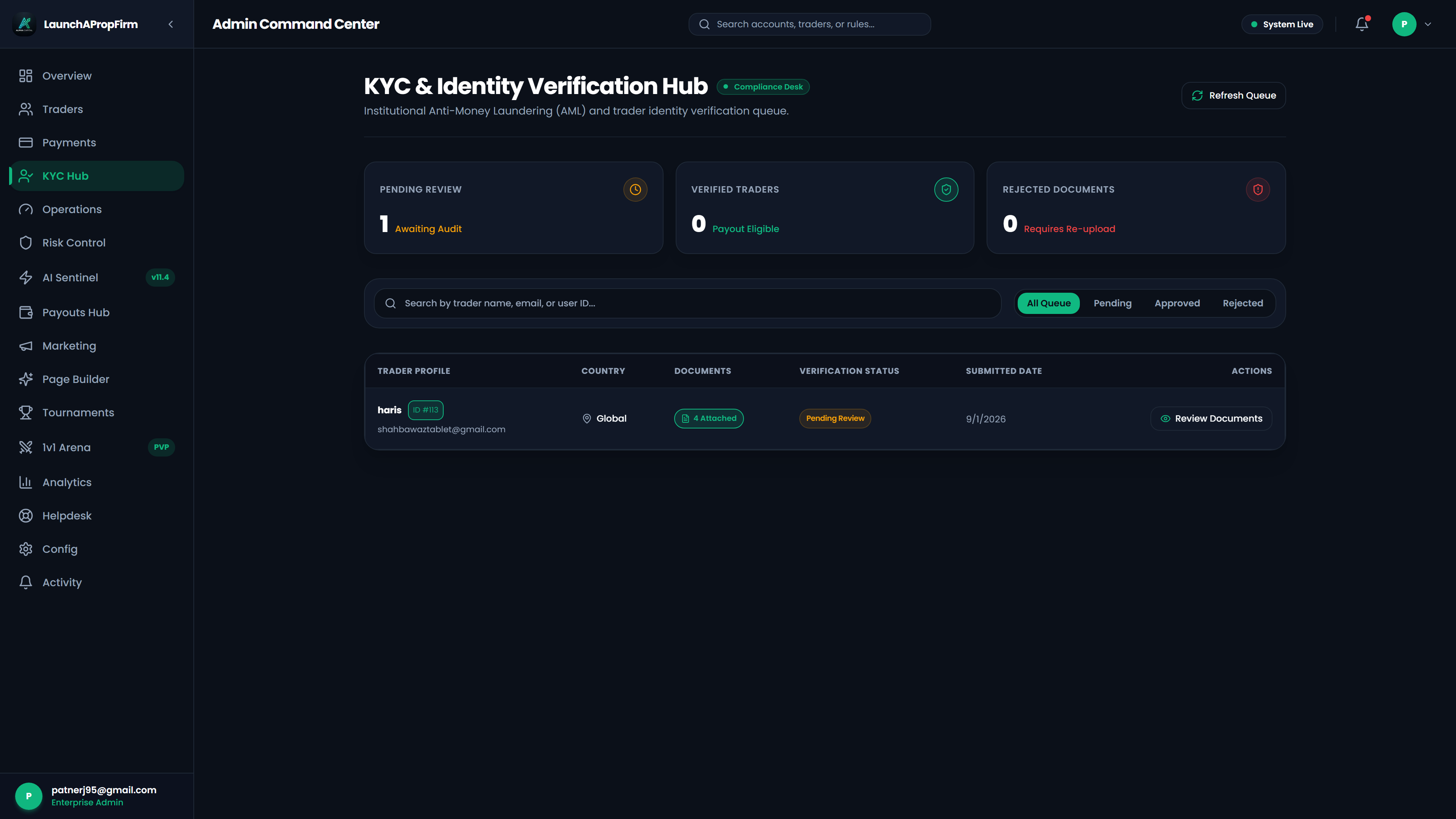
Financial analytics and cohort reporting dashboard providing granular visibility into firm unit economics and revenue retention.
Funded trader evaluation firms operating on simulated accounts are in a different category. They are selling an evaluation service, not managing investor funds. Most operate without broker licenses or investment advisor registration.
This is why thousands of prop firms launched between 2018 and 2025 without SEC or FCA registration. The model does not involve managing outside investor capital.
Regulatory scrutiny is increasing and varies by jurisdiction. Transparency in marketing. clearly communicating that accounts are simulated. is the key risk factor.
Which One You Can Actually Start
A hedge fund requires capital, regulatory approval, and connections to institutional investors. This is not a realistic starting point for most people.
A funded trader evaluation firm requires a platform, a payment system, challenge rules, and traders who know you exist. The technology costs $2,495 to $7,400 one time. The regulatory burden is minimal in most jurisdictions for the evaluation model.
If you have an audience of traders who trust you, a funded trader evaluation firm is one of the most accessible financial businesses to start in 2026.
Overlap: Where They Look Similar
Both prop firms and hedge funds employ or work with professional traders. Both involve profit splits. Both involve risk management.
But the capital structure, the regulatory environment, and the customer relationship are completely different. A hedge fund investor is trusting you with their savings. A prop firm challenger is paying you to evaluate their trading skills.
Operator Tip: The funded evaluation model and the hedge fund model are often confused but are structurally different businesses. A hedge fund manages external capital and generates returns for investors. A prop firm in the evaluation model generates revenue from challenge fees, not trading profits. The regulatory treatment, capital requirements, and business risk profiles are entirely different.
Frequently Asked Questions
What is the fundamental difference between a prop firm and a hedge fund?
A hedge fund manages investor capital and generates returns for those investors. A funded evaluation prop firm charges traders a fee to evaluate their trading skill on simulated accounts. The prop firm does not manage investor capital. The businesses are structurally and legally distinct.
Do prop firms need the same licenses as hedge funds?
No. Hedge funds managing investor capital require investment management licenses (e.g., SEC registration in the US, FCA authorization in the UK). Funded evaluation firms operating on simulated accounts do not fall under these frameworks in most current regulatory analyses.
Which is easier to start: a prop firm or a hedge fund?
A funded evaluation prop firm is significantly easier to start. No minimum capital requirements, no investor registration, no managed fund compliance. The operational complexity is far lower and the startup cost is a fraction of hedge fund formation costs.
Can a prop firm grow into a hedge fund?
Structurally, they are different businesses, not a natural progression. A prop firm operator who wants to manage external capital would need to create a separate legal entity, register with relevant regulators, and build a compliance infrastructure. It is a parallel business, not an upgrade.
What is the risk profile difference between the two models?
Hedge funds carry market risk on managed capital. A poorly performing period directly reduces AUM and fee revenue. Prop firms carry payout risk on challenge fee revenue. The payout risk is more predictable and manageable than market-dependent returns. Prop firm operators face business risk, not market risk.
Calculate SaaS Monthly Rent vs 1-Time Code Ownership
SaaS prop firm providers charge $2,500/mo plus 8% revenue share. Compare 12-month total expenses vs 100% source code ownership.
Prop Firm Monthly Profit Simulator
Simulate your challenge revenue, payout liability, and net monthly take-home profit.
$20,000
From upfront challenge fees-$2,800
~10 funded payouts budgeted$0 / month
Saves $3,000/mo vs SaaS$17,200/mo
Run-rate: $206,400/yr
M.Haris
Founder & Platform ArchitectBuilding open prop trading software infrastructure for operators worldwide
I built LaunchPropFirm to give forex educators, trading communities, and fintech operators complete ownership of their platform with full source code and zero monthly SaaS rent. Every article on this blog is drawn from hands-on platform development, live MT5 risk bridge mechanics, and real operator economics.
All content, financial models, ROI estimates, and architecture guides on LaunchPropFirm are published strictly for educational and informational purposes. LaunchPropFirm provides institutional prop trading software and technology infrastructure; it does not operate as a broker, custodian, or registered investment advisor.
Evaluation challenges and funded trader accounts referenced in this guide operate in simulated demo trading environments using real-time market data feeds. Simulated trading results do not represent actual trading performance or financial advice.
Recommended Next Reads
Hand-picked operator guides to scale your prop trading platform.
Prop Firm Profit Split: How to Set It
Most prop firms offer 70-90% profit splits. Here is how the split works, what the market standard is in 2026, and how to set yours without hurting margins.
Prop Firm Liquidity Providers: Prime of Prime Directory
Compare the top prop firm liquidity providers and Prime of Prime brokers. Review FIX 4.4 API bridge latency, margin rules, crypto rails, and fee structures.
Skip the monthly fees
Own your prop firm platform outright. One time purchase.
Full source code. Live in 7 days. No revenue share. No monthly SaaS bill. See the exact platform before paying anything.
Demo login: haris / asdf1122. No signup needed