Prop Firm Profit Split: How to Set It
Most prop firms offer 70-90% profit splits. Here is how the split works, what the market standard is in 2026, and how to set yours without hurting margins.
💡 Live Payout & Profit Split Audit: Curious what traders actually take home after 80% to 90% profit splits, fee refunds, and rail deductions? Test your numbers with our free Prop Firm Payout & Profit Split Calculator, or simulate operator payout liabilities with the Prop Firm Challenge Pricing & Reserve Simulator.
Prop Firm Profit Split: What the Number Actually Means
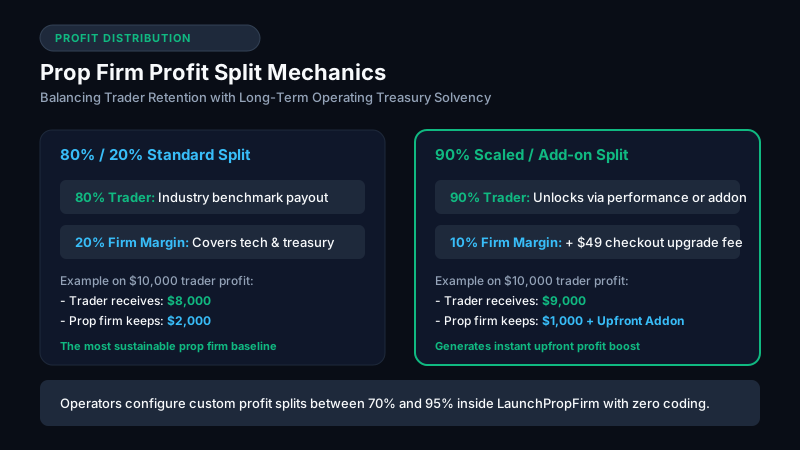
The profit split is the percentage of trading profits a funded trader keeps after passing your challenge. If you offer an 80% split and a trader earns $10,000 in their funded account, they receive $8,000 and you keep $2,000.
The number matters more for marketing than for revenue. Most prop firms collect the bulk of their income from challenge fees paid by traders who never reach the funded stage. The profit split only applies to the small percentage who pass.
That said, the split you advertise affects your conversion rate. Traders compare split percentages across firms before buying, which makes it a visible competitive variable even when its financial impact is smaller than it appears.
What the Market Charges in 2026
The industry has moved toward higher splits over the past three years. In 2021, 70% was standard. By 2026, 80% is the new floor and many firms offer 90% to attract serious traders.
| Firm Type | Typical Split | Notes |
|---|---|---|
| Entry-level firms | 70-75% | Lower splits, lower challenge fees |
| Mid-tier firms | 80% | Standard in 2026 |
| Premium firms | 85-90% | Higher challenge fees to compensate |
| Instant funding firms | 50-70% | Lower split, no evaluation phase |
Running a 90% split sounds generous but is only possible if your challenge fees are high enough to cover payouts. A $99 challenge with a 90% split on a $100,000 account is not sustainable at scale.
How to Set Your Profit Split
Start with the market rate for your account sizes and fees. If you charge $299 for a $100,000 challenge, offering 80% puts you in the competitive range. Offering 90% gives you a marketing edge but reduces your payout margin.
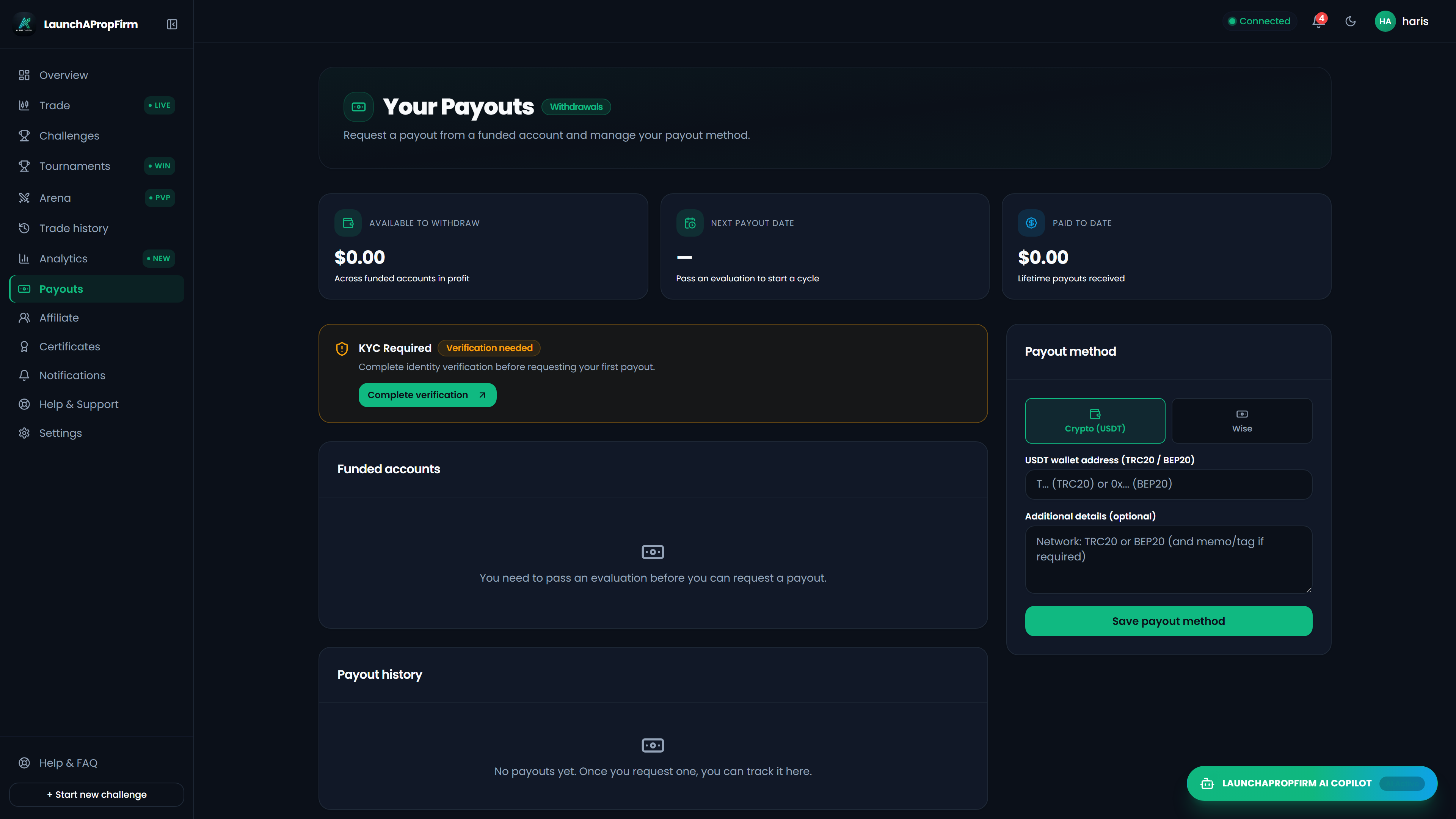
Trader payout dashboard facilitating instant on-demand withdrawal requests and profit share disbursements.
The calculation you need: multiply your expected monthly payouts (funded traders x average monthly profit x your split percentage) and compare that to your expected monthly challenge fee revenue. If payouts exceed 40% of challenge fee revenue, your split may be unsustainable at scale.
Most operators land at 80% as the standard split with an option to increase to 85-90% after a trader demonstrates consistent performance. This keeps the headline number competitive while protecting margins on new funded accounts.
Skip the monthly fees
Own your prop firm platform outright. One time purchase.
Full source code. Live in 7 days. No revenue share. No monthly SaaS bill. See the exact platform before paying anything.
Demo login: haris / asdf1122. No signup needed
Scaling Plans and Split Increases
Many prop firms combine profit splits with scaling plans. A trader starts at 80% on a $25,000 account. After hitting three consecutive profitable months, their account scales to $50,000 and their split increases to 85%.
This structure rewards successful traders and builds retention. It also ties the higher split to accounts that have already proven profitable for the firm, reducing the risk of generous payouts to inconsistent traders.
See Prop Firm Payout System for a full breakdown of how payouts are structured and processed.
Profit Split vs Challenge Fee: Which Drives More Revenue
For most prop firms under 1,000 monthly challenge buyers, challenge fees generate 85-95% of total revenue. Profit splits from funded traders contribute the remainder.
This ratio shifts as your firm scales and your funded trader base grows. A firm with 500 active funded traders generating average monthly profits of $2,000 at 80% split owes $1,600 per trader per month in payouts. That is $800,000 monthly in payout obligations, which requires strong challenge fee revenue to cover.
The profit split percentage itself rarely makes or breaks a prop firm financially. Drawdown rules, pass rates, and maximum account sizes have more impact on payout exposure than the split percentage.
Operator Tip: Advertise your profit split prominently on your homepage and challenge page. Traders use it as a fast comparison signal. The difference between 80% and 85% can meaningfully affect click-through rates on comparison sites even when the financial impact to the firm is small.
How LaunchPropFirm Handles Profit Splits
The LaunchPropFirm platform lets you configure profit split percentages per account tier. You can set different splits for $10,000, $50,000, and $200,000 accounts, and configure automatic split increases tied to scaling milestones.
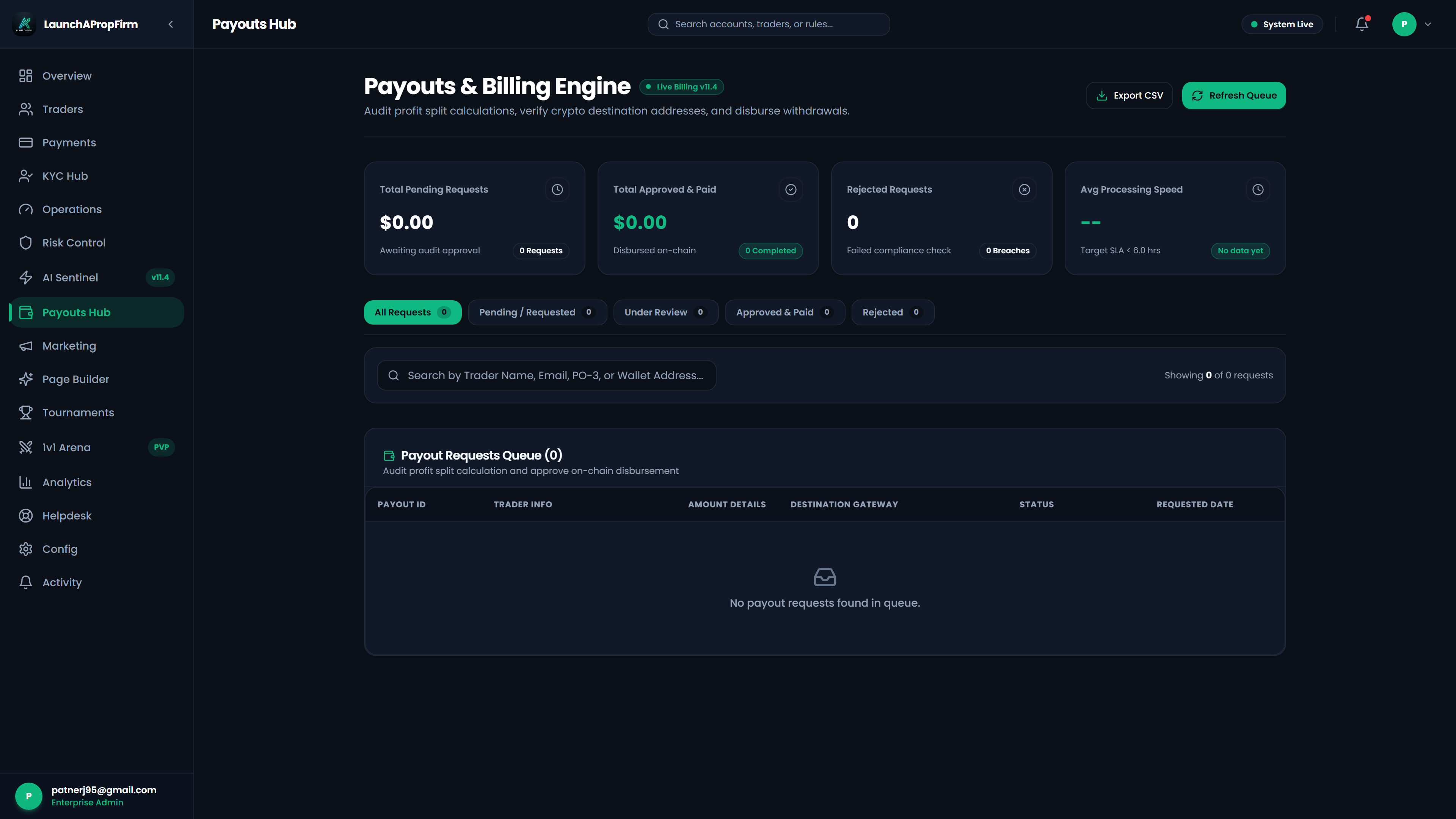
The payout center tracks each funded trader's profit balance, calculates the split automatically, and queues payouts for your approval. Platform pricing starts at $2,495 one time with no monthly fee or revenue share. Try the demo at demo.launchapropfirm.com.
FAQ
What is the standard profit split for prop firms in 2026?
80% is the current market standard for mid-tier prop firms. Premium firms offer 85-90%. Firms below 75% are increasingly uncompetitive unless they offer cheaper challenge fees or faster payouts to compensate.
Does a higher profit split hurt my margins?
Yes, but less than you might expect. Most prop firm revenue comes from challenge fees, not profit splits. Raising from 80% to 85% costs you 5% of what funded traders earn, but funded traders are typically 5-15% of all challenge buyers. The impact on total revenue is usually 1-3%.
Can I offer different splits for different account sizes?
Yes and most operators do. Smaller accounts often carry lower splits (75-80%) while larger accounts ($100,000-$200,000) offer higher splits (85-90%) to attract experienced traders more likely to be consistent.
What happens if a funded trader loses money?
You absorb the simulated loss on your platform. The trader typically has to rebuy a challenge to try again. Funded account losses are why drawdown rules matter more than profit splits in determining your actual payout exposure.
How do competitors display their profit splits?
Most prop firms list the profit split prominently on their pricing page alongside challenge fees, account sizes, and drawdown limits. Tables that show split alongside fee make comparison easier and typically convert better than narrative descriptions.
Calculate Your Net Prop Firm Payout & Profit Split
Compute your net take-home withdrawal after 80-90% splits, challenge fee refunds, and payment rail deductions.
Prop Firm Monthly Profit Simulator
Simulate your challenge revenue, payout liability, and net monthly take-home profit.
$20,000
From upfront challenge fees-$2,800
~10 funded payouts budgeted$0 / month
Saves $3,000/mo vs SaaS$17,200/mo
Run-rate: $206,400/yr
M.Haris
Founder & Platform ArchitectBuilding open prop trading software infrastructure for operators worldwide
I built LaunchPropFirm to give forex educators, trading communities, and fintech operators complete ownership of their platform with full source code and zero monthly SaaS rent. Every article on this blog is drawn from hands-on platform development, live MT5 risk bridge mechanics, and real operator economics.
All content, financial models, ROI estimates, and architecture guides on LaunchPropFirm are published strictly for educational and informational purposes. LaunchPropFirm provides institutional prop trading software and technology infrastructure; it does not operate as a broker, custodian, or registered investment advisor.
Evaluation challenges and funded trader accounts referenced in this guide operate in simulated demo trading environments using real-time market data feeds. Simulated trading results do not represent actual trading performance or financial advice.
Recommended Next Reads
Hand-picked operator guides to scale your prop trading platform.
Prop Firm Liquidity Providers: Prime of Prime Directory
Compare the top prop firm liquidity providers and Prime of Prime brokers. Review FIX 4.4 API bridge latency, margin rules, crypto rails, and fee structures.
Are Prop Firms Legit or a Scam? (2026 Operator Reality)
Are prop firms legit or designed to fail? Breakdown of evaluation mechanics, B-book risk models, regulatory compliance, and operator profit economics.
Skip the monthly fees
Own your prop firm platform outright. One time purchase.
Full source code. Live in 7 days. No revenue share. No monthly SaaS bill. See the exact platform before paying anything.
Demo login: haris / asdf1122. No signup needed