Prop Firm Liquidity Providers: Prime of Prime Directory
Compare the top prop firm liquidity providers and Prime of Prime brokers. Review FIX 4.4 API bridge latency, margin rules, crypto rails, and fee structures.
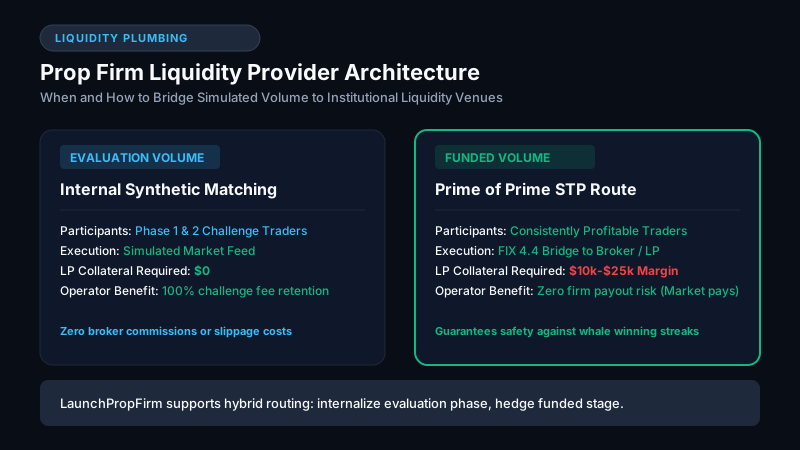
Do Prop Firms Need a Liquidity Provider?
Most retail prop firms do not need a liquidity provider. This is the first thing to understand clearly before spending time and money on broker relationships. To understand the operational distinction between passing simulated trades to an LP and internalizing risk, read our breakdown of Prop Firm Liquidity: A-Book vs B-Book.
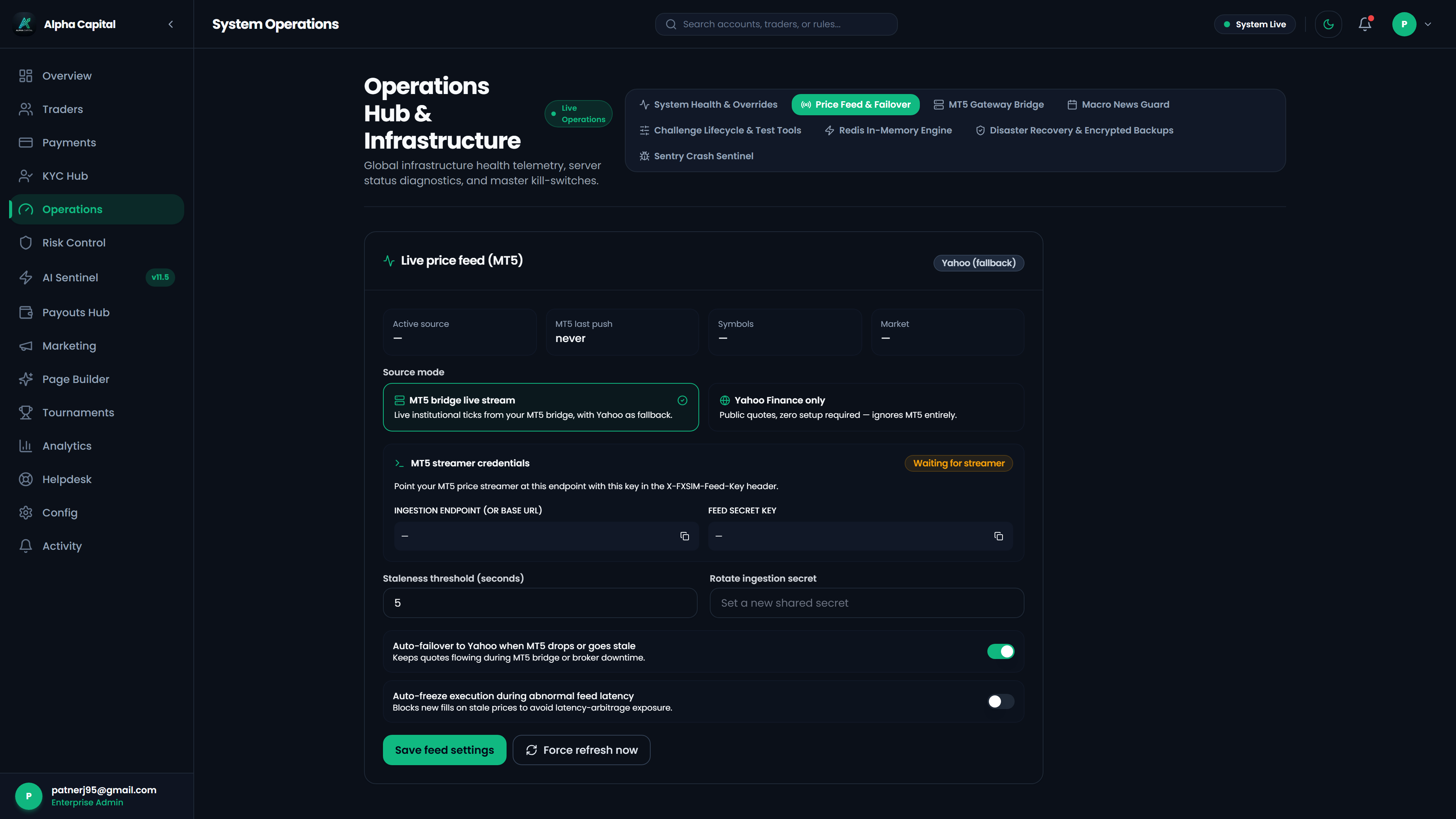
When a trader passes your challenge and starts trading in a funded account, the default setup for most white-label prop firm platforms is simulated trading. Trader positions are not sent to a real broker or market. The P&L is calculated based on real market prices, but no actual order is executed with a counterparty.
LaunchPropFirm uses TradingView as its charting and trading engine. TradingView provides real-time price feeds and order simulation. No positions are routed to a live broker by default. The firm tracks whether a trader would have profited or lost based on real prices, then pays out from its challenge fee revenue pool when traders earn profits. This is the standard model for most retail prop firms in 2026.
When You Would Want a Real Liquidity Provider
Some operators want a broker-backed model. This means funded trader positions are actually sent to a real broker and executed in live markets, with the prop firm managing exposure on the other side.
Reasons operators choose the broker-backed model include regulatory positioning, larger funded account sizes, and marketing differentiation. In some jurisdictions, showing that trader profits come from real market activity provides clearer legal standing. For funded account sizes above $500,000, routing positions to a broker allows the firm to hedge exposure in live markets. Some firms market themselves as broker-backed to differentiate from pure simulation operators.
If a trader or partner asks whether your firm is broker-backed and you want to offer that option, the path is connecting with an MT5 broker directly. LaunchPropFirm does not include a built-in LP, but any operator who wants broker connectivity can arrange it separately and wire it into the platform.
How Broker-Backed Prop Firms Work
In a broker-backed setup, the prop firm has an institutional account with a broker. When a funded trader places a trade, the platform routes that position to the broker account in real time. The broker executes it in live markets at real spreads and commissions.
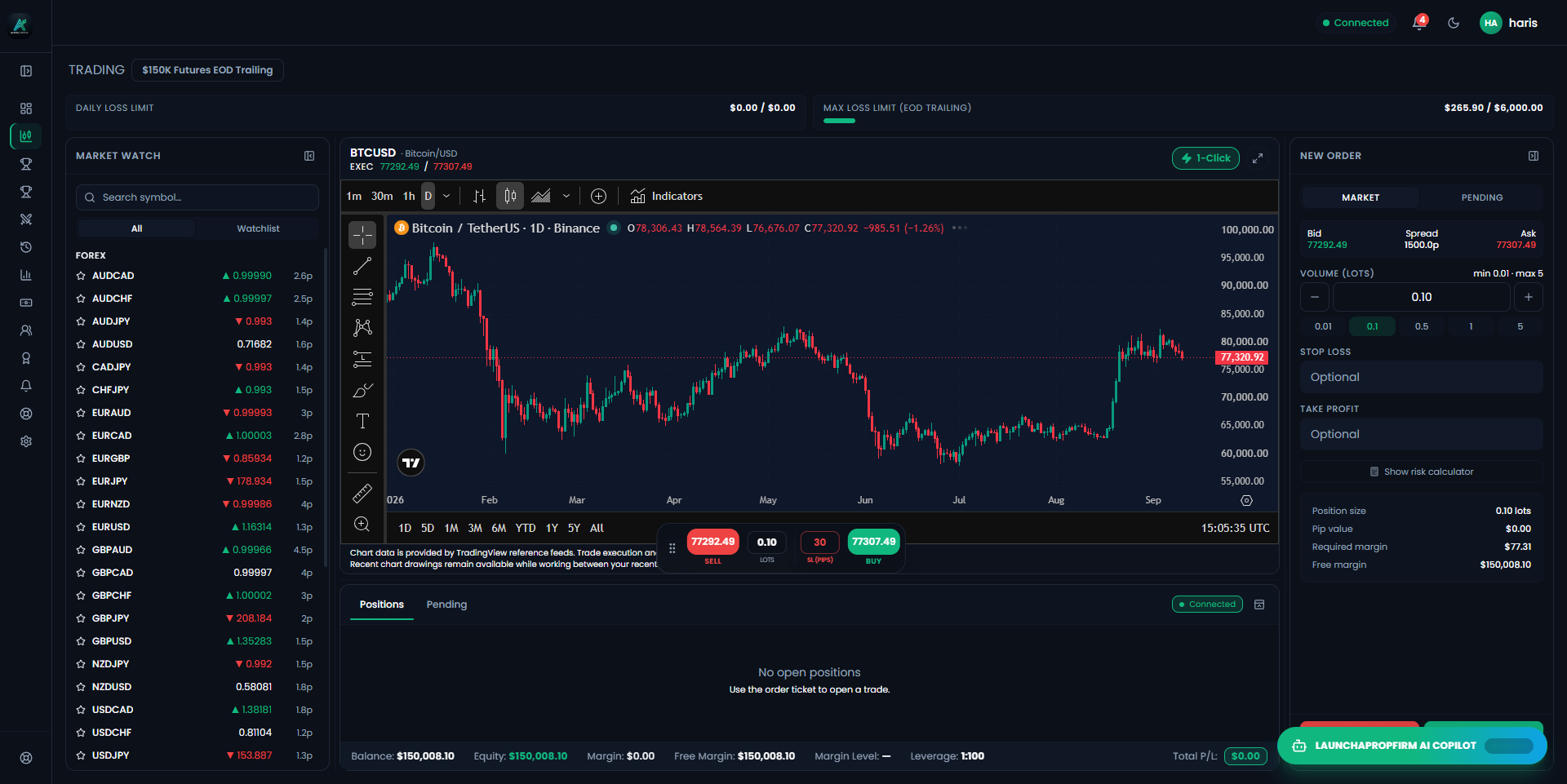
Detailed trade journal tracking execution timestamps, position sizes, and consistency rule compliance.
The prop firm then manages its own risk exposure across the entire pool of funded traders. If traders are collectively net long on EURUSD, the firm may hedge part of that exposure depending on its risk appetite.
| Model | LP Needed | Trader P&L Source | Best For |
|---|---|---|---|
| Simulation (default) | No | Real prices, simulated execution | Most prop firms |
| Broker-backed | Yes | Real market execution via MT5 broker | Large funded accounts |
| Hybrid | Partial | Mix of simulated and live | Scaling operators |
Skip the monthly fees
Own your prop firm platform outright. One time purchase.
Full source code. Live in 7 days. No revenue share. No monthly SaaS bill. See the exact platform before paying anything.
Demo login: haris / asdf1122. No signup needed
How to Connect a Broker as a Liquidity Provider
If you want to add a real LP to your LaunchPropFirm setup, the process involves connecting to an MT5 broker that accepts prop firm business.
You approach the broker directly and negotiate an institutional relationship. The broker provides server API access so your platform can route orders programmatically. Not all MT5 brokers work with prop firms. Some have policies against it, particularly in jurisdictions where prop firm regulation is unclear.
The technical connection works like this: your platform backend sends trade signals to the broker's MT5 server via API when funded traders place orders. The broker executes them and reports fills back to your system. This requires custom integration work beyond the standard LaunchPropFirm setup, done in coordination with the broker's technical team.
Key questions to ask any MT5 broker you approach: Do you accept prop firm clients? Can you provide server API access for order routing? What are your minimum deposit requirements for an institutional account? The answers narrow the field quickly.
For more on the legal side of prop firm structure, see Prop Firm License Requirements. For the broader tech stack overview, see Prop Firm Technology Provider.
Operator Tip: Start with the simulation model. It is simpler, cheaper, and sufficient for most prop firms through their first 1,000 funded traders. Add a real LP only when you have consistent funded trader profitability patterns that make hedging worthwhile, or when your funded account sizes are large enough that simulation payout risk requires market hedging.
FAQ
Does LaunchPropFirm include a liquidity provider?
No. LaunchPropFirm runs on TradingView as the trading engine with simulated execution by default. No LP is included or required for standard prop firm operations. If you want to connect a real MT5 broker for live order routing, that is a custom integration you arrange directly with a broker. The platform source code gives you the API layer to build that connection.
What is the difference between a simulated and broker-backed prop firm?
In a simulated firm, trader positions are tracked against real market prices but not executed in live markets. In a broker-backed firm, funded trader orders are actually routed to a broker and executed. The difference matters for regulatory positioning and for hedging large funded account exposure.
Which MT5 brokers work with prop firms?
Availability varies by region and broker policy. The best approach is to contact MT5 brokers in your jurisdiction directly and ask about institutional prop firm relationships. Brokers in offshore jurisdictions tend to have more flexible policies than regulated EU or US brokers.
How much does it cost to connect a liquidity provider?
The broker typically requires a minimum institutional deposit of $10,000-$100,000 depending on the firm. The technical integration connecting your platform to the MT5 server is custom development work, costing $2,000-$10,000 depending on complexity.
Is a broker-backed prop firm more legitimate than a simulated one?
Not necessarily. Most major retail prop firms run on simulation. Legitimacy comes from paying traders consistently and fairly, not from how the backend execution is structured. The broker-backed model adds operational complexity and cost without automatically making the firm more trustworthy to most retail traders.
Model Your Firm's Monthly Cash Flow & Profit
Simulate challenger intake, pass rate payout reserves, and net operator margins with our free real-time economic calculator.
Prop Firm Monthly Profit Simulator
Simulate your challenge revenue, payout liability, and net monthly take-home profit.
$20,000
From upfront challenge fees-$2,800
~10 funded payouts budgeted$0 / month
Saves $3,000/mo vs SaaS$17,200/mo
Run-rate: $206,400/yr
M.Haris
Founder & Platform ArchitectBuilding open prop trading software infrastructure for operators worldwide
I built LaunchPropFirm to give forex educators, trading communities, and fintech operators complete ownership of their platform with full source code and zero monthly SaaS rent. Every article on this blog is drawn from hands-on platform development, live MT5 risk bridge mechanics, and real operator economics.
All content, financial models, ROI estimates, and architecture guides on LaunchPropFirm are published strictly for educational and informational purposes. LaunchPropFirm provides institutional prop trading software and technology infrastructure; it does not operate as a broker, custodian, or registered investment advisor.
Evaluation challenges and funded trader accounts referenced in this guide operate in simulated demo trading environments using real-time market data feeds. Simulated trading results do not represent actual trading performance or financial advice.
Recommended Next Reads
Hand-picked operator guides to scale your prop trading platform.
Prop Firm Profit Split: How to Set It
Most prop firms offer 70-90% profit splits. Here is how the split works, what the market standard is in 2026, and how to set yours without hurting margins.
Are Prop Firms Legit or a Scam? (2026 Operator Reality)
Are prop firms legit or designed to fail? Breakdown of evaluation mechanics, B-book risk models, regulatory compliance, and operator profit economics.
Skip the monthly fees
Own your prop firm platform outright. One time purchase.
Full source code. Live in 7 days. No revenue share. No monthly SaaS bill. See the exact platform before paying anything.
Demo login: haris / asdf1122. No signup needed