Prop Firm Payment Methods Guide
Prop firms accept challenge fees via Stripe and crypto. Here is which payment processors work, how to set up USDT payments, and how to prevent chargebacks.
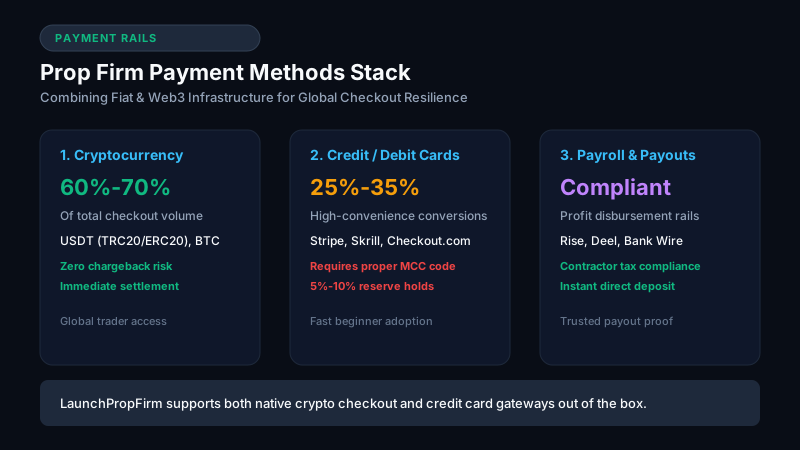
Payment Processing Is More Complicated Than You Think
I assumed accepting payments for prop firm challenges would work like any other e-commerce business. Open a Stripe account, add the checkout, done.
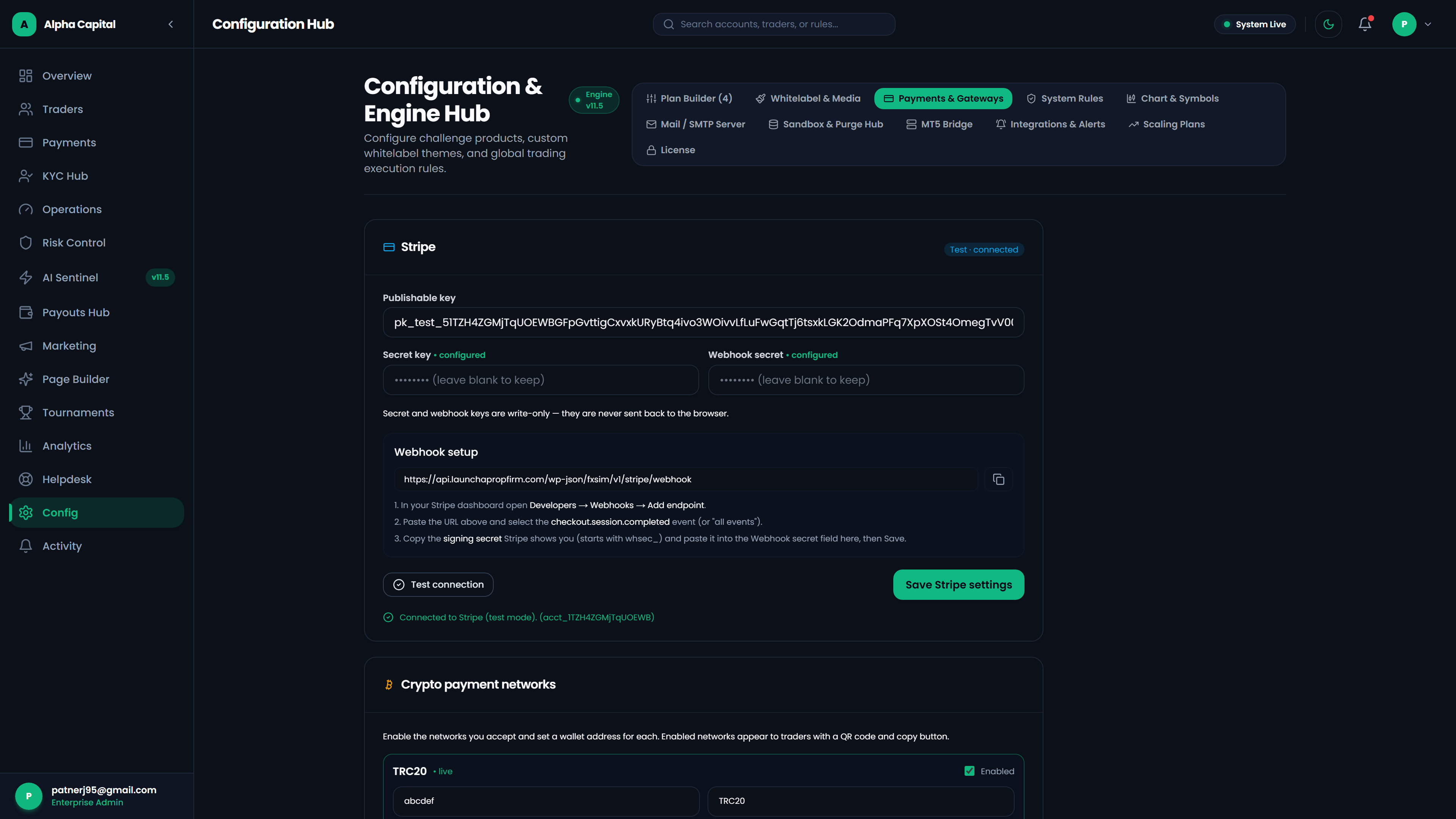
It is not that simple. Prop firms sit in a category Stripe and most payment processors consider high risk. Financial products, especially those involving trading and evaluation models, trigger additional scrutiny. Some operators have had accounts terminated mid-operation after routine risk reviews.
Understanding this before you launch saves you from building on a foundation that disappears.
See how the LaunchPropFirm platform handles payments
What Stripe Accepts and What It Doesn't
Stripe will process payments for prop firm challenges in most jurisdictions, but the classification matters. The key is how you describe your product.
A prop firm selling "trading evaluation services" or "funded trading program entry fee" is typically accepted. A prop firm describing itself as a "financial instrument" or "investment fund" triggers financial services restrictions that Stripe is not set up for.
Stripe's Terms of Service prohibit businesses that deal in speculative financial instruments as their core product. But prop firms that sell evaluation services (where the outcome is a trading opportunity, not a financial return) typically fit within acceptable use.
The practical risk: Stripe can terminate accounts at any point during a risk review. This happens more often to prop firms that grow quickly and have high transaction volumes before their account has any history. The fix is to build Stripe account history gradually before scaling.
How to Set Up Stripe for a Prop Firm Correctly
Register as an individual or LLC, not as a financial services company. Select "Software and Services" or "Education" as your primary category when setting up the account. These are not misrepresentations if your core product is an evaluation service.
Use clear product descriptions on your checkout pages. "Phase 1 Challenge, $25,000 account evaluation" is clear and accurate. "Funded account" or "investment opportunity" in product descriptions will trigger flags.
Start with lower transaction volumes while your account history builds. Process your first 50 to 100 transactions before expecting high-volume months without scrutiny.
Enable 3D Secure on your checkout. This reduces chargebacks, which are the primary reason prop firm payment accounts get flagged. A chargeback rate above 1% is enough to trigger a review.
Keep your refund policy explicit. Stripe rewards merchants who handle disputes gracefully. A clear "30-day refund if not passed to Phase 2" policy, applied consistently, reduces disputes before they become chargebacks.
Skip the monthly fees
Own your prop firm platform outright. One time purchase.
Full source code. Live in 7 days. No revenue share. No monthly SaaS bill. See the exact platform before paying anything.
Demo login: haris / asdf1122. No signup needed
Why Every Prop Firm Needs Crypto Payments
Between 30% and 50% of prop firm challenge purchases globally are paid with cryptocurrency. This is not optional for operators who want to serve the full market.
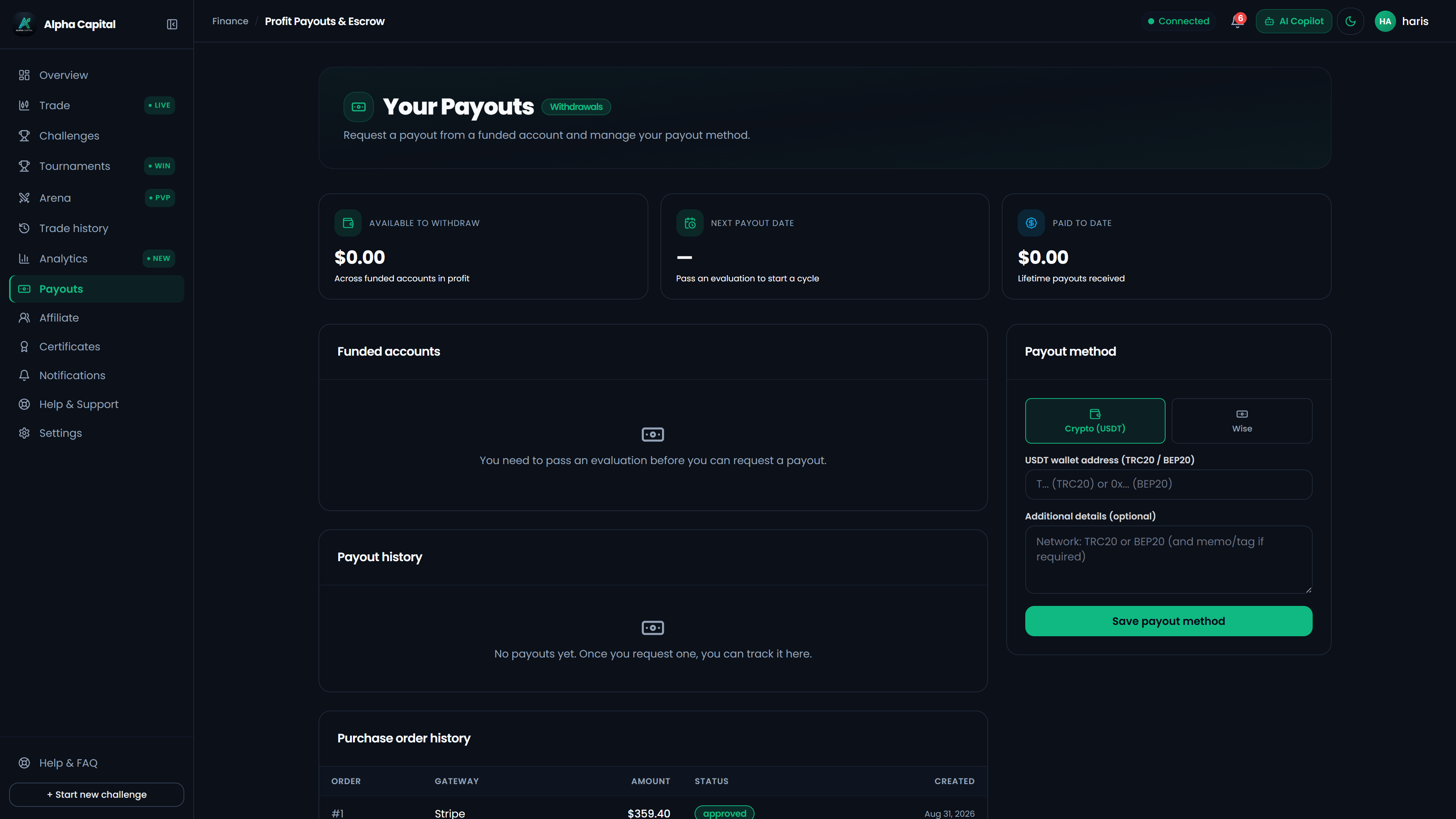
White-label trader dashboard displaying real-time evaluation metrics, equity curves, and active challenge milestones.
The reasons traders use crypto: some are in jurisdictions where card payments to offshore firms trigger bank restrictions or compliance flags. Some prefer the speed and irreversibility of crypto. Some simply have large crypto holdings and prefer to use them.
USDT (Tether) on TRC20 is the most commonly used payment method in the prop firm industry. It combines stable dollar value with near-zero transaction fees on the Tron network. USDC on multiple chains is the second most common.
BTC and ETH are accepted everywhere but have higher transaction fees and slower confirmation times. Most operators accept them alongside USDT rather than relying on them exclusively.
How to Set Up Crypto Payments Without Complexity
The cleanest approach for a new operator: use a crypto payment processor that converts crypto to USD automatically.
Options:
- NOWPayments: integrates with most e-commerce platforms, converts incoming crypto to a stablecoin or to your bank automatically, charges around 0.5% per transaction
- CoinGate: similar model, supports 70 plus cryptocurrencies, slightly higher fees but more coin options
- BitPay: more established, USD settlement, charges 1% per transaction, requires KYB verification
The alternative is accepting crypto manually: the trader sends USDT to your wallet, you verify receipt, you activate their challenge account. This works for low volume (under 20 transactions per month) but does not scale and creates delays that irritate traders who expect immediate access after payment.
For LaunchPropFirm users, the platform integrates directly with Stripe for card payments and has a crypto payment flow built in. Both methods are connected to the challenge activation system so traders get immediate access after payment confirmation.
Chargebacks: The Biggest Payment Risk
A chargeback happens when a trader disputes the charge with their bank rather than requesting a refund from you. The bank reverses the payment. Stripe charges you a $15 dispute fee. If your chargeback rate exceeds 1%, Stripe may limit or terminate your account.
Prop firms are targeted by chargeback fraud more than most businesses. The pattern: a trader fails the challenge, then disputes the charge claiming it was unauthorized or that the service was not delivered.
Preventing chargebacks:
- Send a clear confirmation email immediately on purchase with what the trader bought and how to access it
- Make your refund policy explicit before checkout
- When traders ask for a refund within your policy window, grant it immediately rather than letting them escalate to a chargeback
- Keep records of every challenge attempt, breach event, and communication per trader
- Respond to every Stripe dispute with evidence (challenge attempt logs, email communications, terms acceptance timestamp)
Most chargebacks in prop firms are winnable if you have documentation. Every piece of evidence reduces your dispute rate.
The Payment Stack Most Operators Use
| Payment method | Use case | Fee |
|---|---|---|
| Stripe (card) | US, EU, UK, CA, AU traders | 2.9% + $0.30 per transaction |
| USDT TRC20 (manual) | Global traders, low volume | Near zero |
| NOWPayments (crypto auto) | Global traders, any volume | ~0.5% per transaction |
| PayPal | Secondary option only | 3.49% + fee |
PayPal is included because traders ask for it. Avoid making it primary: PayPal's buyer protection policies are heavily weighted toward the buyer, which makes chargeback fraud easier and harder to dispute.
Most operators at launch use Stripe for cards and manual USDT acceptance for crypto. As volume grows, they add an automated crypto processor to remove the manual step.
Taxes and Compliance
Challenge fees are taxable income. How you structure this depends on your jurisdiction.
If you are operating as an individual from Pakistan, UAE, or most non-US/EU jurisdictions, you generally register as a sole trader or LLC and report income from challenge fees. The tax rate and reporting requirement vary by country.
If you are targeting US or EU customers, you may have sales tax or VAT obligations. Some jurisdictions require VAT collection on digital services sold to their residents. The threshold varies: the EU requires VAT registration once you sell €10,000 per year to EU customers.
Most small operators use Stripe Tax, which automates tax calculation and collection, or consult a local accountant once they hit meaningful revenue. Do not let tax complexity delay your launch. Solve it when the revenue makes it worth the administrative cost.
See the full platform including payment integration. One-time cost from $2,500. See what is included.
Operator Tip: Open your Stripe account and process your first few test transactions before you launch publicly. This builds account history before any real volume hits. Do not launch a marketing campaign to 5,000 people before your Stripe account has processed a single sale. A sudden spike from zero history to 100 transactions in a day is exactly the pattern that triggers automated risk reviews.
Frequently Asked Questions
Can prop firms use Stripe?
Yes, in most jurisdictions. Prop firms that sell evaluation services (where traders pay to take a trading challenge) are generally within Stripe's acceptable use policy. The risk comes from high chargeback rates, which are common in the prop firm industry due to challenge failure disputes. Maintaining a chargeback rate below 0.5% and keeping clear documentation of every transaction reduces termination risk.
What crypto do most prop firms accept?
USDT on TRC20 is the most widely accepted. It has near-zero transaction fees and maintains a stable dollar value. USDC is the second most common. BTC and ETH are accepted at most firms but are used by a smaller percentage of buyers due to higher fees and slower confirmation.
How do I accept crypto payments without a dedicated processor?
Manually: share your wallet address, require the trader to send the exact challenge fee, verify receipt on-chain, then activate the challenge account. This works for under 20 transactions per month. Above that, the manual verification creates delays and errors that frustrate traders. Automated crypto processors like NOWPayments or CoinGate handle verification and activation automatically.
What is a chargeback and how do I prevent them?
A chargeback is when a trader disputes a charge with their bank and the bank reverses the payment. Prevention: send immediate purchase confirmation emails, apply your refund policy consistently (granted refunds rarely become chargebacks), maintain detailed challenge attempt logs, and respond to every Stripe dispute with documentation. Prop firms typically win disputes when they have timestamp evidence of challenge access and breach records.
Do I need to charge VAT or sales tax on prop firm challenges?
It depends on your jurisdiction and where your customers are. Most operators outside the US and EU do not need to collect sales tax at launch. EU operators who sell to EU customers over €10,000 per year may need to register for VAT on digital services. US operators in states with digital services sales tax may have obligations. Consult a local accountant once revenue makes it worth the cost.
Evaluate Your Prop Firm Readiness Score (0-100)
Answer 5 quick operational questions about your acquisition channels, runway, and engine tech to get a personalized launch roadmap.
Prop Firm Monthly Profit Simulator
Simulate your challenge revenue, payout liability, and net monthly take-home profit.
$20,000
From upfront challenge fees-$2,800
~10 funded payouts budgeted$0 / month
Saves $3,000/mo vs SaaS$17,200/mo
Run-rate: $206,400/yr
M.Haris
Founder & Platform ArchitectBuilding open prop trading software infrastructure for operators worldwide
I built LaunchPropFirm to give forex educators, trading communities, and fintech operators complete ownership of their platform with full source code and zero monthly SaaS rent. Every article on this blog is drawn from hands-on platform development, live MT5 risk bridge mechanics, and real operator economics.
All content, financial models, ROI estimates, and architecture guides on LaunchPropFirm are published strictly for educational and informational purposes. LaunchPropFirm provides institutional prop trading software and technology infrastructure; it does not operate as a broker, custodian, or registered investment advisor.
Evaluation challenges and funded trader accounts referenced in this guide operate in simulated demo trading environments using real-time market data feeds. Simulated trading results do not represent actual trading performance or financial advice.
Recommended Next Reads
Hand-picked operator guides to scale your prop trading platform.
Wise Prop Firms: Payouts, Risks and Rails
Explore why direct Wise prop firms payouts trigger account freezes, how Rise compliance bridges protect funds, and why multi-rail payouts guarantee cash flow.
Prop Firm Capital: Requirements, Reserve Buffers and Risk Architecture
Unpack the financial reality of prop firm capital: synthetic exposure vs liquid reserves, challenge fee pool economics, A-Book STP hedging, and exact startup blueprints.
Skip the monthly fees
Own your prop firm platform outright. One time purchase.
Full source code. Live in 7 days. No revenue share. No monthly SaaS bill. See the exact platform before paying anything.
Demo login: haris / asdf1122. No signup needed