Own Prop Firm vs Funded Account
One path builds a business asset. The other builds a skill. Here is the real difference between running a prop firm and buying a funded account as a trader.
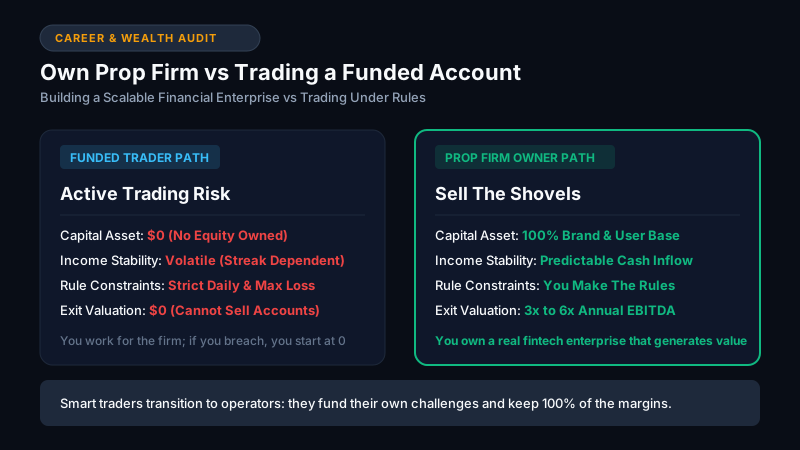
Two Very Different Business Models
I spent two years on the trader side before switching to the operator side. The difference in how money flows is not subtle.
Most people in trading have thought about both paths.
Buy a funded account, pass the challenge, get a profit split. Or build a prop firm, sell challenges, and keep the fees.
These are not the same opportunity. The money flows in opposite directions.
See the platform before reading further
The Funded Trader Path
You pay a challenge fee. typically $99 to $650 depending on account size. You trade a simulated account under strict rules. If you hit the profit target without breaching drawdown limits, you get a funded account.
On the funded account, you earn a profit split. Standard is 80% to you, 20% to the firm.
The economics depend entirely on your trading performance. Good month: you earn.
Bad month: you earn nothing or breach and lose the account.
The ceiling is your trading results. Most funded traders earn between $500 and $5,000 per month when active and profitable. Top performers earn more. Most traders breach within 3 months of getting funded.
The Prop Firm Owner Path
You buy a platform, brand it, and sell challenges to traders.
You collect fees from everyone who attempts the challenge. whether they pass or fail. Around 90 to 95% of traders fail. You keep their fees.
The 5 to 10% who pass get funded accounts. You pay out their profits from your challenge fee reserves. A well-run firm sets aside 25 to 30% of all challenge fees as a payout reserve.
The ceiling is how many traders you can attract. Performance depends on marketing and operations, not trading skill.
Skip the monthly fees
Own your prop firm platform outright. One time purchase.
Full source code. Live in 7 days. No revenue share. No monthly SaaS bill. See the exact platform before paying anything.
Demo login: haris / asdf1122. No signup needed
Real Numbers Side by Side
Funded trader, month 1: challenge fee $199, account size $25,000, profit target 5% = $1,250. Your split at 80%: $1,000. Net after the challenge fee: $801 if you pass.
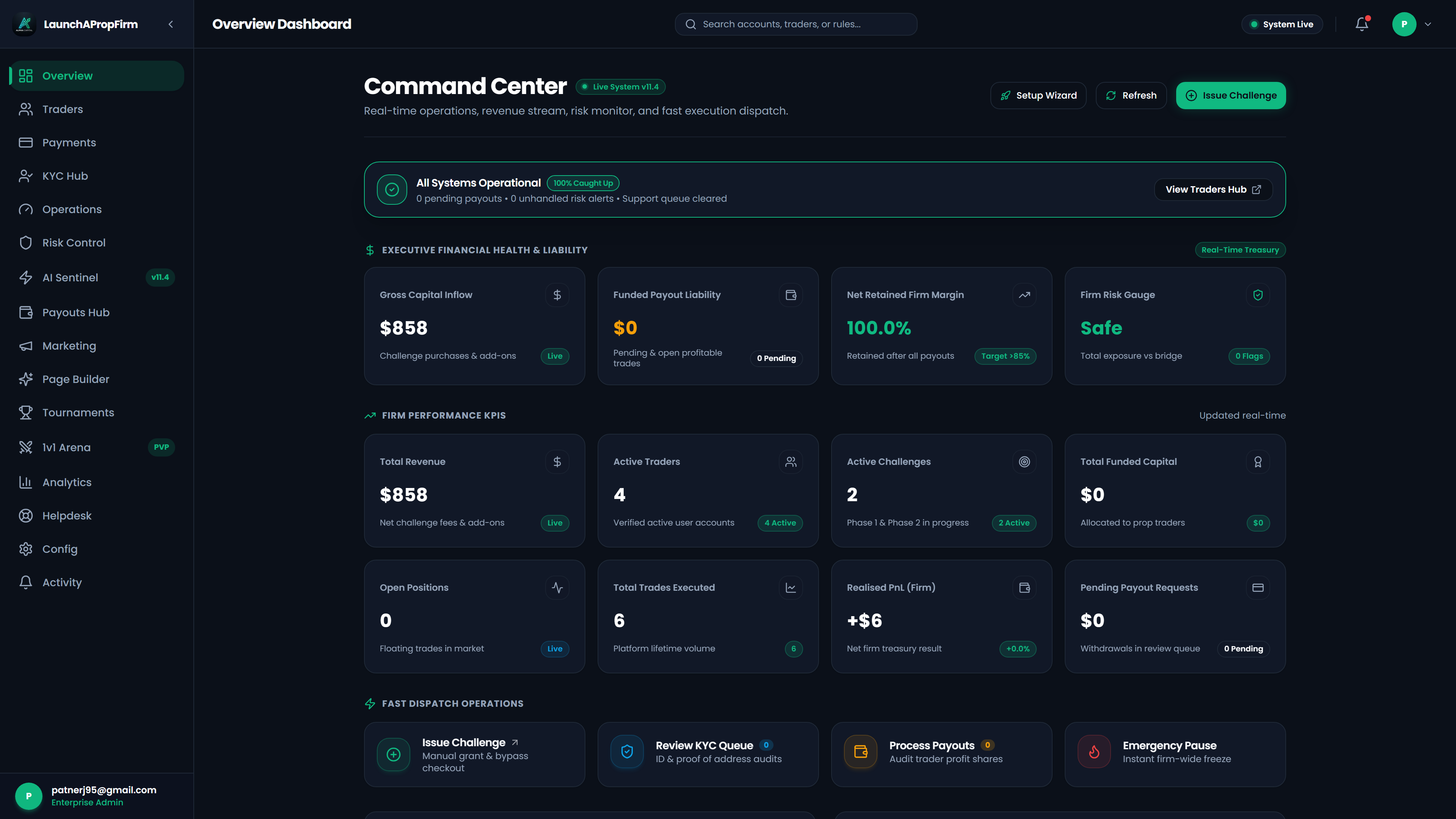
Centralized operator overview displaying real-time platform revenue, trader evaluations, and operating margins with zero recurring SaaS fees.
Most traders do not pass month 1. Expected value for an average trader is negative.
Prop Firm Owner. Month 1
50 challenge sales at $199: $9,950
Payout reserve set aside (25%): $2,487
Platform cost (one time, not monthly): Already paid
Hosting and feed: $70
Net month 1 available: roughly $7,400 before any payouts.
Which One Builds an Asset
Being a funded trader builds no asset. When you stop trading, the income stops. The funded account belongs to the firm, not you.
Running a prop firm builds an asset. The platform is yours. The trader database is yours.
The brand is yours. A prop firm with consistent challenge sales can be sold as a business.
Which One Requires Trading Skill
Being a funded trader requires you to be a consistently profitable trader. Most people are not.
This is not a criticism. Markets are hard. The pass rate data reflects this.
Running a prop firm does not require you to trade. You need to understand the business model, manage risk rules intelligently, and attract traders. Trading skill helps you design fair challenge rules but is not a requirement.
The Honest Comparison
| Factor | Funded Trader | Prop Firm Owner |
|---|---|---|
| Startup cost | $99 to $650 | $2,495 to $7,400 |
| Monthly income potential | Variable | More predictable |
| Requires trading skill | Yes | No |
| Builds an asset | No | Yes |
| Income when not working | No | Yes |
| Scales with effort | Limited | Yes |
| Risk | Performance risk | Operational risk |
Who Should Do Each
Be a funded trader if: You are already a consistently profitable trader and want to scale your returns with firm capital.
Start a prop firm if: You understand the trading world, have an audience or network, and want to build a business rather than a trading career.
Most people who start prop firms come from the trading community. They understand what traders want because they were traders. That knowledge is the real edge.
See what a prop firm platform looks like
Operator Tip: The comparison between trading for a prop firm and running one comes down to scalability. As a funded trader, your income ceiling is your account size and skill. As an operator, your income scales with the number of traders you attract. One operator with 200 monthly challenge buyers earns more than most funded traders with a single account.
Frequently Asked Questions
Which generates more income: being a funded trader or running a prop firm?
Running a prop firm has a higher income ceiling. A funded trader with an $200,000 account at 80% profit split needs to make 5% per month to earn $8,000. A prop firm operator with 50 monthly challenge sales at $200 earns the same amount with a much more predictable revenue model.
What skills transfer from trading to running a prop firm?
Market knowledge helps you design better challenge parameters and evaluate whether your rules are fair. Understanding drawdown and risk management is directly applicable to setting reserve policies. Credibility as a trader helps attract your initial audience. However, operational and marketing skills matter more than trading skill for running the business.
Is there a risk of conflict of interest if I trade while running a firm?
No inherent conflict exists. Traders cannot influence the simulated account performance. However, operators who try to actively trade while managing a growing firm typically find operational demands leave little time for consistent trading.
How long until a prop firm generates more income than a funded account?
With an existing audience, most operators surpass their funded account income within 3 to 6 months of launch. From zero audience, 6 to 12 months is more realistic. The funded account income provides stability during the ramp-up period.
Can you run both simultaneously?
Yes. Many operators maintain funded accounts while running their firm, particularly in the early stages. The prop firm gradually demands more time as it grows, and most operators phase out active trading as the business scales.
Calculate SaaS Monthly Rent vs 1-Time Code Ownership
SaaS prop firm providers charge $2,500/mo plus 8% revenue share. Compare 12-month total expenses vs 100% source code ownership.
Prop Firm Monthly Profit Simulator
Simulate your challenge revenue, payout liability, and net monthly take-home profit.
$20,000
From upfront challenge fees-$2,800
~10 funded payouts budgeted$0 / month
Saves $3,000/mo vs SaaS$17,200/mo
Run-rate: $206,400/yr
M.Haris
Founder & Platform ArchitectBuilding open prop trading software infrastructure for operators worldwide
I built LaunchPropFirm to give forex educators, trading communities, and fintech operators complete ownership of their platform with full source code and zero monthly SaaS rent. Every article on this blog is drawn from hands-on platform development, live MT5 risk bridge mechanics, and real operator economics.
All content, financial models, ROI estimates, and architecture guides on LaunchPropFirm are published strictly for educational and informational purposes. LaunchPropFirm provides institutional prop trading software and technology infrastructure; it does not operate as a broker, custodian, or registered investment advisor.
Evaluation challenges and funded trader accounts referenced in this guide operate in simulated demo trading environments using real-time market data feeds. Simulated trading results do not represent actual trading performance or financial advice.
Recommended Next Reads
Hand-picked operator guides to scale your prop trading platform.
Prop Firm Profit Split: How to Set It
Most prop firms offer 70-90% profit splits. Here is how the split works, what the market standard is in 2026, and how to set yours without hurting margins.
Prop Firm Liquidity Providers: Prime of Prime Directory
Compare the top prop firm liquidity providers and Prime of Prime brokers. Review FIX 4.4 API bridge latency, margin rules, crypto rails, and fee structures.
Skip the monthly fees
Own your prop firm platform outright. One time purchase.
Full source code. Live in 7 days. No revenue share. No monthly SaaS bill. See the exact platform before paying anything.
Demo login: haris / asdf1122. No signup needed