Inverse Fair Value Gap: Complete IFVG Trading Strategy
Master the inverse fair value gap (IFVG) trading strategy. Learn polarity flips, the candle body close rule, 50% CE entries, and the ICT unicorn model.
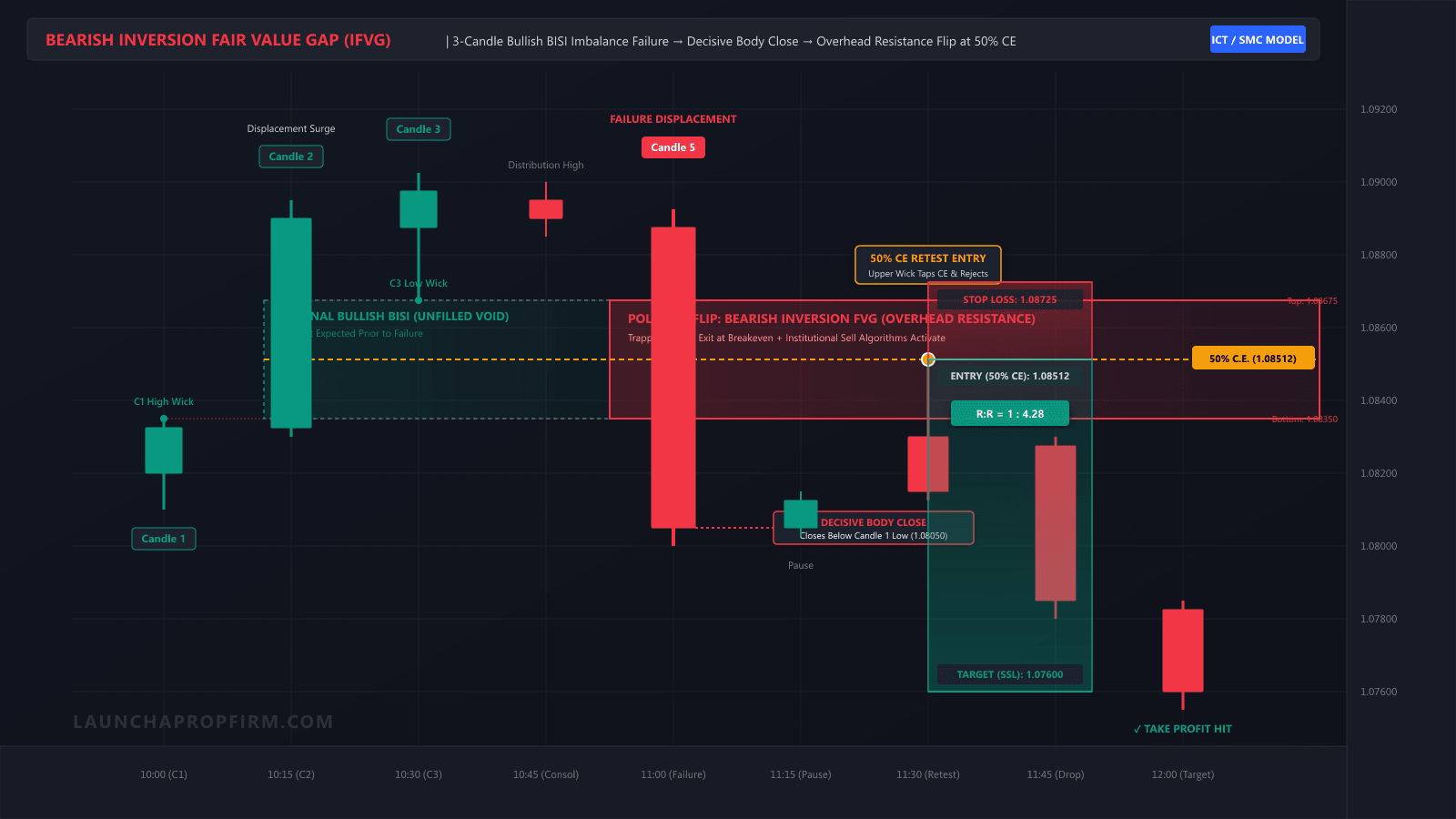
When institutional volume moves markets, retail support and resistance levels fail without warning. Trading desks recognize that failed delivery voids transform into high-probability reversal setups known as inverse fair value gaps.
An inverse fair value gap forms when displacement slices through an imbalance and closes beyond its boundary. This violation flips market polarity, turning former support into resistance or resistance into support.
1. What is an Inverse Fair Value Gap? (Polarity Inversion Mechanics)
An Inverse Fair Value Gap (IFVG) is an institutional Smart Money Concepts pattern where an existing three-candle imbalance fails to hold price delivery and experiences an aggressive displacement close through its opposite boundary. This structural violation flips the former support void into overhead resistance or turns former resistance into a dependable support floor on subsequent retests.
In institutional order flow models, a failed zone represents trapped retail liquidity that algorithmic engines exploit. Unlike a standard fair value gap trading strategy expecting bounces from imbalances, the IFVG capitalizes on failure.
When volume overrides an imbalance, resting limit orders are exhausted and traders become trapped offside. Delivery models seek equilibrium before initiating secondary expansion.
As price retraces, trapped traders exit at breakeven, establishing an institutional pivot. Before executing entries, calculate exact lot allocations with our institutional prop firm lot size calculator.
2. Bearish vs Bullish IFVG: The 3-Candle Failure Blueprint
Bullish and bearish inverse fair value gaps operate through inverted order flow mechanics. A Bearish IFVG occurs when a three-candle bullish BISI fails and closes downward, flipping into overhead resistance. A Bullish IFVG occurs when a three-candle bearish SIBI fails and closes upward, transforming into a reliable support floor for continuation.
Navigating market structure requires mastering the exact geometry of both inversion setups.
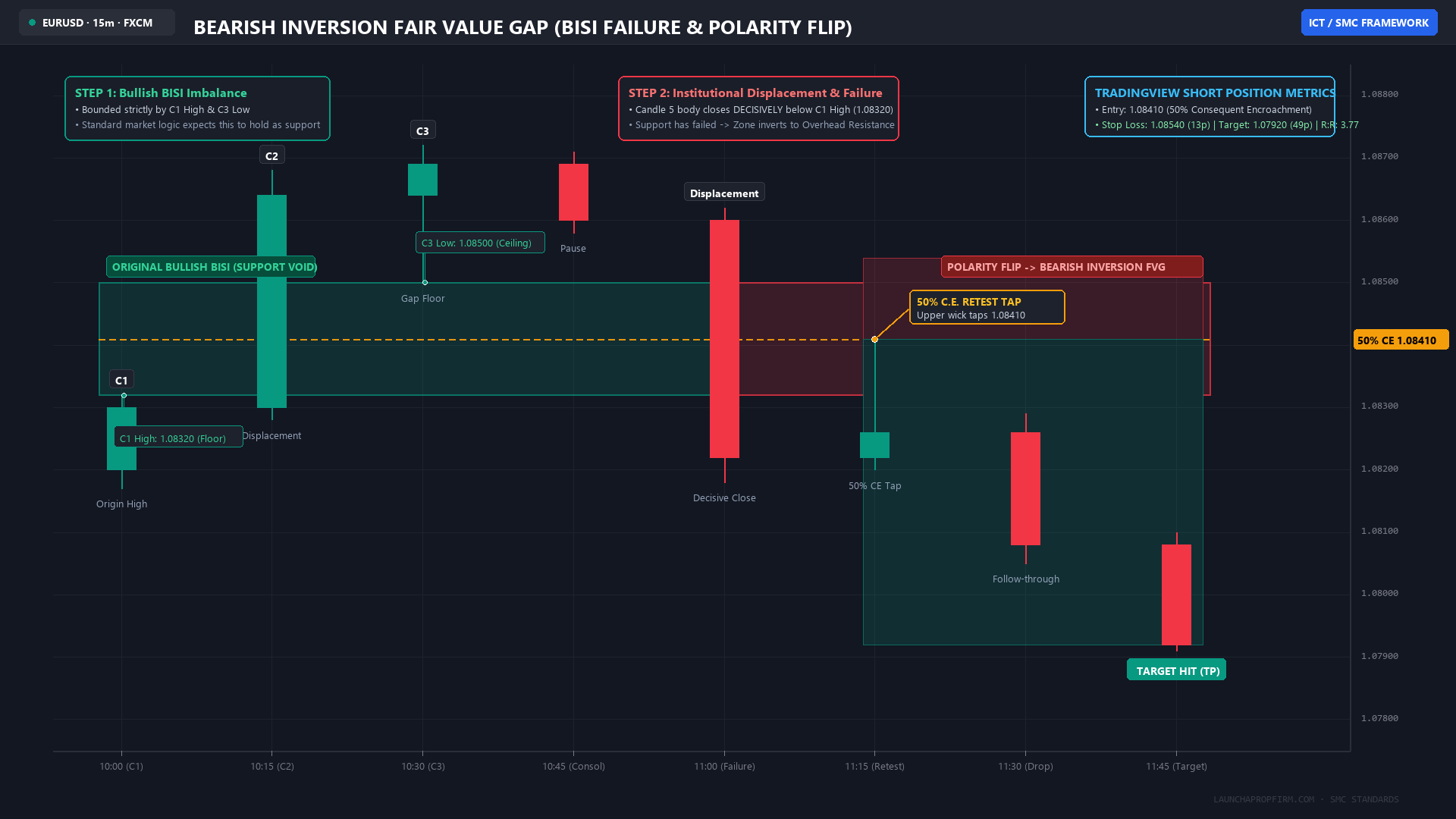
Bearish Inversion FVG (Bullish BISI Failure)
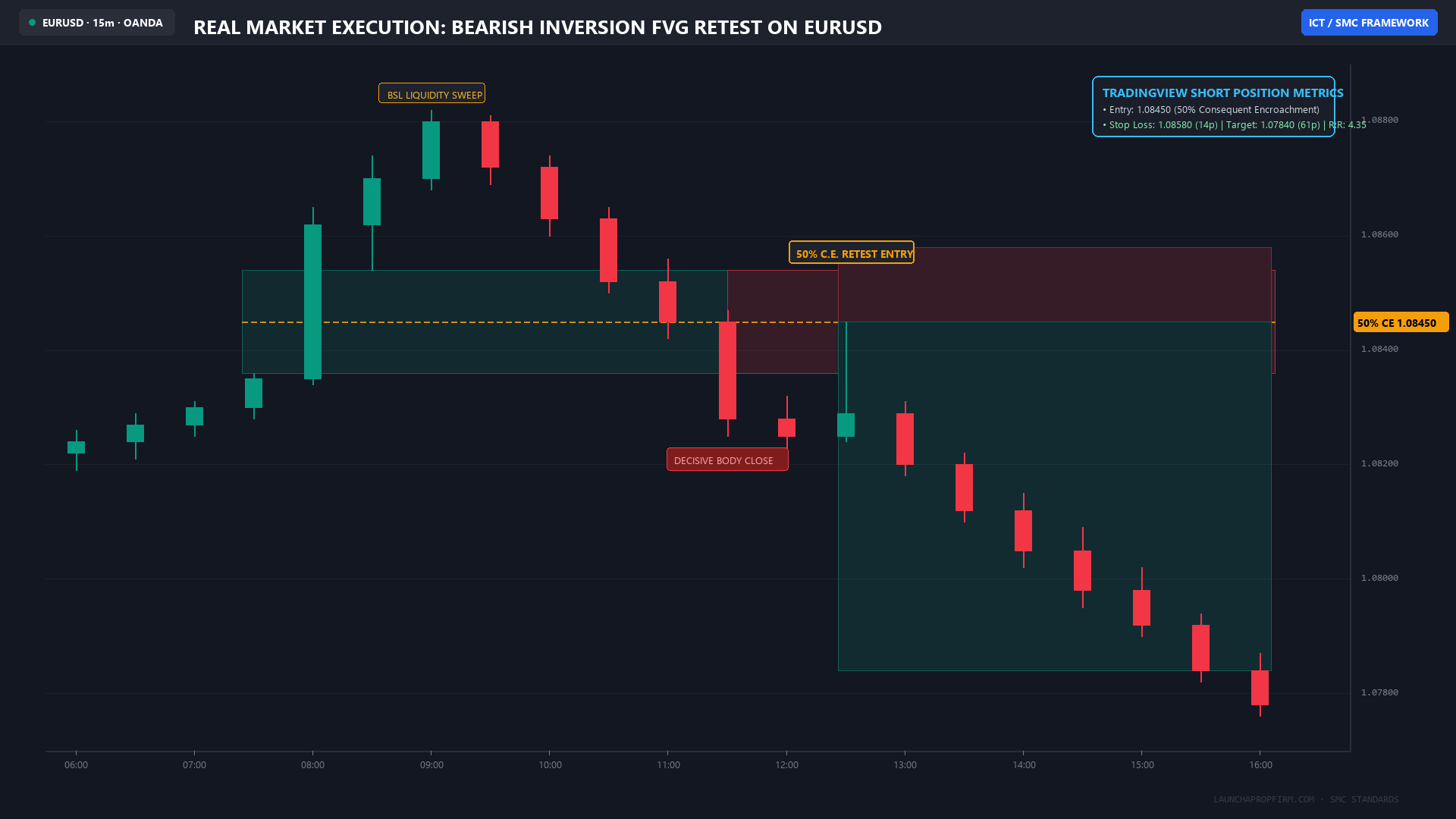
A Bearish Inversion FVG stems from a failed Buy-Side Imbalance Sell-Side Inefficiency (BISI). When an impulsive down-close displacement body slices through the void and closes below Candle 1 low, the BISI inverts into resistance.
Rather than respecting this void as support, aggressive institutional selling drives price downward through Candle 1 low. Traders wait for price to retrace into the inverted corridor, placing short limit entries at 50% Consequent Encroachment.
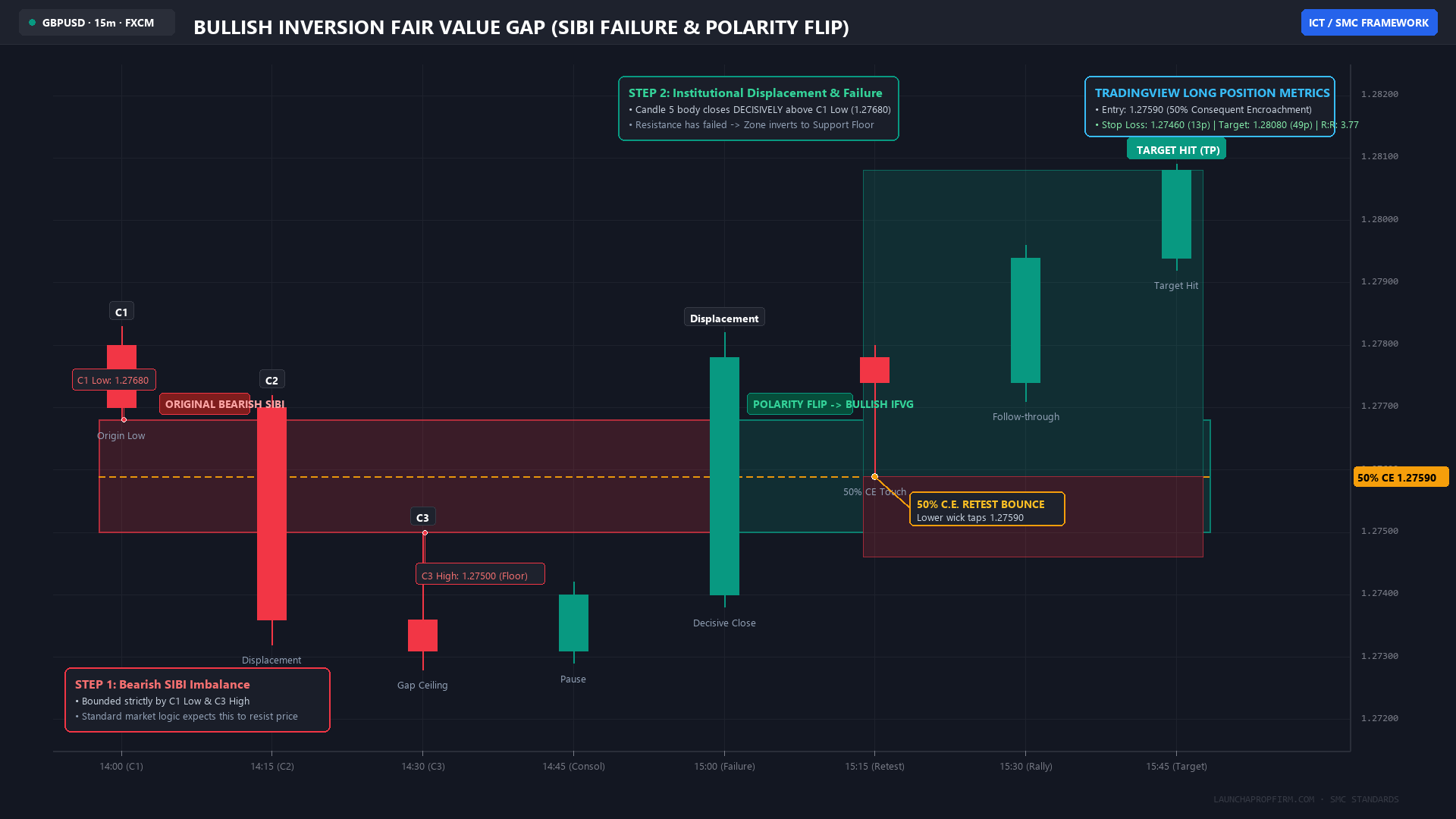
Bullish Inversion FVG (Bearish SIBI Failure)
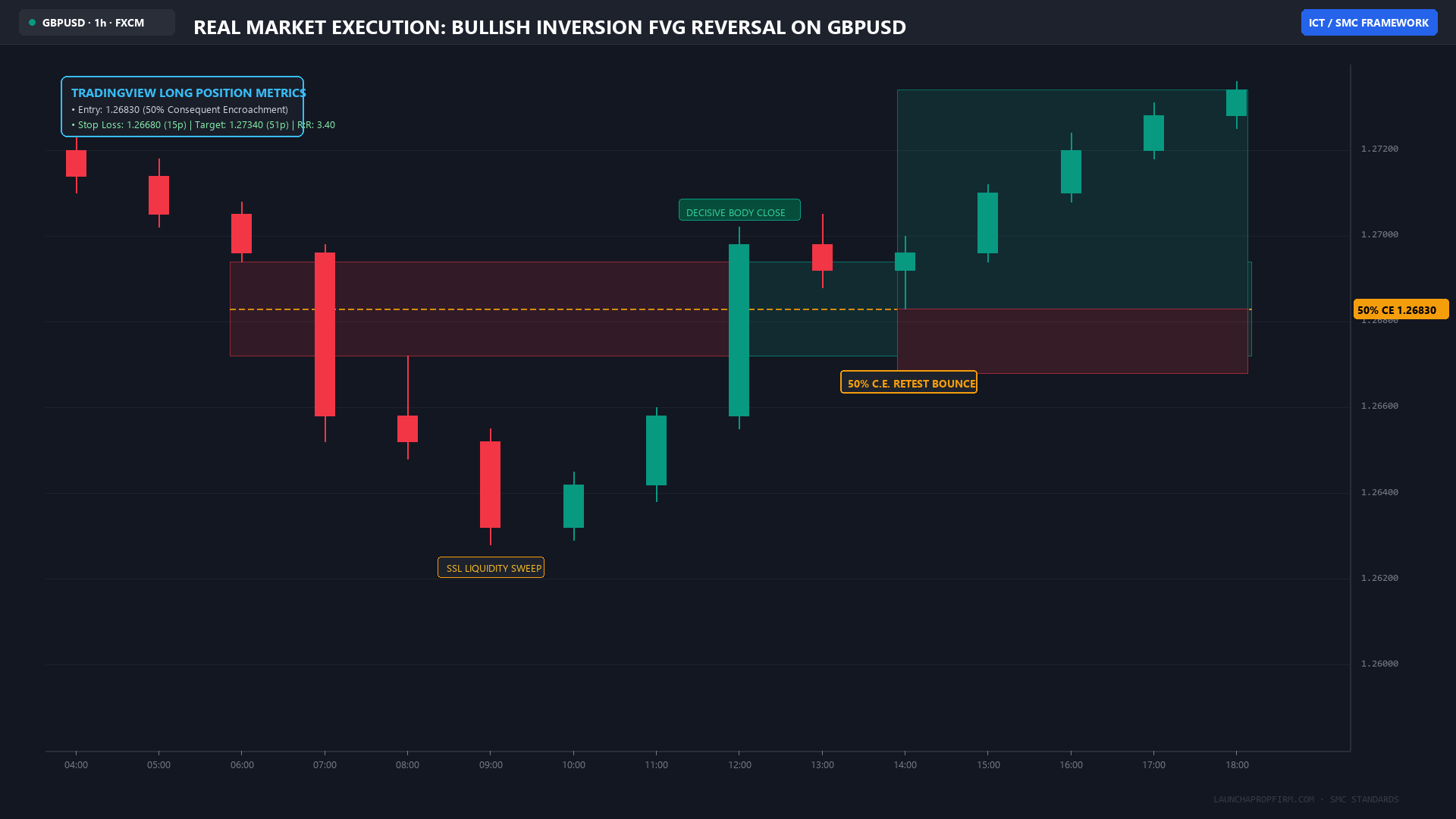
A Bullish Inversion FVG develops from a failed Sell-Side Imbalance Buy-Side Inefficiency (SIBI). When an explosive up-close body powers through the corridor and closes above Candle 1 high, the SIBI inverts into institutional support.
When market sentiment shifts, buyers overwhelm resting sell limits. A displacement candle surges upward, closing above Candle 1 high and establishing discount entries at 50% Consequent Encroachment.
3. The Golden Confirmation Rule: Wick Piercing vs Candle Body Close
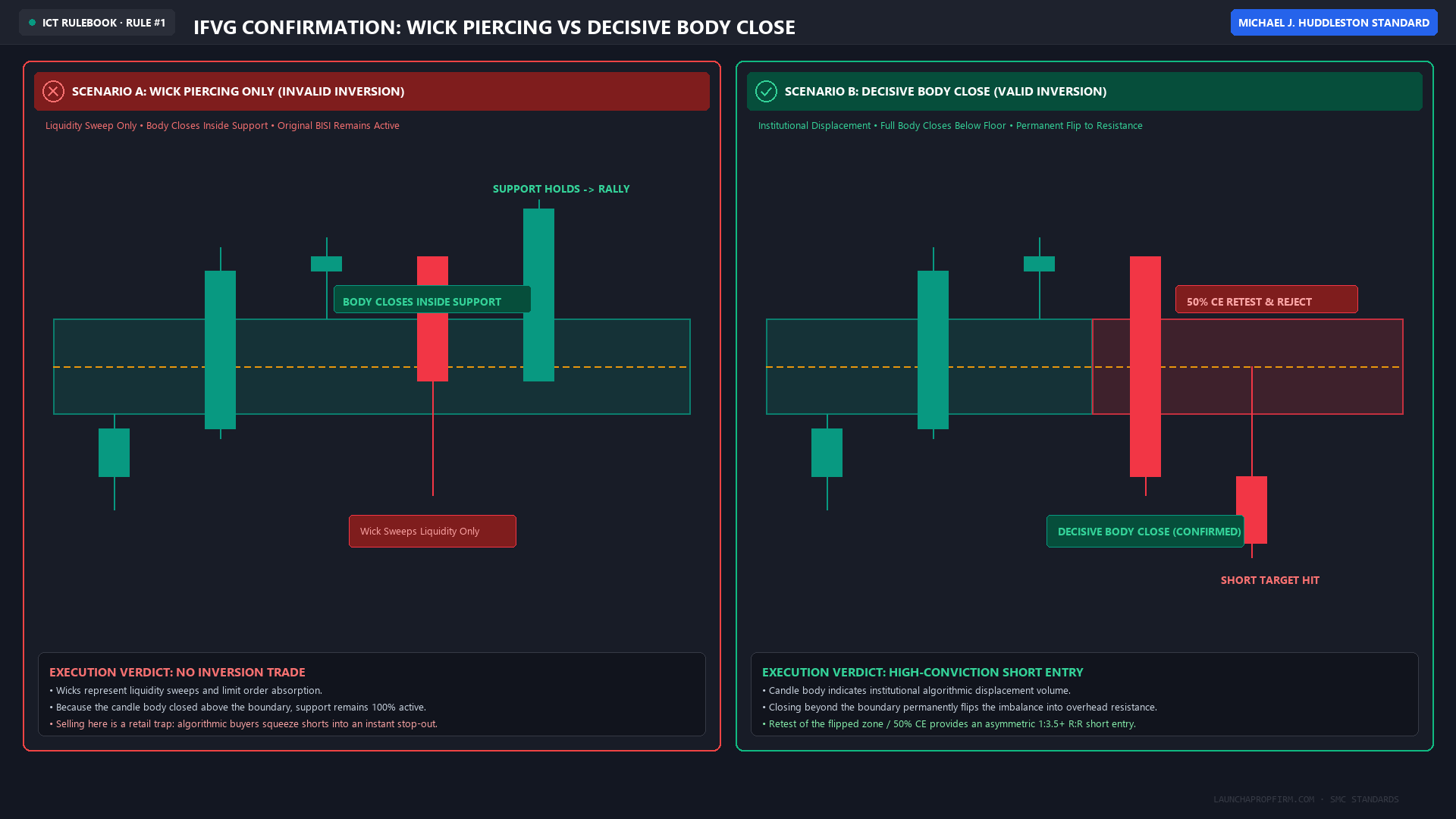
The golden confirmation rule dictates that an Inverse Fair Value Gap is validated strictly by a decisive candle body close outside the imbalance boundary. A wick that pierces beyond the zone represents a liquidity sweep or consequent encroachment mitigation, leaving the original imbalance fully intact rather than inverting its structural polarity.
Distinguishing between genuine inversion and deceptive sweeps is critical when trading market imbalances.
Wick Piercing Mechanics: Liquidity Sweeps
Michael J. Huddleston taught that wicks do damage while candle bodies tell the story. A wick through an FVG sweeps resting stops without altering structural delivery.
If the body closes inside the imbalance, order flow remains unchanged. Traders selling wicks suffer instant stop-outs as algorithms absorb liquidity and resume the trend.
Candle Body Close: Institutional Commitment
Genuine inversion requires institutional commitment, manifesting as a candle body close beyond Candle 1 extreme wick. This print proves opposing volume exhausted resting orders.
Once the body closes outside the corridor, polarity flip is confirmed. Aligning limit entries with verified body closes eliminates premature fakeouts and protects evaluation drawdown limits.
4. 4-Step Institutional IFVG Execution Framework
The institutional IFVG execution framework requires identifying higher timeframe draw on liquidity, verifying an aggressive displacement body close through an existing imbalance, placing limit orders at the 50% Consequent Encroachment midpoint, and setting defensive stop losses beyond the invalidation swing wick. This structured protocol delivers high-probability entries with asymmetric risk-to-reward profiles.
Step 1: Establish Bias and Liquidity Draw
Never trade an IFVG against higher timeframe structure. Analyze 4-hour and 1-hour charts to locate key buy-side or sell-side liquidity pools before London or New York opens.
Step 2: Confirm Displacement and Invalidation
Drop to 15-minute charts after the liquidity sweep. Confirm displacement closes its full body beyond Candle 1 extreme wick before marking an IFVG.
Step 3: Calibrate 50% CE Limit Orders
Calculate the 50% Consequent Encroachment midpoint of the inverted gap. Place limit entries at this equilibrium level to minimize slippage.
Step 4: Position Invalidation Stop Loss
Set stops safely beyond the swing wick that initiated displacement. Align targets with the next unmitigated opposing liquidity pool for a 1:3.5 minimum return.
5. The ICT Unicorn Model: Breaker Block and IFVG Confluence
The ICT Unicorn model represents an elite high-probability confluence setup that occurs when an Inverse Fair Value Gap nests directly within an existing Breaker Block. This dual institutional footprint combines the failure of an order block after a liquidity sweep with the structural polarity flip of an inverted imbalance.
Prop firm evaluation specialists regard the Unicorn model as an elite execution blueprint for passing funded challenges.
Anatomy of Breaker Confluence
A breaker block trading strategy forms when price sweeps liquidity and triggers an authentic market structure shift. When displacement also slices through an imbalance, a confluence zone forms.
This double failure traps breakout and retest traders simultaneously, creating institutional resistance. Desks execute limit orders on retest, capturing rapid expansion as detailed in our guide on break of structure examples.
6. Prop Firm Challenge Risk Management: Lot Sizing & Invalidation Rules
Prop firm challenge risk management mandates capping single-trade risk at 0.50% of total evaluation equity, calculating position sizing strictly from the IFVG invalidation level, and halting daily execution if drawdown reaches 1.5%. These defensive rules safeguard challenge capital against consecutive losses while preserving profit margins.
Technical precision is meaningless if undisciplined sizing breaches daily drawdown limits on your funded account.
When trading volatile currency pairs, calibrate lot size against exact stop distance. Utilize our free institutional profit loss calculator to maintain challenge risk parameters.
For traders scaling evaluations, tracking daily resets is equally crucial. Review our breakdown of prop firm daily drawdown reset times to protect account buffers.
7. 3 False IFVG Traps That Blow Evaluation Accounts
The three most dangerous IFVG execution traps include trading low-displacement consolidation voids, entering counter-trend inversions opposing higher timeframe bias, and executing limit orders into high-impact economic news releases. Eliminating these structural mistakes immediately elevates trading consistency across evaluation challenges.
Understanding where setups fail is just as valuable as knowing where they succeed.
Trap 1: Low-Displacement Consolidation Inversion
Traders mistake tight ranges for displacement. In low-volume consolidation, price oscillates through small imbalances without commercial intent.
Trap 2: Counter-Trend Premium/Discount Conflict
Trading a Bearish IFVG inside a higher timeframe discount zone invites failure. Pair analysis with our guide on bullish reversal patterns to avoid shorting into accumulation floors.
Trap 3: High-Impact Macroeconomic News Volatility
Executing limit orders inside an IFVG moments before high-impact economic releases is disastrous. Always wait 15 minutes post-release for price discovery to stabilize before engaging newly formed inversion corridors.
8. Quantitative IFVG Trading Journal Protocol
A quantitative IFVG trading journal requires recording execution session timing, displacement velocity, mitigation depth, and realized risk-to-reward ratios across a 20-trade statistical sample. This methodical tracking verifies edge viability and pass probability before risking capital on live evaluation accounts.
Proprietary firms require funded traders to log setups mechanically. Log executions with our free trade journal spreadsheet, and explore psychological benefits in our guide on the advantages of forex trading.
9. Frequently Asked Questions (FAQ)
What is the difference between a Fair Value Gap and an Inverse Fair Value Gap?
A Fair Value Gap is an unmitigated void expected to hold as support or resistance. An Inverse Fair Value Gap is a failed imbalance where displacement closes through the void, flipping its polarity.
How do you confirm an IFVG is valid and not a liquidity sweep fakeout?
An IFVG is validated exclusively when an aggressive displacement body closes completely beyond the imbalance boundary. If a candle merely pierces the zone with a wick, it represents a liquidity sweep, leaving the original gap active.
Which timeframe is most reliable for trading Inverse Fair Value Gaps?
The 15-minute and 5-minute timeframes offer reliable execution when aligned with 4-hour order flow. Higher timeframes establish directional bias, while lower timeframes provide entries at 50% Consequent Encroachment.
Where should you place your stop loss when trading an IFVG?
When trading a Bearish IFVG, position your stop loss beyond the swing high wick that initiated failure displacement. When trading a Bullish IFVG, place stops below the failure swing low wick.
What is the ICT Unicorn setup in relation to an Inverse FVG?
The ICT Unicorn setup occurs when an Inverse Fair Value Gap directly overlaps an existing Breaker Block. This confluence merges order block failure after a sweep with inverted imbalance polarity, producing an elite reversal pattern.
Prop firm founders and quantitative mentors can leverage our enterprise prop technology to deploy custom evaluation challenges with automated risk monitoring. Explore software capabilities on our compare page, read insights on our trading blog, or test parameters with our free trader tools. For operators seeking an independent brand, review our scalable white label prop firm software architecture.
Evaluate Your Prop Firm Readiness Score (0-100)
Answer 5 quick operational questions about your acquisition channels, runway, and engine tech to get a personalized launch roadmap.

M.Haris
Founder & Platform ArchitectBuilding open prop trading software infrastructure for operators worldwide
I built LaunchPropFirm to give forex educators, trading communities, and fintech operators complete ownership of their platform with full source code and zero monthly SaaS rent. Every article on this blog is drawn from hands-on platform development, live MT5 risk bridge mechanics, and real operator economics.
All content, financial models, ROI estimates, and architecture guides on LaunchPropFirm are published strictly for educational and informational purposes. LaunchPropFirm provides institutional prop trading software and technology infrastructure; it does not operate as a broker, custodian, or registered investment advisor.
Evaluation challenges and funded trader accounts referenced in this guide operate in simulated demo trading environments using real-time market data feeds. Simulated trading results do not represent actual trading performance or financial advice.
Recommended Next Reads
Hand-picked operator guides to scale your prop trading platform.
Market Structure Shift: Complete MSS Trading Strategy
Master the market structure shift (MSS) trading strategy. Learn MSS vs BOS mechanics, candle body close rules, displacement FVGs, and prop firm risk math.
Fair Value Gap Trading Strategy: Complete FVG Guide
Master the fair value gap trading strategy. Learn how to identify BISI, SIBI, and consequent encroachment with exact entry, stop loss, and RR rules.
Community Monetization & Platform Ownership
Run a Trading Discord, Telegram, or Signal Group? Launch Your Own Prop Firm in 7 Days.
Stop sending your community to third-party prop firms. Own our complete white-label prop firm platform with all automated risk engines, live TradingView charts, MT5 bridge, and paid tournament engine from just $995 down under 50% milestone escrow. Zero monthly SaaS fees.