Breaker Block Trading Strategy: How to Trade Block Failures
Master the breaker block trading strategy. Learn how failed order blocks create high-probability liquidity retests with exact entry, stop loss, and RR rules.
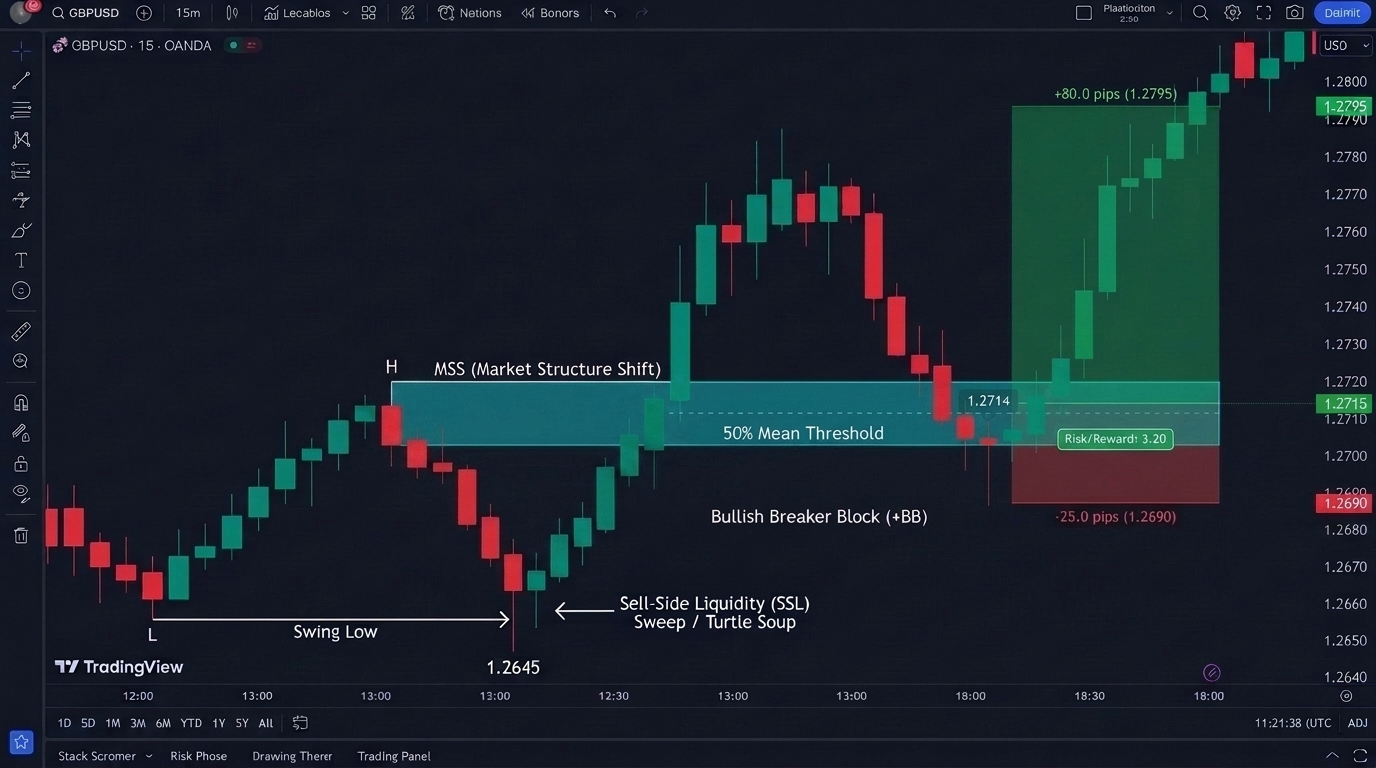
When an order block fails, retail traders panic. Institutional desks treat a broken order block as a liquidity trap: a breaker block.
A breaker swept liquidity before an aggressive market structure shift violated it, flipping the zone into institutional support or resistance. Trapped trader breakeven exits fuel rapid continuation with asymmetric risk-to-reward ratios.
1. What is a Breaker Block? (Failed Order Block Mechanics & Liquidity Traps)
Retail technical analysis relies on static support lines across pivots. Smart Money Concepts reveal that institutions manipulate liquidity at swing extremes before expansions.
Unlike an order block trading strategy holding price on retest, a breaker block purges liquidity and invalidates the original block.
Trapping breakout traders, institutions mitigate inventory on retest, flipping the zone into institutional support or resistance.
Calculate defensive risk parameters on our institutional prop firm lot size calculator before executing entries.
2. Bullish vs Bearish Breaker Blocks: Anatomical Blueprint
Isolating high-probability breakers requires understanding algorithmic market structure. Every valid breaker requires a liquidity purge followed by a confirmed break of structure in forex.
Bullish Breaker Block Anatomy
A bullish breaker originates from a 4-point structural sequence: Low (L) to High (H) to Lower Low (LL) to Higher High (HH).
Price first establishes a swing high, then plunges below the swing low to purge sell stops in a classic Turtle Soup sweep.
Once liquidity clears, an aggressive displacement leg surges upward, body-closing above the swing high to confirm a Market Structure Shift (MSS).
In authentic ICT methodology, the Bullish Breaker is the highest up-close candle of that initial swing high prior to the liquidity sweep.
When price displaces upward, this up-close candle transforms into high-conviction institutional support.
Traders place long limits at the candle body or 50% Mean Threshold (MT), setting invalidation stops below the sweep wick.
Bearish Breaker Block Anatomy
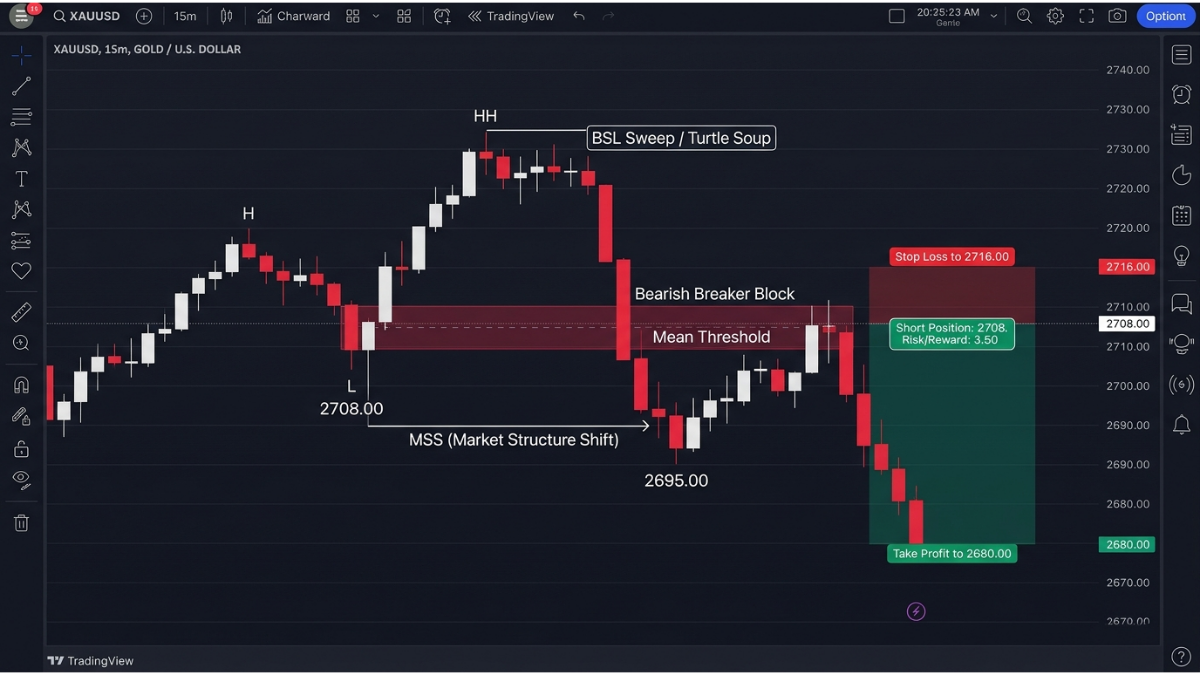
A bearish breaker unfolds through the inverse 4-point sequence: High (H) to Low (L) to Higher High (HH) to Lower Low (LL).
Price establishes a swing low before surging above the previous swing high to raid buy-side liquidity (BSL).
Once buyers are trapped, institutions inject heavy volume, creating downward displacement that closes firmly below the initial swing low.
In ICT doctrine, the Bearish Breaker is the lowest down-close candle of that swing low preceding the run to the higher high.
As price violates this level, the old bullish order block flips into institutional resistance.
Traders place sell limit orders at the candle open or 50% Mean Threshold, targeting opposing liquidity pools with tight risk parameters.
3. Breaker Block vs Order Block vs Mitigation Block
Navigating institutional market structure requires distinguishing between order blocks, breaker blocks, and mitigation blocks:
| Setup Tier | Liquidity Sweep | Structural Trigger | Invalidation Boundary | Win Rate & RR | Prop Fit |
|---|---|---|---|---|---|
| Breaker Block (BB) | Mandatory sweep | Violated OB after MSS shift | Extreme sweep wick | 68% - 75% (1:3+ RR) | Optimal |
| Mitigation Block (MB) | No sweep occurred | Exhaustion break without sweep | Failure swing point | 55% - 62% (1:2 RR) | Moderate |
| Standard Order Block (OB) | Optional sweep | Unviolated origin candle | Opposite candle edge | 70% - 78% (1:3+ RR) | High |
A Breaker Block requires a confirmed liquidity purge before breaking structure. Raided liquidity pools guarantee energetic continuation.
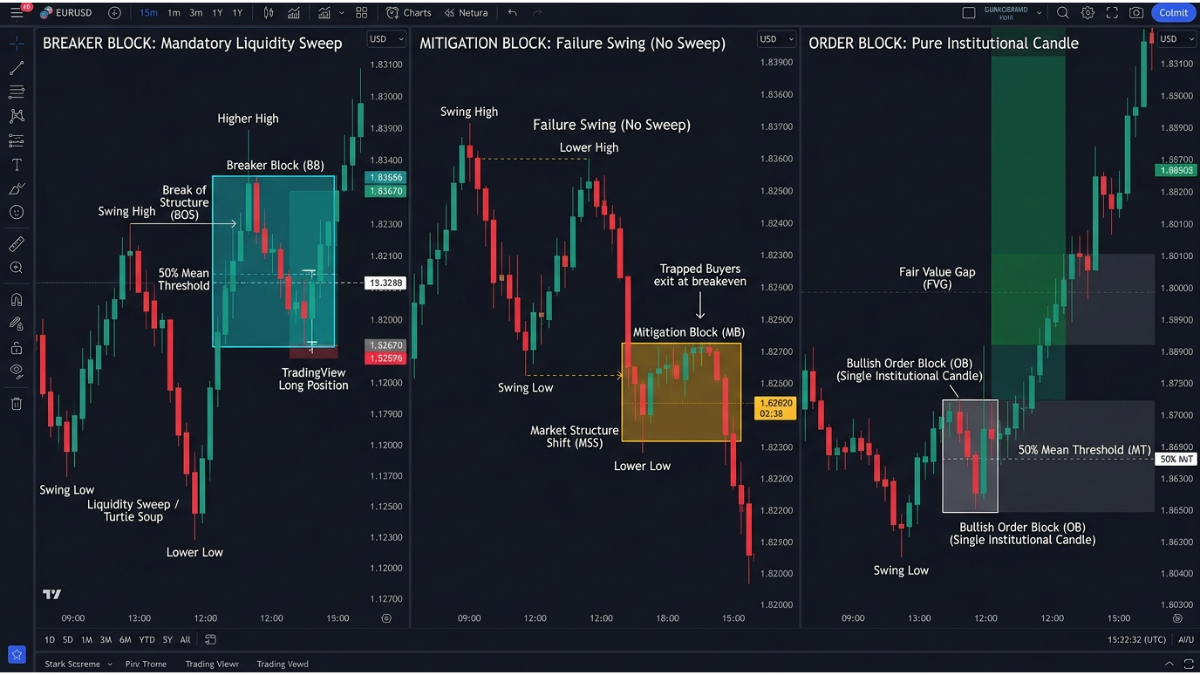
A Mitigation Block forms when price fails to raid liquidity before breaking, resulting in lower momentum.
These distinctions allow traders to capitalize on the structural advantages of forex trading across currency pairs.
4. 4-Step "Yes/No" Breaker Qualification Checklist
Never enter a breaker block setup without running through a pre-execution audit:
| Step | Audit Question | Validation Metric | Decision |
|---|---|---|---|
| Step 1 | Swept HTF liquidity first? | Purge session high/low or key swing extreme | If NO: Discard |
| Step 2 | Clean displacement FVG? | Energetic expansion creating price imbalance | If NO: Reject |
| Step 3 | Body close past opposing swing? | Full body close beyond structural pivot | If NO: Skip |
| Step 4 | Offers at least 1:3 RR? | Target liquidity with stop beyond sweep | If NO: Pass |
If all four conditions answer "YES", place your limit order at the breaker open or 50% Mean Threshold. If any condition answers "NO", protect your buffer.
5. Prop Firm Challenge Survival Rules: Lot Sizing & Drawdown Math
Passing a prop evaluation requires disciplined risk management.
Trading breaker blocks on the best forex pairs to trade for beginners ensures reliable delivery, but arbitrary sizing breaches accounts.
Prop firms enforce strict daily drawdown limits (4% to 5%) and trailing drawdowns (8% to 10%). To survive challenges, risk strictly 0.50% per trade:
| Account Tier | Daily Limit (5%) | Trade Risk (0.5%) | Losses to Breach | 15-Pip Lot Size (EUR/USD) |
|---|---|---|---|---|
| $10,000 Challenge | $500.00 | $50.00 | 10 Losses | 0.33 Standard Lots |
| $50,000 Challenge | $2,500.00 | $250.00 | 10 Losses | 1.66 Standard Lots |
| $100,000 Challenge | $5,000.00 | $500.00 | 10 Losses | 3.33 Standard Lots |
Calculate lot sizes with our prop firm lot size calculator to lock trade risk at 0.50%.
Simulate drawdown limits with our prop firm drawdown calculator and audit criteria with our prop firm consistency calculator.
Manage rollover and daily reset parameters via our prop firm daily drawdown reset time guide.
6. 3 False Breaker Traps That Blow Funded Accounts
Avoid these three common execution traps that frequently trigger evaluation breaches:
Trap 1: The High-Impact News Slippage Trap
Trading breaker blocks ahead of major economic releases triggers severe slippage as liquidity providers pull limit orders. Price spikes through technical zones, making it vital to close positions before high-impact prints.
Trap 2: The No-Displacement Grind
A valid breaker block requires explosive institutional displacement. If price drifts slowly past an order block with small overlapping candles, momentum is absent and retests result in stop-outs. Always demand clear Fair Value Gaps.
Trap 3: Higher Timeframe Trend Conflict
Executing lower-timeframe breaker blocks opposing the dominant higher-timeframe trend lowers your win rate. A 5-minute bullish breaker fails rapidly if the 4-hour chart is trending aggressively downward.
Always align lower-timeframe execution with 1-hour and 4-hour market structure to maintain high win expectancy.
7. TradingView Indicator Blueprint: Automated Breaker Zone Identifier
To streamline chart analysis, implement this automated institutional breaker block detection framework in your TradingView setup:
Copy and paste this clean 15-line Pine Script code directly into your TradingView Pine Editor to automatically highlight breaker zones:
1//@version=52indicator("Breaker Block Identifier [LaunchPropFirm]", overlay=true)3lookback = input.int(5, "Swing Lookback Pivot")4h = ta.highest(high, lookback)[1]5l = ta.lowest(low, lookback)[1]6bullish_mss = ta.crossover(close, h)7bearish_mss = ta.crossunder(close, l)8var box breaker_box = na9if bullish_mss10 breaker_box := box.new(bar_index[lookback], h, bar_index, l, border_color=color.green, bgcolor=color.new(color.green, 85))11if bearish_mss12 breaker_box := box.new(bar_index[lookback], h, bar_index, l, border_color=color.red, bgcolor=color.new(color.red, 85))13plotshape(bullish_mss, "Bullish Breaker", shape.triangleup, location.belowbar, color.green, size=size.small)14plotshape(bearish_mss, "Bearish Breaker", shape.triangledown, location.abovebar, color.red, size=size.small)15alertcondition(bullish_mss or bearish_mss, "Breaker Block Detected", "Breaker zone formed on chart")This script highlights breaker blocks with algorithmic fidelity, alerting traders to institutional retests without manual charting bias.
8. The 20-Trade Breaker Testing Journal Framework
Before risking evaluation capital on a live prop firm challenge, execute at least 20 consecutive breaker block setups in a demo environment or trade logging sheet:
| Log Field | Tracking Variable | Benchmark Metric |
|---|---|---|
| Field 1 | Session Time & Ticker | London Open or NY Overlap |
| Field 2 | Liquidity Sweep Type | Documented BSL or SSL purge |
| Field 3 | Entry Level Precision | Retest of Breaker open or 50% MT |
| Field 4 | Realized Risk-to-Reward | Minimum 1:3.0 RR on target hit |
| Field 5 | Drawdown Dwell Time | Profit movement within 3 to 5 candles |
Free Institutional Journal: Download our unlocked Professional Trading Journal Workbook (.xlsx) to track your 20-trade breaker sample size, R-multiples, and pass probability.
Reviewing a 20-trade journal validates execution consistency. Calculate passing probabilities with our prop firm calculator before paying evaluation fees.
9. Frequently Asked Questions (FAQ)
What is the difference between a breaker block and an order block?
An order block is an unviolated zone holding price upon retest. A breaker block is an order block that swept liquidity and was violated by an opposite structural shift, flipping polarity into support or resistance.
Does a breaker block require a liquidity sweep to be valid?
Yes. A valid breaker block requires sweeping liquidity before the structural shift. Without a sweep, the pattern is classified as a lower-tier mitigation block.
Where should I place my stop loss when trading a breaker block?
Position your defensive stop loss 2 to 3 pips beyond the sweep wick. Conservative traders place stops beyond the far boundary of the breaker candle body.
What timeframe is best for trading breaker block setups?
Breaker blocks are fractal across timeframes. For intraday prop challenges, combine 1-hour or 4-hour liquidity pools with 5-minute or 15-minute execution charts.
Can breaker blocks be traded on commodities like Gold and indices?
Yes. Breaker blocks function reliably across synthetic forex pairs, Gold (XAU/USD), and major equity indices because algorithmic delivery operates identically across centralized liquidity pools.
10. Institutional Infrastructure for Trading Leaders
Discover how LaunchPropFirm empowers trading leaders with turnkey infrastructure. Review economics on our compare page, read our trading blog, or test parameters with our free trader tools.
Explore our turnkey white label prop firm software featuring integrated TradingView charting and automated risk monitoring.
Evaluate Your Prop Firm Readiness Score (0-100)
Answer 5 quick operational questions about your acquisition channels, runway, and engine tech to get a personalized launch roadmap.

M.Haris
Founder & Platform ArchitectBuilding open prop trading software infrastructure for operators worldwide
I built LaunchPropFirm to give forex educators, trading communities, and fintech operators complete ownership of their platform with full source code and zero monthly SaaS rent. Every article on this blog is drawn from hands-on platform development, live MT5 risk bridge mechanics, and real operator economics.
All content, financial models, ROI estimates, and architecture guides on LaunchPropFirm are published strictly for educational and informational purposes. LaunchPropFirm provides institutional prop trading software and technology infrastructure; it does not operate as a broker, custodian, or registered investment advisor.
Evaluation challenges and funded trader accounts referenced in this guide operate in simulated demo trading environments using real-time market data feeds. Simulated trading results do not represent actual trading performance or financial advice.
Recommended Next Reads
Hand-picked operator guides to scale your prop trading platform.
Advantages of Forex Trading: 2026 Benefits & Risk Guide
Explore the core advantages of forex trading in 2026. Master 24/5 liquidity, leverage mechanics, major currency pairs, and the risk reality.
Order Block Trading Strategy: 2026 SMC & Breaker Guide
Master order block trading strategy in 2026. Learn HTF liquidity zones, bullish vs bearish order blocks, breaker blocks, and precision execution rules.
Community Monetization & Platform Ownership
Run a Trading Discord, Telegram, or Signal Group? Launch Your Own Prop Firm in 7 Days.
Stop sending your community to third-party prop firms. Own our complete white-label prop firm platform with all automated risk engines, live TradingView charts, MT5 bridge, and paid tournament engine from just $995 down under 50% milestone escrow. Zero monthly SaaS fees.