How Much Money to Start Day Trading? 2026 Capital Guide
How much money do you need to start day trading in 2026? Compare $25k PDT rules, $500 personal accounts, and prop firm leverage with real risk math.
The single most pervasive lie sold in retail trading is that you can open a broker account with $100 or $500, practice good risk management, and replace your full-time income within six months.
The math behind this promise is fundamentally broken. If you hold a $500 account and adhere to professional risk parameters—risking no more than 1% to 2% ($5 to $10) per trade—even an exceptional 10% monthly performance produces just $50 in profit. You cannot pay rent, buy groceries, or cover software expenses with $50.
Faced with this economic ceiling, almost every undercapitalized trader abandons their rules. They increase position sizes from 0.05 micro-lots to 1.0 or 2.0 standard lots, risk 20% to 40% of their balance on a single trade, and suffer total account liquidation within two weeks. They do not fail because their technical analysis was wrong; they fail because their capital base was too small to survive normal market variance.
Understanding how much money you actually need to start day trading requires separating personal capital risk, statutory account minimums like the US Pattern Day Trader (PDT) rule, and modern synthetic prop firm capitalization.
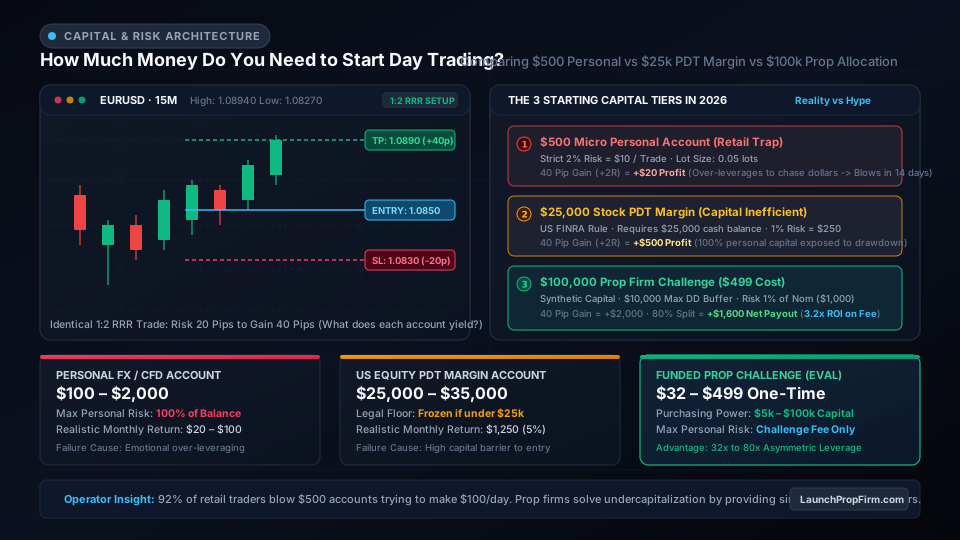
The Three Day Trading Capital Models in 2026
Depending on the market you trade and the regulatory framework of your jurisdiction, your capital path falls into one of three distinct models:
1. The Personal Forex & CFD Micro Account ($250 to $2,000)
In off-exchange retail Forex and CFD trading, brokers allow account creation with as little as $10 to $100. However, having enough capital to satisfy a broker minimum deposit is not the same as having enough capital to trade sustainably.
To survive drawdowns, your position sizing must allow for at least 15 to 20 consecutive losses without losing more than 20% to 25% of your total balance.
On a $500 personal account with a 20-pip stop loss on EUR/USD:
- 1% account risk equals $5.00.
- 20 pips at $5.00 maximum risk limits your lot size to exactly 0.025 lots (2.5 micro-lots).
- A textbook 1:2 Risk-to-Reward ratio (RRR) setup hitting a 40-pip target yields +$10.00.
If you execute 15 winning trades and 10 losing trades in a month (a 60% win rate), your net profit is approximately +$100 (a remarkable 20% account return). While a 20% monthly return is hedge-fund caliber performance, an absolute dollar return of $100 cannot sustain an independent trader. This disparity triggers emotional distress, causing traders to over-leverage until their balance reaches zero.
2. The US Pattern Day Trader (PDT) Margin Account ($25,000 Minimum)
If you day trade US equities or equity options through a regulated US broker, you are legally bound by FINRA Rule 4210 and SEC regulations known as the Pattern Day Trader (PDT) rule.
Under the PDT rule:
- Any margin account executing four or more "day trades" (opening and closing a position within the same market session) within five rolling business days is classified as a Pattern Day Trader.
- Once designated, the account must maintain a minimum net equity of $25,000 at all times.
- If your account balance drops to $24,999 due to market drawdown, commission deductions, or overnight gaps, your day trading privileges are instantly suspended for 90 days or until you deposit additional cash to clear the threshold.
To day trade US stocks comfortably without the constant threat of a PDT lockout, operators recommend an active starting buffer of $30,000 to $35,000. On a $30,000 account, risking 1% ($300) per trade on a 1:2 RRR setup yields +$600 per winning trade. While the dollar returns become viable, the trader must put $30,000 of personal liquid savings at 100% loss exposure.
3. The Synthetic Prop Firm Challenge Model ($32 to $499 One-Time Fee)
Over the past five years, synthetic evaluation proprietary trading firms have restructured how retail capital operates. Instead of saving $30,000 or destroying $500 personal accounts through over-leverage, traders purchase access to simulated capital evaluations.
A retail trader pays a one-time evaluation fee ($32 for a $5,000 account, $139 for a $25,000 account, or $399–$499 for a $100,000 account). The trader is given simulated liquidity on MetaTrader 5, cTrader, or TradingView.
When you purchase a $100,000 prop firm challenge, you are not risking $100,000 of personal capital. Your maximum risk is strictly capped at your $499 fee. The true capital you manage is the firm's maximum drawdown buffer—typically 10% ($10,000).
On that $100,000 account:
- Risking 0.5% to 1.0% ($500 to $1,000) per trade represents 5% to 10% of your allowable drawdown buffer.
- On an identical 20-pip stop loss trade on EUR/USD, a $500 risk allows a position size of 2.5 standard lots.
- A 40-pip target (1:2 RRR) generates +$1,000 to +$2,000 in gross simulated profit.
- With an 80% to 90% performance split, your net payout is +$800 to +$1,600—all achieved from an initial upfront capital commitment of $499.
Risk Mathematics: Comparing Personal Capital vs Prop Allocation
To understand why professional operators emphasize capital leverage over personal deposits, consider three traders executing the exact same 40-pip winning trade on EUR/USD:
| Parameter | $500 Personal Micro Account | $25,000 PDT Stock Margin | $100,000 Prop Firm Challenge |
|---|---|---|---|
| Upfront Capital Required | $500 personal cash | $25,000 personal cash | $499 one-time evaluation fee |
| Maximum Capital at Risk | $500 (100% of balance) | $25,000 (100% of balance) | $499 (Evaluation fee only) |
| Standard Trade Risk (1%) | $5.00 per trade | $250.00 per trade | $1,000.00 per trade |
| Lot Size (20-Pip Stop Loss) | 0.025 micro-lots | Scaled equity shares | 5.0 standard lots |
| Gross Profit (40-Pip Gain) | +$10.00 | +$500.00 | +$2,000.00 |
| Trader Profit Share | 100% (+$10.00) | 100% (+$500.00) | 80% Payout (+$1,600.00) |
| Return on Capital at Risk | 2.0% on $500 cash | 2.0% on $25,000 cash | 320.6% on $499 fee |
| Psychological Failure Trigger | High (Forced over-leveraging) | Moderate (Fear of losing savings) | Low (Pre-defined risk limit) |
The comparison reveals why so many traders have migrated to prop firms. To make a meaningful living wage from a personal account, you must already be wealthy enough to deploy $50,000 to $100,000 in liquid capital without emotional attachment. If you do not have that surplus capital, attempting to day trade a personal account almost always ends in forced over-leveraging.
What Capital Do You Need to Day Trade Part-Time vs Full-Time?
The exact dollar figure you need depends entirely on whether trading is a supplementary income stream or your primary source of livelihood.
Level 1: Learning and Strategy Development ($0 to $200)
If you have never executed trades in live market conditions, your capital commitment should be zero.
- Phase A (Demo Trading): Spend 60 to 90 days executing on a demo account using TradingView or MT5. Verify that your trade setup produces a positive expectancy over at least 100 discrete executions.
- Phase B (Micro Challenge Evaluation): Once profitable on demo, transition to a small $5,000 or $10,000 prop firm challenge costing $16 to $32. This introduces real psychological consequences (loss of the entry fee and rule enforcement) without endangering your personal finances.
Level 2: Supplementary Side Income ($500 to $2,500)
If your goal is to generate $500 to $1,500 per month in supplementary income:
- Using a personal account, you need at least $10,000 to $20,000 generating a realistic 3% to 5% monthly return.
- Using funded accounts, you can purchase a combination of two $25,000 challenges or one $50,000 challenge for approximately $240 to $300. Hitting a modest 3% gain ($1,500) on a $50k funded account nets you $1,200 at an 80% split.
Level 3: Full-Time Professional Day Trading ($5,000 to $10,000 Reserve)
To trade full-time and cover $4,000 to $6,000 in monthly living expenses:
- Living Expense Runway: You must maintain a separate liquid emergency fund of at least 6 to 12 months of living expenses ($25,000 to $50,000) completely outside of your trading accounts. If you trade with money you need for rent, loss aversion will paralyze your decision-making.
- Funded Capital Base: You need active access to $200,000 to $400,000 in combined funded accounts. A consistent, low-stress 2% to 3% monthly return across $300,000 in allocated capital produces $6,000 to $9,000 in gross profit, yielding $4,800 to $7,200 in net monthly payouts.
Attempting full-time day trading with a $2,000 personal account is financial self-sabotage. You would need to generate a 250% monthly return every month just to survive—a statistical impossibility over any prolonged sample size.
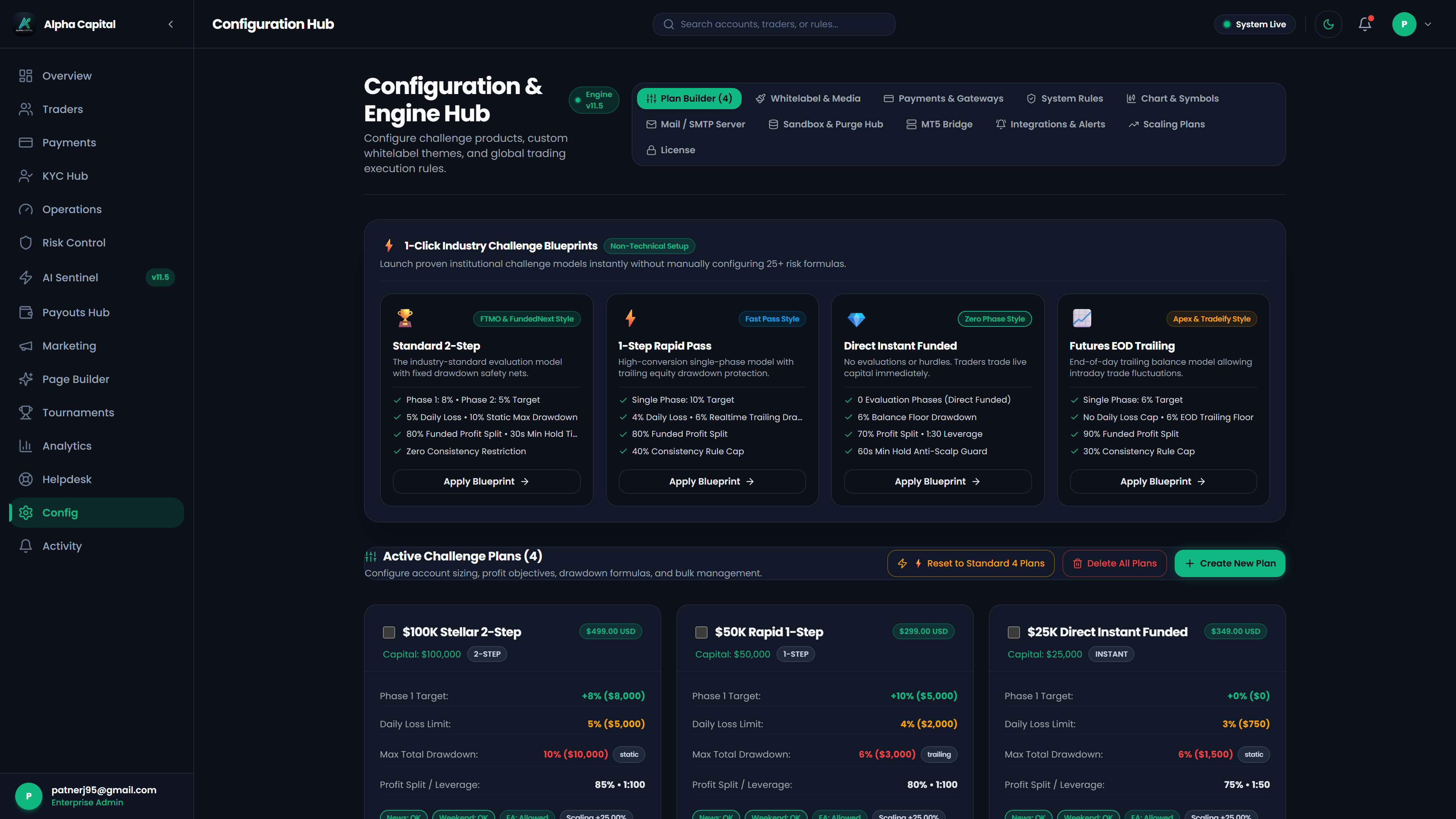
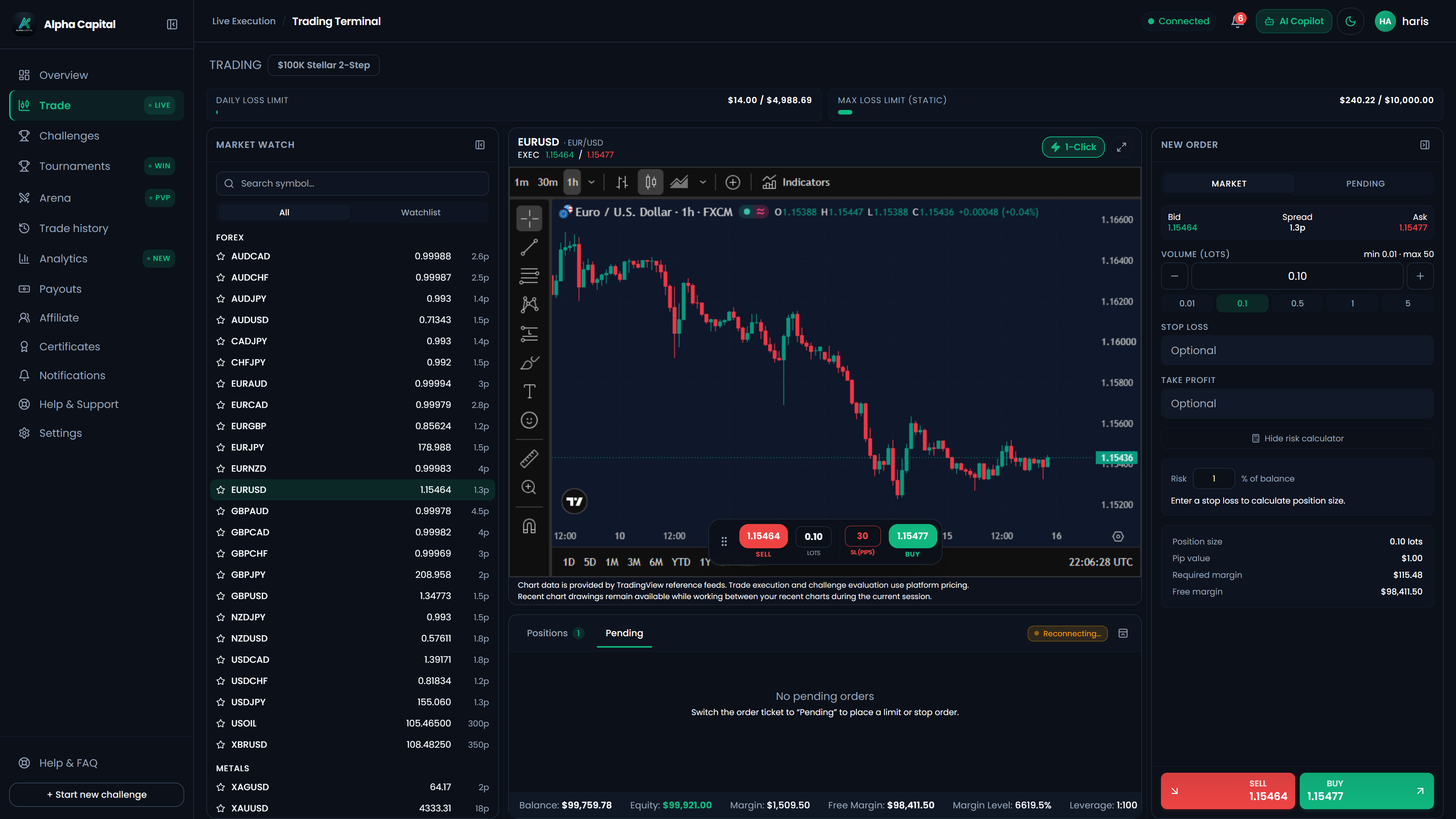
Skip the monthly fees
Own your prop firm platform outright. One time purchase.
Full source code. Live in 7 days. No revenue share. No monthly SaaS bill. See the exact platform before paying anything.
Demo login: haris / asdf1122. No signup needed
Essential Hardware and Software Costs
Trading capital is not just the balance in your account. You must budget for the infrastructure necessary to execute trades without latency or technical failure:
- Charting Platform: While free TradingView plans exist, an active day trader requires at least TradingView Essential or Plus ($14.95 to $29.95/month) for multiple indicator layouts, custom alert webhooks, and second-based intervals.
- High-Speed Internet & Backup Hotspot: High-speed fiber internet paired with a secondary mobile 5G hotspot backup ($80 to $120/month) is mandatory. If your home internet drops while holding an open NASDAQ or Gold position during CPI news, you can lose thousands in seconds.
- Computer Hardware: You do not need a six-monitor wall. A reliable laptop or desktop with an M-series Apple Silicon chip or Intel i7/AMD Ryzen processor, 16GB of RAM, and two 27-inch monitors ($800 to $1,500 one-time cost) is more than sufficient.
The Operator Perspective: Why Prop Firms Solve the Retail Capital Deficit
From the vantage point of proprietary trading firm founders, the retail market's capital starvation represents the core business driver of the entire prop industry.
Traditional brokerages require retail clients to deposit their own capital, where 70% to 90% lose money due to inadequate capitalization and emotional pressure. Prop firm operators recognize that retail traders do not lack analytical skill; they lack sufficient capital to trade small enough sizes to survive statistical drawdowns.
By establishing structured evaluation challenges:
- Prop firms provide access to $5,000 to $200,000 in simulated account environments for a nominal fee.
- The firm's risk engine protects the business through automated daily loss limits (typically 5%) and maximum drawdown thresholds (typically 8% to 10%).
- Profitable traders who pass evaluations receive consistent payouts, while the firm hedges high-alpha traders or funds payout reserves through evaluation fee volume.
Entrepreneurs launching their own prop firms with LaunchPropFirm's turnkey self-hosted software deploy this exact institutional infrastructure. With native TradingView browser charting, real-time bridge connectivity to MT5, cTrader, and DXtrade, and an automated risk engine, operators can launch with zero monthly SaaS fees, keeping 100% of their operational revenue while empowering traders worldwide.
Actionable Capital Checklist for New Traders
Before depositing a single dollar with a broker or purchasing an evaluation challenge, complete this four-step capital audit:
- Calculate Your Absolute Dollar Risk: Use our free Prop Firm Lot Size Calculator to ensure your position sizing matches your exact stop loss distance. Never risk more than 1% of your available buffer on any single trade idea.
- Model Personal Compounding vs Funded Allocation: Run your numbers through the Prop Firm vs Personal Account Calculator to see the multi-year difference between compounding a $1,000 account versus withdrawing payouts from a $100k funded allocation.
- Audit Your Drawdown Tolerance: Use the Prop Firm Drawdown Calculator to simulate consecutive loss streaks and ensure your strategy remains safely above daily and overall drawdown floors.
- Never Trade with Essential Capital: Only trade with capital you can afford to lose without changing your standard of living. When financial survival depends on the outcome of the next candle, sound trading psychology becomes impossible.
Explore our comprehensive directory of operational tools, risk calculators, and challenge sizing simulators in the LaunchPropFirm Tools Suite to construct your professional trading plan today.
Written by the LaunchPropFirm Risk & Trading Architecture Desk.
Evaluate Your Prop Firm Readiness Score (0-100)
Answer 5 quick operational questions about your acquisition channels, runway, and engine tech to get a personalized launch roadmap.

M.Haris
Founder & Platform ArchitectBuilding open prop trading software infrastructure for operators worldwide
I built LaunchPropFirm to give forex educators, trading communities, and fintech operators complete ownership of their platform with full source code and zero monthly SaaS rent. Every article on this blog is drawn from hands-on platform development, live MT5 risk bridge mechanics, and real operator economics.
All content, financial models, ROI estimates, and architecture guides on LaunchPropFirm are published strictly for educational and informational purposes. LaunchPropFirm provides institutional prop trading software and technology infrastructure; it does not operate as a broker, custodian, or registered investment advisor.
Evaluation challenges and funded trader accounts referenced in this guide operate in simulated demo trading environments using real-time market data feeds. Simulated trading results do not represent actual trading performance or financial advice.
Recommended Next Reads
Hand-picked operator guides to scale your prop trading platform.
Prop Firm Passing Services: The Scam, IP Traps & Ban Reality
Prop firm passing services promise guaranteed challenge passes, but 99% get banned before payouts. Exposing syndicate IP radar and broker latency traps.
Congrats on Being a Funded Trader: First 48-Hour Protocol
Received the 'congrats on being a funded trader' email? Here is the exact survival protocol for KYC verification, contract signing, and your first payout.
Skip the monthly fees
Own your prop firm platform outright. One time purchase.
Full source code. Live in 7 days. No revenue share. No monthly SaaS bill. See the exact platform before paying anything.
Demo login: haris / asdf1122. No signup needed