Congrats on Being a Funded Trader: What to Do in the First 48 Hours
Received the 'congrats on being a funded trader' email? Here is the exact survival protocol for contract signing, KYC verification, drawdown buffers, and your first payout.
You just passed Phase 2. The notification dings on your phone, and the email hits your inbox: "Congrats on being a funded trader!"
The dopamine rush is immediate. You screenshot the email, drop it into your favorite trading Discord, share it on Twitter/X, and start calculating the math. On a $100,000 funded account, an 8% month represents an $8,000 gross gain, meaning a cool $6,400 to $7,200 deposited straight into your bank account or crypto wallet.
Now take a deep breath, step away from your desk, and do not execute a single trade today.
Here is the cold, statistical reality that prop firm marketing rarely highlights: Over 90% of retail traders who pass an evaluation challenge lose their funded account within the first 14 to 30 days—without ever withdrawing a single dollar in payouts.
Passing a challenge requires an aggressive offensive strategy: chasing an 8% to 10% profit target within a compressed timeframe. Keeping a funded account requires an entirely defensive mindset: risk minimization, equity curve stabilization, and strict capital defense.
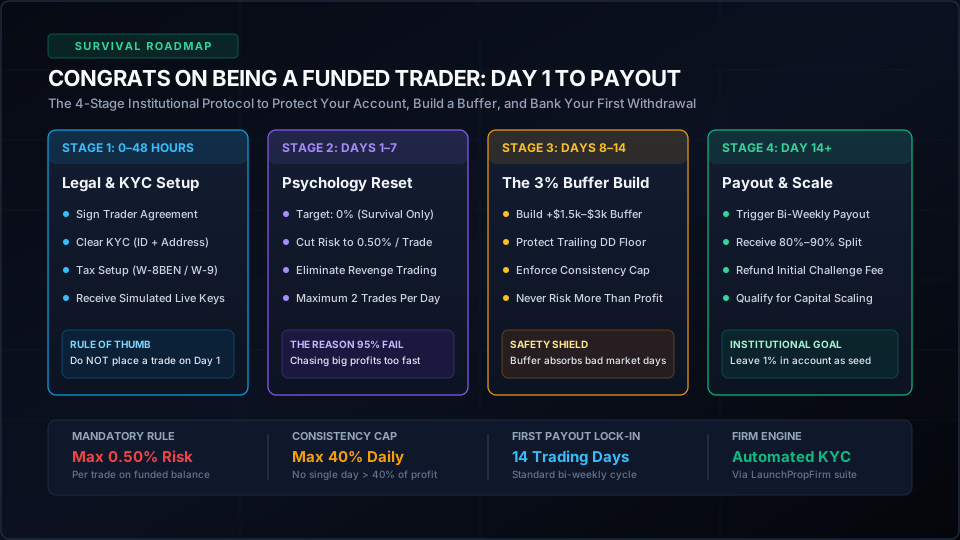
Stage 1: The First 48 Hours (Contracts, KYC & Account Setup)
The moment you receive the congratulations email, your evaluation credentials are frozen. You cannot trade until your live funded profile is provisioned. How you handle the next 48 hours determines whether your account setup proceeds smoothly or gets delayed by compliance flags.
1. The Trader Agreement (Independent Contractor Status)
Before any credentials are issued, you must sign a legally binding digital contract. You are not an employee of the proprietary trading firm. You are acting as an independent contractor providing trading signals or managing a simulated capital allocation under a commercial profit-share agreement.
Key contractual clauses to inspect:
- Tax Withholding Declarations: International non-US traders typically submit a Form W-8BEN to certify foreign status and exempt the firm from US backup withholding. US-based traders complete Form W-9.
- Intellectual Property & Signal Ownership: Standard contracts specify that the firm retains the right to copy, aggregate, hedge, or monetize your trade execution telemetry across external liquidity providers.
- Breach Liability Shield: Verify that you have zero personal liability for simulated capital drawdowns. Legitimate modern prop firms explicitly state that trading losses remain paper losses absorbed by the firm's balance sheet.
2. KYC Clearance & Identity Verification
Compliance teams use automated identity verification suites (such as SumSub, Veriff, or Didit) to verify your credentials. To prevent verification rejections:
- Document Validity: Ensure your passport or government national ID has at least 6 months of validity before expiration.
- Proof of Address (PoA): Utility bills or bank statements must be dated within the last 90 days, match the exact spelling on your passport, and show your full residential address (not a P.O. Box).
- Prohibited Geographies: Ensure you are not traveling in a sanctioned or restricted jurisdiction (e.g., OFAC-sanctioned territories) during verification.
3. Simulated Live vs. Real Live Capital
Most retail prop firms deploy newly funded traders onto simulated live accounts (demo accounts with real payout guarantees) rather than immediate A-book live brokerage accounts.
In a simulated live environment, the prop firm pays your profit split directly from its treasury reserves funded by challenge fees and back-end copy trading profits. Understanding this architecture is vital: the firm's automated risk sentinel monitors your execution quality, slippage tolerance, and holding times to determine whether your volume will eventually be bridged to live broker liquidity feeds.
Stage 2: The Psychological Shift (Challenge vs. Funded Mindset)
The single biggest reason newly funded traders blow up their accounts in week one is psychological inertia. They continue trading the funded account with the exact same aggression that allowed them to pass Phase 2.
| Metric / Parameter | Challenge Evaluation Phase | Live Funded Account Phase |
|---|---|---|
| Profit Target Requirement | 8% to 10% (Must reach target to advance) | 0.00% (No target; survival is the only goal) |
| Time Limit Pressure | 30 to 60 days (or psychological rush) | Infinite / Unlimited (Take as long as needed) |
| Risk Per Trade (Recommended) | 0.75% to 1.00% | 0.25% to 0.50% Maximum |
| Drawdown Loss Consequence | Loss of initial $100–$500 entry fee | Loss of entire $100k allocation + months of effort |
| Payout Eligibility | $0.00 (Non-eligible) | 80% to 90% Bi-Weekly Profit Share |
| Primary Trader Failure Cause | Chasing target before time runs out | Over-leveraging on Day 1 & revenge trading |
The "Target is Zero" Revelation
During the evaluation phase, sitting on your hands feels like failure because you have an 8% profit mountain to climb. The moment you are funded, your profit target drops to zero.
If you make 0.5% this month, you get paid. If you make 1.2%, you get paid. If you make 0% and break even, your account remains active and healthy. You do not need home-run trades. You only need a non-negative balance on payout day.
The 0.50% Golden Rule
Cut your lot sizes in half immediately. If you were risking 1.0% ($1,000 on a $100,000 account) to pass Phase 2, scale down to 0.25% or 0.50% ($250 to $500 per trade) on your funded account.
A 0.50% risk model provides a 20-trade losing buffer before threatening a standard 10% maximum drawdown ceiling. A 1.0% risk model gives you only 10 consecutive losses before account termination. Check your position sizes using our interactive Prop Firm Lot Size & Pip Risk Calculator before placing your first funded trade.
Stage 3: The 3% Equity Buffer Formula
In prop trading, you do not actually manage a $100,000 balance. If your firm enforces a 10% maximum drawdown, you are managing a $10,000 risk allocation.
If your account balance is $100,000, your drawdown floor sits at $90,000. If you take three consecutive 1% losses, your balance drops to $97,000, and your remaining risk capital is reduced by 30%. You enter the danger zone where panic and revenge trading trigger.
Drawdown Danger Zone Math:
Starting Allocation: $100,000 | Max DD Floor: $90,000 | Usable Risk Capital: $10,000
After -3% Loss: Balance: $97,000 | Distance to Breach: $7,000 (-30% cushion gone!)
To permanently neutralize this vulnerability, implement the 3% Equity Buffer Strategy:
- Target a 3% Cushion ($3,000 on a $100k account): Trade with conservative 0.25% to 0.35% risk until your account reaches $103,000.
- Lock the Principal: Once your balance reaches $103,000, your starting balance of $100,000 is fully insulated. You now have a $3,000 safety cushion that can absorb normal market drawdown without ever touching your initial capital floor.
- Never Risk More Than Half the Cushion: If you build a $3,000 cushion, your maximum allowable drawdown for any individual trading week should not exceed $1,500.
The Consistency Rule & Payout Eligibility Trap
Many traders hit a lucky 5% swing trade on Day 3 of their funded account, request a payout on Day 14, and are stunned when compliance rejects the withdrawal due to a consistency rule violation.
Most tier-1 prop firms enforce a 33%, 40%, or 50% consistency cap. If you generate $6,000 in total profit, but $3,500 of that profit came from a single high-impact trade, that trade accounts for 58.3% of your total gain. Under a 40% consistency rule, your payout will be frozen until you trade additional volume to dilute that single day's proportion.
Test your profit distribution against institutional standards using our live in-article checker below:
To calculate precise profit dilution requirements across multiple trades, explore our complete Prop Firm Consistency Calculator.
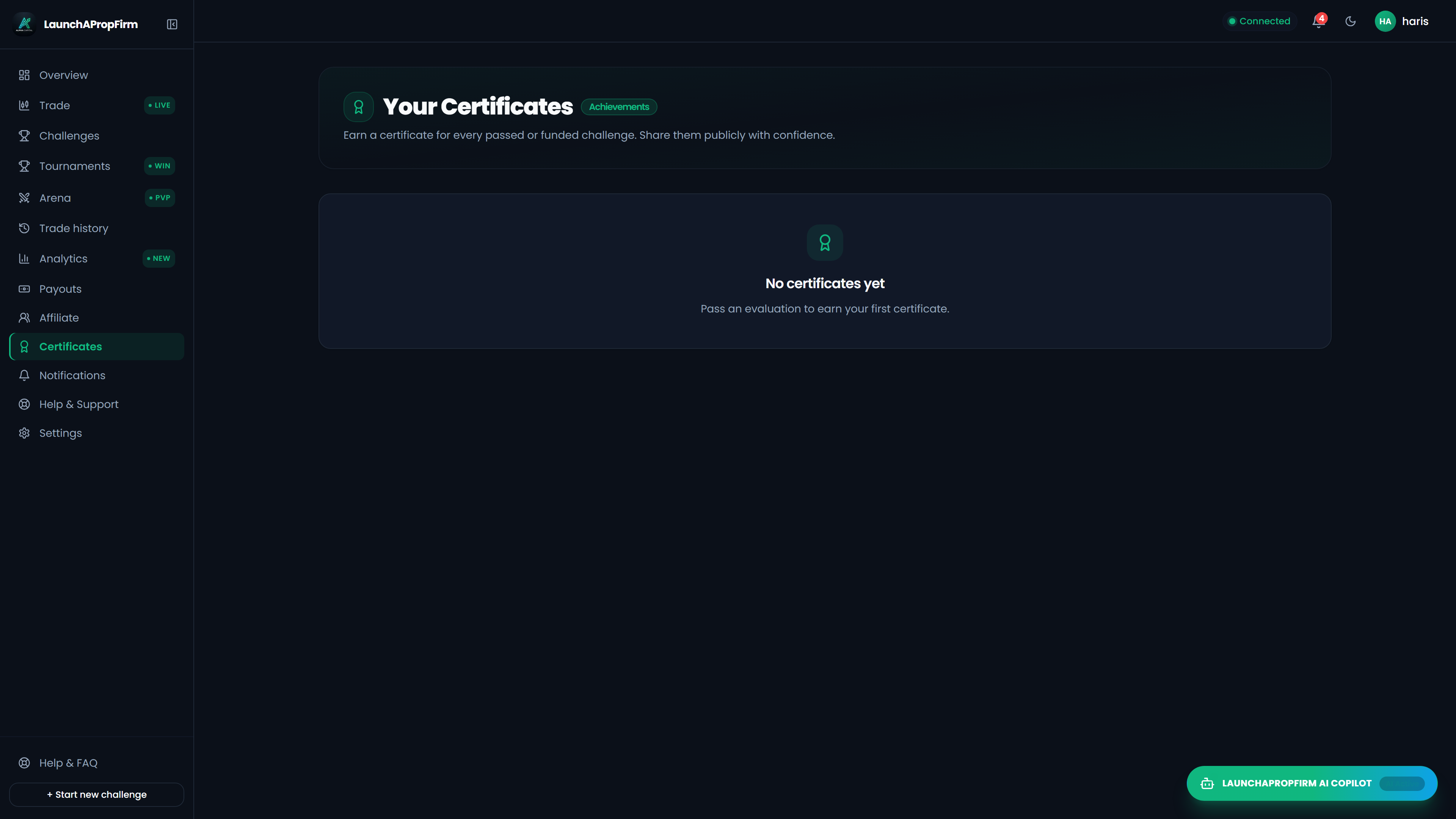
Skip the monthly fees
Own your prop firm platform outright. One time purchase.
Full source code. Live in 7 days. No revenue share. No monthly SaaS bill. See the exact platform before paying anything.
Demo login: haris / asdf1122. No signup needed
Stage 4: Claiming Your First Profit Split (Payout Roadmap)
Your first funded payout is a psychological milestone. Once that first payment clears into your crypto wallet or bank account, trading prop firms ceases to be a theoretical gaming exercise and becomes a tangible business.
Standard Payout Mechanics & Timelines
- The First Payout Lock-in (14 to 30 Days): Most prop firms require you to trade for a minimum of 14 calendar days (or 5 active trading days) before unlocking the payout request button.
- Bi-Weekly Cycles: Following your initial withdrawal, subsequent payouts are typically eligible every 14 days on-demand.
- Challenge Fee Refund: On your first successful payout, reputable firms issue a 100% to 110% refund of your initial challenge fee alongside your profit split.
Settlement Rails Comparison
When configuring your withdrawal preferences in the client portal, choose the rail that maximizes speed and minimizes banking friction:
| Settlement Rail | Processing Speed | Network / Wire Fees | Institutional Advantage |
|---|---|---|---|
| Crypto (USDT / USDC TRC20/ERC20) | 2 to 6 hours | $1.00 – $5.00 flat | Instant global liquidity; zero intermediary bank freezes |
| Rise Works (Contractor Portal) | Same-day (12–24h) | Minimal platform fee | Direct fiat conversion to local bank accounts across 190+ countries |
| Direct SWIFT / SEPA Bank Wire | 2 to 5 business days | $25 – $45 intermediary fee | Traditional banking paper trail for domestic income tax filings |
To evaluate how much profit you retain after firm splits and operational buffers, run your projections through our Prop Firm Payout Calculator.
Behind the Curtain: What Prop Firms Do When You Get Funded
Have you ever wondered what happens on the operator's screen when that "Congrats on being a funded trader" email triggers?
Prop firm operators rely on comprehensive institutional back-office software—such as LaunchPropFirm's self-hosted platform—to manage risk, automate compliance, and maintain firm solvency.
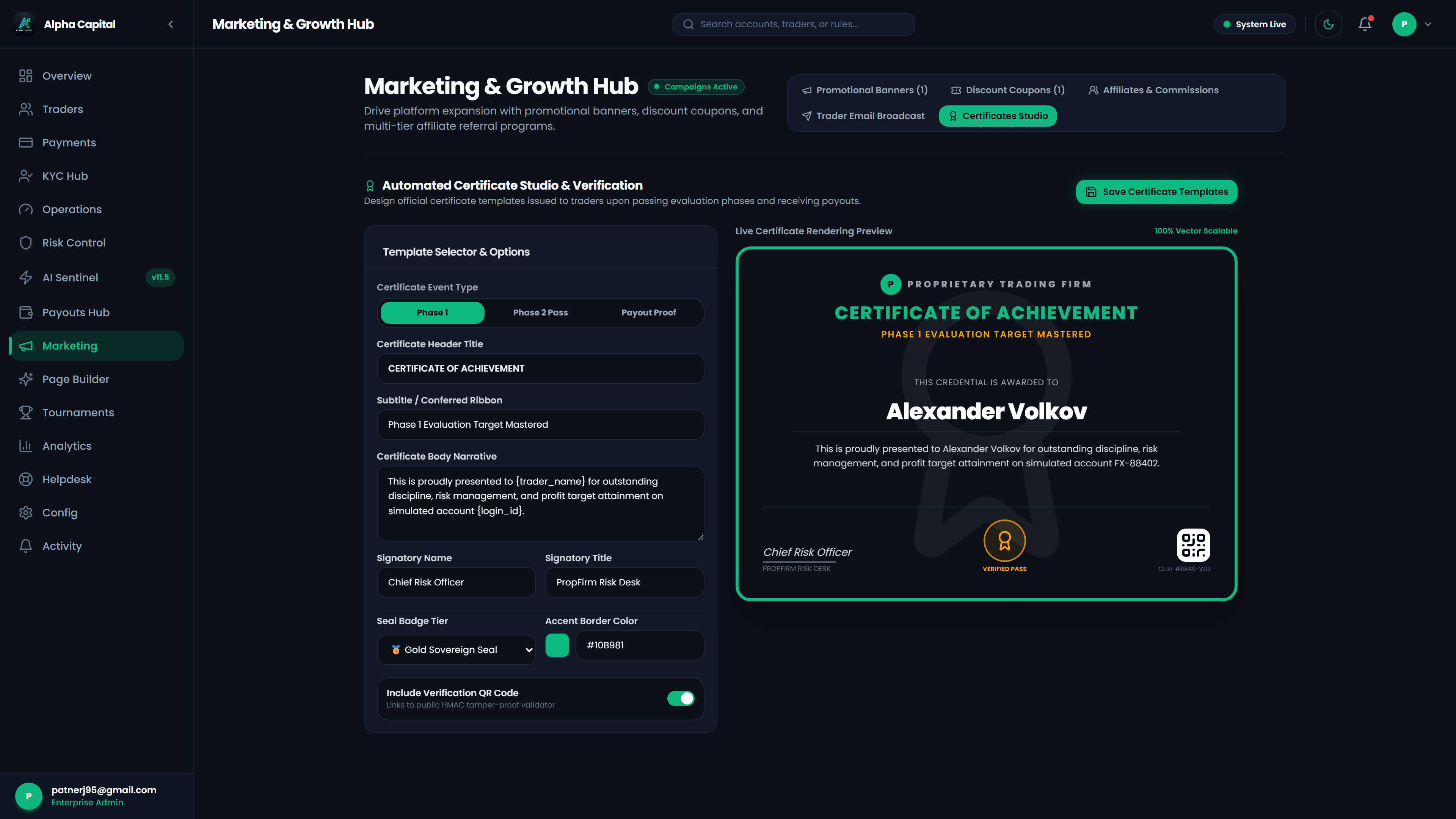
1. Automated Certificate Generation & Public Verification
The moment your Phase 2 pass status is validated by the system, the platform's Certificates Studio automatically generates a cryptographically signed, shareable certificate bearing your name, account size, pass date, and unique verification hash.
Traders love sharing these on social media, generating thousands of impressions of organic word-of-mouth marketing for the firm at zero customer acquisition cost (CAC).
2. Risk Sentinel & Exposure Profiling
In the admin portal, new funded accounts are immediately tagged by the firm's AI Sentinel & Risk Control Engine. The operator monitors:
- Order Latency & Toxic Flow: Ensuring trades are not exploiting feed latency or price arbitrage across broker bridges.
- High-Impact News Exposure: Automated news guards detect whether positions are being held through red-folder economic releases if the firm enforces news trading restrictions.
- Midnight Server Reset Exposure: The system tracks open positions as daily equity loss resets occur at server rollover time (typically 00:00 UTC/broker time). Monitor your broker's rollover countdown using our Prop Firm Daily Drawdown Reset Clock.
3. Treasury & Payout Reserve Allocation
A sustainable prop firm never gambles with payout liquidity. When a trader reaches funded status, modern risk engines automatically calculate expected payout liabilities based on the trader's historical win rate and average risk-reward ratio. Capital is earmarked in the firm's operational treasury reserves so that when you hit the withdrawal button on Day 14, funds are released without hesitation.
To understand how profitable prop firm operators structure challenge intake, payout reserves, and trader retention, read our comprehensive industry breakdown on how much prop firm owners make.
The Funded Trader Survival Checklist
Before placing trade #1 on your new funded account, complete this operational checklist:
- Wait 24 Hours: Let the adrenaline wear off. Never trade on the day your live credentials arrive.
- Double-Check Contract Limits: Know your exact dollar drawdown limit. On a $100k account with a 5% daily / 10% maximum trailing limit, memorize $95,000 daily floor and $90,000 absolute floor.
- Set Position Size Caps: Never risk more than 0.50% ($500 per $100k balance) per trade setup.
- Target a 3% Equity Buffer: Focus exclusively on building a $3,000 profit cushion before attempting to scale volume.
- Verify Rollover Hours: Know your broker's server time to avoid holding widening-spread trades through the midnight daily reset.
- Focus on the First Withdrawal: Your objective is not to become a millionaire in month one. Your objective is to achieve your first payout, recoup your challenge fee, and establish statistical consistency.
Whether you are a retail trader aiming to turn funded accounts into a long-term income stream or an aspiring founder planning to launch your own proprietary firm, explore our comprehensive suite of free Prop Firm Calculators and Simulators to model risk, payout projections, and institutional growth mechanics.
Written by the LaunchPropFirm Engineering & Risk Architecture Desk.
Evaluate Your Prop Firm Readiness Score (0-100)
Answer 5 quick operational questions about your acquisition channels, runway, and engine tech to get a personalized launch roadmap.

M.Haris
Founder & Platform ArchitectBuilding open prop trading software infrastructure for operators worldwide
I built LaunchPropFirm to give forex educators, trading communities, and fintech operators complete ownership of their platform with full source code and zero monthly SaaS rent. Every article on this blog is drawn from hands-on platform development, live MT5 risk bridge mechanics, and real operator economics.
All content, financial models, ROI estimates, and architecture guides on LaunchPropFirm are published strictly for educational and informational purposes. LaunchPropFirm provides institutional prop trading software and technology infrastructure; it does not operate as a broker, custodian, or registered investment advisor.
Evaluation challenges and funded trader accounts referenced in this guide operate in simulated demo trading environments using real-time market data feeds. Simulated trading results do not represent actual trading performance or financial advice.
Recommended Next Reads
Hand-picked operator guides to scale your prop trading platform.
Funding Pips Account Sizes and Prices 2026: Evaluation Tiers, Rules, and Scaling Plan
Complete 2026 Funding Pips account sizes and prices guide. Compare challenge fees ($5k to $100k), 2-step evaluation rules, drawdown limits, and the $2M scaling plan.
List of Prop Trading Firms (2026 Directory): Best Evaluated and Instant Funding Programs
Complete 2026 list of prop trading firms. Compare the top 6 evaluated prop firms across platforms (MT5, cTrader), drawdown rules, profit splits, and entry fees.
Skip the monthly fees
Own your prop firm platform outright. One time purchase.
Full source code. Live in 7 days. No revenue share. No monthly SaaS bill. See the exact platform before paying anything.
Demo login: haris / asdf1122. No signup needed