Prop Firm Passing Services: The Scam, IP Traps & Ban Reality
Prop firm passing services promise guaranteed challenge passes, but 99% get banned before payouts. Exposing syndicate IP radar and broker latency traps.
If you spend five minutes on trading Telegram channels, Discord servers, or Instagram reels, you will encounter the pitch: "100% Guaranteed Prop Firm Pass in 24 Hours. No risk, pass first pay later, HFT bot ready."
For an aspiring trader who has failed two or three evaluations, the offer sounds like the ultimate cheat code. Why grind for three months through Phase 1 and Phase 2, battling emotional discipline and daily drawdown limits, when a vendor claims their automated algorithm can clear an 8% profit target by tomorrow afternoon for a modest fee of $300 to $800?
Here is the brutal statistical reality that passing service vendors will never reveal: Over 99% of prop firm accounts cleared by third-party passing services are terminated by compliance before the trader ever receives a single payout.
Passing an evaluation is not the finish line—it is merely the qualifying round. When you use a passing bot, hand over your credentials, or participate in syndicated copy-trading, you leave behind an unmistakable forensic trail across broker bridges, server IP logs, and order books. The prop firm's risk desk knows exactly what you did, how you did it, and why your volume is un-hedgeable.
You have not cheated the system; you have simply paid two separate entities—the prop firm for the challenge fee and the passing vendor for the bot service—only to end up with zero payout, a permanently blacklisted name, and an empty wallet.
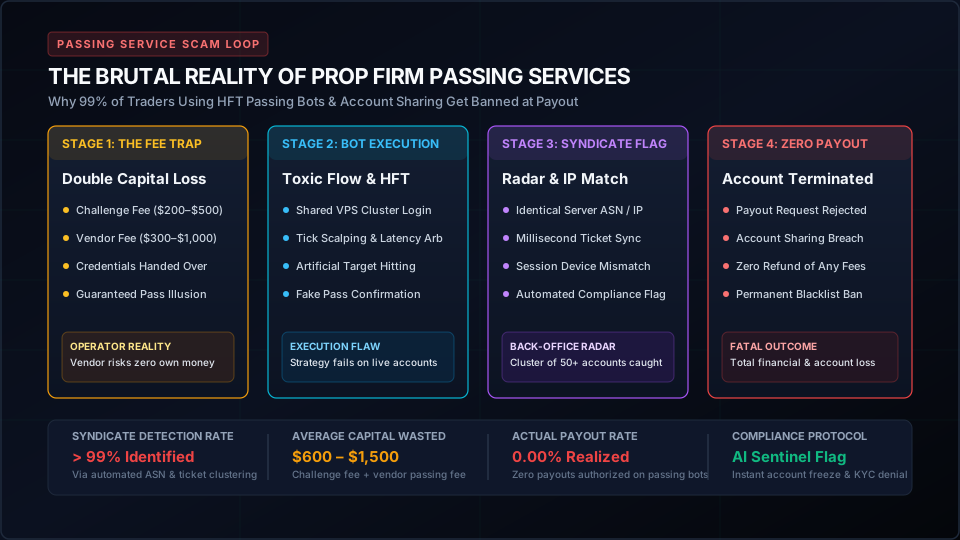
1. The Economics of the Passing Service Racket (Why Vendors Never Lose)
To understand why prop firm passing services are so pervasive, you must understand their financial asymmetry. The vendor operates on pure profit with zero downside risk, while the retail trader absorbs 100% of the financial liability.
The Double-Loss Capital Equation
When you hire a passing service, you are not just risking the vendor's service fee. You are double-allocating capital into an operation mathematically guaranteed to fail:
- The Prop Firm Challenge Entry Fee: You purchase a $100,000 challenge for $300 to $500 from a reputable firm.
- The Vendor's "Guaranteed Pass" Fee: You transfer $300 to $1,000 via crypto (USDT/BTC) or non-refundable peer-to-peer rails to the passing service provider.
- Total Out-of-Pocket Expenditure: You have committed $600 to $1,500 of real cash before placing a single legitimate trade.
The "Free Retry" Illusion
What happens when the passing vendor's bot experiences negative slippage during a news spike and blows the daily drawdown on Day 1?
The vendor does not refund your money. Instead, their terms of service promise a "free retry on the next account." But to claim that free retry, you must buy another challenge fee from the prop firm with your own money. The vendor risks nothing; they simply plug their automated script into your newly purchased credentials and roll the dice again. If it blows up, you lose another $400; if it passes, they take credit for your "success."
| Feature / Metric | The Passing Vendor's Marketing Claim | The Prop Firm Back-Office Reality | Real Trader Financial Outcome |
|---|---|---|---|
| Pass Guarantee | 100% guaranteed pass rate in 24 to 48 hours | Artificial demo fills exploiting bridge latency | Temporary illusion of funded status |
| Account Credential Handling | Safe and encrypted connection via private VPS | Master server running 50+ accounts simultaneously | Immediate IP mismatch and account sharing flag |
| Trading Strategy Deployed | Proprietary institutional AI algorithm | Toxic HFT latency arbitrage or grid gambling | Prohibited trading practice breach under contract |
| Funded Account Transition | Smooth transition to live funded payouts | Live STP/ECN bridge rejects latency arbitrage | Instant account blow-up on live market slippage |
| Withdrawal & Payout Rate | Regular 80% to 90% bi-weekly profit splits | 0.00% payout approval on identified bot clusters | Account termination, profit forfeiture, and ban |
Before committing hard-earned capital to any evaluation challenge, test whether your genuine trading system possesses statistical validity using our free Prop Firm Pass Probability Calculator.
2. How Passing Services Actually "Pass": The Toxic Exploits
Passing services do not trade standard technical analysis. They do not analyze market structure, mark fair value gaps, or trade clean swing setups. If they did, their win rate would hover around 45% to 55%, exactly like every other discretionary trader, making a "guaranteed pass" mathematically impossible.
Instead, passing services rely on toxic technical exploits designed to take advantage of vulnerabilities in retail demo trading environments.
1. High-Frequency Trading (HFT) Latency Arbitrage
On evaluation demo servers, MetaTrader 5 or cTrader broker bridges receive market price feeds with a minor processing delay (typically 20 to 80 milliseconds behind Tier-1 institutional liquidity feeds like LMAX, FastMatch, or Currenex).
HFT passing bots connect to an ultra-low latency feed alongside the prop firm's demo server. When the institutional feed moves violently on a microsecond basis, the bot recognizes where the demo price will be 30 milliseconds before the demo server updates its quotation. It executes rapid-fire 50-lot market orders, captures 0.5 to 1.5 pips of artificial profit, and closes the position before the broker bridge catches up.
2. Zero-Slippage Tick Scalping
In a real live trading account routed to external STP/ECN liquidity providers, an aggressive 50-lot market order during high volatility will experience negative slippage—it will get filled 2 to 5 pips worse than the displayed quote, instantly wiping out any micro-scalping strategy.
However, standard demo trading servers fill orders instantly at the displayed price with virtual zero slippage and zero liquidity book depletion. The bot generates massive paper profits on the evaluation account that are physically impossible to replicate in real-world market conditions.
3. Syndicated Copy-Trading & Reverse Arbitrage Clusters
Many passing services operate massive syndicated copy-trading networks. A central operator deploys a single master EA running on a dedicated server. When a signal generates, that order is broadcast to 50, 100, or 200 client accounts simultaneously.
In other cases, vendors execute reverse arbitrage: they take Trader A's account and buy 50 lots on US30, while simultaneously taking Trader B's account and selling 50 lots on US30 at the exact same second. One account inevitably blows up, while the other hits its 8% profit target and passes. The vendor collects a full passing fee from Trader A, leaves Trader B with a blown account, and moves on to the next victim.
3. The Operator's Trap: Why Prop Firms Allow Passing Bots to Pass
Traders who buy passing services often experience a short-lived sense of triumph. The bot hits the 8% target in 14 hours. The prop firm sends a congratulatory email: "Phase 1 Passed." Two days later, Phase 2 is cleared, and the trader receives their official funded certificate.
The trader thinks: *"If the prop firm hated this bot, why didn't their system stop it immediately?"*
Understanding the back-office business model of modern prop firms reveals why this happens.
The Cash Flow Mechanics of Challenge Fees
Prop firms generate a primary stream of gross revenue from evaluation challenge fees. When you purchase an evaluation, the firm's financial objective is to deliver the evaluation service you paid for without credit card chargeback liability.
If the prop firm blocked your account on Day 1 of Phase 1, you might contact your bank or payment gateway claiming "technical server error" or "service not delivered." But by allowing the passing bot to complete Phase 1 and Phase 2, the firm has indisputably fulfilled its contractual obligation: you were provided an evaluation environment, you traded it, and you cleared the phases.
The Payout Review Gate (The Guillotine Drops)
A prop firm does not spend expensive compliance labor auditing every single trade on 20,000 active evaluation demo accounts. It costs computational overhead and staff hours to run deep packet inspections on accounts that have not yet qualified for withdrawals.
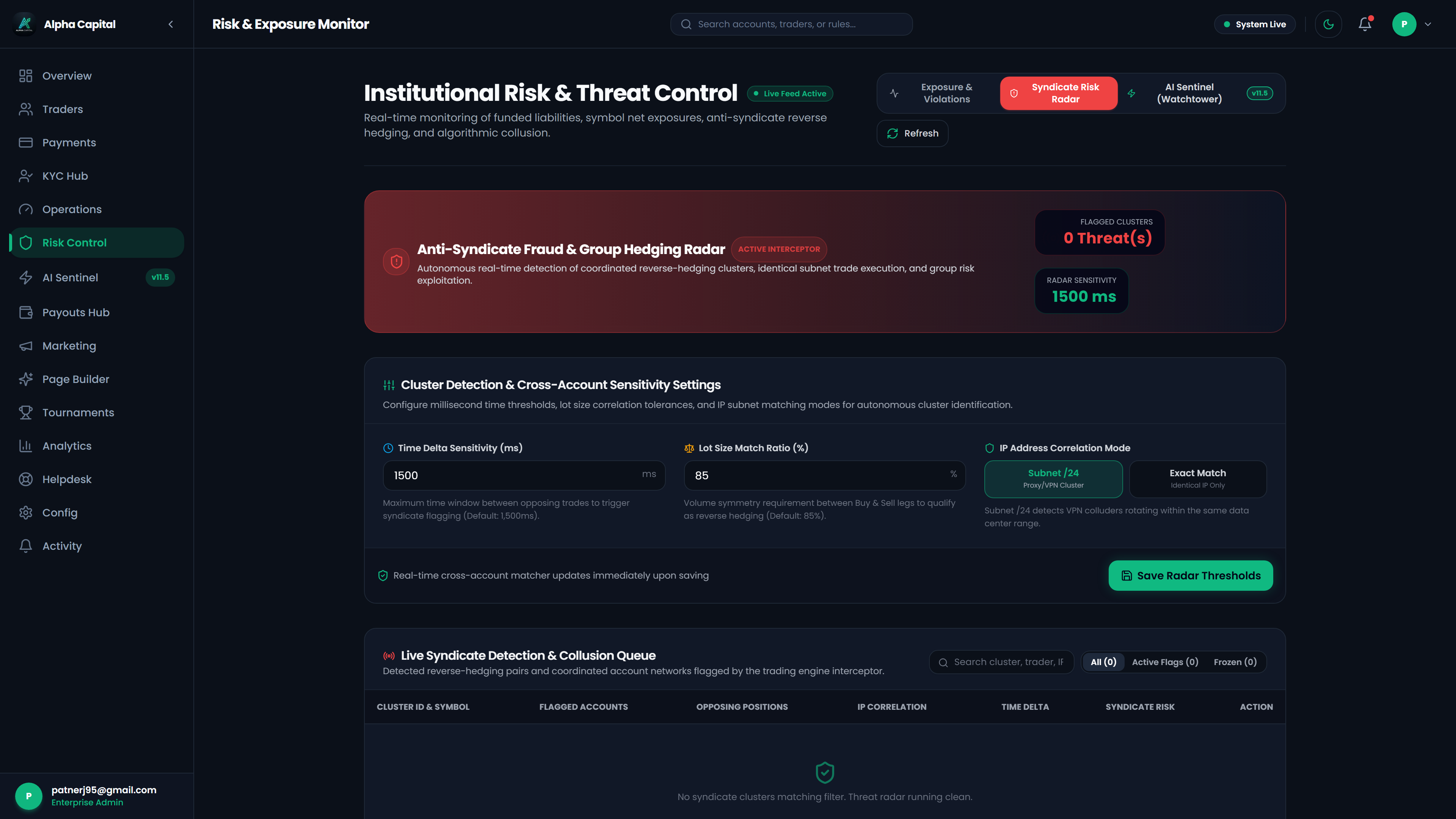
Instead, the firm's automated compliance architecture enforces a Mandatory Forensic Audit Gate the moment a newly funded trader clicks the "Request Payout" button on Day 14 or Day 30.
During this review, the risk desk's automated audit scripts analyze the account's complete execution telemetry from Day 1 of Phase 1 through to the payout request:
- Order Open Duration: Were 90% of trades held for less than 15 seconds?
- Tick-to-Execution Latency: Did the trades execute during microsecond price feed gaps?
- Lot Size Anomalies: Were massive, uncalculated 40-lot orders deployed to hit a fast target and never repeated?
- Syndicate Ticket Matching: Did the account's order tickets match trades executed across 30 other accounts within a 50-millisecond window?
If any of these markers match, the trader receives an automated termination notification: "Breach of Section 5: Unfair Trading Practices, Latency Arbitrage & Prohibited Expert Advisors." The payout is cancelled, the simulated profits are wiped out, and the account is closed.
Skip the monthly fees
Own your prop firm platform outright. One time purchase.
Full source code. Live in 7 days. No revenue share. No monthly SaaS bill. See the exact platform before paying anything.
Demo login: haris / asdf1122. No signup needed
4. Account Sharing & IP Rules: The Contractual Death Trap
Even if a passing service vendor claims their bot does not use latency arbitrage or toxic HFT strategies, hiring a third party to access your account triggers an immediate, non-negotiable contractual breach: Prohibited Account Sharing.
Every reputable prop firm's Terms of Service and Trader Agreement includes explicit clauses regarding device fingerprinting and geolocation authorization.
The Anatomy of an IP & ASN Breach
When you register for a prop firm challenge, you log in from your residential internet connection: for example, a home broadband IP in Dallas, Texas (Spectrum or Comcast residential ASN).
When you give your MetaTrader 5 or cTrader login credentials to a passing service vendor, the vendor connects those credentials to their automated VPS farm:
- Datacenter ASN Flag: Passing service bots run on commercial cloud servers (such as Hetzner, OVH, Contabo, Amazon Web Services, or DigitalOcean). Prop firm risk management software immediately flags connections originating from known datacenter hosting ranges rather than residential internet service providers.
- Geographical Teleportation: If your trader portal is accessed from Texas at 10:15 AM, but MetaTrader 5 orders are being placed from a server farm in Nuremberg, Germany at 10:18 AM, the platform's security sentinel logs an impossible travel anomaly.
- Session Fingerprint Discrepancy: Every device leaves a unique cryptographic fingerprint—including operating system kernel, screen resolution, browser headers, and hardware MAC signatures. When the trading session fingerprint differs completely from your KYC verification profile, compliance flags account hijacking.
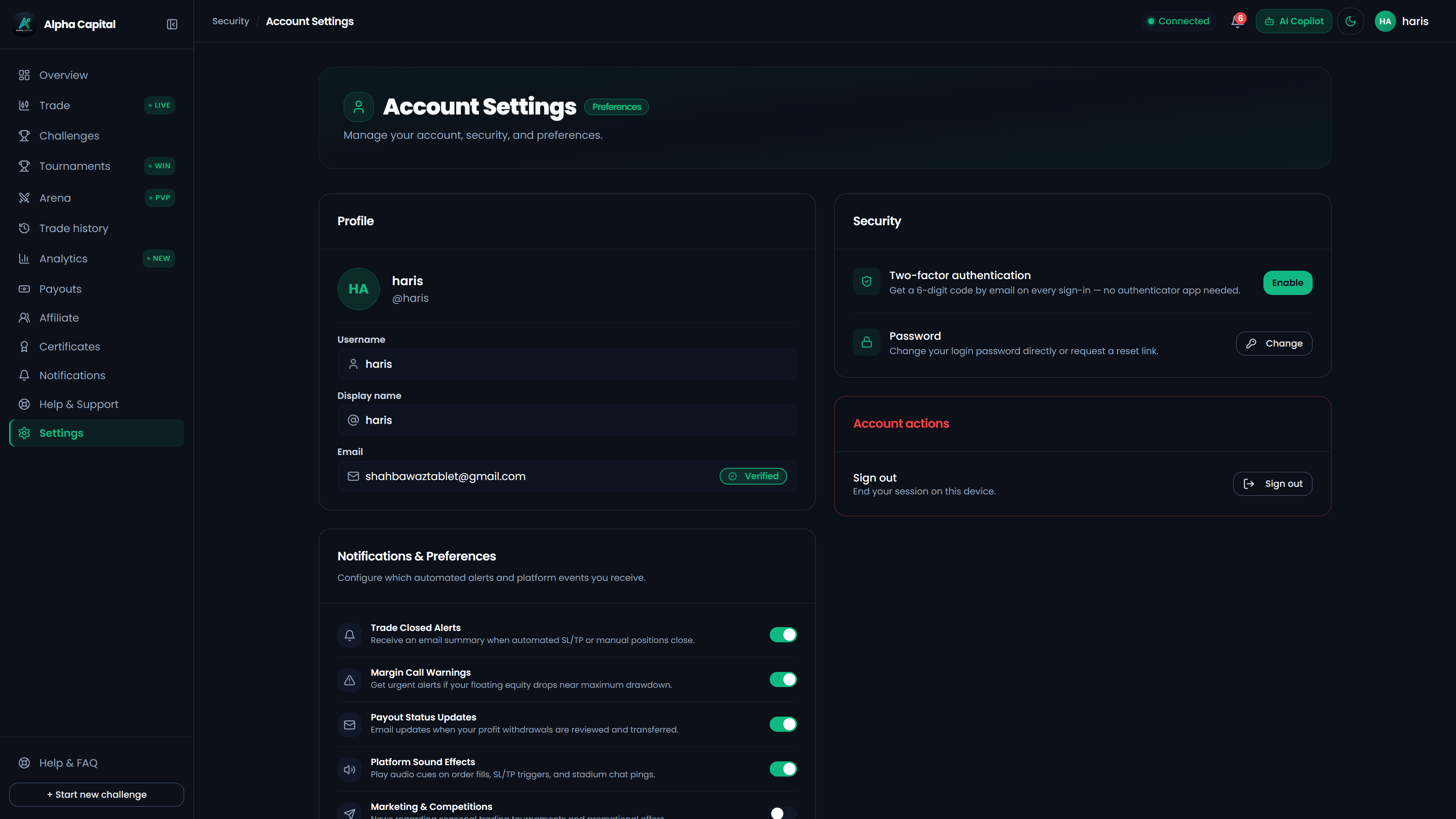
Inside the modern client cabinet—such as the security hub integrated into LaunchPropFirm's self-hosted platform—every login attempt, session duration, device fingerprint, and IP ASN origin is permanently logged. When compliance pulls your security audit, claiming "I was just using a VPN" is universally rejected because professional prop firms explicitly prohibit commercial VPNs and VPS proxies during trade execution without prior written approval.
5. The Funded Account Catastrophe: What Happens Post-Pass?
Let us examine the best-case scenario that passing service customers dream of: the bot clears Phase 1 and Phase 2, and the firm issues funded account credentials without noticing the VPS datacenter IP.
What happens next?
This is where the entire passing service premise completely implodes.
Trap 1: The Bot Cannot Trade the Funded Account
Passing service vendors explicitly tell you: *"Our bot is only for Phase 1 and Phase 2. Once you get funded, you must trade the account yourself."*
Why won't the vendor run their "guaranteed" bot on the live funded account? Because they know with 100% certainty that the bot will blow up the funded account in under five minutes.
On evaluation accounts, demo broker bridges provide zero-slippage instant fills. On funded accounts—which are either connected to live institutional STP/ECN liquidity pools or routed through sophisticated A-book simulated bridges—latency arbitrage does not exist. The bridge rejects microsecond orders, re-quotes price movements, and charges live market spreads. The moment the bot fires its 50-lot order, negative slippage triggers a massive drawdown, instantly breaching the firm's 4% to 5% trailing drawdown ceiling.
Trap 2: The Trader Has Zero Practical Skill
If you paid a bot to pass your challenge, you never learned:
- How to manage daily equity drawdown during high-impact news releases.
- How to calculate dynamic position sizing based on pip distance and market volatility.
- How to handle consecutive losing trades without experiencing psychological revenge trading.
A trader who could not pass an evaluation on their own is suddenly thrown into a $100,000 funded account with a strict $5,000 maximum loss limit. Within 48 to 72 hours, the trader executes an emotional, oversized trade, panics when the position moves against them, and breaches the account balance.
Trap 3: The Consistency Rule & Profit Dilution Lock
Even if a trader takes over the funded account and manages to capture a lucky $4,000 profit on a single high-volatility trade, they run headfirst into institutional consistency rules.
Most sustainable prop firms enforce a 30% to 50% consistency cap. If you generate $5,000 in total profit, but $3,500 of that profit came from a single high-impact trading day, that single trade accounts for 70% of your total gain—a clear consistency violation. Your withdrawal request is frozen until you execute dozens of additional consistent trading days to dilute that outlier spike.
Test your profit distribution and compliance limits right now using our live interactive consistency tool:
To model complex lot-size limits and multi-day profit distributions, use our institutional Prop Firm Consistency Calculator and read our complete guide on the Prop Firm Consistency Rule Explained.
6. Behind the Curtain: How Institutional Prop Firms Protect Themselves
Aspiring entrepreneurs and prop firm operators frequently ask: *"How do top-tier firms defend their liquidity pools against coordinated bot attacks and passing syndicates?"*
Prop firm operators cannot afford to pay out un-hedged profits generated by artificial demo server bugs. If a firm paid out every trader who used an HFT latency bot, the firm's cash reserves would be wiped out within 60 days.
To maintain long-term balance-sheet solvency, modern prop firm founders deploy institutional software suites like LaunchPropFirm's turn-key platform.
The Modern Operator's Defense Arsenal
- Automated Syndicate Radar: The risk engine scans all incoming orders across the entire server cluster. If multiple accounts execute identical symbol, direction, and stop-loss tickets within a 100-millisecond window, the system groups them into a suspected "Syndicate Cluster" for administrative review.
- Bridge Latency Normalization: Modern trading bridges introduce artificial latency buffers (randomized 20 to 50 millisecond delays) on demo accounts to simulate real-world liquidity routing, rendering microsecond latency bots completely inert.
- ASN & Proxy Geofencing: Incoming socket connections are filtered through real-time IP intelligence databases. Datacenter ASNs (Contabo, Hetzner, AWS) are automatically flagged, requiring traders to verify legitimate residential connectivity before funded credentials unlock.
- Treasury Reserve Protection: Payouts are systematically audited against execution telemetry. Legitimate, consistent traders who trade verified market strategies receive instant automated payouts via crypto or fiat rails; toxic arbitrage exploits are filtered out before capital leaves treasury reserves.
To understand the economics of prop firm operations, risk allocation, and how sustainable firms generate healthy 25% to 40% net operating margins while rewarding real trading talent, read our comprehensive industry breakdown on how much prop firm owners make.
7. The Legitimate Path: How to Actually Pass and Keep a Funded Account
There are no shortcuts in proprietary trading. The skills required to pass an evaluation are the exact same skills required to keep a funded account and receive regular bi-weekly payouts.
If you want to achieve legitimate funded trader status, replace passing service scams with this proven operational framework:
1. Calculate Your Statistical Edge First
Do not buy a challenge hoping for luck. Before spending money on an entry fee, verify your trading system's mathematical expectancy:
- Win Rate: What percentage of your trades hit take-profit?
- Risk-to-Reward Ratio (RRR): Is your average winner at least 1.5x larger than your average loser?
- Maximum Historical Drawdown: What is the maximum number of consecutive losses your strategy has experienced over a 100-trade backtest?
If your system cannot survive a 10-trade losing streak without losing more than 4% of total equity, you are not ready for an evaluation.
2. Cap Your Risk at 0.50% Per Trade
The number one reason traders fail challenges is over-leveraging. When you risk 2.0% per trade on a challenge account with a 10% maximum drawdown ceiling, you are only five consecutive losses away from account termination.
Scale your risk down to 0.25% to 0.50% per trade setup ($250 to $500 on a $100,000 balance). A 0.50% risk model provides a 20-trade losing cushion, giving your statistical edge room to play out without triggering panic. Use our Prop Firm Lot Size & Pip Risk Calculator to determine exact lot sizes before entering every market position.
3. Track Midnight Server Rollover Times
Many evaluation accounts are breached not during active market hours, but at midnight server rollover time (00:00 broker time). During rollover, institutional liquidity dries up, causing spreads on major currency pairs and indices to widen by 5 to 15 pips.
If you have open positions near your daily loss floor, widening spreads can instantly trigger an automated breach. Track your broker's exact rollover countdown using our Prop Firm Daily Drawdown Reset Clock Tracker.
4. Five Warning Signs of a Passing Service Scam
Before you even consider hiring a third-party service, look out for these red flags:
- "100% Guaranteed Pass" Claims: In financial markets, anyone offering a 100% guarantee is running an exploit or an outright scam.
- Pass First, Pay Later Offers: Vendors use this to gain your trust. They run high-risk reverse arbitrage across dozens of accounts. When half the accounts blow up, they abandon them; when yours passes by chance, they demand payment.
- Requiring Account Login Credentials: Giving your MT5/cTrader password to a stranger is an automatic breach of every prop firm's Terms of Service.
- Requiring HFT-Friendly Prop Firms: If a vendor tells you to buy challenges only from specific, low-tier firms that allow HFT bots, it is because those firms intentionally allow bots on evaluations to collect fees, knowing full well they will deny the payout later.
- Crypto-Only Untraceable Payments: Legitimate software vendors provide commercial merchant processing with invoice receipts, not untraceable Telegram crypto wallet addresses.
Summary Checklist: Passing Service Fantasy vs. Reality
| Operational Reality | Passing Service Route | Legitimate Trader Route |
|---|---|---|
| Total Capital Investment | $600 to $1,500 (Double fees) | $150 to $500 (Challenge fee only) |
| Account Ownership & Control | Compromised by third-party VPS | 100% owned and operated by you |
| Risk Desk Flag Status | Flagged for HFT latency and ASN sharing | Clean residential IP and organic execution |
| Funded Account Survival | Blown in under 48 hours | Scalable long-term profit generation |
| First Payout Approval Rate | Less than 1% (Over 99% denied) | High approval for rule-compliant traders |
| Long-Term Career Viability | Zero skill developed; permanent bans | Mastery of market risk and capital growth |
Passing a prop firm evaluation is an earned achievement, not a purchased commodity. When you build the discipline to manage risk, preserve drawdown, and execute with consistency, you do not need to pay a bot vendor. You keep 100% of your profits, maintain an unblemished compliance record, and build a sustainable career trading institutional capital.
Explore our full library of institutional trading tools, risk calculators, and operational simulators in the LaunchPropFirm Tools Suite to optimize your funded trading journey.
Written by the LaunchPropFirm Risk & Trading Architecture Desk.
Evaluate Your Prop Firm Readiness Score (0-100)
Answer 5 quick operational questions about your acquisition channels, runway, and engine tech to get a personalized launch roadmap.

M.Haris
Founder & Platform ArchitectBuilding open prop trading software infrastructure for operators worldwide
I built LaunchPropFirm to give forex educators, trading communities, and fintech operators complete ownership of their platform with full source code and zero monthly SaaS rent. Every article on this blog is drawn from hands-on platform development, live MT5 risk bridge mechanics, and real operator economics.
All content, financial models, ROI estimates, and architecture guides on LaunchPropFirm are published strictly for educational and informational purposes. LaunchPropFirm provides institutional prop trading software and technology infrastructure; it does not operate as a broker, custodian, or registered investment advisor.
Evaluation challenges and funded trader accounts referenced in this guide operate in simulated demo trading environments using real-time market data feeds. Simulated trading results do not represent actual trading performance or financial advice.
Recommended Next Reads
Hand-picked operator guides to scale your prop trading platform.
Congrats on Being a Funded Trader: First 48-Hour Protocol
Received the 'congrats on being a funded trader' email? Here is the exact survival protocol for KYC verification, contract signing, and your first payout.
Funding Pips Account Sizes & Prices (2026 Comparison Table)
Complete 2026 Funding Pips account sizes and prices guide. Compare challenge fees ($5k to $100k), 2-step evaluation rules, and the $2M scaling plan limits.
Skip the monthly fees
Own your prop firm platform outright. One time purchase.
Full source code. Live in 7 days. No revenue share. No monthly SaaS bill. See the exact platform before paying anything.
Demo login: haris / asdf1122. No signup needed