Prop Firm Payout Calculator: Profit Split & Net Pay Guide
Calculate your exact take-home prop firm payout after 80% or 90% profit splits, challenge fee refunds, crypto rail fees, and consistency rule deductions.
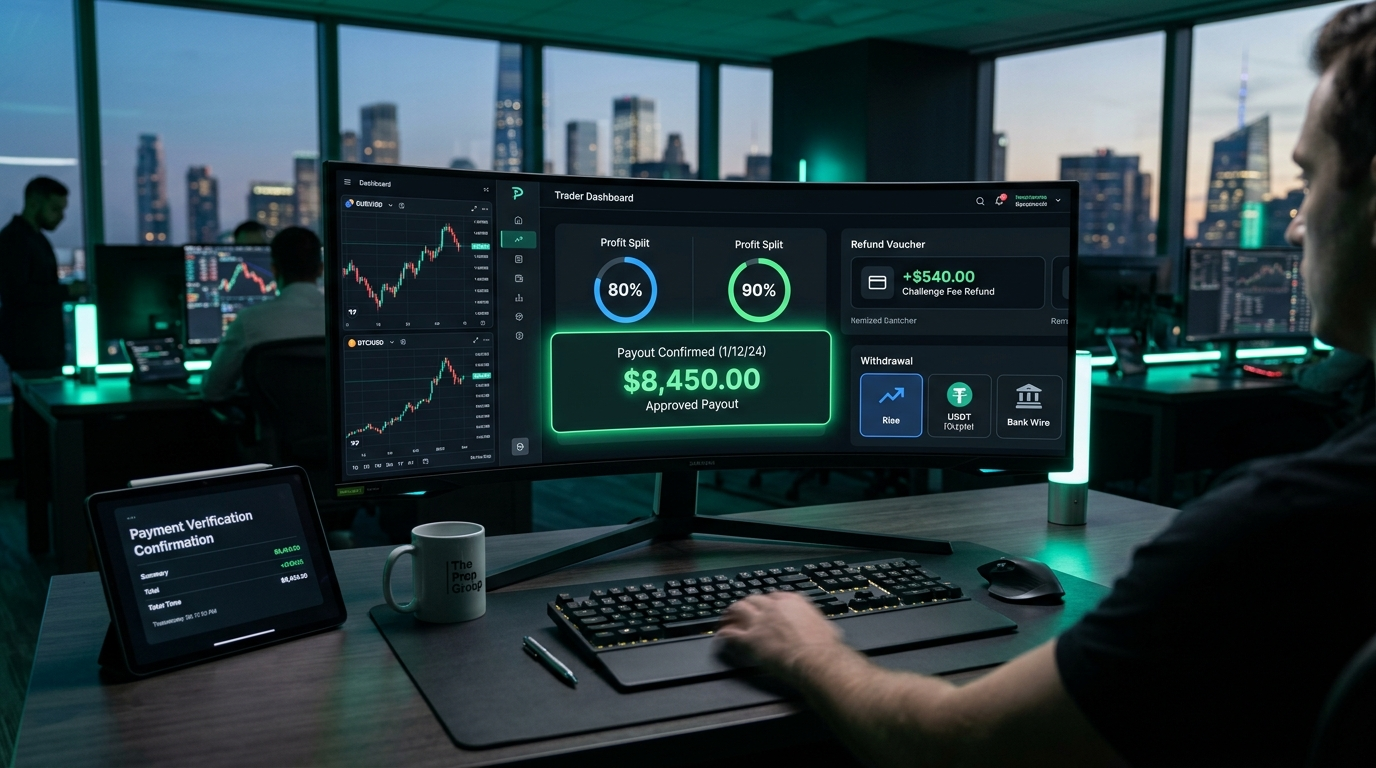
Seeing a positive account balance inside your funded trader dashboard is a major milestone. However, generating ten thousand dollars in closed trading profits does not mean ten thousand dollars lands inside your bank account.
Between contractual profit splits, initial evaluation fee refunds, consistency rule caps, and payment rail processing fees, your actual take-home payout follows a precise mathematical pipeline. Understanding this exact gross-to-net calculation protects you from unexpected deductions on withdrawal day.
Before requesting your next withdrawal, simulate your exact net take-home pay using our free interactive Prop Firm Payout Calculator. It factors in your challenge refund, custom profit split percentage, and payment rail transaction fees.
1. Gross Profit vs Net Payout: The Prop Firm Calculation Formula
The foundation of every prop firm payout begins with your gross realized profit. This represents the total net gain generated above your starting funded account balance during the active payout cycle.
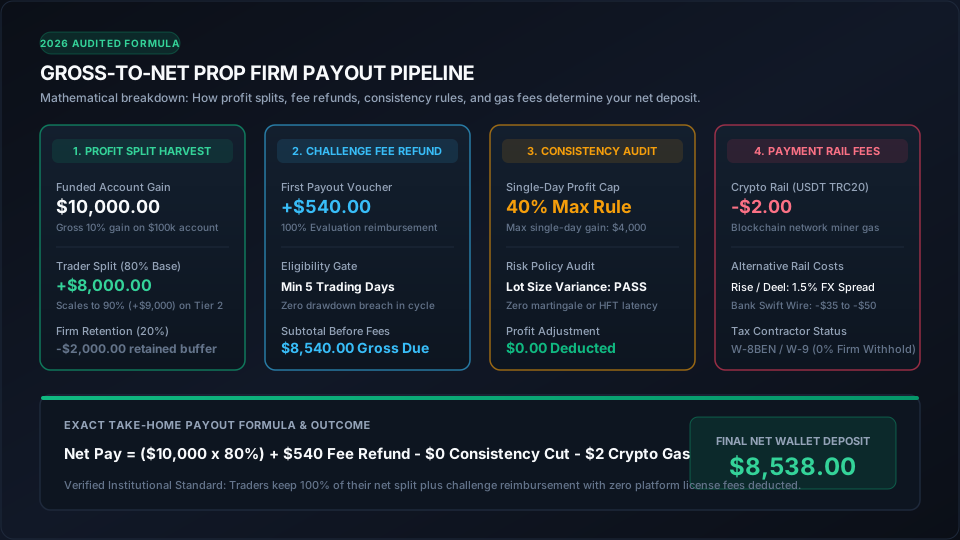
Most institutional prop firms assign an 80% default profit split to standard funded accounts. Under an 80% split model, you retain $8,000 of a $10,000 closed profit, while the firm retains $2,000 to cover operational overhead and risk reserves.
When you advance through an official scaling plan, your profit split can increase to 90% or 100%. Moving from an 80% to a 90% split puts an additional $1,000 directly into your wallet on a $10,000 gain.
Your final payout also reflects evaluation fee reimbursements, potential consistency rule haircuts, and third-party payment gateway transaction fees.
Prop Firm Net Payout Formula:
Net Take-Home Pay = (Gross Closed Profit x Trader Split %) + Challenge Fee Refund - Consistency Haircuts - Payment Rail Fees
To avoid unexpected surprises, verify your profit consistency metrics beforehand using our Prop Firm Consistency Calculator. This ensures that no single trading day exceeds the maximum profit concentration cap enforced by your firm.
2. Challenge Fee Refunds: When and How You Get Your Money Back
One of the most attractive financial incentives in modern prop trading is the 100% evaluation fee refund. When you successfully reach your first funded payout, reputable prop firms reimburse your upfront challenge fee in full.
Prop firms structure fee refunds as a customer acquisition investment. Because only a disciplined minority pass multi-stage evaluations, firms willingly reimburse fees to retain profitable traders.
To qualify for your challenge fee reimbursement on your first payout, firms enforce three standard operational gates:
First, you must satisfy the minimum profitable trading days requirement, typically ranging from 5 to 14 days. Placing a single trade on day one and requesting an immediate withdrawal pauses your request until the full schedule is met.
Second, your closed net profit must exceed the minimum payout threshold. While some firms allow withdrawals from $50, others require an account buffer of at least 1% to ensure your balance remains above the daily drawdown floor.
Third, you must complete your identity verification (KYC) and sign the contractor agreement before the payout window opens. Completing these requirements early ensures your payout processes without administrative delays.
If you violate a drawdown rule after receiving your first payout, your account is closed, but you keep all previous earnings and your reimbursed fee. To compare upfront pricing and refund policies across top operators, explore our Prop Firm Pricing Calculator and our guide on cheapest prop firm challenge accounts.
3. 2026 Prop Firm Payout Terms & Profit Split Comparison Matrix
Different prop firms enforce widely contrasting payout frequencies, scaling milestones, and withdrawal rails. Selecting a firm that aligns with your cash flow needs is just as important as passing the initial evaluation.
The comparison table below details current payout terms, base and maximum profit splits, fee refund structures, and supported withdrawal methods across top-tier proprietary trading firms:
| Prop Firm | Base Profit Split | Max Scaled Split | 1st Payout Refund | Payout Cycle | Primary Rails & Typical Fees |
|---|---|---|---|---|---|
| FTMO | 80% Base | 90% via Scaling | 100% on 1st Payout | 14 Days (Bi-weekly) | Rise, Crypto (USDT), Swift Wire ($0 to $35) |
| FundedNext | 80% Base (+15% Pass) | 90% via Scaling | 100% on 1st Payout | 14 Days (24h Guarantee) | Rise, Crypto (USDT TRC20), Direct Bank |
| The5ers | 75% to 80% | 100% (High Stakes) | 100% on 1st Payout | 14 Days / Monthly | Rise, Crypto, International Bank Wire |
| Funding Pips | 80% Base | 90% via Scaling | 100% on 1st Payout | 5 Days (Bi-weekly) | Crypto (USDT TRC20/BEP20), Rise |
| E8 Markets | 80% Base | 100% (Custom Add-on) | 100% on 1st Payout | 8 Days (E8 Track) | Rise, Crypto (USDT), Bank Wire |
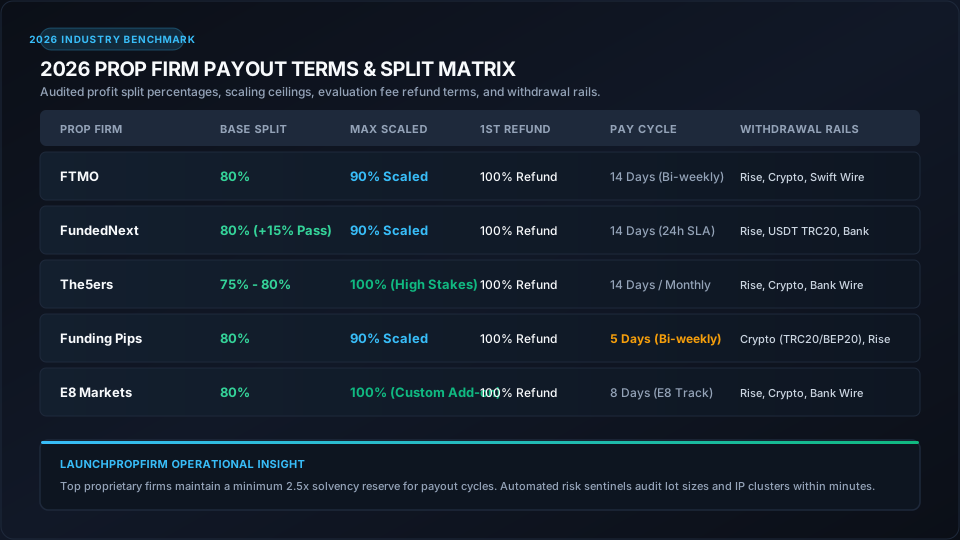
Payout cycles have compressed dramatically across the industry. While 30-day cycles were standard in prior years, most leading firms now operate on 14-day, 8-day, or even 5-day withdrawal schedules.
Faster payout schedules significantly reduce your exposure to mid-month market volatility. Withdrawing profits on a bi-weekly basis secures capital in your personal account rather than leaving accumulated gains exposed to sudden drawdown breaches.
Before entering trades during volatile rollover periods, check our Prop Firm Daily Drawdown Reset Time Guide to verify the exact server clock times when high-water mark equity calculations reset.
4. Withdrawal Rails Breakdown: Rise, Crypto (USDT), and Bank Wire
Once your payout is approved by the prop firm risk desk, funds transfer through your selected payment rail. Each withdrawal channel involves distinct fee structures, settlement speeds, and conversion rates.
Rise has become the primary payout partner for the global prop trading industry. It allows prop firms to contract with traders worldwide while providing instant payouts into a secure digital wallet.
When withdrawing funds from Rise into your local bank account, local currency transfers generally cost $0 to $5 in flat transaction fees. However, Rise applies an exchange conversion markup of approximately 1.5% to 2.5% on non-USD bank accounts.
Cryptocurrency withdrawals, primarily using Tether (USDT), offer fast settlement times with zero banking intermediary delays. Payouts sent via USDT on the Tron (TRC20) or Binance Smart Chain (BEP20) networks incur minimal blockchain gas fees ranging from $0.50 to $2.50 per transaction.
Traders utilizing crypto withdrawals must also account for secondary off-ramping spreads, as exchanges and P2P desks often charge 0.5% to 1.5% when converting USDT into local fiat.
Direct International Bank Wire transfers via the SWIFT network provide traditional bank settlement but represent the slowest payout channel. Intermediary correspondent banks routinely deduct $25 to $50 in processing fees, and funds take 3 to 5 business days to clear.
Prop firm payouts represent gross contractor revenue rather than employee payroll. Prop firms do not withhold income taxes, Medicare, or pension contributions from your withdrawal.
Non-US traders submit IRS Form W-8BEN, while US-based traders complete Form W-9. You are personally responsible for calculating and reporting self-employment income to your local tax authority. For comprehensive risk management strategies, review our guide on trading risk management tools.
5. How Prop Firm Operators Configure Payout Queues & Solvency Buffers
Behind every successful trader payout lies a complex backend risk management infrastructure. For founders building proprietary trading firms, managing the payout engine effectively is critical to long-term solvency.
When a trader submits a payout request, automated risk sentinels execute an instantaneous compliance scan. The system verifies that trades complied with maximum lot size limits, that no toxic latency arbitrage strategies were deployed, and that login IP addresses matched the verified profile.
To maintain stability, institutional operators maintain strict liquidity buffers, holding at least 2.5 times the average bi-weekly payout volume in dedicated fiat and crypto reserves.
Many startup prop firm founders make the critical error of utilizing rigid SaaS platforms that charge monthly rent and percentage cuts on trader payout volumes. Over twelve months, these SaaS fees drain tens of thousands of dollars from founder treasury buffers.
Modern operators build their brands on turnkey platforms like LaunchPropFirm White Label Software. For a transparent $2,495 one-time license, founders secure complete self-hosted source code ownership, automated payout queuing, multi-tier profit split engines, and zero monthly revenue sharing.
Explore our comprehensive Prop Firm Platform Comparison to evaluate self-hosted architecture against legacy SaaS rental models. Discover how our full-stack trading infrastructure empowers operators to scale their firms with complete technical independence.
Frequently Asked Questions
What percentage of profit do prop firms take from payouts?
Standard proprietary trading firms retain between 10% and 20% of closed trading profits on funded accounts, providing traders with an 80% to 90% profit split. Some firms offer scaling programs that elevate the trader split up to 100% after reaching specific profit milestones without violating risk parameters.
Do prop firms refund the challenge fee on the first payout?
Yes, most reputable proprietary trading firms provide a 100% refund of your initial evaluation fee alongside your first successful profit withdrawal. To qualify for fee reimbursement, traders must fulfill the minimum profitable trading days, achieve the minimum payout balance, and pass standard KYC identity verification.
What is the fastest payout prop firm in 2026?
Funding Pips and FundedNext rank among the fastest payout prop firms in 2026. Funding Pips offers a 5-day payout cycle on funded accounts, while FundedNext provides bi-weekly payouts with an official 24-hour payout processing guarantee.
How do prop firm payouts work with taxes and contractor forms?
Prop firm traders operate as independent contractors rather than corporate employees. Prop firms do not deduct payroll taxes from payouts. Traders residing outside the United States submit IRS Form W-8BEN, while US citizens submit Form W-9, and report net earnings as self-employment income.
Why would a prop firm deny or deduct from a payout request?
Prop firms may deny or adjust a payout request if a trader violates trading rules during the payout cycle. Common violations include exceeding single-day profit consistency caps, deploying prohibited latency arbitrage bots, failing KYC verification, or engaging in account sharing across multiple IP addresses.
Calculate Your Net Prop Firm Payout & Profit Split
Compute your net take-home withdrawal after 80-90% splits, challenge fee refunds, and payment rail deductions.

M.Haris
Founder & Platform ArchitectBuilding open prop trading software infrastructure for operators worldwide
I built LaunchPropFirm to give forex educators, trading communities, and fintech operators complete ownership of their platform with full source code and zero monthly SaaS rent. Every article on this blog is drawn from hands-on platform development, live MT5 risk bridge mechanics, and real operator economics.
All content, financial models, ROI estimates, and architecture guides on LaunchPropFirm are published strictly for educational and informational purposes. LaunchPropFirm provides institutional prop trading software and technology infrastructure; it does not operate as a broker, custodian, or registered investment advisor.
Evaluation challenges and funded trader accounts referenced in this guide operate in simulated demo trading environments using real-time market data feeds. Simulated trading results do not represent actual trading performance or financial advice.
Recommended Next Reads
Hand-picked operator guides to scale your prop trading platform.
Breaker Block Trading Strategy: How to Trade Block Failures
Master the breaker block trading strategy. Learn how failed order blocks create high-probability liquidity retests with exact entry, stop loss, and RR rules.
Advantages of Forex Trading: 2026 Benefits & Risk Guide
Explore the core advantages of forex trading in 2026. Master 24/5 liquidity, leverage mechanics, major currency pairs, and the risk reality.
Community Monetization & Platform Ownership
Run a Trading Discord, Telegram, or Signal Group? Launch Your Own Prop Firm in 7 Days.
Stop sending your community to third-party prop firms. Own our complete white-label prop firm platform with all automated risk engines, live TradingView charts, MT5 bridge, and paid tournament engine from just $995 down under 50% milestone escrow. Zero monthly SaaS fees.