What Is an Institutional Trading Platform? 2026 Guide
Discover what an institutional trading platform is in 2026. Explore FIX API bridges, L2 liquidity routing, risk engines, and prop trading architecture.
When retail traders open a standard brokerage account, they interact with a basic graphical interface designed for simple order execution.
Behind that surface, retail orders are routed through dealing desks, internalized against retail book makers, or matched with synthetic pricing feeds.
An institutional trading platform operates on a fundamentally different engineering paradigm, built for multi-asset liquidity aggregation, sub-millisecond execution, and algorithmic risk management.
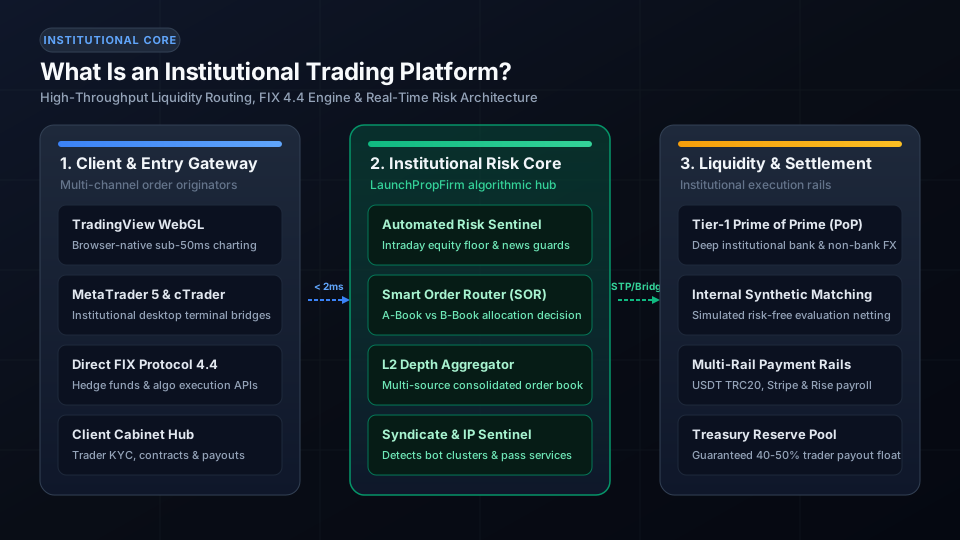
1. What Is an Institutional Trading Platform? Architecture & Core Definition
To understand how institutional trading platforms work, we must first define their primary function in modern financial market structure.
Quick Definition: An institutional trading platform is a high-throughput financial software ecosystem connecting proprietary trading desks and institutional funds directly to Tier-1 liquidity via FIX Protocol 4.4 and ultra-low latency Smart Order Routers (SOR). Unlike retail brokers, it offers multi-asset L2 order book depth, sub-millisecond execution, and automated real-time risk sentinels.
At institutional scale, trading platforms are not standalone desktop programs. They are distributed microservice ecosystems that handle millions of incoming tick events per second.
The architecture separates the presentation layer from the execution core, ensuring that graphical rendering never creates latency bottlenecks during high-volatility market events.
Proprietary trading desks, hedge funds, and modern prop firm operators rely on these systems to bridge trader orders directly to interbank liquidity pools without slippage spikes.
2. Retail Broker vs Institutional Trading Platform: Structural Comparison
Retail trading software focuses primarily on ease of use, chart aesthetics, and simplified single-click order tickets.
In contrast, institutional trading platforms prioritize raw execution throughput, transparent depth of market, and direct market access:
| Architectural Dimension | Retail Broker Platform (MT5/cTrader Standard) | Institutional Trading Platform (Proprietary / Tier-1 Desk) |
|---|---|---|
| Execution Latency | 50ms to 250ms (internet routing + broker dealing desk) | Sub-millisecond (< 5ms via cross-connected Equinix fiber) |
| Liquidity Access | Single broker internal B-Book feed or retail aggregator | Multi-bank Tier-1 liquidity, Non-Bank LPs, and ECN venues |
| Order Book Visibility | Level 1 (Top of Book Bid/Ask only) | Level 2 (Full market depth with order volumes at every tick) |
| Connectivity Protocol | Proprietary client-server websocket or web terminal | Native FIX Protocol 4.4 / 5.0 and binary API gateways |
| Order Routing Logic | Static routing to broker clearing entity | Dynamic Smart Order Routing (SOR) optimizing fill rates |
| Risk Sentinels | Periodic margin checks and end-of-day stop-outs | Nanosecond pre-trade risk checks and automated circuit breakers |
| Slippage Model | Asymmetric dealer slippage on volatile news events | Transparent price improvement and multi-venue fill blending |
| Hosting Infrastructure | Shared cloud servers with unpredictable load | Dedicated bare-metal servers collocated at Equinix LD4/NY4 |
For retail traders aspiring to trade institutional capital, recognizing these differences demystifies why professional prop firms enforce strict latency and consistency standards.
For prop firm founders, choosing an institutional-grade engine prevents catastrophic server crashes and execution disputes during high-impact news releases.
3. The Retail Trader Reality: Why Institutional Tech Protects Your Capital
For a beginner trader, terms like FIX protocol or Level 2 depth can sound like abstract academic jargon.
However, the difference between a retail broker and an institutional trading platform directly impacts whether your trade hits take-profit or suffers unexpected losses.
Consider what happens during a high-impact macroeconomic event like US Non-Farm Payrolls (NFP):
The Retail Broker Trap:
- Artificial Spread Blowouts: Your retail broker widens EUR/USD spreads from 1.0 pip to 7.0 pips to protect their internal dealing desk.
- Negative Slippage & Hang-Ups: When you click 'Buy', your order hangs for 800 milliseconds and fills 12 pips worse than the market price.
- Simulated Stop Hunts: Your stop loss gets triggered on a broker wick even though interbank market prices never touched that level.
The Institutional Platform Reality:
- Raw Interbank Spreads: The platform aggregates live quotes from Tier-1 banks, maintaining tight 0.0 to 0.4 pip spreads.
- Sub-Millisecond Execution: Your order routes via cross-connected fiber in under 5 milliseconds with zero dealer intervention.
- Transparent Order Book: Every limit order sits openly in Level 2 depth, giving you the exact same execution privileges as institutional funds.
Understanding this execution gap explains why disciplined traders migrate from retail brokers to funded prop firm accounts.
Skip the monthly fees
Own your prop firm platform outright. One time purchase.
Full source code. Live in 7 days. No revenue share. No monthly SaaS bill. See the exact platform before paying anything.
Demo login: haris / asdf1122. No signup needed
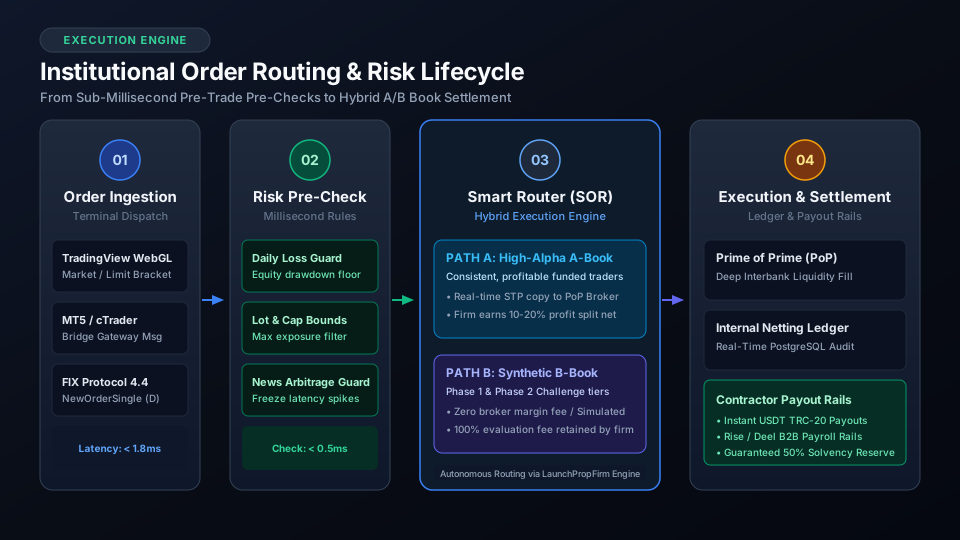
4. The Sub-Millisecond Order Routing Lifecycle: From Click to Settlement
Every trade placed on an institutional trading platform passes through an ultra-low latency execution pipeline.
This four-stage lifecycle guarantees risk compliance before a single unit of risk reaches the liquidity bridge:
Phase 1: Pre-Trade Risk Sentinel (< 2ms)
Before an order packet reaches market liquidity, the internal risk sentinel intercepts the request.
The risk core verifies account balance, remaining daily drawdown buffer, maximum lot size limits, and open exposure caps in under two milliseconds.
If the trade violates risk rules, the platform rejects the ticket locally without creating external liquidity traffic.
Phase 2: FIX Protocol 4.4 Serialization
Once cleared by the risk engine, the order is serialized into a standard Financial Information eXchange (FIX) packet.
The platform assigns unique Client Order IDs (Tag 11), symbol specifications (Tag 55), order side (Tag 54), and precise microsecond timestamps (Tag 60).
Standardized FIX packaging ensures universal compatibility across global interbank liquidity providers and institutional matching engines.
Phase 3: Smart Order Router (SOR) & Liquidity Aggregation
The Smart Order Router analyzes real-time quote feeds across multiple Tier-1 liquidity providers simultaneously.
The SOR evaluates order book depth, spread width, and fill probability to split or route the order to the optimal counterparty.
This dynamic routing eliminates toxic fills and secures price improvements for large position blocks.
Phase 4: Hybrid A/B-Book Settlement & Execution Report
In modern prop trading environments, orders are settled based on the firm's automated risk allocation profile.
High-alpha trades are copied or routed via STP bridge to external liquidity (A-Book), while standard evaluation flow is netted internally (B-Book).
The execution report (FIX Tag 35=8) returns instantly to update trader balance, margin equity, and public leaderboard metrics.
5. Key Technology Pillars Powering Institutional Platforms in 2026
Building or operating an institutional platform requires robust technical infrastructure designed for fault tolerance and speed.
Four engineering pillars distinguish institutional platforms from generic retail solutions:
1. Financial Information eXchange (FIX) Protocol 4.4
The FIX protocol is the universal language of global financial markets, powering communications between brokers, liquidity providers, and matching engines.
Unlike sluggish REST APIs that introduce significant JSON serialization overhead, FIX protocol delivers lightweight, tag-value binary transmissions.
Traders running algorithmic strategies and automated trading desks require FIX connectivity to achieve predictable execution without connection drops.
2. Level 2 (L2) Depth of Market (DoM)
Retail platforms typically show Level 1 pricing, displaying only the highest bid and lowest ask price.
Institutional platforms provide full Level 2 Depth of Market, displaying available liquidity volumes across multiple price rungs above and below the spread.
This transparency allows algorithmic traders to gauge true institutional liquidity depth, detect absorption blocks, and avoid liquidity voids.
3. Automated Risk Engines & Real-Time Circuit Breakers
Institutional platforms incorporate autonomous risk sentinels that monitor every active trading account simultaneously.
These engines calculate floating drawdown, daily high-water mark losses, and correlation exposures tick-by-tick.
If an account breaches institutional parameters, the engine closes open positions and locks the terminal within milliseconds, protecting firm solvency.
4. Cross-Connected Fiber & Equinix Colocation
To achieve sub-millisecond execution speeds, institutional servers are collocated in Tier-3 financial data centers such as Equinix LD4 (London) and NY4 (New York).
Direct fiber cross-connects between the platform bridge and liquidity provider matching engines minimize physical distance latency.
This colocation architecture ensures that orders execute at true interbank speeds without exposure to public internet routing delays.
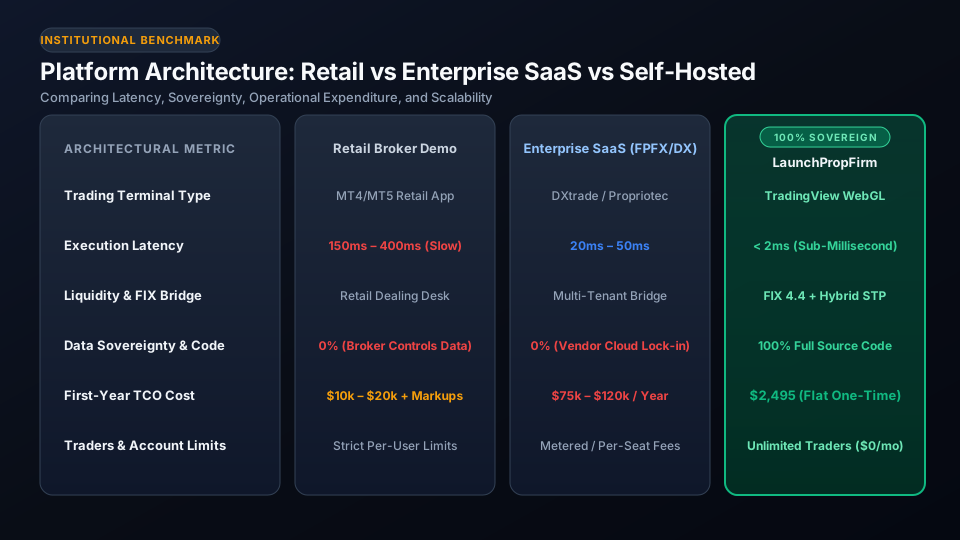
6. Proprietary Trading Firm Infrastructure: How Prop Firms Use Institutional Tech
Over the last three years, the funded trader industry has matured from basic affiliate setups into a multi-billion-dollar institutional sector.
Modern prop firms can no longer rely on simple retail broker white labels that offer zero risk control or synthetic customization.
Today, proprietary trading firms deploy institutional trading platforms to solve three fundamental operational challenges:
Multi-Asset Synthetic Evaluation Environments
Prop firms provide simulated trading evaluations across Forex, Commodities, Indices, and Crypto markets.
An institutional prop platform provides authentic market feeds, simulated spread widening during rollover, and realistic slippage modeling.
This environment tests retail traders under authentic market conditions while insulating the prop firm from live brokerage capital requirements.
Real-Time Challenge Rule Enforcement
Evaluating thousands of active challenge participants manually is operationally impossible.
Institutional platforms automatically track prop firm consistency rules, minimum trading days, and maximum trailing drawdown limits.
When a trader hits an evaluation profit target, the platform generates automated account upgrade certificates and credentials without human intervention.
Automated STP Bridge & Payout Treasury Management
When successful traders qualify for funded status, institutional platforms enable automated risk segregation.
Firms can route profitable trader signals via institutional copy bridges directly to Prime-of-Prime broker accounts.
Profits generated from live execution flow seamlessly into the firm's treasury reserve to back prop firm payout proof distributions.
7. The SaaS Rental Trap vs Sovereign Self-Hosted Institutional Platforms
Aspiring prop firm founders often assume that launching a brand requires paying exorbitant monthly software subscriptions to legacy SaaS providers.
Legacy SaaS vendors (such as FPFX Tech or DXtrade white labels) charge heavy monthly retainers, setup fees, and volume taxes that drain startup capital:
| Cost & Operational Category | Legacy Turnkey SaaS Provider (FPFX / DXtrade White Label) | LaunchPropFirm Sovereign Platform (Self-Hosted Source Code) |
|---|---|---|
| Upfront Setup Investment | $15,000 to $35,000 onboarding fee | $2,495 one-time purchase (100% source code ownership) |
| Monthly Subscription Rent | $3,000 to $8,000 per month recurring | $0.00 / month (deploy on your own $150/mo VPS) |
| Per-User Volume Tax | $2.00 to $5.00 per active challenge account | $0.00 (unlimited traders and evaluations) |
| Profit-Share Surcharge | 2% to 5% of monthly challenge fee revenue | 0% profit share (keep 100% of all challenge revenue) |
| Data & User Ownership | Trader database stored on vendor's shared cloud | 100% sovereign database on your private PostgreSQL server |
| First-Year Total Cost of Ownership | $51,000 to $95,000+ per year | $4,295 total ($2,495 platform + hosting infrastructure) |
Renting a SaaS platform leaves your business vulnerable to vendor de-platforming, surprise fee hikes, and shared database outages.
By investing in self-hosted institutional architecture via LaunchPropFirm prop firm source code, founders own their entire operational stack permanently.
To calculate your exact savings across 12, 24, and 36 months, use our interactive SaaS vs self-hosted TCO calculator.
8. Institutional Risk Management: Protecting Capital & Solvency Buffers
Operating an institutional platform requires rigorous balance sheet management and automated risk controls.
Whether managing proprietary capital or funded evaluation accounts, platforms employ two primary risk mechanisms:
Static vs Trailing Drawdown Architecture
Institutional platforms allow operators to configure flexible drawdown mechanics to match their business model.
Static drawdown sets a permanent loss floor based on the starting account balance, giving traders maximum psychological breathing room.
Trailing drawdown recalculates the loss floor continuously as equity reaches new high-water marks, protecting firm capital during violent market reversals.
Traders can model both drawdown mechanics in advance using our free prop firm drawdown calculator.
Latency Arbitrage & Toxic Flow Protection
Institutional platforms incorporate toxic flow filters to identify latency arbitrage bots, tick-scalping algorithms, and account-sharing syndicates.
By tracking execution timestamps and IP fingerprints, platforms protect firm capital from predatory trading strategies that exploit synthetic feed latency.
To learn more about how firms detect and manage syndicated bot activity, read our deep dive on prop firm passing services.
9. Interactive Platform Evaluation & Risk Management Tools
Whether you are a retail trader sizing positions or a founder evaluating platform unit economics, mathematical modeling eliminates guesswork.
Explore our suite of institutional tools designed to optimize your trading performance and platform profitability:
- SaaS vs Self-Hosted TCO Calculator: Model the exact 3-year cost difference between renting legacy SaaS platforms and owning self-hosted software.
- Prop Firm Lot Size & Exposure Calculator: Calculate precise position sizing across Forex, Gold, and Indices based on stop loss pips and risk percentage.
- Prop Firm Drawdown & Buffer Simulator: Simulate static versus trailing high-water mark drawdown buffers in real time.
- Prop Firm Pass Probability Calculator: Run Monte Carlo simulations to calculate your statistical probability of passing evaluation challenges.
- Master Prop Firm Tools Directory: Access all 13+ free institutional calculators and financial models in one central hub.
10. The Founder's 5-Point Platform Selection Checklist
Before choosing an institutional trading platform for your proprietary firm or fund, verify these five essential technical criteria:
- [ ] 1. 100% Source Code & Database Ownership: Ensure you own the source code and host your database independently to protect proprietary trader data and platform autonomy.
- [ ] 2. Native Multi-Platform Terminal Support: Verify that the platform integrates seamlessly with industry-standard client interfaces including MT5, cTrader, and TradingView browser terminals.
- [ ] 3. Built-In Automated Risk Sentinels: Confirm that pre-trade risk checks, daily drawdown resets, and profit target upgrades execute automatically without manual admin tasks.
- [ ] 4. Zero Monthly SaaS Volume Surcharges: Choose a software partner that does not charge monthly active user fees, challenge volume taxes, or platform retainers.
- [ ] 5. Flexible Bridge & LP Connectivity: Ensure the platform supports FIX Protocol 4.4 bridges so you can connect to any Prime of Prime liquidity provider as trading volume scales.
Frequently Asked Questions About Institutional Trading Platforms
What makes a trading platform institutional?
An institutional trading platform is defined by sub-millisecond execution, direct FIX protocol connectivity, Level 2 market depth, and automated pre-trade risk sentinels.
Unlike retail brokerage software designed for basic charting and order entry, institutional platforms are built for high-throughput liquidity aggregation, dynamic smart order routing, and multi-desk operational scalability.
Can retail traders access institutional trading platforms?
Retail traders cannot typically access direct Tier-1 institutional trading platforms directly due to high capital requirements ($1M+ minimum balance) and institutional prime brokerage credit criteria.
However, traders can access institutional-grade execution environments, tight spreads, and Level 2 market depth by trading funded accounts through reputable proprietary trading firms.
What is the FIX protocol and why is it essential for institutional platforms?
The Financial Information eXchange (FIX) protocol is the global standard electronic communications language used by institutional financial institutions for real-time order routing and trade execution.
FIX Protocol 4.4 enables platforms to transmit lightweight, standardized trade messages directly between trading engines and liquidity providers with minimal latency and zero third-party software interference.
How much does it cost to build or deploy an institutional prop trading platform?
Building a proprietary institutional trading platform from scratch costs between $150,000 and $300,000 in software engineering, bridge licenses, and infrastructure colocation expenses.
Renting enterprise SaaS platforms (such as FPFX Tech or DXtrade white labels) costs $50,000 to $95,000+ per year in recurring fees.
With LaunchPropFirm's turn-key prop firm source code, founders can deploy a complete self-hosted institutional platform for a one-time purchase of $2,495.
What is the difference between Level 1 and Level 2 market data?
Level 1 market data displays only the current best bid and best ask price along with the most recent trade price and volume.
Level 2 market data provides complete order book depth, displaying the exact volume of resting buy and sell limit orders available at multiple price increments above and below the current spread.
How does an institutional platform protect prop firms from bankruptcy?
Institutional platforms incorporate autonomous risk engines that operate directly on the server level to monitor account equity, daily loss thresholds, and open position exposure tick-by-tick.
If a trader breaches maximum drawdown rules or attempts predatory latency arbitrage, the platform instantly liquidates open trades and revokes execution privileges, safeguarding the firm's capital reserves.
Evaluate Your Prop Firm Readiness Score (0-100)
Answer 5 quick operational questions about your acquisition channels, runway, and engine tech to get a personalized launch roadmap.

M.Haris
Founder & Platform ArchitectBuilding open prop trading software infrastructure for operators worldwide
I built LaunchPropFirm to give forex educators, trading communities, and fintech operators complete ownership of their platform with full source code and zero monthly SaaS rent. Every article on this blog is drawn from hands-on platform development, live MT5 risk bridge mechanics, and real operator economics.
All content, financial models, ROI estimates, and architecture guides on LaunchPropFirm are published strictly for educational and informational purposes. LaunchPropFirm provides institutional prop trading software and technology infrastructure; it does not operate as a broker, custodian, or registered investment advisor.
Evaluation challenges and funded trader accounts referenced in this guide operate in simulated demo trading environments using real-time market data feeds. Simulated trading results do not represent actual trading performance or financial advice.
Recommended Next Reads
Hand-picked operator guides to scale your prop trading platform.
Wise Prop Firms: Payouts, Risks and Rails
Explore why direct Wise prop firms payouts trigger account freezes, how Rise compliance bridges protect funds, and why multi-rail payouts guarantee cash flow.
Prop Firm Capital: Reserve Buffers & Risk Architecture
Explore the financial reality of prop firm capital: synthetic exposure vs liquid reserves, challenge fee pool economics, and A-Book STP risk architecture.
Skip the monthly fees
Own your prop firm platform outright. One time purchase.
Full source code. Live in 7 days. No revenue share. No monthly SaaS bill. See the exact platform before paying anything.
Demo login: haris / asdf1122. No signup needed