High Leverage Forex Brokers (2026 Risk & Comparison Matrix)
Compare high leverage forex brokers in 2026. Review 1:500 vs 1:30 limits, offshore B-book margin risks, spread traps, and funded account alternatives.
For retail currency traders operating with modest initial capital, the promise of high leverage forex brokers offering 1:500, 1:1000, or even 1:2000 leverage appears to be the ultimate financial equalizer. The marketing narrative is seductive: deposit $200, control $100,000 to $200,000 worth of currency, and generate full-time trading returns from a modest home workstation.
However, beneath the promotional claims of offshore broker marketing lies a brutal mathematical reality. Leverage is not a one-way wealth accelerator. It is a symmetrical multiplier of risk that exponentially compresses your distance to total account liquidation. While leverage multiplies your nominal purchasing power, it proportionally reduces the number of adverse pips your account can survive before automated risk engines trigger an irreversible margin call stop-out.
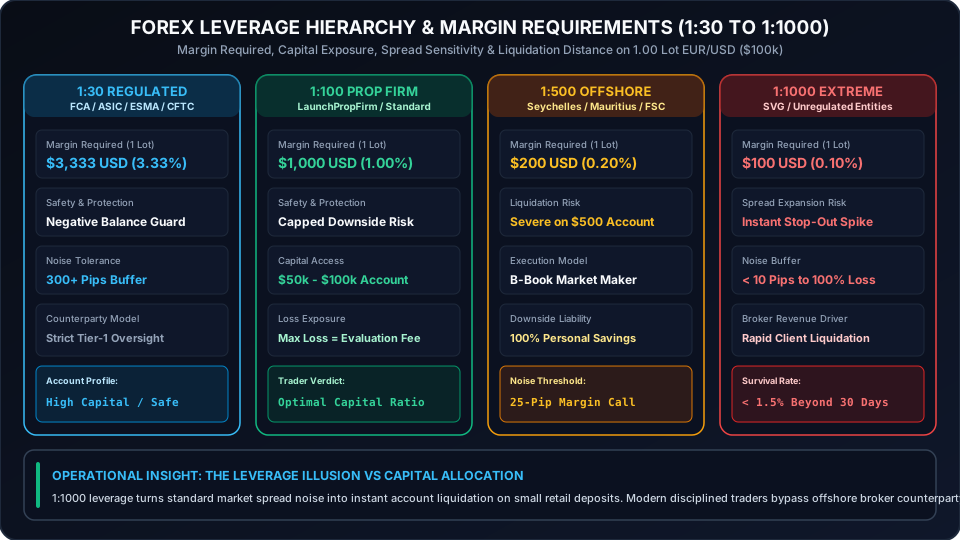
In this institutional guide, our risk desk dissects the global architecture of high leverage forex brokers. We analyze why tier-1 regulatory bodies capped retail leverage at 1:30, expose the offshore B-book market maker models that profit directly from trader liquidations, model the exact mathematics of a 10-pip margin call, and explain why thousands of undercapitalized traders are abandoning offshore brokers in favor of funded prop firm evaluations with capped downside risk.
The High Leverage Allure: Why Retail Traders Hunt for 1:500 to 1:1000 Brokers
The surge in search volume for high leverage forex brokers is driven by the structural undercapitalization of the retail trading community. A trader with $500 in personal savings facing a regulated broker capped at 1:30 leverage can control a maximum position size of approximately 0.15 lots ($15,000 notional volume). On a 50-pip trending move on EUR/USD, that trader realizes a gross profit of $75. For an individual seeking to build meaningful wealth, $75 appears negligible.
When that same trader encounters an offshore broker offering 1:500 or 1:1000 leverage, the perceived financial ceiling transforms overnight:
- At 1:500 leverage, a $500 deposit unlocks $250,000 in nominal purchasing power (2.50 standard lots).
- A 50-pip move on 2.50 lots yields $1,250 in profit (a +250% single-day return on investment).
- At 1:1000 leverage, a $500 deposit theoretically controls $500,000 in currency volume (5.00 standard lots), yielding $2,500 on the same 50-pip expansion.
This dramatic asymmetric upside creates what behavioral economists term the leverage lottery bias. Traders focus entirely on the profit potential of favorable price expansions while systematically ignoring the mathematical probability of adverse price variance. When you operate with extreme leverage, normal market noise (fluctuations that occur every hour on every currency pair) becomes an existential threat to your entire account balance.
To understand how professional position sizing mitigates this psychological trap, study our institutional guide to the forex lot size chart.
Regulatory Reality: Why Tier-1 Regulators Capped Retail Leverage at 1:30
Between 2010 and 2018, retail forex brokers worldwide routinely offered 1:200 to 1:500 leverage to retail clients. During this era, regulatory audits across the United Kingdom, Europe, and Australia uncovered a devastating statistical pattern: between 82% and 89% of all retail CFD and forex accounts suffered complete capital liquidation, with the average client lifespan lasting fewer than 90 days.
In response to this systemic loss of retail savings, global tier-1 financial authorities intervened with sweeping leverage caps:
| Regulatory Body | Jurisdiction | Retail Major FX Cap | Retail Minor/Gold Cap | Mandatory Client Protections |
|---|---|---|---|---|
| FCA | United Kingdom | 1:30 (3.33% Margin) | 1:20 (5.00% Margin) | Negative Balance Protection, FSCS Compensation (£85,000) |
| ESMA / CySEC | European Union | 1:30 (3.33% Margin) | 1:20 (5.00% Margin) | Negative Balance Protection, Investor Compensation Fund (€20,000) |
| ASIC | Australia | 1:30 (3.33% Margin) | 1:20 (5.00% Margin) | Standardized Risk Warnings, Mandatory Client Money Segregation |
| CFTC / NFA | United States | 1:50 (2.00% Margin) | 1:20 (5.00% Margin) | Strict FIFO Rule, Ban on Hedging, No Offshore Solicitation |
| Offshore Entities | Seychelles / Mauritius / SVG | 1:500 to 1:2000+ | 1:200 to 1:1000+ | Zero Mandatory Negative Balance Protection, No Deposit Insurance |
Tier-1 regulators did not restrict leverage to harm retail traders. They restricted leverage because rigorous econometric studies proved that high leverage is mathematically incompatible with retail survival. At 1:30 leverage, an adverse move of 100 pips on EUR/USD inflicts an equity drawdown that a disciplined trader can easily recover from. At 1:1000 leverage, that same 100-pip move destroys the account balance ten times over.
The Offshore B-Book Matrix: Where High Leverage Brokers Live & How They Profit
To circumvent tier-1 leverage restrictions while continuing to service global retail demand, international brokerage conglomerates established multi-jurisdictional corporate structures. While the parent holding company maintains an FCA or ASIC license in London or Sydney, retail traders seeking 1:500 leverage are redirected to offshore subsidiaries operating in lightly regulated jurisdictions:
- Seychelles Financial Services Authority (FSA)
- Mauritius Financial Services Commission (FSC)
- Belize Financial Services Commission (FSC)
- Bahamas Securities Commission (SCB)
- St. Vincent and the Grenadines (SVG FSA) (Note: SVG FSA explicitly states it does not regulate, monitor, or license forex trading brokers)
The B-Book Internalization Model Explained
Why are offshore brokers eager to grant you 1:500 or 1:1000 leverage? The answer lies in their dealing desk architecture.
In institutional finance, brokers operate two distinct order execution models:
- A-Book (STP/ECN Execution): The broker acts as an authentic intermediary, routing your buy and sell orders directly to external liquidity providers (tier-1 banks, non-bank market makers). The broker earns a transparent commission or spread markup and remains entirely indifferent to whether you win or lose.
- B-Book (Internal Market Making): The broker does not route your order to the interbank market. Instead, the broker takes the other side of your trade, internalizing 100% of the risk on their private proprietary ledger. When you enter a buy order, the broker sells to you. When you lose your deposit, your loss becomes 100% net revenue for the broker.
Offshore high leverage brokers operate almost exclusively on a B-book execution model for retail clients. Broker risk management algorithms analyze client profiles in real-time. Because historical data proves that 95% of retail traders using 1:500 leverage blow their accounts within 30 days due to overleveraging, the broker has zero incentive to hedge your orders externally. Offering extreme leverage is the most efficient mechanism for accelerating the speed at which an undercapitalized retail trader transfers their deposit to the broker balance sheet.
Skip the monthly fees
Own your prop firm platform outright. One time purchase.
Full source code. Live in 7 days. No revenue share. No monthly SaaS bill. See the exact platform before paying anything.
Demo login: haris / asdf1122. No signup needed
The Mathematical Trap: Margin Call Mechanics & The 10-Pip Liquidation Reality
To understand why high leverage is toxic for small trading accounts, examine the mechanical relationship between leverage, margin requirements, and pip tolerance.
Margin is the minimum collateral balance required by your broker to keep a leveraged position active. The formula to calculate required margin for a currency trade is:
Required Margin = (Position Size in Units * Market Price) / Broker Leverage Ratio
Consider what happens when a trader opens 1.00 standard lot of EUR/USD ($100,000 contract value at an exchange rate of 1.0850) with a $500 starting account balance across varying leverage tiers:
| Leverage Ratio | Margin Required (1.00 Lot) | Usable Free Margin ($500 Balance) | Pip Value ($) | Adverse Pips to Total Liquidation | Margin Call Risk Level |
|---|---|---|---|---|---|
| 1:30 (Regulated) | $3,616.67 | Trade Rejected (Insufficient Balance) | $10.00 | N/A | Zero (Prevented by Margin Gate) |
| 1:100 (Prop Standard) | $1,085.00 | Trade Rejected (Insufficient Balance) | $10.00 | N/A | Zero (Requires Smaller Lot Size) |
| 1:500 (Offshore) | $217.00 | $283.00 Free Margin | $10.00 | 28.3 Pips | Extreme (Liquidated in Minutes) |
| 1:1000 (Extreme) | $108.50 | $391.50 Free Margin | $10.00 | 39.1 Pips (Or 9.1 Pips on 2.0 Lots) | Fatal (Standard Session Volatility) |
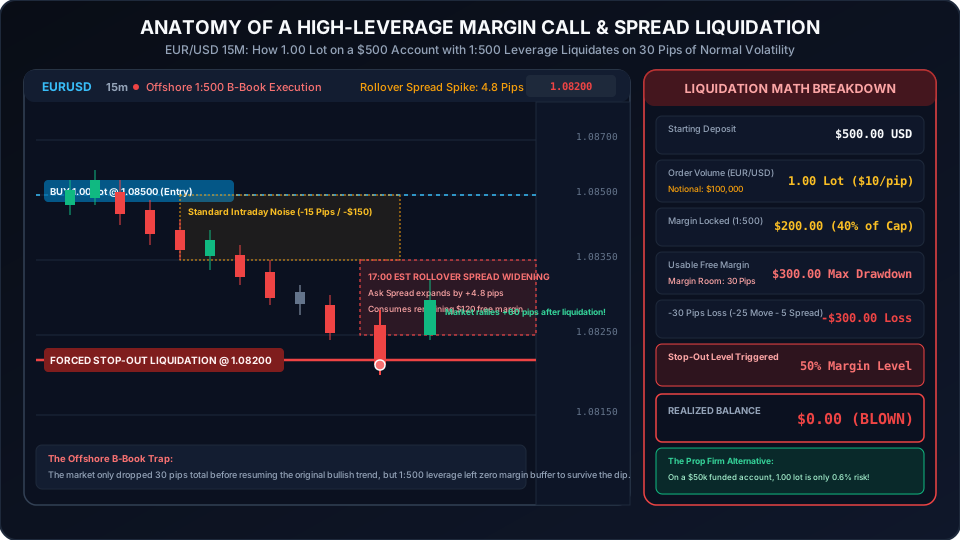
The Anatomy of the 10-Pip Stop-Out
Examine the terminal anatomy above. A trader deposits $500 into an offshore 1:500 broker and executes a 1.00 lot EUR/USD buy order at 1.0850.
- The broker instantly locks $217.00 as required margin, leaving $283.00 in free usable equity.
- EUR/USD experiences a normal 15-pip intraday pullback to 1.0835. The position is now floating at -$150.00. Remaining equity is $350.00.
- At 17:00 EST (the daily CME and interbank settlement rollover), the broker spreads widen from 0.8 pips to 4.8 pips. This 4-pip spread blowout instantly adds -$40.00 in floating loss.
- Price dips another 9 pips during European pre-market liquidity gaps. Total adverse displacement is 28 pips (-$280.00).
- Account equity drops to $220.00, approaching the locked margin. The broker margin level drops below 50%.
- The automated dealing desk engine triggers an immediate Forced Liquidation Stop-Out. The position is closed at market price.
- Ten minutes later, institutional buyers step in, and EUR/USD rallies +75 pips in the direction of the trader original thesis. But the trader balance is now $0.00.
The trader thesis was correct, but their extreme leverage deprived them of the margin breathing room required to survive standard market oscillation. To measure your margin buffer against realistic market swings, calculate your drawdown limits on our free prop firm drawdown calculator.
The Hidden Costs: Spread Blowouts, Negative Slippage, and Rollover Spikes
High leverage brokers rarely generate the majority of their revenue from transparent commissions. Instead, offshore B-book operators extract value through structural friction embedded directly into price feeds:
1. Rollover Spread Expansion Traps
Every trading day at 5:00 PM EST (21:00 UTC), global interbank liquidity thins as New York financial institutions close and Tokyo has yet to fully open. During this 45-minute window, regulated ECN brokers experience modest spread widening (e.g., EUR/USD widens from 0.2 to 1.5 pips).
Offshore high leverage brokers frequently expand spreads on synthetic feeds to 5.0 to 12.0 pips. If you are holding an overleveraged swing position, this artificial spread blowout will trigger an immediate stop-out on your account even if the underlying mid-market price never touched your stop loss. To track exact daily session changeovers and protect your positions, use our prop firm reset clock tracker.
2. Asymmetric Negative Slippage
When trading with 1:500 leverage, speed of execution is vital. On offshore dealing desks, traders frequently experience asymmetric slippage:
- When the market moves in your favor, your limit order fills at your exact price (zero positive slippage).
- When the market moves against you during volatile economic announcements (CPI, NFP), your stop loss fills 5 to 15 pips worse than your specified price.
- On a 2.00 lot position, 10 pips of negative slippage represents a sudden, unhedged -$200 loss, frequently driving small accounts into negative equity.
3. Punitive Overnight Financing (Swap) Rates
Because high leverage allows you to borrow up to 99.9% of the notional value of a currency trade, brokers charge daily swap fees for holding positions overnight. Offshore brokers routinely inflate overnight financing fees by 300% to 500% above institutional interbank benchmark rates (SOFR and EURIBOR), creating a steady mathematical drag that erodes account equity over multi-day holding periods.
Regulated 1:30 vs Offshore 1:500 vs Prop Firm Funded Accounts
Before committing personal savings to an offshore high leverage broker, evaluate how the operational structure compares to tier-1 regulated accounts and modern proprietary trading firm evaluations:
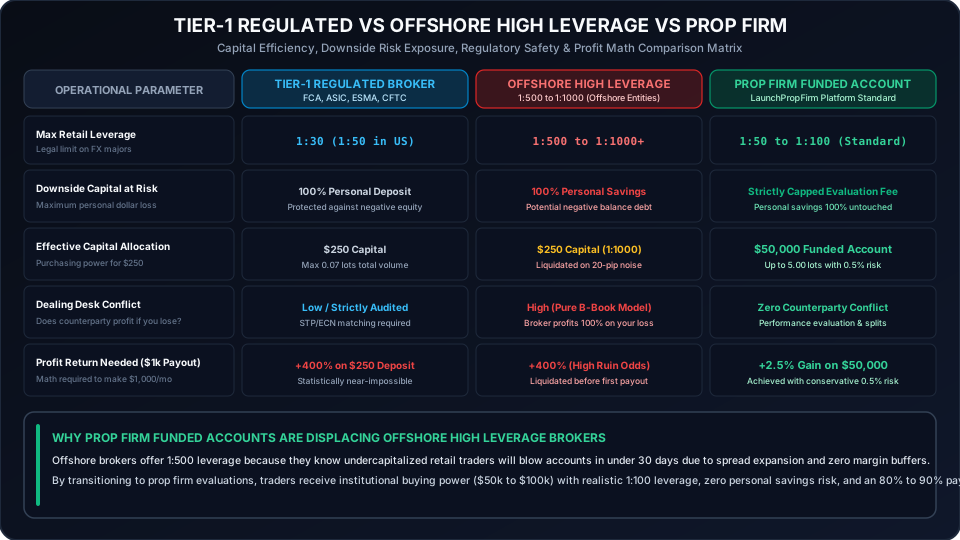
| Operational Parameter | Tier-1 Regulated Broker | Offshore High Leverage Broker | Prop Firm Funded Account |
|---|---|---|---|
| Primary Regulators | FCA, ASIC, ESMA, CFTC | Seychelles FSA, FSC, SVG | Commercial Performance Contract |
| Maximum FX Leverage | 1:30 (1:50 in US) | 1:500 to 1:2000+ | 1:50 to 1:100 |
| Downside Risk Exposure | 100% Personal Capital | 100% Personal Capital + Debt | Capped at Evaluation Fee ($150-$250) |
| Capital Purchasing Power | Limited to Personal Cash | Limited to Personal Cash | $50,000 to $100,000 Simulated Liquidity |
| Dealing Desk Model | STP / Audited ECN Feeds | 100% B-Book Market Maker | Institutional Synthetic Bridge Feeds |
| Negative Balance Protection | Legally Mandated Guarantee | Optional / Often Voided | Irrelevant (Zero Personal Liability) |
| Withdrawal Safety | Bank Wire, Tier-1 Custody | Crypto, Unregulated Gateways | Rise, Crypto USDT, Direct Bank Wire |
| Monthly Profit Goal ($1,000) | Requires +200% on $500 | High Probability of Account Wipeout | Requires only 2.5% Gain on $50k |
The Funded Trader Alternative: Getting $50k-$100k Purchasing Power Without Personal Risk
In 2026, the rise of the modern proprietary trading firm has fundamentally altered retail capital allocation. Aspiring traders who previously sought out dangerous 1:1000 offshore brokers are discovering that funded trader evaluations deliver superior purchasing power with virtually zero personal risk.
Consider the cold financial comparison between these two paths for a trader with $250 in disposable capital:
Path A: Depositing $250 with an Offshore 1:1000 Broker
- Capital at Risk: $250 of your hard-earned personal savings.
- Effective Leverage: 1:1000.
- Margin for 1.00 Lot EUR/USD: $108.50.
- Free Margin Room: $141.50 (Exactly 14 pips before total liquidation).
- Survival Expectancy: Less than 7 trading days. One errant news spike or rollover spread blowout destroys 100% of your savings.
- Profit Target: To earn $1,000 per month, you must generate a +400% monthly return, an outcome achieved by fewer than 0.01% of global retail participants.
Path B: Purchasing a $50,000 Prop Firm Challenge
- Capital at Risk: $200 to $250 (The one-time challenge evaluation fee).
- Effective Leverage: Professional 1:100 leverage.
- Usable Liquid Capital: $50,000.00.
- Maximum Daily Loss Floor: $2,500.00 (5.0%).
- Position Sizing on 1.00 Lot EUR/USD: A 15-pip stop loss risks $150.00, representing a conservative 0.30% account risk.
- Margin Buffer: Over 250 pips of breathing room, easily absorbing market volatility without stress.
- Profit Target: To earn a $1,000 monthly payout (at an 80% profit split), your $50,000 account only needs to gain 2.5% net profit ($1,250 * 80% = $1,000).
In Path B, your personal emergency savings are never exposed to market liquidity gaps, and your psychological burden drops to zero because your downside liability is strictly limited to the upfront evaluation fee. If you breach the daily drawdown floor, you lose the challenge, but debt collectors will never pursue you for negative equity.
To compare challenge costs across verified platforms, explore our analysis of the cheapest prop firm challenges and learn the fundamentals of evaluation structures in what is a funding account.
Interactive Diagnostic & Position Sizing Tools for Leveraged Traders
Whether you trade with an offshore broker or evaluate on a prop firm account, mastering position sizing mathematics is non-negotiable. Leverage our free engineering tools to bulletproof your risk parameters:
- Dynamic Position Sizing: Calculate the exact lot size required to keep your risk under 1.0% with our Prop Firm Lot Size & Pip Calculator.
- Personal vs Prop Capital Modeling: Simulate 12-month capital growth between personal high-leverage accounts and funded challenges with the Compounding Simulator.
- Drawdown Buffer Analysis: Model your distance to liquidation across varying lot sizes using the Drawdown Calculator.
- Monte Carlo Pass Benchmarking: Test your strategy win rate and risk-reward profile against 1,000 simulated challenge runs with the Pass Probability Calculator.
- Full Architecture Suite: Explore all 13 interactive engineering engines in our Prop Firm Tools Directory.
The Prop Firm Operator Architecture: How Modern Platforms Manage Leverage
Aspiring proprietary firm founders frequently ask how platforms provide retail traders with 1:50 to 1:100 leverage on $50,000 to $200,000 accounts without holding multi-million dollar broker regulatory licenses.
When you launch your own prop firm with LaunchPropFirm turnkey software, the platform operates as an institutional performance assessment ecosystem:
- Simulated Synthetic Liquidity: Challenges run in demo environments mirroring live interbank price feeds via ultra-low-latency MT5, cTrader, and TradingView bridges. Operators do not hold client deposits as a broker; they evaluate trader risk management skills.
- Automated Leverage Configuration: The LaunchPropFirm admin panel allows founders to define customizable leverage ratios per asset class (e.g., 1:100 on FX majors, 1:50 on FX crosses, 1:20 on gold and indices, 1:5 on crypto).
- Automated Margin Sentinels: The platform risk engine calculates trailing high-water mark drawdown and daily equity floors in real-time, preventing traders from overleveraging and protecting the firm operational payout reserves.
- Zero-Monthly-SaaS Overhead: While legacy SaaS vendors charge $35,000 to $72,000 annually in recurring software fees, LaunchPropFirm delivers 100% self-hosted source code ownership from $2,495 one-time, ensuring your working capital funds trader payouts rather than third-party software rent.
Frequently Asked Questions About High Leverage Forex Brokers
What is the maximum leverage allowed by forex brokers in 2026?
Tier-1 regulated brokers in the UK, EU, and Australia are legally capped at 1:30 for major currency pairs and 1:20 for minors and gold. In the United States, the CFTC permits up to 1:50 on major pairs. However, offshore brokers operating in jurisdictions like the Seychelles, Mauritius, and Belize offer retail leverage ranging from 1:500 to 1:2000, with some unregulated entities advertising "unlimited leverage."
Is 1:500 leverage good for beginner forex traders?
No. Operating with 1:500 leverage is dangerous for beginners. While it reduces required margin to $200 per standard lot, it compresses your account tolerance to market noise. A normal 25-pip pullback on an overleveraged trade will trigger an immediate margin call liquidation. Beginners should master position sizing on simulated demo accounts or micro prop challenges before trading with leverage.
Why do offshore brokers offer such high leverage?
Offshore brokers operate primarily on a B-book market maker model where trader losses represent direct broker profit. Because statistical data demonstrates that more than 95% of retail traders using 1:500 leverage blow their accounts within 30 days due to overleveraging, offering high leverage accelerates client liquidation and maximizes broker revenue.
What is the difference between margin call and stop-out level?
A margin call is a warning threshold (typically 100% margin level) indicating that your account equity equals your required margin, preventing you from opening new positions. A stop-out level (typically 50% or 20% margin level) is the liquidation boundary where the broker automated risk engine forcefully closes your active positions at market price to prevent your balance from falling into negative equity.
Can high leverage forex trading make you owe money to the broker?
Yes, if you trade with an offshore broker that does not provide guaranteed negative balance protection. During extreme market events (such as central bank rate surprises or geopolitical announcements), price gaps can bypass your stop loss, executing liquidation at a price that leaves your account balance negative. Regulated tier-1 brokers legally mandate negative balance protection, guaranteeing you can never lose more than your initial deposit.
How does 1:100 leverage work on a funded prop firm account?
On a $50,000 funded prop account with 1:100 leverage, your nominal purchasing power is $5,000,000. However, disciplined prop firm risk rules restrict your maximum drawdown to 5% daily ($2,500) and 10% overall ($5,000). The 1:100 leverage ensures you have sufficient margin to open disciplined 0.5 to 2.0 lot positions without tying up collateral, while the strict drawdown rules protect your capital from reckless overleveraging.
What happens to high leverage positions during daily market rollover?
At 5:00 PM EST (21:00 UTC), global interbank liquidity thins during the daily CME settlement break. During this 45-minute window, offshore brokers frequently widen spreads on major pairs from 0.8 pips to 5.0 or 10.0 pips. If your account is operating near maximum margin, this artificial spread blowout will trigger an immediate forced stop-out, closing your position at the widest point of the spread.
Why do professional prop traders rarely use more than 1:10 effective leverage?
Professional traders calculate position size based on dollar risk and stop loss distance rather than maximum available broker leverage. Even if a broker or prop firm provides 1:100 leverage, a professional risking 1% ($1,000 on a $100,000 account) with a 20-pip stop loss executes a 5.00 lot position ($500,000 notional volume). Their effective leverage is only 1:5, ensuring their account easily survives market noise and unexpected volatility.
Are there any US-regulated high leverage forex brokers?
No. Under National Futures Association (NFA) and Commodity Futures Trading Commission (CFTC) regulations, retail forex leverage in the United States is strictly capped at 1:50 for major currency pairs and 1:20 for non-major pairs. Any broker offering 1:500 leverage to US residents is operating offshore outside US regulatory jurisdiction.
How do I transition from offshore high leverage to funded prop trading?
Begin by benchmarking your strategy in our free lot size calculator to ensure you risk no more than 1% per trade. Once your execution consistently maintains a positive risk-to-reward ratio over 100 simulated trades, select an entry-level evaluation challenge ($10,000 to $50,000) from our cheapest prop firm challenges guide. This provides you with substantial institutional purchasing power while completely isolating your personal savings from market risk.
Evaluate Your Prop Firm Readiness Score (0-100)
Answer 5 quick operational questions about your acquisition channels, runway, and engine tech to get a personalized launch roadmap.

M.Haris
Founder & Platform ArchitectBuilding open prop trading software infrastructure for operators worldwide
I built LaunchPropFirm to give forex educators, trading communities, and fintech operators complete ownership of their platform with full source code and zero monthly SaaS rent. Every article on this blog is drawn from hands-on platform development, live MT5 risk bridge mechanics, and real operator economics.
All content, financial models, ROI estimates, and architecture guides on LaunchPropFirm are published strictly for educational and informational purposes. LaunchPropFirm provides institutional prop trading software and technology infrastructure; it does not operate as a broker, custodian, or registered investment advisor.
Evaluation challenges and funded trader accounts referenced in this guide operate in simulated demo trading environments using real-time market data feeds. Simulated trading results do not represent actual trading performance or financial advice.
Recommended Next Reads
Hand-picked operator guides to scale your prop trading platform.
Forex Trading for Beginners PDF (Free 2026 Starter Guide)
Download the free forex trading for beginners PDF guide. Master currency pairs, pip math, lot sizing, risk rules, and funded trader evaluation roadmaps.
Forex Lot Size Chart: Pip Calculator & Risk Guide 2026
Master forex lot sizes in 2026. Explore micro, mini, and standard lots, calculate exact pip values, manage spread risks, and use our free lot size tool.
Skip the monthly fees
Own your prop firm platform outright. One time purchase.
Full source code. Live in 7 days. No revenue share. No monthly SaaS bill. See the exact platform before paying anything.
Demo login: haris / asdf1122. No signup needed