Best Time to Trade Forex: 2026 Hours & Session Clocks
Discover the best time to trade forex in 2026. Explore London and New York session overlaps, hourly pip volatility, spread traps, and killer trade setups.
Ask any quantitative analyst on a Tier-1 institutional FX desk what determines retail profitability, and they will tell you that entry precision is meaningless without session timing. You can execute a flawless technical setup based on order blocks, fair value gaps, or support-and-resistance levels, but if you enter that position when European and North American institutional desks are closed, the trade will suffocate in low-volume chop, bleed capital to broker spread markups, or get stopped out by midnight rollover slippage.
The foreign exchange market is not a homogenous 24-hour pricing stream. It is a decentralized, relay-style network of interbank trading centers spanning Sydney, Tokyo, London, and New York. Knowing the exact hours when institutional liquidity floods the book is the foundational prerequisite for passing prop firm evaluations and achieving long-term capital preservation.
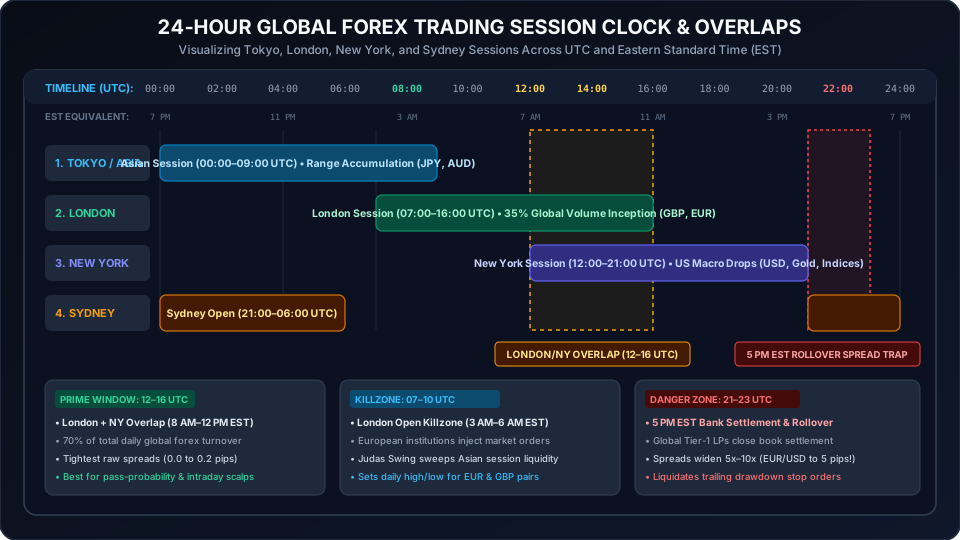
The 24-Hour Forex Clock: Why Timing Outweighs Directional Bias
Retail education frequently advertises the foreign exchange market as an around-the-clock opportunity machine where anyone can execute profitable orders at any hour of the day or night. While the market technically accepts orders 24 hours a day from Sunday 5:00 PM EST to Friday 5:00 PM EST, treating every trading hour equally is one of the primary reasons retail traders blow challenge accounts.
The 24/5 Decentralized Liquidity Engine
Unlike centralized stock exchanges like the New York Stock Exchange (NYSE) or Tokyo Stock Exchange (TSE), foreign exchange does not have a single physical clearing house. Liquidity is generated through an over-the-counter (OTC) electronic network linking central banks, commercial clearing institutions, hedge funds, multinational corporations, and prime brokers.
This liquidity follows the sun across four distinct financial time zones:
- The Pacific/Australasia Zone: Centered in Sydney and Wellington.
- The Asian Zone: Centered in Tokyo, Singapore, and Hong Kong.
- The European Zone: Centered in London, Frankfurt, and Zurich.
- The North American Zone: Centered in New York, Chicago, and Toronto.
When major institutional desks in London or New York are actively trading, billions of dollars change hands every minute. Bid-ask spreads compress to near zero (0.0 to 0.2 pips on raw interbank feeds), and price displacement is smooth and directional. When those desks log off, market liquidity drops by more than 75%, bid-ask spreads widen, and algorithmic market makers harvest retail stop orders in tight, erratic ranges.
The Myth of Trading Whenever You Feel Like It
Novice traders often attempt to fit forex trading around their personal daily schedules rather than aligning their schedules with institutional market hours. A retail trader living in California who attempts to trade EUR/USD at 6:00 PM Pacific Time (02:00 UTC) is trading during the quiet Asian session when European banks are asleep.
During these dead hours, EUR/USD typically moves fewer than 15 pips across a four-hour window. The trader quickly becomes frustrated by the lack of price velocity, begins forcing low-probability entries, moves their stop loss to avoid premature liquidation, and suffers catastrophic account drawdown before the London bell even rings.
As emphasized in our comprehensive guide on how to learn how to day trade, professional day traders do not stare at charts all day. They identify a single high-probability 90-minute window within a major session overlap, execute their mechanical setup, and immediately step away from the terminal.
The 4 Global Forex Sessions: Hours, Pairs, and Pip Characteristics
To structure an effective trading schedule, you must master the operational characteristics of each major trading session. The table below outlines the four primary daily sessions, their active operating hours in Coordinated Universal Time (UTC) and Eastern Standard Time (EST), and their historical volatility metrics.
| Global Trading Session | UTC Active Hours | EST Active Hours | Key Currency Pairs | Average Hourly Pip Movement | Institutional Role |
|---|---|---|---|---|---|
| Sydney / Pacific | 21:00 to 06:00 UTC | 5:00 PM to 2:00 AM EST | AUD/USD, NZD/USD, AUD/JPY | 12 to 20 pips | Order book opening & sovereign reserve positioning |
| Tokyo / Asian | 00:00 to 09:00 UTC | 8:00 PM to 5:00 AM EST | USD/JPY, AUD/JPY, EUR/JPY | 15 to 30 pips | Asian manufacturing trade flows & range accumulation |
| London / European | 07:00 to 16:00 UTC | 3:00 AM to 12:00 PM EST | EUR/USD, GBP/USD, EUR/GBP | 35 to 65 pips | Primary European interbank liquidity & daily trend ignition |
| New York / US | 12:00 to 21:00 UTC | 8:00 AM to 5:00 PM EST | EUR/USD, USD/CAD, GBP/USD | 40 to 75 pips | US economic data releases & global equity correlation |
| London / NY Overlap | 12:00 to 16:00 UTC | 8:00 AM to 12:00 PM EST | EUR/USD, GBP/USD, Gold (XAU/USD) | 50 to 95 pips | 70% of global daily volume & tightest institutional spreads |
1. The Sydney / Pacific Session: Institutional Positioning (21:00–06:00 UTC)
The global trading week begins on Sunday afternoon at 5:00 PM EST (21:00 UTC) in Wellington and Sydney. Because Australian and New Zealand financial institutions represent a smaller percentage of global turnover, this session features the lowest trading volume and tightest volatility of the 24-hour cycle.
Primary characteristics of the Sydney session:
- Major Focus Pairs: AUD/USD, NZD/USD, AUD/JPY, and NZD/JPY.
- Liquidity Profile: Low volume and wide spreads. Retail spreads on EUR/USD can expand by 3x to 5x during the Sunday open as liquidity providers establish initial price quotes.
- Trading Viability: Generally unsuitable for aggressive intraday scalping. Professional traders use the Sydney session primarily to observe initial weekend gap pricing and monitor early geopolitical headlines.
2. The Tokyo / Asian Session: Range Accumulation (00:00–09:00 UTC)
The Asian session officially begins as Tokyo financial markets open at 00:00 UTC (8:00 PM EST). Japan is the world's third-largest foreign exchange trading center, driven by the Bank of Japan (BOJ), commercial export conglomerates (such as Toyota and Sony), and large institutional pension funds.
Primary characteristics of the Tokyo session:
- Major Focus Pairs: USD/JPY, EUR/JPY, GBP/JPY, and AUD/USD.
- Liquidity Profile: Moderate volatility concentrated in yen and Australasian currency crosses. Major European pairs (EUR/USD, GBP/USD) frequently consolidate within well-defined 20 to 30-pip ranges.
- The Asian Range Paradigm: Smart money and institutional algorithmic systems view the Asian session high and low as benchmark liquidity boundaries. Because retail traders place stop-loss buy orders above the Asian high and stop-loss sell orders below the Asian low, these levels serve as primary liquidity targets during the subsequent London open.
3. The London Session: 35% of Global Volume Inception (07:00–16:00 UTC)
London is the undisputed financial capital of the global foreign exchange market, accounting for approximately 35% to 38% of total daily interbank transaction volume. When the City of London opens at 07:00 UTC (3:00 AM EST), institutional money enters the market with immense force.
Primary characteristics of the London session:
- Major Focus Pairs: GBP/USD, EUR/USD, GBP/JPY, EUR/GBP, and USD/CHF.
- Liquidity Profile: Massive volume injection, ultra-tight raw spreads (0.0 to 0.2 pips on institutional bridges), and explosive directional volatility.
- Daily Trend Establishment: In over 70% of trading days, the true high or low of the daily candle for EUR/USD and GBP/USD is established within the first two hours of the London session (between 07:00 UTC and 09:00 UTC). This initial price sweep is commonly referred to in institutional order flow trading as the Judas Swing.
4. The New York Session: Macro Climax & Wall Street Crossflows (12:00–21:00 UTC)
New York is the second-largest foreign exchange center, accounting for nearly 19% of global turnover. The New York session begins at 12:00 UTC (8:00 AM EST) and carries massive institutional weight because the US Dollar (USD) is involved in approximately 88% of all currency transactions globally.
Primary characteristics of the New York session:
- Major Focus Pairs: EUR/USD, GBP/USD, USD/CAD, USD/JPY, and Gold (XAU/USD).
- Macroeconomic Drivers: Crucial Tier-1 US economic reports (Non-Farm Payrolls, CPI inflation, PPI, Retail Sales, and Federal Reserve FOMC decisions) are released between 8:30 AM EST (12:30 UTC) and 2:00 PM EST (18:00 UTC).
- Equity and Bond Cross-Hedging: Wall Street equity market open at 9:30 AM EST (13:30 UTC) triggers massive portfolio currency rebalancing from mutual funds and sovereign wealth funds.
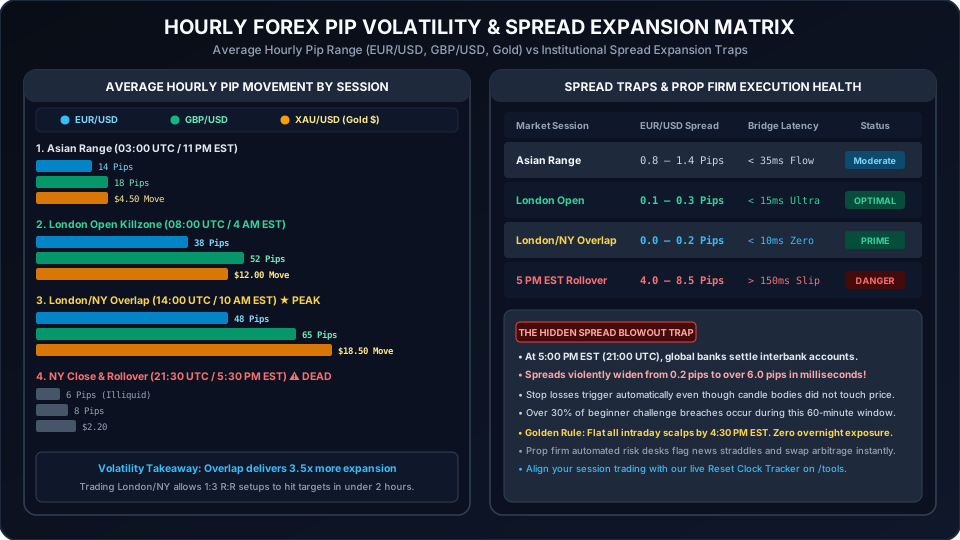
Session Overlaps: Where 70% of Daily Volume Truly Lives
While individual sessions have distinct personalities, the most lucrative trading environments occur when two major financial centers operate concurrently. During session overlaps, liquidity pools from both regions combine, generating unprecedented depth of market, minimum execution slippage, and sustained directional momentum.
The London and New York Overlap: The Golden Liquidity Window (12:00–16:00 UTC)
The overlap between London and New York from 12:00 UTC to 16:00 UTC (8:00 AM to 12:00 PM EST) is the single best time of day to trade foreign exchange.
Key reasons why the London/New York overlap dominates global trading:
- 70% of Global Volume: The world's two largest trading centers are active simultaneously. London traders are managing European afternoon book reconciliations while New York desks are initiating fresh morning positions.
- Maximum Pip Expansion: Major pairs like GBP/USD and EUR/USD experience their highest average hourly pip ranges (often 45 to 80 pips within a single two-hour window). This volatility allows intraday scalpers to achieve 1:2 and 1:3 reward-to-risk targets without enduring hours of sideways drawdown.
- Deepest Liquidity and Zero Slippage: Interbank liquidity is at its absolute peak. On self-hosted prop trading platforms powered by high-speed bridges, execution latency is sub-10 milliseconds with zero artificial slippage.
- Macro Economic Trend Confirmation: High-impact economic news releases during this window provide the fundamental fuel required for structural trend breakouts, as discussed in our analysis of prop firm news trading rules.
The Tokyo and London Transition: The Frankfurt Pre-Open (06:00–08:00 UTC)
A secondary overlap occurs between 06:00 UTC and 09:00 UTC (2:00 AM to 5:00 AM EST) as Asian markets wind down their daily operations and European desks come online. Specifically, Frankfurt and Zurich open at 06:00 UTC, one full hour before the London bell.
During this transition, institutional desks often execute preliminary liquidity sweeps. European banks test the market by pushing price into resting Asian session stop-loss orders. Traders who monitor the Frankfurt open often spot early warning signals of the primary London trend before the general public reacts.
Skip the monthly fees
Own your prop firm platform outright. One time purchase.
Full source code. Live in 7 days. No revenue share. No monthly SaaS bill. See the exact platform before paying anything.
Demo login: haris / asdf1122. No signup needed
The Hidden Danger: The 5:00 PM EST Rollover Spread Blowout
Understanding when not to trade is just as critical as knowing when to trade. The single most dangerous hour in the entire 24-hour forex cycle occurs between 4:50 PM EST and 5:30 PM EST (20:50 UTC to 21:30 UTC).
How Interbank Book Balancing Traps Unsuspecting Traders
At precisely 5:00 PM EST, the global banking system concludes its official value-date clearing cycle. Interbank foreign exchange desks in New York close their electronic order books for thirty to sixty minutes to reconcile accounts, compute interest rate differentials (swaps), and roll open positions forward to the next business day.
During this daily interbank settlement window:
- Major Tier-1 liquidity providers pull their resting market quotes.
- The depth of market evaporates to near-zero levels.
- Retail broker feeds widen bid-ask spreads exponentially to protect against inventory risk.
On standard retail currency pairs, the spread blowout is catastrophic:
- EUR/USD: Normal spread of 0.2 pips widens to 4.0 to 6.5 pips.
- GBP/USD: Normal spread of 0.5 pips widens to 6.0 to 10.0 pips.
- EUR/GBP & Crosses: Spreads routinely blow out to 12.0 to 18.0 pips.
- Gold (XAU/USD): Spread widens from $0.15 to $1.80–$3.50 per ounce.
Trailing Drawdown Annihilation: The Overnight Exposure Trap
For proprietary firm traders attempting to pass evaluations or maintain funded status, holding open intraday trades through the 5:00 PM EST rollover window is financial suicide.
Here is the exact mechanism that destroys trader accounts during rollover:
- A trader holds an open buy position on EUR/USD with a 15-pip stop loss located safely below structural market support.
- At 5:00 PM EST, the bid price suddenly drops by 5 pips due entirely to spread widening, even though no actual underlying market transactions occurred at that price.
- The broker's automated risk engine registers that the bid price touched the trader's stop-loss order and executes an immediate market liquidation.
- If the account operates under a Trailing High-Water Mark equity rule, the artificial loss floor is permanently locked in, registering a daily drawdown breach.
Over 35% of all rule breaches logged on prop firm administrative dashboards occur between 4:55 PM EST and 5:15 PM EST. Professional traders enforce a mandatory operational rule: all intraday day trades must be fully closed by 4:30 PM EST. Monitor your firm's specific reset timetable with our real-time Daily Drawdown Reset Clock Tracker.
The London Killzone Playbook: High-Probability Intraday Execution
To convert session timing into consistent trading profits, institutional order flow traders utilize specific intraday timing windows known as Killzones. The premier execution setup of the trading day is the London Open Killzone (07:00 UTC to 10:00 UTC / 3:00 AM to 6:00 AM EST).
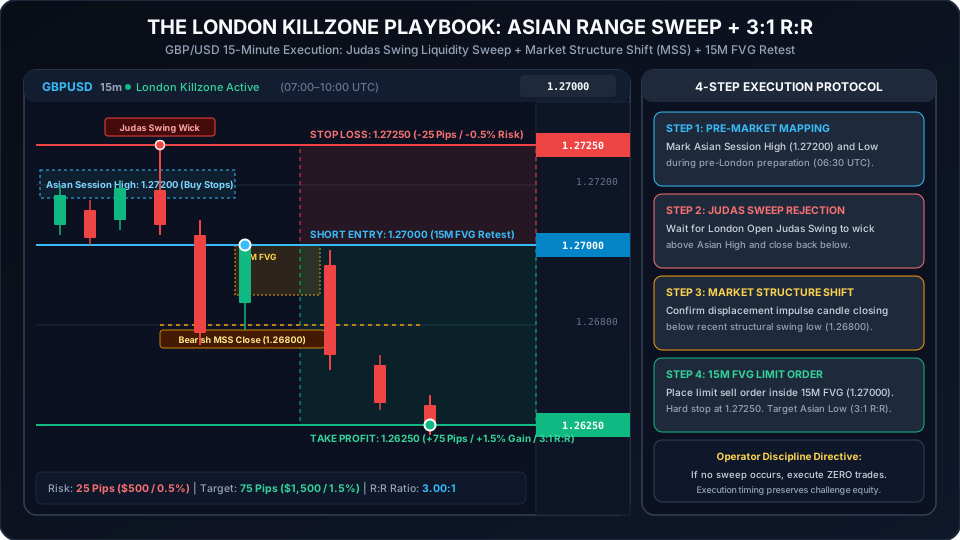
The infographic below illustrates the anatomical structure of a high-probability GBP/USD 15-minute London Killzone setup delivering an asymmetric 3:1 reward-to-risk ratio.
Step 1: Mapping the Asian Range Benchmark
Before the London open, you must map the baseline liquidity boundaries established during the Tokyo session:
- Open your charting terminal at 06:30 UTC (2:30 AM EST).
- Identify the highest high and lowest low printed between 00:00 UTC and 06:00 UTC.
- Draw horizontal ray lines across these levels. The Asian High represents accumulated buy-side liquidity (retail breakout buy stops and short-seller stop losses). The Asian Low represents sell-side liquidity (breakout sell stops and long-buyer stop losses).
Step 2: The Judas Swing Liquidity Sweep
Between 07:00 UTC and 07:45 UTC, European institutional market makers initiate a false directional push designed to engineer liquidity. If the prevailing higher-timeframe daily trend is bearish, the market maker will aggressively bid price higher, driving the market through the Asian session high.
Retail breakout traders see the green candle pushing above the Asian range and enter aggressive long positions. Simultaneously, early short sellers who placed their stops above the Asian high are triggered and stopped out. This creates a massive pool of buy market orders, providing the exact counterparty volume institutional desks require to fill their massive short positions.
Step 3: Market Structure Shift on the 15-Minute Chart
Once the Asian liquidity has been swept, observe the candlestick reaction closely. Do not blindly short the highs. Wait for institutional confirmation:
- The price prints an aggressive bearish displacement candle that plunges back inside the Asian range.
- The displacement candle closes decisively below the most recent 15-minute swing low, creating an authenticated Market Structure Shift (MSS) as detailed in our analysis of break of structure examples.
- The aggressive impulse leaves behind an unfilled 15-minute Fair Value Gap (FVG) or imbalance.
Step 4: Fair Value Gap Limit Entry with 3:1 Reward-to-Risk
Once market structure has shifted, execute your entry mechanically without emotional hesitation:
- Place a limit sell order at the bottom threshold of the 15-minute Fair Value Gap (in our example setup, at 1.27000).
- Position your hard stop loss safely 5 pips above the Judas Swing sweep high (at 1.27250), representing a tight 25-pip risk.
- Calculate your position size using our free lot size calculator so that a 25-pip loss represents exactly 0.5% or 1.0% of your account balance.
- Set your primary take-profit target at the resting sell-side liquidity pool sitting at the Asian session low (1.26250), capturing a 75-pip gain.
- Asymmetric Outcome: Risking 25 pips to capture 75 pips delivers a textbook 3.0:1 reward-to-risk ratio. Because the trade was executed during the London open, the entire 75-pip expansion frequently completes in under ninety minutes.
Best Days of the Week to Trade Forex
Just as trading volume varies by hour of the day, market participation fluctuates across the five days of the business week. Institutional capital flows follow structured corporate treasury and banking schedules.
Monday Asian Open: Weekend Gap Liquidity Digestion
Mondays are historically characterized by erratic, low-conviction price action. Institutional desks spend the first several hours of Monday assessing weekend geopolitical developments, digesting macro announcements, and establishing weekly portfolio risk budgets.
Unless a clean Judas Swing forms during the London session, Mondays frequently produce false breakout whipsaws. Professional prop traders routinely reduce their position sizing by 50% on Mondays to avoid unnecessary evaluation drawdown.
Tuesday to Thursday: The Core Institutional Expansion Highway
Tuesday, Wednesday, and Thursday represent the undisputed prime trading days of the week, generating over 70% of total weekly pip movement:
- Tuesday: The directional weekly trend typically ignites during Tuesday's London session. European and US desks deploy aggressive institutional size.
- Wednesday: Often produces the widest daily ranges of the week. Weekly US macroeconomic indicators and central bank rate announcements frequently drop on Wednesday mornings.
- Thursday: Provides powerful trend continuation as momentum funds push positions toward their weekly profit targets. In terms of average pip movement, Thursday is statistically the most volatile day for EUR/USD and GBP/USD.
Friday Afternoon: De-Risking Flows and Profit Taking
Friday morning (London Open through 11:00 AM EST) offers excellent trading opportunities as institutional desks push final weekly expansions. However, trading Friday afternoon after 12:00 PM EST (16:00 UTC) carries severe operational risks.
During Friday afternoon:
- London desks close their weekly books, triggering massive profit-taking flows that can cause violent, unpredictable trend reversals.
- Institutional desks square up positions to avoid carrying overnight weekend risk.
- Liquidity dries up rapidly after 2:00 PM EST, leading to choppy, spread-widened tape action.
- Proprietary firm traders should close all intraday positions and exit the market completely by 1:00 PM EST on Friday.
The Operator Perspective: How Prop Firms Manage Session Execution Risk
Viewing session dynamics from the proprietary firm founder and risk desk perspective reveals why execution rules are engineered the way they are. Operating a commercial prop firm requires balancing retail challenge volume against institutional solvency.
Synthetic B-Book vs Hybrid STP Liquidity Routing
Proprietary trading platforms operate either as pure simulated B-Book brokers (netting risk internally against challenge fee reserves) or hybrid A-Book brokers (copying winning traders through Straight-Through Processing bridges onto institutional Prime of Prime liquidity providers).
During high-liquidity session overlaps (like London/NY from 12:00 to 16:00 UTC):
- Bid-ask spreads from Tier-1 LPs (such as Finalto, LMAX, or Swissquote) are razor-thin.
- The prop firm's STP bridge can copy profitable trader orders to live markets with near-zero slippage.
- Risk desks experience virtually zero execution errors or unhedged exposure gaps.
During illiquid periods (such as the 5:00 PM EST rollover or Asian bank holidays):
- Institutional LP feeds become fragmented.
- If an unhedged trader holds an oversized position, a sudden 15-pip spread blowout can create negative balance events that threaten the firm's treasury reserve.
- This is precisely why modern prop firm platforms enforce automated overnight holding restrictions and pre-news buffer freezes.
Automated Session Rules and Server Reset Monitors
Modern proprietary trading platforms built on sovereign architectures like LaunchPropFirm feature enterprise-grade administrative engines that monitor session risk in real time. Rather than relying on manual staff oversight, the software enforces automated server parameters:
- Daily Drawdown Reset Engine: Calibrates daily equity high-water mark calculations to precise server time (typically 00:00 UTC or 5:00 PM EST), preventing dispute discrepancies between retail traders and the firm.
- Automated Rollover Spread Filter: Temporarily widens demo terminal spreads during the 5:00 PM EST window to perfectly replicate live interbank market conditions, ensuring that funded traders do not exploit unrealistic zero-spread simulator environments.
- Session Latency Guards: Detects and flags toxic latency arbitrage algorithms attempting to exploit stale prices during low-volume Asian sessions.
Entrepreneurs seeking to launch an independent proprietary trading brand can explore our complete SaaS vs Self-Hosted comparison to discover how a $2,495 one-time platform purchase eliminates the $40,000 to $80,000 annual recurring SaaS fees demanded by legacy white-label vendors.
Frequently Asked Questions About the Best Time to Trade Forex
What is the single best hour of the day to trade forex?
Statistically and operationally, the single best hour of the day to trade forex is 8:00 AM to 9:00 AM Eastern Standard Time (12:00 UTC to 13:00 UTC). During this window, the London afternoon session overlaps with the New York morning session, high-impact US macroeconomic reports are released, and global interbank liquidity reaches its peak daily depth.
Which currency pair moves the most pips during the London session?
GBP/JPY (the British Pound against the Japanese Yen) and GBP/USD (Cable) move the highest number of pips during the London trading session. GBP/JPY regularly moves between 80 and 130 pips across the European morning, making it a favorite among experienced intraday momentum traders.
Why are forex spreads so high at 5:00 PM EST?
Forex spreads widen dramatically at 5:00 PM EST because interbank trading desks in New York close temporarily for daily settlement, rollover interest accounting, and electronic book reconciliation. With major institutional liquidity providers temporarily offline, market makers widen their bid-ask spreads by 5x to 15x to protect against liquidity gaps.
Should beginner traders hold positions over the weekend?
No. Beginner traders should never hold open positions over the weekend. Financial markets are closed to retail participants from Friday afternoon to Sunday evening, but global geopolitical and economic developments continue. If unexpected news breaks over the weekend, the market can gap open by 50 to 100 pips on Sunday afternoon, completely bypassing your stop-loss order and liquidating your challenge account.
How do prop firm daily drawdown reset clocks interact with session trading?
Prop firm daily drawdown limits reset at a specific broker server time (most commonly midnight 00:00 server time, which corresponds to 5:00 PM EST). If you hold an open trade with floating negative equity across that exact midnight second, your daily drawdown limit for the new day is calculated based on that reduced equity, severely compressing your risk buffer for the remainder of the session. Always monitor your firm's exact reset time using our Reset Clock Tracker.
Evaluate Your Prop Firm Readiness Score (0-100)
Answer 5 quick operational questions about your acquisition channels, runway, and engine tech to get a personalized launch roadmap.

M.Haris
Founder & Platform ArchitectBuilding open prop trading software infrastructure for operators worldwide
I built LaunchPropFirm to give forex educators, trading communities, and fintech operators complete ownership of their platform with full source code and zero monthly SaaS rent. Every article on this blog is drawn from hands-on platform development, live MT5 risk bridge mechanics, and real operator economics.
All content, financial models, ROI estimates, and architecture guides on LaunchPropFirm are published strictly for educational and informational purposes. LaunchPropFirm provides institutional prop trading software and technology infrastructure; it does not operate as a broker, custodian, or registered investment advisor.
Evaluation challenges and funded trader accounts referenced in this guide operate in simulated demo trading environments using real-time market data feeds. Simulated trading results do not represent actual trading performance or financial advice.
Recommended Next Reads
Hand-picked operator guides to scale your prop trading platform.
How to Learn How to Day Trade: 2026 Step-by-Step Blueprint
Master day trading in 2026 with a proven 5-stage roadmap. Learn market mechanics, 1% risk rules, demo forward-testing, and funded challenge protocols.
Free Trade Journal: Excel Spreadsheet Template & Guide
Download our free trade journal Excel template for prop firm traders. Track R-multiples, win rate, daily drawdown, and emotional discipline in 2026.
Skip the monthly fees
Own your prop firm platform outright. One time purchase.
Full source code. Live in 7 days. No revenue share. No monthly SaaS bill. See the exact platform before paying anything.
Demo login: haris / asdf1122. No signup needed