Most Successful Day Traders: Strategies, Math & Risk Rules
Study the most successful day traders in history and modern prop trading. Learn their position sizing math, win rates, R-multiples, and risk rules.
Social media is flooded with rented supercars, fabricated MetaTrader screenshots, and self-proclaimed trading gurus selling $997 signal groups. When beginners search for the most successful day traders, they are often met with lifestyle marketing rather than audited performance records.
If you want to survive institutional prop firm evaluations and scale a six-figure funded allocation, you must study traders whose track records are backed by audited brokerage statements, regulatory filings, and verified prop firm payout ledgers.
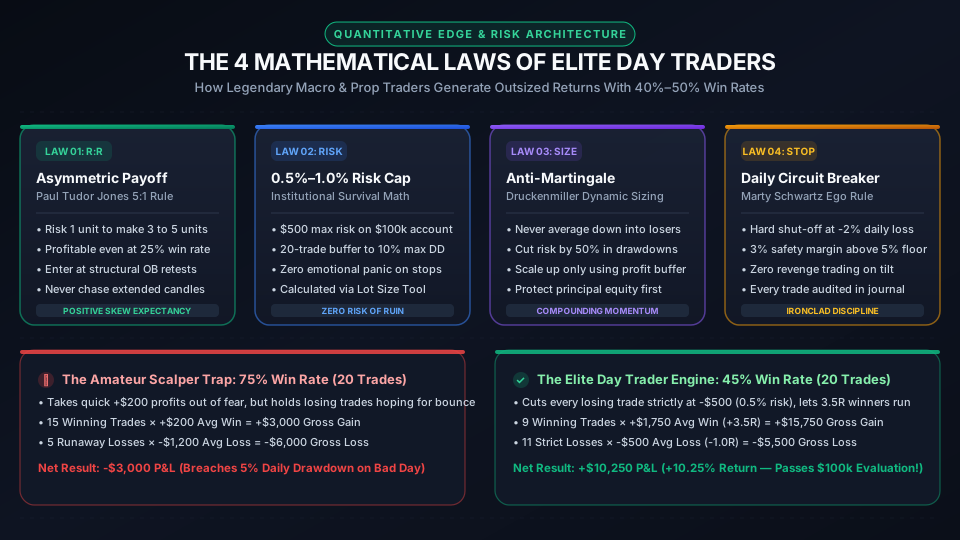
More importantly, you need to understand the cold mathematical engine behind their returns. Elite day traders do not win 90% of their trades. Most operate with a 40% to 55% win rate, yet they compound millions by enforcing asymmetric 3:1 to 5:1 Reward-to-Risk (R-Multiple) targets and capping single-trade risk at 0.50% to 1.0% of total equity.
Here is the institutional breakdown of the most successful day traders and active short-term speculators in financial history, how modern funded prop traders replicate their rules on $100,000 to $400,000 accounts, and the exact mathematical formulas that separate top 1% earners from the 94% who blow their accounts.
1. Master Comparison Matrix: The Most Successful Day Traders
Before dissecting individual trading playbooks, examine how history's most audited short-term traders and modern funded prop leaderboard champions structure their market focus, holding periods, and risk parameters:
| Trader / Archetype | Primary Market Focus | Core Execution Strategy | Audited / Verified Milestone | Non-Negotiable Risk Rule |
|---|---|---|---|---|
| Paul Tudor Jones | Global Macro, FX & Indices | Momentum Inflection & Asymmetric R:R | 5 consecutive years of triple-digit returns | Never risk more than 1% per idea; minimum 5:1 R:R |
| Stanley Druckenmiller | Spot Forex (GBP/USD, DEM) & Macro | Liquidity-Driven Trend Scaling | 30% average annual return over 30 years (0 losing years) | Scale aggressively when in profit; cut immediately when thesis fails |
| Marty Schwartz ("Pit Bull") | Intraday Equities & Index CFDs | EMA Pullbacks + Market Internals | Won US Investing Championship (+781% audited in 1 year) | Take a mandatory break and reduce size after any major drawdown |
| Takashi Kotegawa (BNF) | Japanese Equities (Intraday Reversals) | Mean-Reversion Oversold Panics | Turned $13,600 into $150M+ in 8 years | Hold zero overnight attachment; exit immediately if bounce stalls |
| Andrew Krieger | Spot Forex (NZD/USD "Kiwi" & G10 FX) | Macroeconomic Valuation Imbalances | Generated $300M+ profit on a single NZD short cycle | Use asymmetric sizing only when central bank liquidity is trapped |
| Modern Top 1% Prop Traders | Spot FX, Gold (XAU/USD) & Index CFDs | Session Liquidity Sweeps + BOS | Consistent $10k to $50k+ bi-weekly funded payouts | Strict 0.50% risk per trade; hard 2.0% daily loss circuit breaker |
Notice what is completely absent from this institutional table: nobody built an audited fortune by risking 10% of their account on a single candle or martingaling losing positions without a stop loss.
2. Case Studies: What Actually Made These Traders Profitable?
To apply the habits of the most successful day traders to your own MetaTrader 5, cTrader, or TradingView execution, you must look past the headline net worth numbers and study their specific operational rules.
Paul Tudor Jones: The 5:1 Asymmetric Risk-to-Reward Rule
Paul Tudor Jones famously stated that his entire career is built on a 5:1 reward-to-risk ratio. When evaluating an intraday or multi-day macro inflection point, he looks for setups where his stop loss is 1 unit away and his profit target is 5 units away.
Why does a 5:1 ratio change your trading psychology? Because at a 5:1 R-multiple, you can be wrong 80% of the time and still not lose money.
In a prop firm evaluation, retail traders constantly choke because they believe they need to win every single trade. When you adopt Paul Tudor Jones's asymmetric mindset, taking a 1R stop loss (-0.50% of your account) is simply the cost of buying an institutional ticket to find a +3R to +5R runner.
Marty Schwartz ("Pit Bull"): The Red-to-Green Checklist & Drawdown Reset
Marty Schwartz proved in the audited US Investing Championship that short-term intraday trading can produce extraordinary returns when treated as a mechanical business. For the first nine years of his market career, Schwartz lost money consistently as a fundamental analyst. He only became profitable when he switched to pure technical price action and strict pre-market checklists.
Schwartz enforced two rules that every funded prop trader should copy today:
- Moving Average Filter: Never fight the dominant intraday trend. If price is trading below the 10-period and 20-period Exponential Moving Averages (EMA) on your execution timeframe, do not look for hero bottom-picking longs.
- Post-Loss Size Reduction: Whenever Schwartz suffered a significant losing day, he immediately cut his position size by 50% on the following session until his rhythm and confidence returned. In a prop firm challenge with a strict 5% daily drawdown limit, cutting your risk from 0.50% to 0.25% after two losing trades is the single best defense against blowing your evaluation (see our complete analysis on why day trading is hard).
Takashi Kotegawa (BNF): Emotionless Intraday Execution
Trading from a bedroom in Tokyo with multiple monitors, Takashi Kotegawa turned $13,600 into over $150 million in eight years by day trading liquid Japanese stocks during high-volatility sessions.
Kotegawa's edge was not a secret institutional data feed. His edge was complete emotional detachment from money. He viewed account balances as video game points rather than purchasing power. While amateur traders freeze when a trade is up $2,000 because they start thinking about what that money can buy, Kotegawa executed purely on price divergence from short-term moving averages, closing trades the exact second momentum stalled.
Stanley Druckenmiller & Andrew Krieger: Forex Conviction & Sizing Discipline
In the spot currency markets, Stanley Druckenmiller and Andrew Krieger demonstrated how elite Forex traders manage position sizing. Rather than risking the same oversized lot on random range-bound sessions, they waited patiently for high-conviction liquidity imbalances (such as central bank policy mispricings or major structural breaks).
When price confirmed a Break of Structure (BOS) with heavy volume, they scaled into the winning trend while keeping their initial downside strictly capped. If the market invalidated their thesis, they liquidated the entire position in seconds without ego or hesitation.
3. The 4 Mathematical Laws of Elite Day Traders
Whether you are studying historic market wizards or inspecting the real-time telemetry of modern funded traders on prop firm leaderboards, every consistently profitable short-term trader obeys four mathematical laws:
Law 1: Fixed Fractional Risk (0.25% to 1.0% Maximum Per Trade)
Amateur traders size their positions by "feel" or by how much money they want to make today. Elite day traders size their positions strictly by how much they are willing to lose if their stop loss is hit.
On a $100,000 prop firm evaluation account with a 5% daily loss limit ($5,000) and a 10% maximum drawdown limit ($10,000), risking 0.50% ($500) per trade gives you a cushion of 10 consecutive losses in a single day or 20 consecutive losses overall before breaching your account. Before entering any currency or Gold setup, elite traders verify their exact contract volume using a Prop Firm Lot Size & Pip Risk Calculator.
Law 2: Asymmetric Positive Expectancy (Win Rate Is Not Edge)
Beginners obsess over high win rates because losing feels uncomfortable. Professional traders obsess over Mathematical Expectancy per trade:
The Elite Trader Expectancy Equation:
Expectancy (E) = (Win Rate × Average Win in R) − (Loss Rate × Average Loss in R)
Elite Profile: Win Rate = 45% (0.45) | Average Win = 3.5R | Loss Rate = 55% (0.55) | Average Loss = 1.0R
Calculation: E = (0.45 × 3.5R) − (0.55 × 1.0R) = +1.575R − 0.550R = +1.025R per trade
Now compare that +1.025R expectancy to a typical retail scalper who wins 75% of their trades for +0.5R (+$250), but refuses to accept losses and takes -3.0R (-$1,500) hits on the remaining 25%:
- Amateur Scalper Calculation: (0.75 × 0.5R) − (0.25 × 3.0R) = +0.375R − 0.750R = -0.375R per trade (Guaranteed account failure over 30 trades).
Law 3: The Daily Drawdown Circuit Breaker (2R Stop Rule)
The most successful day traders never allow a single bad morning to destroy a month of disciplined compounding. They enforce a hard daily loss circuit breaker: if you lose 2R (-1.0% to -2.0%) in a single trading session, you shut down your terminal for the next 24 hours.
Why is the 2R stop rule mandatory? Because after two consecutive stopouts, human cortisol and adrenaline spike, triggering revenge trading. Shutting down at -2R guarantees that you never come close to violating a prop firm's 4% or 5% daily equity ceiling.
Law 4: Session Specialization & Liquidity Timing
Elite intraday traders do not sit in front of 1-minute charts for 14 hours a day. Overtrading during low-liquidity dead zones (such as the late New York afternoon or mid-Asian consolidation on European pairs) destroys your expectancy through spread widening and choppy fakeouts.
Top-performing prop traders restrict their execution to a 2-to-3-hour window during peak institutional volume:
- London Open Killzone (07:00 to 10:00 UTC): Ideal for GBP/USD, EUR/USD, and EUR/GBP structural breakouts.
- London-New York Overlap (12:00 to 15:00 UTC): Peak global liquidity for Gold (XAU/USD), US30, NAS100, and major USD crosses.
Skip the monthly fees
Own your prop firm platform outright. One time purchase.
Full source code. Live in 7 days. No revenue share. No monthly SaaS bill. See the exact platform before paying anything.
Demo login: haris / asdf1122. No signup needed
4. 20-Trade Simulation: Retail Scalper vs Elite Prop Trader ($100k Account)
To see how these four laws play out in real dollars on a $100,000 prop firm evaluation account (with an $8,000 Phase 1 target and a $5,000 daily loss limit), review this 20-trade performance comparison between an emotional retail scalper and a disciplined institutional prop trader:
| Performance Metric | Amateur High-Win-Rate Scalper | Elite Asymmetric Day Trader |
|---|---|---|
| Starting Account Balance | $100,000 (Phase 1 Evaluation) | $100,000 (Phase 1 Evaluation) |
| Risk Per Trade ($ and %) | Erratic ($500 to $3,000 per trade) | Fixed 0.50% ($500 risk per 1R) |
| Win Rate Across 20 Trades | 75% Win Rate (15 Wins / 5 Losses) | 45% Win Rate (9 Wins / 11 Losses) |
| Average Winning Trade | +$300 (+0.60R early profit taking) | +$1,750 (+3.50R structural target) |
| Average Losing Trade | -$2,100 (-4.20R moving stop loss) | -$500 (-1.00R hard stop loss) |
| Gross Profit (Winning Trades) | +$4,500 (15 × $300) | +$15,750 (9 × $1,750) |
| Gross Loss (Losing Trades) | -$10,500 (5 × -$2,100) | -$5,500 (11 × -$500) |
| Net P&L After 20 Trades | -$6,000 (-6.0% / Account Breached) | +$10,250 (+10.25% / Phase 1 Passed) |
Read that bottom row twice. The amateur trader won 15 out of 20 trades (75% accuracy) and still failed the evaluation because of five oversized, undisciplined losses. The elite day trader lost 11 out of 20 trades (only 45% accuracy) and comfortably cleared the $8,000 profit target with +$10,250 in net gains while never coming close to the daily drawdown limit.
5. How Modern Funded Prop Traders Replicate Institutional Success
In the 1980s and 1990s, aspiring traders needed significant personal savings or an institutional floor seat to generate meaningful income. If you started with $2,000 in a personal retail brokerage account, even a phenomenal 10% monthly return only produced $200 before living expenses (as detailed in our breakdown of how much money you need to start day trading).
Today, the most successful day traders in the retail and semi-institutional space use evaluated proprietary trading firms as their capital accelerator.
The Modern Prop Trader Capital Stack:
- Low-Cost Evaluation Entry: Instead of risking $50,000 of personal family savings in a high-leverage offshore broker, disciplined traders purchase a $100,000 evaluation for ~$399 to $500 (or build initial capital using micro challenges starting at $32).
- Multi-Account Allocation: Once funded, elite traders scale horizontally and vertically up to $300,000 to $600,000+ in active prop capital, retaining 80% to 90% of their simulated profit splits.
- Capital Compounding into Personal Reserves: After withdrawing their first funded payout, top leaderboard traders funnel 50% of their prop payouts into long-term sovereign assets and personal institutional brokerage accounts.
- Relentless Trade Journaling: Every single top-ranked funded trader maintains a granular execution log. They record every entry, setup tag, session, and realized R-multiple inside a structured free trade journal to eliminate negative-expectancy habits before they cause a drawdown.
Test how a disciplined monthly return compounds across scaled prop firm allocations using our interactive scaling simulator below:
You can also model your exact target profit splits and account growth milestones across multiple evaluation tiers using our Prop Firm Profit & Risk Calculator and Prop Firm Scaling Plan Calculator.
6. Operator Insights: How Prop Firms Identify & Retain Top 1% Traders
What does elite day trading look like from the other side of the desk, inside the risk management and operations center of a proprietary trading firm?
For prop firm founders and operators, the top 1% of consistently profitable traders are not a liability when managed with institutional technology; they are your firm's most valuable asset.
How Smart Prop Firm Operators Leverage Elite Traders:
- Hybrid A-Book / STP Copy-Trading Revenue: While 92% to 94% of undisciplined evaluation accounts fail in internal simulated (B-Book) environments, smart operators tag the top 1% of traders who show consistent +0.5R to +1.0R expectancy over 50+ trades. Using automated execution bridges, the firm mirrors or routes those high-alpha order flows to external Prime-of-Prime liquidity providers, generating real institutional market returns alongside the trader.
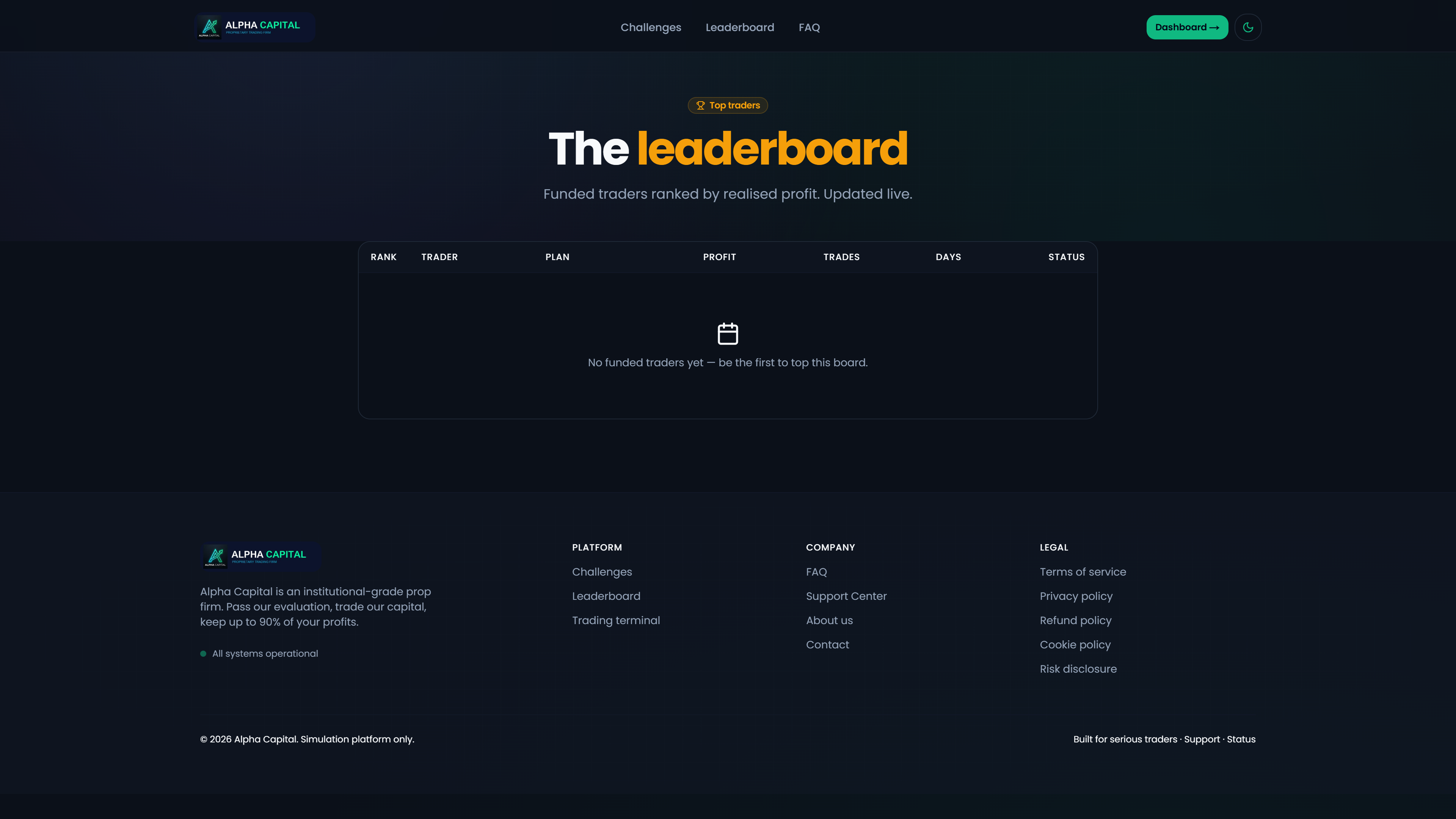
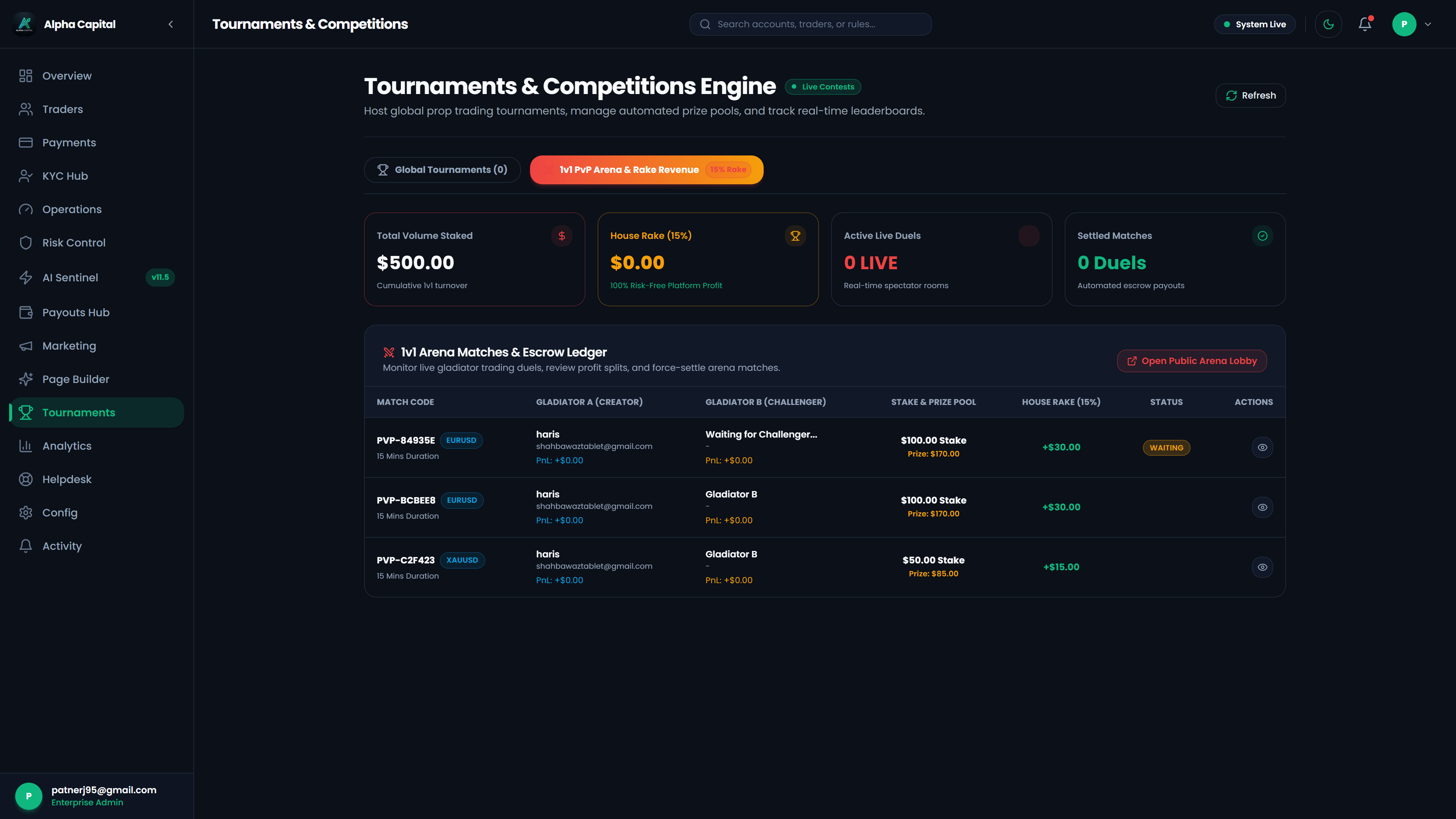
- Public Leaderboards & Viral Tournaments as Social Proof: Nothing lowers a prop firm's Customer Acquisition Cost (CAC) faster than a verified public leaderboard and live trading competitions. When prospective retail traders see real leaderboard champions winning 1v1 PvP duels and withdrawing verified USDT or Rise payouts, organic conversion rates surge.
- Eliminating Toxic SaaS Rent: Legacy white-label SaaS providers (like FPFX Tech, Propriotec, or DXtrade bundles) charge operators $3,500 to $8,000+ every single month plus per-account licensing fees, draining $42,000 to $90,000+ per year from your treasury reserve.
With LaunchPropFirm, founders launch their own sovereign, self-hosted prop firm platform for a $2,495 one-time purchase with 100% Next.js/Node.js source code ownership and $0 monthly SaaS fees. You get built-in MetaTrader 5, cTrader, and DXtrade bridges, browser-native TradingView terminals, automated Public Leaderboards, Tournaments Engine, and a 1v1 PvP Trading Battle Arena deployed on your own private VPS in 48 hours.
7. Trader Self-Check Diagnostic: Do You Trade Like the Top 1%?
Before placing your next intraday order, compare your current habits against the non-negotiable standards of the most successful day traders:
- The 1% Risk Ceiling: Is your stop loss on every single trade mathematically sized so that a loss never exceeds 0.50% to 1.0% of your account balance?
- The 2:1+ Asymmetric Filter: Do you refuse to enter any trade unless the realistic structural target (next liquidity pool or swing high/low) offers at least 2.5R to 3.5R?
- The 2R Daily Circuit Breaker: Do you immediately close your trading platform for the day if you take two consecutive 1R stopouts?
- Zero Stop-Loss Widening: Have you completely eliminated the habit of dragging your stop loss further away when price moves against your entry?
- 100% Logged Execution: Have you logged your last 25 trades (including setup tag, session, and realized R-multiple) inside our Free Professional Trading Journal Workbook (.xlsx)?
Interactive Strategy & Risk Check: Which of the four mathematical laws above is currently your biggest leak: position sizing, cutting winners too early, or revenge trading after a loss? If you want our risk desk to review your challenge parameters or show you how our institutional prop platform tracks top trader telemetry, reach out directly on WhatsApp (+92 315 8583905) or test the live LaunchPropFirm Platform Demo.
Frequently Asked Questions
Who is considered the most successful day trader of all time?
Among audited short-term and intraday traders, Marty Schwartz ("Pit Bull"), Takashi Kotegawa (BNF), Paul Tudor Jones, and Stanley Druckenmiller hold the most verified track records. Marty Schwartz achieved up to +781% in the audited US Investing Championship day trading equities and index contracts, while Japanese intraday trader Takashi Kotegawa turned $13,600 into over $150 million in eight years trading liquid intraday price reversals.
What is the average win rate of the most successful day traders?
Contrary to social media myths claiming 85% to 95% accuracy, the most successful institutional day traders and funded prop traders operate with a 40% to 55% win rate. Their profitability comes from asymmetric reward-to-risk ratios, losing strictly 1R (0.50% to 1.0% of equity) on losing trades while capturing 2.5R to 5.0R on winning setups.
How much do top funded prop firm day traders make?
Top-tier funded prop traders managing $100,000 to $400,000 in evaluation allocations typically target a disciplined 3% to 8% net monthly return. With an 80% to 90% profit split, a consistent 5% monthly gain on a $200,000 funded portfolio generates $8,000 to $9,000 per month in bi-weekly payouts while keeping maximum personal capital at risk limited to the initial challenge fee.
What trading strategy do the most successful day traders use?
While execution styles vary between momentum breakouts (Paul Tudor Jones, Marty Schwartz) and intraday mean-reversion (Takashi Kotegawa), virtually all elite day traders combine higher-timeframe market structure (Break of Structure and liquidity levels) with strict session timing (trading only during the London Open or New York Overlap) and mechanical position sizing.
Written by the LaunchPropFirm Technical Analysis & Risk Architecture Desk.
Evaluate Your Prop Firm Readiness Score (0-100)
Answer 5 quick operational questions about your acquisition channels, runway, and engine tech to get a personalized launch roadmap.

M.Haris
Founder & Platform ArchitectBuilding open prop trading software infrastructure for operators worldwide
I built LaunchPropFirm to give forex educators, trading communities, and fintech operators complete ownership of their platform with full source code and zero monthly SaaS rent. Every article on this blog is drawn from hands-on platform development, live MT5 risk bridge mechanics, and real operator economics.
All content, financial models, ROI estimates, and architecture guides on LaunchPropFirm are published strictly for educational and informational purposes. LaunchPropFirm provides institutional prop trading software and technology infrastructure; it does not operate as a broker, custodian, or registered investment advisor.
Evaluation challenges and funded trader accounts referenced in this guide operate in simulated demo trading environments using real-time market data feeds. Simulated trading results do not represent actual trading performance or financial advice.
Recommended Next Reads
Hand-picked operator guides to scale your prop trading platform.
Free Trade Journal: Excel Spreadsheet Template & Guide
Download our free trade journal Excel template for prop firm traders. Track R-multiples, win rate, daily drawdown, and emotional discipline in 2026.
Is Day Trading Hard? Why 95% Fail & The Math Explained
Discover why 95% of day traders fail, the mathematical reality of leverage drag, and how funded evaluation accounts cap your personal downside risk.
Skip the monthly fees
Own your prop firm platform outright. One time purchase.
Full source code. Live in 7 days. No revenue share. No monthly SaaS bill. See the exact platform before paying anything.
Demo login: haris / asdf1122. No signup needed