Forex Lot Size Chart: Pip Calculator & Risk Guide 2026
Master forex lot sizes in 2026. Explore micro, mini, and standard lots, calculate exact pip values, manage spread risks, and use our free lot size tool.
Ask any institutional risk manager why 90% of retail day traders fail their prop firm evaluations within forty-eight hours, and they will not cite faulty technical analysis or poor chart timing. The statistical cause of account liquidation is almost always arbitrary position sizing.
Beginner retail traders routinely make the fatal mistake of picking a fixed lot size based on emotion rather than mathematics. A trader opens a $50,000 evaluation account, arbitrarily types "2.00 lots" into their order ticket, and executes every trade with identical volume. When their stop loss is 15 pips, they risk $300. But when their next setup requires a 45-pip stop loss, that exact same 2.00 lot position exposes $900 of capital: immediately threatening their maximum daily loss limit on a single adverse market swing.
In professional proprietary trading, position sizing is the dependent variable, while stop loss distance is the independent variable. You must let your chart invalidation distance determine your volume, never the reverse.
This comprehensive guide, visual forex lot size chart, and mathematical sizing matrix will teach you how to calculate exact pip values, neutralize the bid-ask spread, and utilize our free institutional position sizing tools to protect your funded capital across every trade.
What Is Lot Size in Trading? Standard, Mini, Micro & Nano Lots Explained
In financial markets, mastering your lot size in currency trading is the foundational prerequisite to disciplined capital preservation. A lot size represents the standardized quantity of financial units traded in a single order contract. Because individual currency exchange rates move in tiny fractions of a cent (pips), trading a single dollar or euro would yield negligible profits. Currency brokers and liquidity providers bundle currencies into standardized contract blocks to enable meaningful financial exchange.
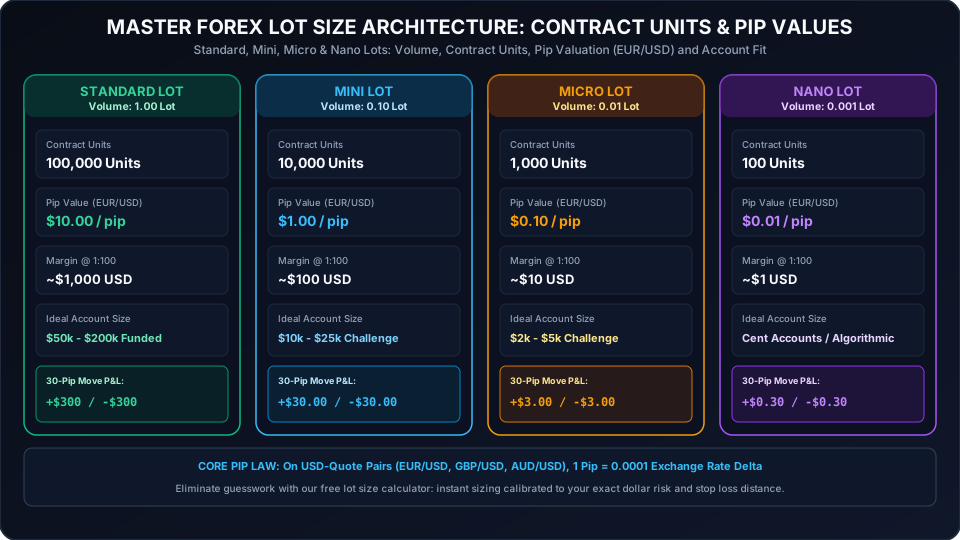
To understand what is lot size in trading, market participants must distinguish between the four universal lot categories recognized across all MetaTrader 5 (MT5), cTrader, and TradingView institutional bridges:
| Lot Type | Trading Volume | Contract Units | Pip Value (EUR/USD) | Required Margin (@ 1:100) | Recommended Capital Tier |
|---|---|---|---|---|---|
| Standard Lot | 1.00 Lot | 100,000 Units | $10.00 / pip | ~$1,000 USD | $50,000 to $200,000 Funded Accounts |
| Mini Lot | 0.10 Lot | 10,000 Units | $1.00 / pip | ~$100 USD | $10,000 to $25,000 Evaluation Challenges |
| Micro Lot | 0.01 Lot | 1,000 Units | $0.10 / pip | ~$10 USD | $2,000 to $5,000 Micro Accounts |
| Nano Lot | 0.001 Lot | 100 Units | $0.01 / pip | ~$1 USD | Cent Accounts & Algorithmic EA Testing |
1. The Standard Lot (1.00 Lot = 100,000 Units)
The standard lot is the benchmark institutional contract in global foreign exchange. When you execute 1.00 lot on EUR/USD, you are purchasing or selling 100,000 units of the base currency (Euros) against the quote currency (US Dollars). On any currency pair where the US Dollar is the quote currency (EUR/USD, GBP/USD, AUD/USD, NZD/USD), each one-pip price fluctuation generates an exact $10.00 gain or loss. While standard lots deliver substantial profits during clean momentum expansions, an unhedged 30-pip adverse swing extracts $300 from your equity curve.
2. The Mini Lot (0.10 Lot = 10,000 Units)
A mini lot represents one-tenth of a standard lot contract. Executing 0.10 lots controls 10,000 units of currency, yielding a pip valuation of exactly $1.00 per pip on USD quote pairs. Mini lots serve as the foundational execution unit for retail traders navigating $10,000 to $25,000 prop firm evaluation phases. If your trading plan risks $100 per setup with a 20-pip stop loss, executing 0.50 mini lots achieves perfect risk containment.
3. The Micro Lot (0.01 Lot = 1,000 Units)
A micro lot represents one-hundredth of a standard lot contract, controlling 1,000 currency units. On USD quote pairs, each pip movement equals $0.10 (ten cents). Micro lots provide unmatched precision for traders managing micro challenge tiers ($2,000 to $5,000 accounts) or scaling into high-probability swings with tight invalidation buffers. If you are learning how to learn how to day trade, micro lots allow you to execute live order tickets with genuine psychological skin in the game while risking less than $5 per trade.
4. The Nano Lot (0.001 Lot = 100 Units)
Available primarily on specialized broker cent accounts and algorithmic sandbox environments, nano lots control 100 currency units, pricing each pip at $0.01 (one cent). Quantitative developers and prop firm risk engineers utilize nano lots to stress-test automated execution bots, bridge latency routes, and automated trailing drawdown triggers before deploying institutional capital.
What Does Pips Mean in Day Trading and How to Calculate Pip Values
Before selecting an execution lot size, every trader must understand what does pips mean in day trading. The term pip stands for "Percentage in Point" or "Price Interest Point." It represents the smallest standardized unit of price measurement in foreign exchange markets.
For the vast majority of currency pairs, a pip is measured at the fourth decimal place (0.0001) of the exchange rate quote:
Example (EUR/USD): If the EUR/USD exchange rate moves from 1.08500 to 1.08510, the price has expanded by exactly 1.0 pip.
Most modern brokerages and TradingView terminals display price quotes with an additional fifth decimal place, known as a pipette or fractional pip (0.00001). Ten pipettes equal one full pip. When evaluating what is spread in forex, a broker displaying a spread of "12" is quoting 1.2 pips.
How to Calculate Pips in Forex Across Different Currency Pairs
Understanding how to calculate pips in forex depends on whether the US Dollar serves as the quote currency, the base currency, or is absent from the pair:
Case A: USD is the Quote Currency (EUR/USD, GBP/USD, AUD/USD)
When USD is the second currency in the pair, the pip value formula is direct and constant:
Pip Value = Contract Size × 0.0001
Case B: Japanese Yen Pairs (USD/JPY, EUR/JPY, GBP/JPY)
The Japanese Yen is traded at a significantly lower nominal value relative to Western currencies. Consequently, JPY pairs are quoted to two decimal places (0.01) rather than four:
JPY Pip Value = (Contract Size × 0.01) ÷ USD/JPY Exchange Rate
Notice that because the Yen's exchange rate fluctuates continuously, the dollar value of a pip on JPY pairs changes dynamically. Performing this calculation manually during high-speed market expansions causes fatal execution delays. This is why professional prop firm traders rely on our free lot size calculator forex to resolve cross-currency exchange rates automatically.
Case C: Cross-Currency Pairs (EUR/GBP, GBP/AUD, AUD/NZD)
When trading currency pairs without the US Dollar, the pip value is initially calculated in the quote currency and then converted into USD using the live interbank exchange rate of the quote currency against the dollar. For instance, on EUR/GBP, each pip on a standard lot is worth £10.00 GBP. If the GBP/USD exchange rate is 1.2700, that £10.00 pip converts to $12.70 USD.
The Master Forex Lot Size Chart: Dynamic Position Sizing Matrix
To safeguard your prop firm challenge account, you must never trade a fixed lot size across varying market structures. A breakout trade on GBP/JPY during the London open might require a 35-pip stop loss, while an intraday fair value gap scalp on EUR/USD might only require an 11-pip invalidation.
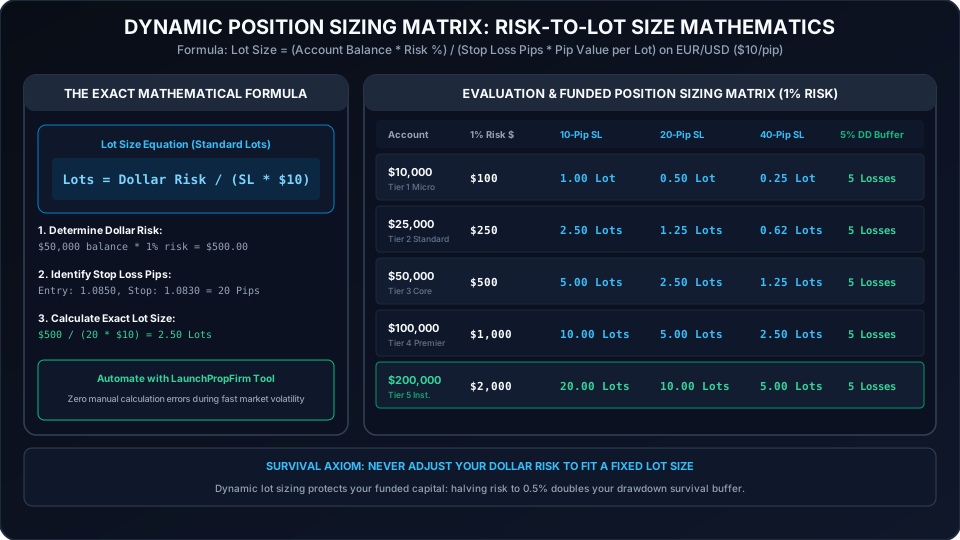
The following master forex lot size chart displays the exact mathematical lot size required to risk exactly 1.0% and 0.5% of your total account balance across standard stop loss distances on EUR/USD:
| Account Size | 1% Risk ($) | 0.5% Risk ($) | 10-Pip SL | 15-Pip SL | 20-Pip SL | 30-Pip SL | 40-Pip SL | Max Consecutive 1% Losses to Breach (5% DD) |
|---|---|---|---|---|---|---|---|---|
| $5,000 Micro | $50.00 | $25.00 | 0.50 Lot | 0.33 Lot | 0.25 Lot | 0.16 Lot | 0.12 Lot | 5 Losses |
| $10,000 Challenge | $100.00 | $50.00 | 1.00 Lot | 0.66 Lot | 0.50 Lot | 0.33 Lot | 0.25 Lot | 5 Losses |
| $25,000 Challenge | $250.00 | $125.00 | 2.50 Lots | 1.66 Lots | 1.25 Lots | 0.83 Lots | 0.62 Lots | 5 Losses |
| $50,000 Evaluation | $500.00 | $250.00 | 5.00 Lots | 3.33 Lots | 2.50 Lots | 1.66 Lots | 1.25 Lots | 5 Losses |
| $100,000 Premier | $1,000.00 | $500.00 | 10.00 Lots | 6.66 Lots | 5.00 Lots | 3.33 Lots | 2.50 Lots | 5 Losses |
| $200,000 Institutional | $2,000.00 | $1,000.00 | 20.00 Lots | 13.33 Lots | 10.00 Lots | 6.66 Lots | 5.00 Lots | 5 Losses |
The Dynamic Position Sizing Formula
Every cell in the matrix above is derived from the core equation of quantitative risk management:
Mathematical Sizing Formula:
Lot Size = Dollar Risk ÷ (Stop Loss Pips × Pip Value per Standard Lot)
Where:
Practical Calculation Walkthrough:
Assume you are trading a $50,000 funded account and intend to risk 0.50% on an intraday setup:
- Calculate Dollar Risk: $50,000 × 0.005 = $250.00 USD.
- Measure Stop Loss Distance: Your chart setup has an entry at 1.08500 and a structural stop loss at 1.08300 (a distance of 20.0 pips).
- Determine Sizing: $250.00 ÷ (20 pips × $10.00) = $250.00 ÷ $200.00 = 1.25 Standard Lots.
If your next trade setup requires a wider 40.0-pip stop loss, your calculation automatically adjusts:
- $250.00 ÷ (40 pips × $10.00) = $250.00 ÷ $400.00 = 0.62 Standard Lots.
Notice that even though the stop loss distance doubled from 20 pips to 40 pips, your total capital at risk remained exactly $250.00. This dynamic calibration guarantees that no single bad trade can damage your evaluation buffer more than intended.
To eliminate mental arithmetic during fast-moving trading sessions, bookmark our free prop firm lot size calculator. The tool computes exact contract lots across all major, minor, and exotic currency pairs in under two seconds.
Skip the monthly fees
Own your prop firm platform outright. One time purchase.
Full source code. Live in 7 days. No revenue share. No monthly SaaS bill. See the exact platform before paying anything.
Demo login: haris / asdf1122. No signup needed
What Is Spread in Forex and How It Warps Position Sizing
When executing orders in live market conditions, calculating your stop loss purely from the candlestick chart is insufficient. You must account for what is spread in forex.
The spread is the price differential between the bid price (the highest price a buyer will pay) and the ask price (the lowest price a seller will accept). When you execute a long (buy) order, your position is filled at the ask price and closed at the bid price. When you execute a short (sell) order, your position is filled at the bid price and closed at the ask price.
The moment you click buy or sell, your position opens with an immediate unrealized loss equal to the spread:
Spread Cost = Spread in Pips × Pip Value × Lot Size
How Spread Expansion Destroys Tight Stop Losses
Many retail day traders attempt to trade with ultra-tight 5-pip or 8-pip stop losses without considering spread drag. If you trade EUR/USD with an 8-pip stop loss on a 1.5-pip broker spread, the spread alone consumes 18.75% of your total allowable risk:
Spread Drag Ratio = 1.5 Pips Spread ÷ 8.0 Pips Total Stop Loss = 18.75%
Even worse, during high-impact macroeconomic news releases (such as US Non-Farm Payrolls or CPI announcements) and daily market rollover at 5:00 PM EST, institutional liquidity dries up. Interbank spreads on major pairs can widen from 0.2 pips to 6.0 or 12.0 pips in fractions of a second.
As detailed in our market analysis on the best time to trade forex, holding open positions across the 5:00 PM EST rollover window exposes traders to artificial stop-outs. If your stop loss is positioned 10 pips away and the spread expands by 12 pips, your order is liquidated immediately, even if the candlestick chart never touched your invalidation level. This dynamic is even more severe when trading commodities like Gold (XAU/USD); review our institutional breakdown of gold market trading hours to see how session liquidity shifts and midnight rollover spreads impact precious metals sizing.
To stress-test your account against worst-case spread blowouts, verify your cushion with our prop firm drawdown calculator before opening new positions.
Realistic Intraday Trade Execution: EUR/USD Order Ticket Case Study
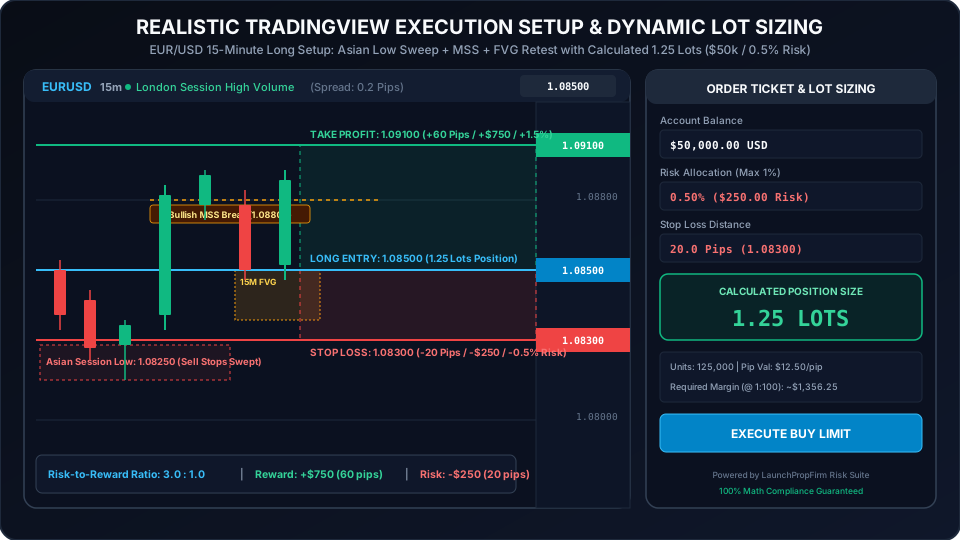
To observe how professional lot sizing operates inside a modern trading terminal, let us dissect a live trade setup on the EUR/USD 15-minute chart during the London trading session:
Setup Breakdown & Execution Architecture
- Liquidity Sweep Benchmark: Prior to the European open, the Asian session established a local low at 1.08250. At 07:15 UTC, London market makers engineer an aggressive downward thrust that sweeps through the Asian low, capturing retail sell stop-losses and engineering deep liquidity.
- Market Structure Shift (MSS): Immediately following the sweep, an institutional displacement candle surges upward, closing decisively above the prior 15-minute swing high (1.08650). This validates a bullish Market Structure Shift.
- Fair Value Gap Inception: The explosive displacement leaves an unfilled 15-minute Fair Value Gap (FVG) between 1.08300 and 1.08500.
- Order Execution Plan:
* Entry Order: Buy Limit placed at the top of the FVG at 1.08500.
* Stop Loss Invalidation: Positioned safely below the liquidity sweep low at 1.08300 (a distance of 20.0 pips).
* Take Profit Target: Anchored at the resting buy-side liquidity pool at 1.09100 (a distance of 60.0 pips).
* Asymmetric Expectancy: 60 pips target ÷ 20 pips risk = 3.0 : 1 Reward-to-Risk Ratio.
The Terminal Order Ticket Calibration
On a $50,000 funded evaluation account, the trader strictly caps risk at 0.50% ($250.00). Opening the order ticket in cTrader or TradingView, the trader inputs the execution parameters:
- Account Equity: $50,000.00 USD
- Risk Allocation: 0.50% ($250.00 USD)
- Entry Price: 1.08500
- Stop Loss: 1.08300 (20.0 Pips)
- Calculated Volume: 1.25 Standard Lots (125,000 contract units)
- Potential Reward: +$750.00 USD (+1.50% Account Gain)
- Required Margin (@ 1:100 Leverage): ~$1,356.25 USD
By following this disciplined sequence, the trader removes all guesswork. If the trade is stopped out, the account balance drops to $49,750.00 (a minor scratch that preserves 95% of the daily drawdown buffer). If the trade hits its 1.09100 target, the account gains $750.00, completing 15% of the total challenge profit target in a single execution.
Compounding Disciplined Risk: Growing From Micro Tiers to Multi-Firm Allocations
The true advantage of mathematical position sizing becomes apparent when compounded over hundreds of trades. When beginner day traders discover that day trading is difficult, as proven in our mathematical breakdown on is day trading hard, their instinct is to increase leverage to recoup losses quickly.
Professional operators do the exact opposite. By maintaining fixed percentage risk, your dollar position size naturally expands as your account balance compounds, while shrinking automatically during standard losing periods:
Consider the long-term mathematical difference between a reckless trader risking 3% per trade versus a disciplined operator risking 0.5% with an asymmetric 2.5:1 reward-to-risk ratio:
- The 3% Trader: An unavoidable streak of four consecutive losses destroys 12% of the account, instantly breaching maximum drawdown limits and forfeiting the evaluation fee.
- The 0.5% Operator: Four consecutive losses extract only 2.0% of total equity. The account remains fully solvent, easily recovering the deficit with a single 1:3 R:R winning trade (+1.5% net profit).
Traders can model projected equity trajectories across multiple funded accounts using our comprehensive prop firm calculator or explore our complete suite of institutional utilities in the LaunchPropFirm trading tools directory.
The Prop Firm Operator Perspective: How Bridge Risk Engines Monitor Lot Sizing Anomalies
Understanding the institutional mechanics behind prop firm risk controls provides valuable perspective on why proprietary trading firms enforce strict position sizing parameters.
Proprietary trading firms running on enterprise platforms like LaunchPropFirm deploy automated AI Sentinel risk engines and MT5/cTrader bridge gateways that continuously scan execution logs for toxic trading behavior:
- Martingale Lot Multipliers: When a trader doubles their lot size after a loss (e.g., 1.0 lot -> 2.0 lots -> 4.0 lots), automated bridge algorithms flag the account for destructive martingale behavior. In retail environments, martingale sizing carries a 100% statistical probability of eventual total account ruin.
- High-Impact News Gambling: When an account that normally trades 0.5 lots suddenly enters a 10.0 lot market execution sixty seconds before a US CPI release, risk filters trigger automated pre-news position caps or leverage freezes. Read our detailed guide on prop firm challenge rules to understand how firms restrict news gambling.
- Layered Order Flooding: Splitting a 10-lot position into twenty 0.5-lot orders to circumvent maximum lot limits is immediately detected by modern order router bridges.
- Drawdown Floor Telemetry: When an account approaches within 1.0% of its trailing drawdown limit, automated server protocols restrict maximum allowable lot sizes, preventing a single reckless trade from pushing the account balance into a negative deficit.
Prop firm operators do not design evaluation parameters to fail competent traders. They design them to filter out undisciplined gamblers and identify systematic, risk-managed market operators who can responsibly handle six-figure capital allocations. To learn how modern firms model these risk tolerances, review our operational analysis on prop firm drawdown explained.
Frequently Asked Questions About Forex Lot Sizes and Pip Calculations
What is lot size in trading and why does it matter?
A lot size is the standardized quantity of currency units or contracts traded in an open financial position. It matters fundamentally because lot size directly dictates how much money you make or lose on every single pip of price movement. Using excessive lot sizes without calculating your stop loss distance leads to catastrophic drawdown breaches and rapid account liquidation.
What does pips mean in day trading and how do you calculate them?
A pip stands for "Percentage in Point" and represents the fourth decimal place (0.0001) in most major currency pairs such as EUR/USD and GBP/USD. To calculate pip movement, subtract the entry price from the exit price. On a standard 1.00 lot contract of EUR/USD, each pip equals exactly $10.00 USD. On pairs quoted in Japanese Yen, a pip is measured at the second decimal place (0.01).
What is spread in forex and how does it affect my lot size?
The spread is the difference between the bid price and the ask price quoted by your broker or liquidity provider. Because you enter at the ask and exit at the bid, your trade opens with an immediate negative balance equal to the spread multiplied by your lot size. On tight stop losses (e.g., 10 pips or fewer), wide spreads consume a significant portion of your risk allowance and require traders to widen their stops or reduce position sizes accordingly.
How to calculate pips in forex for JPY pairs?
On Japanese Yen currency pairs (such as USD/JPY, EUR/JPY, or GBP/JPY), 1 pip equals 0.01 (the second decimal digit). To calculate the dollar pip value for a standard lot (100,000 units), multiply 100,000 by 0.01 ($1,000 JPY) and divide by the current USD/JPY exchange rate. For example, if USD/JPY is trading at 150.00, one pip on a standard lot equals $1,000 ÷ 150.00 = $6.67 USD.
How does LaunchPropFirm's lot size calculator protect funded trader accounts?
LaunchPropFirm's free prop firm lot size calculator protects funded traders by automatically computing the exact, mathematically compliant lot size based on your current account balance, exact stop loss pips, and live interbank cross-currency exchange rates. This completely eliminates manual sizing errors, prevents accidental over-leveraging, and guarantees you never violate your prop firm's daily drawdown boundaries.
Calculate Exact Prop Firm Lot Sizes & Pip Risk
Determine safe position sizes for Gold (XAUUSD), Forex, and Indices with real-time prop firm daily loss limit protection.

M.Haris
Founder & Platform ArchitectBuilding open prop trading software infrastructure for operators worldwide
I built LaunchPropFirm to give forex educators, trading communities, and fintech operators complete ownership of their platform with full source code and zero monthly SaaS rent. Every article on this blog is drawn from hands-on platform development, live MT5 risk bridge mechanics, and real operator economics.
All content, financial models, ROI estimates, and architecture guides on LaunchPropFirm are published strictly for educational and informational purposes. LaunchPropFirm provides institutional prop trading software and technology infrastructure; it does not operate as a broker, custodian, or registered investment advisor.
Evaluation challenges and funded trader accounts referenced in this guide operate in simulated demo trading environments using real-time market data feeds. Simulated trading results do not represent actual trading performance or financial advice.
Recommended Next Reads
Hand-picked operator guides to scale your prop trading platform.
Gold Trading Hours: Best Times to Trade XAU/USD in 2026
Discover the best gold trading hours in 2026. Explore London and New York overlaps, hourly XAU/USD volatility, spread traps, and killer execution setups.
How to Learn How to Day Trade: 2026 Step-by-Step Blueprint
Master day trading in 2026 with a proven 5-stage roadmap. Learn market mechanics, 1% risk rules, demo forward-testing, and funded challenge protocols.
Skip the monthly fees
Own your prop firm platform outright. One time purchase.
Full source code. Live in 7 days. No revenue share. No monthly SaaS bill. See the exact platform before paying anything.
Demo login: haris / asdf1122. No signup needed