How to Price Prop Firm Challenges
Prop firm challenge fees run $49 to $999 depending on account size. Here is what the market charges in 2026, the unit economics, and how to price yours.
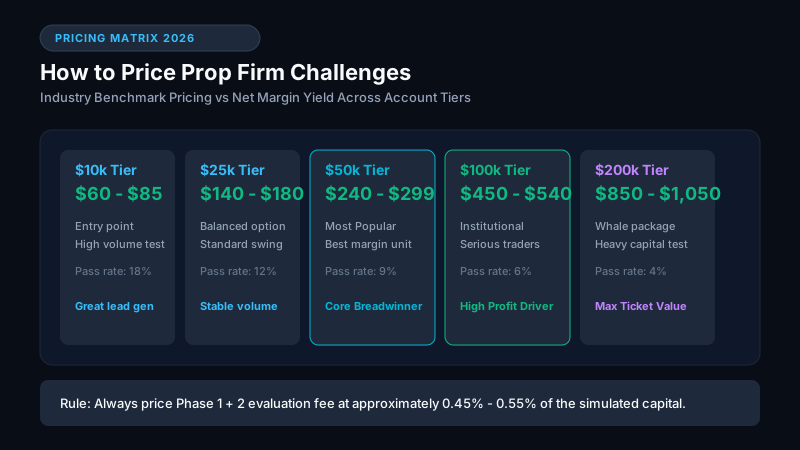
💡 Live Interactive Modeling: Want to test break-even ticket fees across $10k to $200k accounts? Model your pass rate liabilities and 3.0x liquidity reserve funds in real time with our free Prop Firm Challenge Pricing & Payout Reserve Simulator.
Pricing Determines Everything
When I was setting up challenge prices for LaunchPropFirm, I studied every major firm's fee structure before setting my own.
The numbers you choose affect three things that determine whether the business works: how many traders buy challenges, how much revenue each challenge generates, and what your margins look like after payouts.
Get the pricing right and the math works. Get it wrong and you are either leaving revenue on the table or pricing traders out before they even compare your rules.
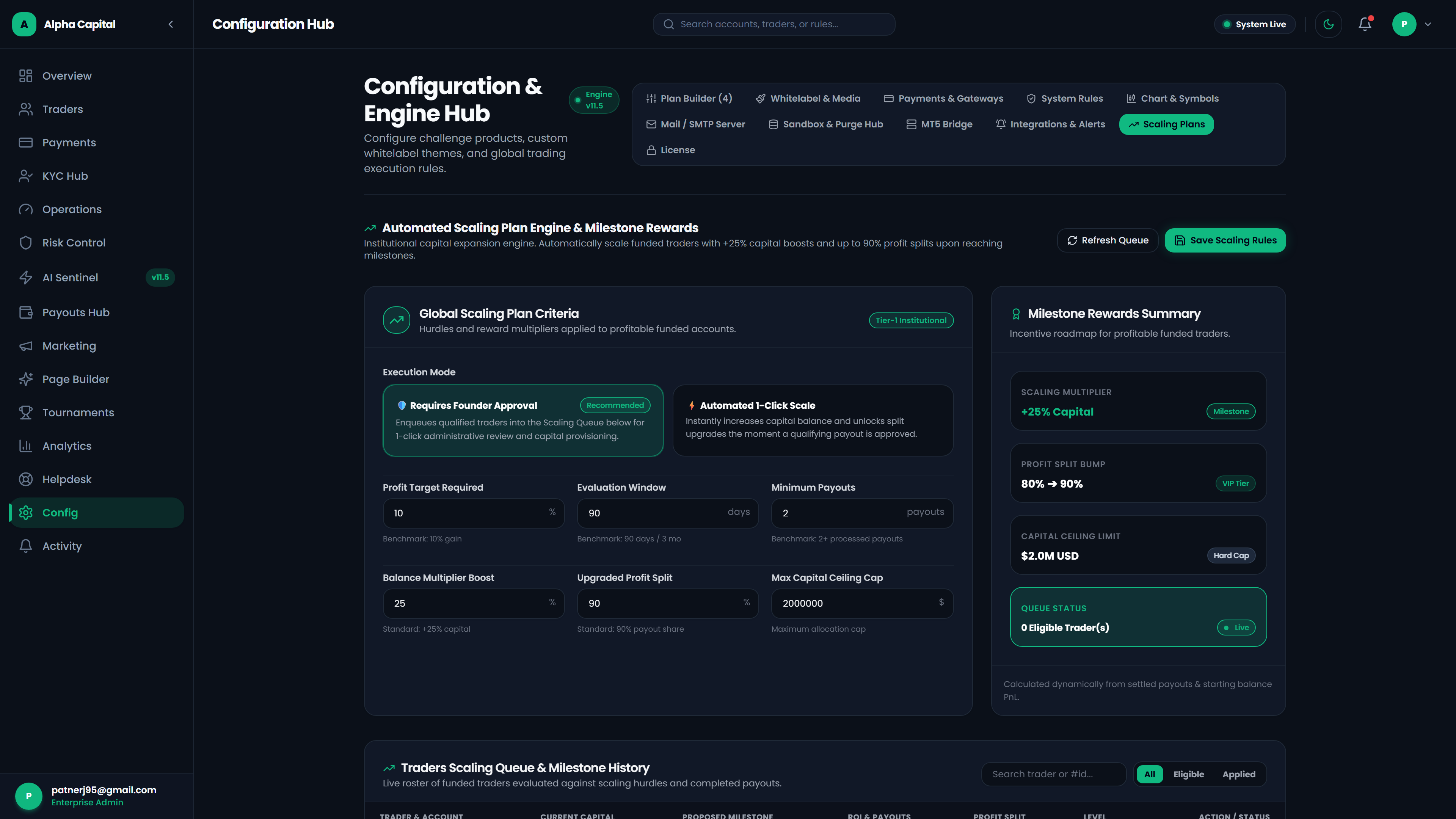
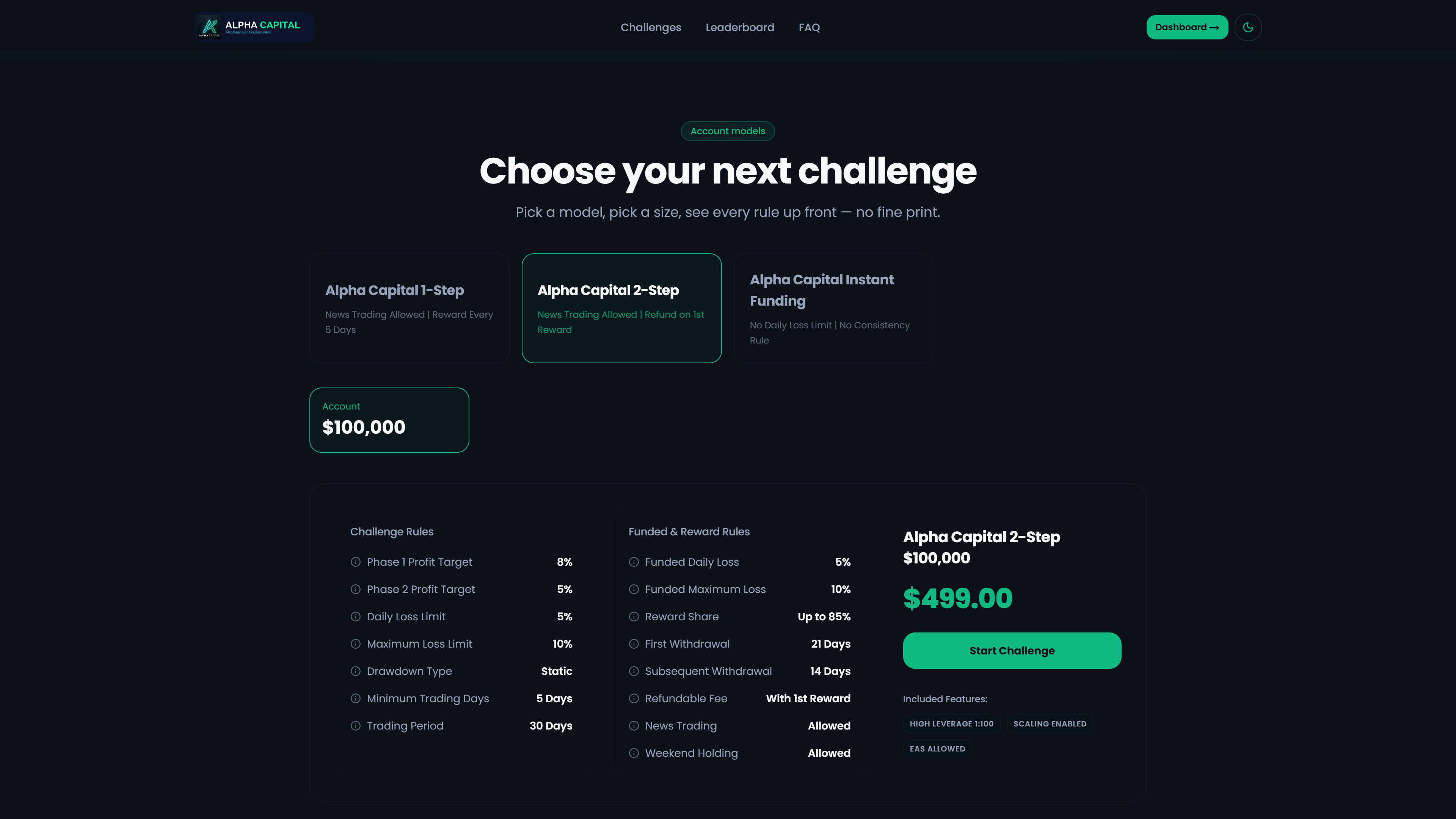
See what the platform looks like with challenge plans configured
Current Market Rate: What Competitors Charge in 2026
Before setting your prices, know what the market expects. Here is what major and mid-tier prop firms charge in mid-2026:
| Account Size | Standard Two-Phase | One-Phase |
|---|---|---|
| $5,000 | $49 to $59 | $79 to $89 |
| $10,000 | $89 to $109 | $149 to $169 |
| $25,000 | $179 to $219 | $279 to $329 |
| $50,000 | $269 to $329 | $429 to $499 |
| $100,000 | $449 to $559 | $649 to $799 |
| $200,000 | $799 to $999 | Not standard |
These are ranges across 15 to 20 prop firms. The spread reflects branding and positioning: a firm known for strict rules and high pass standards can charge the top of the range. A new firm with no track record starts at the bottom.
New operators should price in the middle to lower half of each range. Matching a high-end price requires reputation you have not built yet.
The Economics of Challenge Pricing
Understanding the unit economics before you set prices prevents the biggest mistake new operators make: pricing for volume when you should be pricing for margin.
On a $199 challenge for a $25,000 account:
- 93 out of 100 traders fail and pay nothing beyond the fee (industry pass rate 5 to 10%)
- 7 traders pass and receive a funded account
- Funded traders earn an average of $1,500 to $2,500 per month at the $25,000 level
- At 80% profit split, you owe funded traders $1,200 to $2,000 per month each
- Revenue from 100 challenges: $19,900
- Expected monthly payout exposure from 7 funded traders: $8,400 to $14,000
The math only works because most funded traders breach within 1 to 3 months and rebuy. Account for that cycle in your projections.
A $179 challenge generates $17,900 per 100 sales. A $219 challenge generates $21,900. The $40 per challenge difference adds up to $4,000 per 100 sales. Price conservatively only if competitive pressure requires it.
Skip the monthly fees
Own your prop firm platform outright. One time purchase.
Full source code. Live in 7 days. No revenue share. No monthly SaaS bill. See the exact platform before paying anything.
Demo login: haris / asdf1122. No signup needed
How to Price by Account Size
The ratio between account sizes should follow a consistent multiplier. If your $10K challenge is $99, your $25K should be roughly 2x ($199), your $50K should be 3x ($299), and your $100K should be 4.5x ($449).
Detailed trade journal tracking execution timestamps, position sizes, and consistency rule compliance.
Flat pricing across all account sizes (everyone pays $199) kills demand for larger accounts. Traders prefer larger accounts because more capital means more potential profit. Make them pay more for that.
Pricing that is too steep between account sizes kills the upgrade path. If $10K is $99 and $25K is $399, most traders stay at $10K.
The standard market multiplier per account size doubling is 1.4x to 1.6x. This feels reasonable to traders and maintains your margin as account sizes increase.
Discount Strategy
Discounts increase volume but reduce per-challenge revenue. Use them tactically, not as a permanent price cut.
Launch discounts: offer 15 to 20% off all challenges for the first 30 days. This fills your trader pipeline with early adopters, generates social proof, and gives you a reason to announce the firm's opening. End the discount publicly. "Launch pricing has ended" signals scarcity and validates the higher price.
Holiday and event discounts: Black Friday, New Year, and FTMO-style batch events are opportunities. Run a 10 to 15% discount for 72 hours. Announce the end of the discount with a countdown. These convert well because there is genuine urgency.
Affiliate codes: let affiliates offer 10% off with their promo code. This is effectively split between you and the affiliate. It costs you 10% revenue per sale, but the sale would not have happened without the affiliate. The net is still positive.
Never run discounts longer than 7 days. Extended discounts train traders to wait for the next discount rather than buying at full price.
Refund Policy and Its Effect on Pricing
A refund policy affects how aggressively you can price. A firm with no refunds can price lower because every purchase is guaranteed revenue. A firm with a 14-day refund window needs to price higher to account for refund volume.
Industry standard is: no refund once Phase 1 is started. If the trader has not started trading and requests a refund within 7 days, some firms honor it. Once a trader has made any trade, the fee is non-refundable.
A strict no-refund policy at launch will generate some chargebacks from dissatisfied traders. A limited refund policy reduces chargebacks but costs you real revenue on the small percentage who request it. Most operators use the limited policy to reduce chargebacks, which are more expensive and operationally disruptive than refunds.
When to Raise Prices
The signal to raise prices is consistent demand. If you are selling 30 challenges per week and your challenge waitlist is growing, you are underpriced.
A price increase of 10 to 15% with 30 days' notice is the standard. Announce it publicly ("Challenge prices are increasing on August 1st") to generate a rush of purchases at the old price, then let the new price stabilize.
Do not raise prices during your first 90 days. Your first job is to prove the model works and generate social proof. Once you have 20 funded traders and consistent weekly sales, the conditions for a price increase exist.
One-Phase vs Two-Phase Pricing
One-phase challenges should be priced at 1.4x to 1.6x the equivalent two-phase price. A $199 two-phase challenge becomes a $279 to $319 one-phase option.
The justification is simple: one-phase is faster for the trader. They pay a premium for speed. Serious traders who are confident in their consistency prefer one-phase. They are willing to pay more to avoid the second evaluation phase.
If your one-phase price is only 1.2x the two-phase price, most traders upgrade to one-phase and your margins on those accounts drop because one-phase challenges fail at lower rates than two-phase (better traders buy them).
Price the one-phase at 1.5x to keep both tiers selling at similar rates.
See how challenge plans are configured in the admin panel. The platform starts at $2,500 one-time. See pricing.
Operator Tip: When you are unsure whether to price at $179 or $199 for your $25K challenge, price at $199. The conversion rate difference between these two prices is small (traders compare rules and reputation more than they compare a $20 price difference). The revenue difference at scale is significant. Anchoring your prices in the middle of the market range from day one avoids the need to raise prices later, which always generates some friction.
Frequently Asked Questions
What is the average challenge fee for a $25,000 prop firm account?
$179 to $219 is the standard range for a two-phase $25,000 challenge in 2026. $199 sits in the competitive middle. One-phase $25,000 challenges typically run $279 to $329. New firms starting at the lower end of the range is common as they build reputation.
How much profit margin does a prop firm make on challenge fees?
Challenge fee revenue minus payout obligations is the core margin. At a 7% pass rate on a $199 challenge: 93 failed traders pay $199 each ($18,507 revenue), 7 traders receive funded accounts. The payout liability depends on funded trader performance. Most operators target 40 to 60% net margin on challenge fee revenue after reserving for payouts.
Should I offer discounts on prop firm challenges?
Yes, but tactically. Launch discounts for the first 30 days, brief holiday events, and affiliate promo codes are the three main use cases. Never run discounts longer than 7 days: extended discounts train traders to wait for the next promotion rather than buying at full price.
How do I price one-phase challenges relative to two-phase?
Price one-phase challenges at 1.4x to 1.6x the equivalent two-phase price. A $199 two-phase challenge becomes a $279 to $319 one-phase option. This reflects the value traders receive (speed, one fewer evaluation phase) and maintains healthy margins on the faster evaluation path.
When should a prop firm raise its challenge prices?
When you are selling 25 or more challenges per week consistently and there is no meaningful price objection in support communications. Price increases of 10 to 15% with 30 days' advance notice are standard. Announce the increase publicly to generate a last-chance purchase spike before the new price takes effect.
How does the refund policy affect challenge pricing?
A stricter no-refund policy lets you price slightly lower because all revenue is guaranteed. A 7-day refund window costs you 2 to 5% of revenue in practice but significantly reduces chargebacks, which carry $15 dispute fees and account termination risk with Stripe. Most operators price 5 to 8% higher than they otherwise would to absorb the cost of limited refund policies.
Model Your Firm's Monthly Cash Flow & Profit
Simulate challenger intake, pass rate payout reserves, and net operator margins with our free real-time economic calculator.
Prop Firm Monthly Profit Simulator
Simulate your challenge revenue, payout liability, and net monthly take-home profit.
$20,000
From upfront challenge fees-$2,800
~10 funded payouts budgeted$0 / month
Saves $3,000/mo vs SaaS$17,200/mo
Run-rate: $206,400/yr
M.Haris
Founder & Platform ArchitectBuilding open prop trading software infrastructure for operators worldwide
I built LaunchPropFirm to give forex educators, trading communities, and fintech operators complete ownership of their platform with full source code and zero monthly SaaS rent. Every article on this blog is drawn from hands-on platform development, live MT5 risk bridge mechanics, and real operator economics.
All content, financial models, ROI estimates, and architecture guides on LaunchPropFirm are published strictly for educational and informational purposes. LaunchPropFirm provides institutional prop trading software and technology infrastructure; it does not operate as a broker, custodian, or registered investment advisor.
Evaluation challenges and funded trader accounts referenced in this guide operate in simulated demo trading environments using real-time market data feeds. Simulated trading results do not represent actual trading performance or financial advice.
Recommended Next Reads
Hand-picked operator guides to scale your prop trading platform.
Wise Prop Firms: Payouts, Risks and Rails
Explore why direct Wise prop firms payouts trigger account freezes, how Rise compliance bridges protect funds, and why multi-rail payouts guarantee cash flow.
Prop Firm Capital: Requirements, Reserve Buffers and Risk Architecture
Unpack the financial reality of prop firm capital: synthetic exposure vs liquid reserves, challenge fee pool economics, A-Book STP hedging, and exact startup blueprints.
Skip the monthly fees
Own your prop firm platform outright. One time purchase.
Full source code. Live in 7 days. No revenue share. No monthly SaaS bill. See the exact platform before paying anything.
Demo login: haris / asdf1122. No signup needed