Prop Firm Challenges Explained in 2026
A prop firm challenge is an evaluation to earn funded capital. Learn how the three main challenge types work and which model fits your trading style.
A prop firm challenge is a paid evaluation on a simulated account where traders must hit a profit target without breaching a maximum drawdown limit. Passing the challenge is the standard path to trading a prop firm's capital without risking your own savings beyond the evaluation fee.
Here is how the three main challenge formats work, what each one costs, and which suits your trading style.
What Happens During a Prop Firm Challenge
During a challenge, the trader operates a simulated account with real market prices, real spreads, and a live drawdown counter. The account starts at a set balance, usually $25,000 to $200,000, and the trader must hit a profit target, usually 8 to 10%, within a set number of trading days.
If the daily loss limit (usually 5% of balance) or the total drawdown limit (usually 10% of balance) is breached at any point, the challenge ends immediately. To see the raw mathematical breach probabilities under standard evaluation rules, use the Prop Firm Pass Probability Calculator. The trader loses the fee but owes nothing else.
On passing, the trader advances to either a verification phase or directly to a funded account where they trade with the firm's capital and keep 80% of all profits earned.
The Three Challenge Types
Most prop firms offer one or more of three formats. Each has different costs, timelines, and risk characteristics.
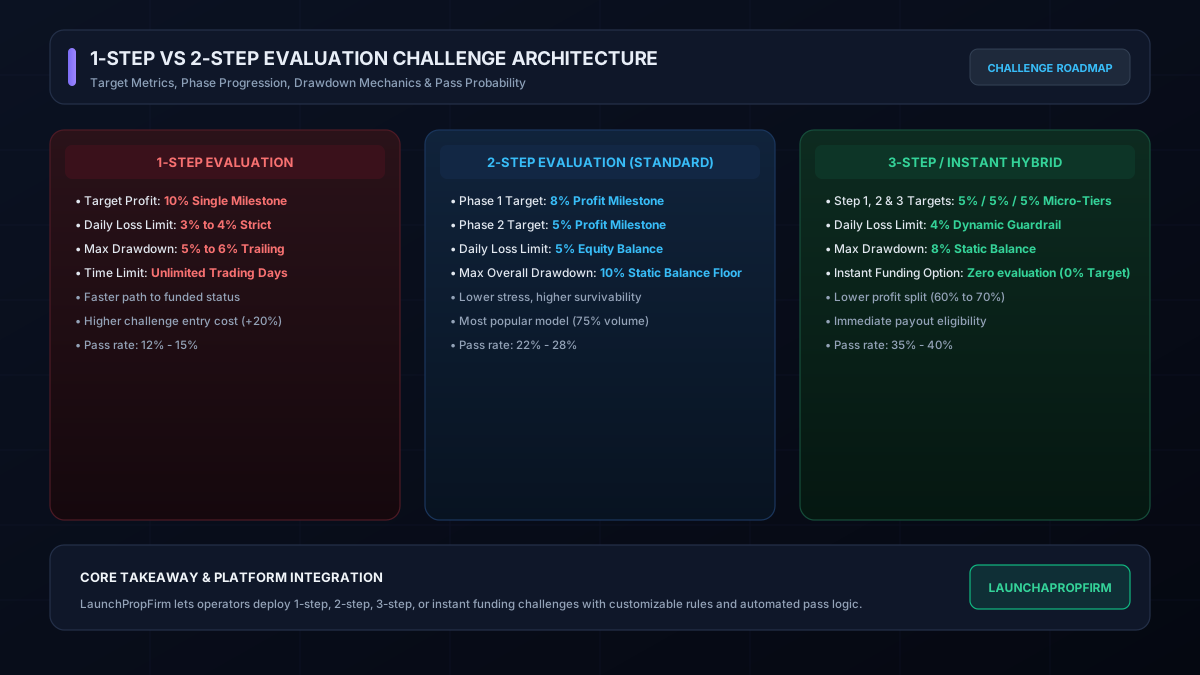
The two-phase challenge is the most common format. Phase one requires hitting an 8% profit target without breaching a 10% max drawdown. Phase two lowers the target to 5% with the same drawdown rules. Both phases typically run on 30-day cycles.
This format gives traders the most time and the clearest structure for demonstrating consistency across a larger sample of trades.
The one-phase challenge condenses everything into a single phase with a slightly higher profit target, usually 10%. The fee is typically lower than a two-phase challenge at the same account size, and the path to funding is faster. Traders who want speed over time choose this format.
Instant funding skips the evaluation entirely. The trader pays a higher upfront fee and starts on a funded account immediately. The profit split starts lower, often 50/50, and scales to 80/20 after proving consistency. This suits traders who are already consistently profitable and prefer to start earning immediately.
Challenge Types Side by Side
| Two-Phase | One-Phase | Instant Funding | |
|---|---|---|---|
| Evaluation phases | 2 | 1 | 0 |
| Profit target | 8% then 5% | 10% | None |
| Max drawdown | 10% | 8-10% | 5-8% |
| Typical fee ($50k account) | $300-$400 | $150-$250 | $500-$800 |
| Time to funded account | 4-8 weeks | 2-4 weeks | Immediate |
| Starting profit split | 80/20 | 80/20 | 50/50 |
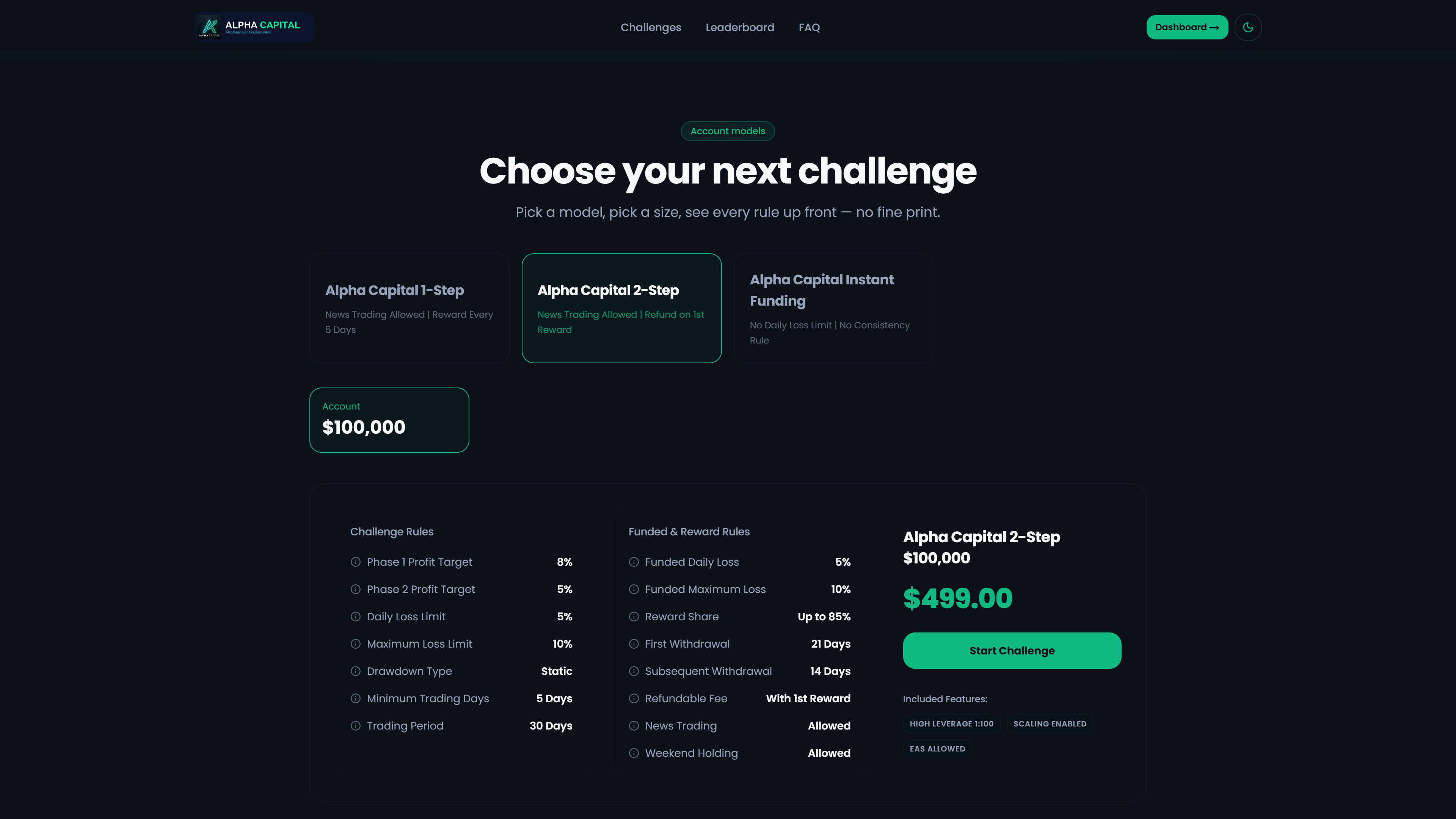
Trader challenge matrix presenting real-time pricing and drawdown parameters across active evaluation tiers.
Skip the monthly fees
Own your prop firm platform outright. One time purchase.
Full source code. Live in 7 days. No revenue share. No monthly SaaS bill. See the exact platform before paying anything.
Demo login: haris / asdf1122. No signup needed
Challenge Fees and How to Reduce Them
Challenge fees are set by account size, not by trading performance. A $25,000 two-phase challenge costs $100 to $200 at most firms. A $100,000 challenge costs $300 to $600.
Some firms refund the fee in the first payout after passing. This makes the challenge effectively free overall if you pass on the first attempt. Confirm the refund policy before purchasing.
Discount codes reduce fees by 10% to 90% during promotional periods. Following the firm's social channels before buying is usually worth a few minutes of checking. You can also see free prop firm challenge for a breakdown of every free and discounted offer type.
You can see exactly how challenges, drawdown tracking, and payout cycles work from the firm side at demo.launchapropfirm.com. LaunchPropFirm is a white-label prop trading platform that operators use to launch funded trader businesses on a one-time fee with full source code and no monthly revenue share.
Which Challenge Type Fits Your Trading Style
Risk Warning: Choosing a challenge type based on the lowest fee rather than your actual trading style increases the probability of failing the evaluation. A one-phase challenge with a 10% target in 30 days suits aggressive intraday traders. Forcing a swing strategy into that window leads to rushed trades that violate the drawdown rules.
Day traders who close all positions before market close are best suited to the two-phase challenge. The longer timeline reduces time pressure and the two-phase structure rewards consistency over a larger sample of trades.
Traders who want speed suit the one-phase challenge. The lower fee and shorter timeline reduce both financial exposure and the psychological weight of a long evaluation period.
Traders who are already consistently profitable and want to start earning immediately suit instant funding. The higher upfront cost is offset by immediate access to a funded account.
Read how to pass a prop firm challenge for the full breakdown on rules, mindset, and session management across all three formats.
Key Rules That Apply to All Challenge Types
Every challenge type has a daily loss limit and a total drawdown limit. Breaching either ends the challenge. Most challenges also require a minimum number of trading days, usually five to ten per phase, regardless of whether the profit target has already been hit.
Turnkey deployment setup wizard enabling rapid 7-day prop firm launch with pre-configured risk templates.
Trailing drawdown is a rule used by some firms where the drawdown floor rises as the account equity peaks. This is more restrictive than static drawdown and affects swing traders who hold positions overnight. Always confirm which drawdown type a firm uses before purchasing.
LaunchPropFirm gives operators full control over challenge structure, including profit targets, drawdown type, phase count, and minimum trading days. Operators on the platform have run all three challenge formats successfully with their own trader communities.
FAQ
What is a prop firm challenge?
A prop firm challenge is a paid evaluation traders take on a simulated account to prove consistent profitability within defined risk limits. Passing earns access to a funded account with the firm's capital, where the trader keeps a percentage of all profits.
How long does a prop firm challenge take?
A two-phase challenge takes four to eight weeks for most traders. A one-phase challenge takes two to four weeks. Instant funding has no evaluation period. The minimum trading day requirement, usually five to ten days per phase, sets the floor regardless of how fast the profit target is hit.
What is the easiest prop firm challenge to pass?
One-phase challenges with a static drawdown rule and no minimum trading day requirement are the most forgiving. Static drawdown fixes the floor at the starting balance, whereas trailing drawdown rises with account equity and reduces room for open positions.
Can you fail a prop firm challenge more than once?
Yes. Most firms allow unlimited repurchases. You lose the fee each time you fail but owe nothing else. Some firms offer free retries after failure or discounted fees for repeat attempts.
What is the difference between a prop firm challenge and instant funding?
A challenge requires passing an evaluation before receiving a funded account. Instant funding skips the evaluation and gives immediate access to a funded account at a higher upfront cost and a lower starting profit split. Challenges have lower upfront fees; instant funding has faster access.
Evaluate Your Prop Firm Readiness Score (0-100)
Answer 5 quick operational questions about your acquisition channels, runway, and engine tech to get a personalized launch roadmap.

M.Haris
Founder & Platform ArchitectBuilding open prop trading software infrastructure for operators worldwide
I built LaunchPropFirm to give forex educators, trading communities, and fintech operators complete ownership of their platform with full source code and zero monthly SaaS rent. Every article on this blog is drawn from hands-on platform development, live MT5 risk bridge mechanics, and real operator economics.
All content, financial models, ROI estimates, and architecture guides on LaunchPropFirm are published strictly for educational and informational purposes. LaunchPropFirm provides institutional prop trading software and technology infrastructure; it does not operate as a broker, custodian, or registered investment advisor.
Evaluation challenges and funded trader accounts referenced in this guide operate in simulated demo trading environments using real-time market data feeds. Simulated trading results do not represent actual trading performance or financial advice.
Recommended Next Reads
Hand-picked operator guides to scale your prop trading platform.
Prop Firm Passing Services: The Scam, IP Traps & Ban Reality
Prop firm passing services promise guaranteed challenge passes, but 99% get banned before payouts. Exposing syndicate IP radar and broker latency traps.
Congrats on Being a Funded Trader: First 48-Hour Protocol
Received the 'congrats on being a funded trader' email? Here is the exact survival protocol for KYC verification, contract signing, and your first payout.
Skip the monthly fees
Own your prop firm platform outright. One time purchase.
Full source code. Live in 7 days. No revenue share. No monthly SaaS bill. See the exact platform before paying anything.
Demo login: haris / asdf1122. No signup needed