Prop Firm KYC: Verify Traders Compliantly
Prop firms need KYC to verify traders and prevent fraud. Here is how KYC works for prop firm operators, what documents to collect, and which tools handle it.
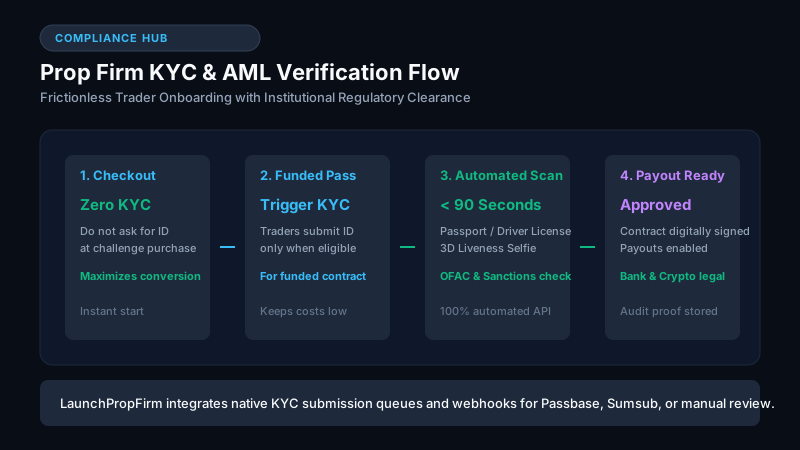
Why Prop Firms Need KYC
When I started thinking about KYC for a prop firm, I assumed it was only for banks. Then I saw what happens with chargebacks. A trader buys a $500 challenge, passes, gets paid, then files a chargeback claiming they never made the purchase. No KYC, no verification on file. Nothing to contest it with.
That is a $1,100 lesson: the challenge fee plus the payout already sent. Here is what you actually need to know about KYC before you launch.
Prop firms handle real money: challenge fees in, payouts out. Even if you are not a regulated broker, you have three practical reasons to verify your traders. First, chargebacks: card networks side with the cardholder when there is no identity verification on file. Second, fraud rings: organized groups buy challenges with stolen cards, pass with bots, and collect payouts before anyone notices. Third, payout compliance: payment processors like Wise, Payoneer, and Deel require identity verification before releasing funds above certain thresholds.
You do not need to run AML checks like a bank. You need enough verification to defend a chargeback and to confirm your payout recipient is a real person.
When to Collect KYC
There are two points where operators typically collect verification data.
At payout only. Many prop firms skip verification at purchase and only collect it when a trader requests their first withdrawal. This reduces friction at signup and challenge purchase. The downside is that fraud has already happened by the time you ask for ID.
At signup. Collect ID before the trader can start a challenge. This blocks fraud rings before they get in but adds friction that can reduce conversion by 10-20% depending on your audience.
The middle path most operators land on: collect email and basic info at purchase, then require full ID verification before the first payout is processed. This balances conversion rate against fraud exposure.
What Documents to Collect
For a standard prop firm, you need three things from each trader.
Government-issued photo ID (passport, national ID, or driver's license). Proof of address (a utility bill or bank statement dated within 3 months). And a selfie or liveness check, to confirm the person in the photos matches the documents being submitted.
For higher payout amounts above $5,000, add a source of funds declaration. Most traders will not dispute this if you frame it as standard payout processing rather than an interrogation.
Skip the monthly fees
Own your prop firm platform outright. One time purchase.
Full source code. Live in 7 days. No revenue share. No monthly SaaS bill. See the exact platform before paying anything.
Demo login: haris / asdf1122. No signup needed
KYC Tools Comparison
You do not need to build this yourself. Several verification platforms offer per-check pricing that works for prop firm volumes.
| Tool | Cost per Check | Liveness Check | API Available | Best For |
|---|---|---|---|---|
| Sumsub | $1.50-3.00 | Yes | Yes | Volume operators |
| Veriff | $2.00-4.00 | Yes | Yes | High accuracy |
| Onfido | $1.00-2.50 | Yes | Yes | Enterprise |
| Persona | $0.50-2.00 | Yes | Yes | Startups |
| Manual (email) | $0 | No | No | Under 50 payouts/month |
At launch, manual email verification is fine. You ask for a passport photo and selfie, store them securely, and verify by eye. Once you hit 100+ payouts per month, switch to an automated tool.
How KYC Fits Into the LaunchPropFirm Platform
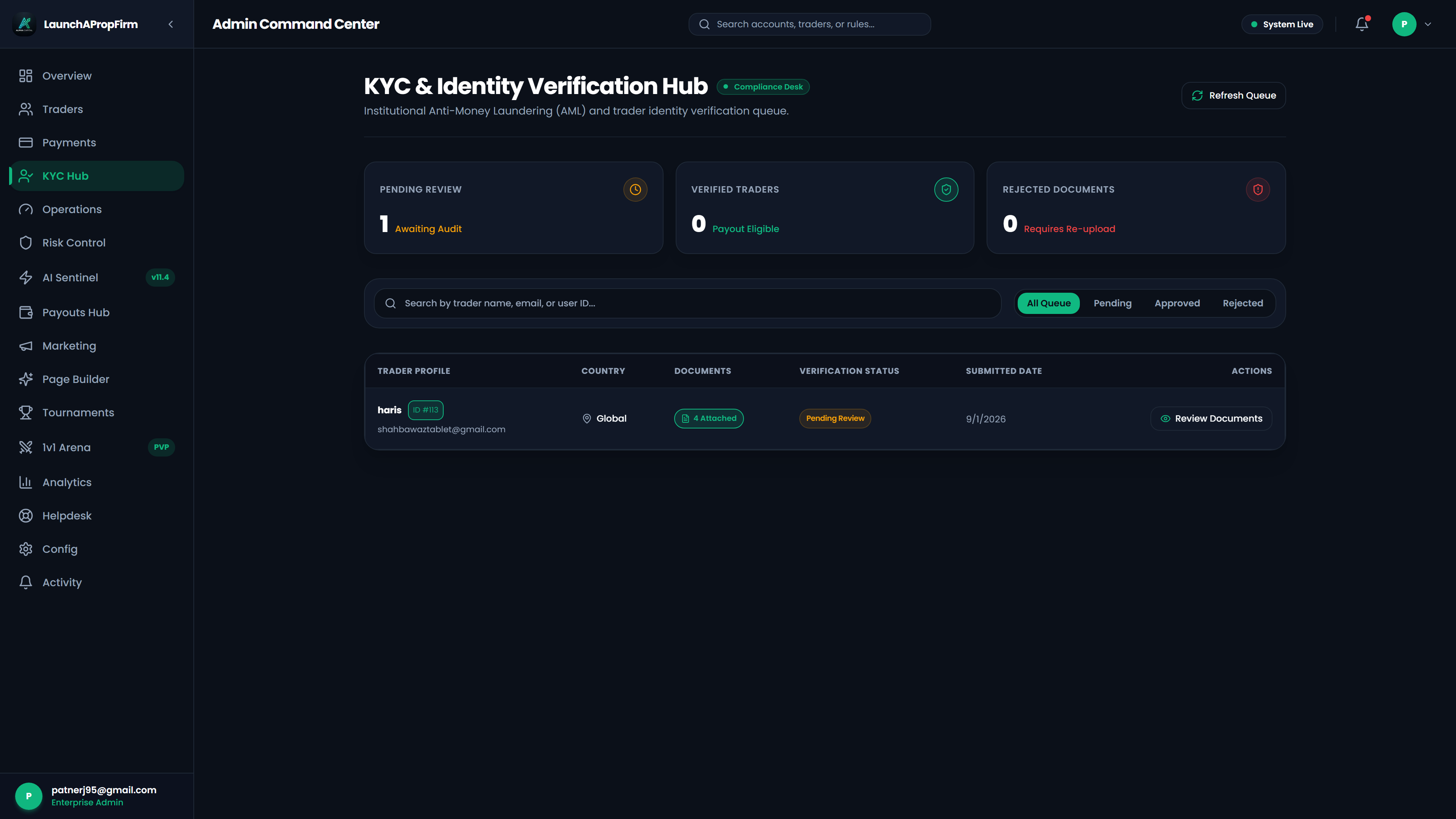
LaunchPropFirm builds the challenge system, dashboard, and payout center. The platform does not include a built-in KYC module because KYC requirements vary by country and risk appetite. Instead, you integrate one of the tools above via webhook.
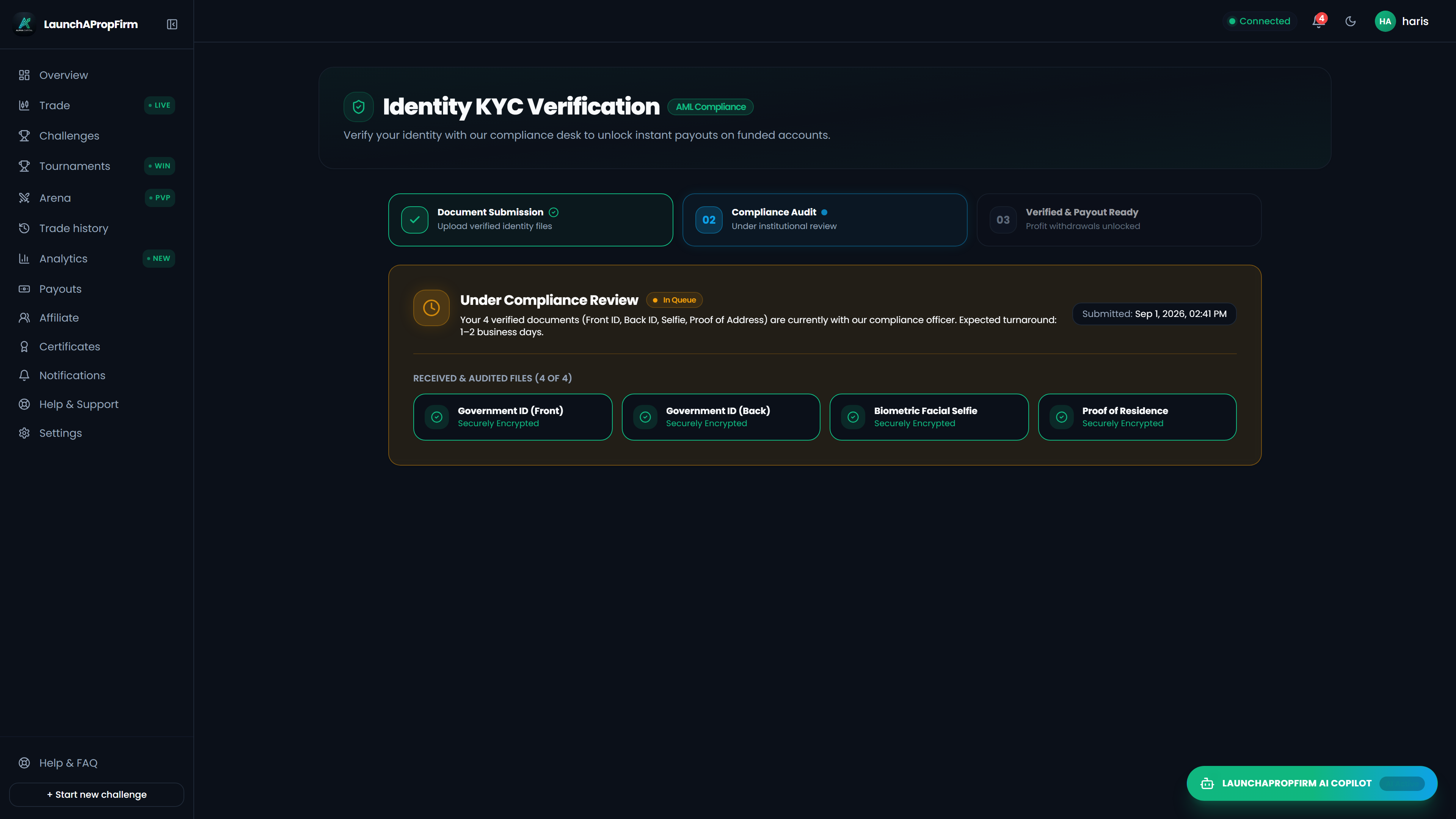
Trader identity verification portal displaying submitted identity documents and automated compliance approval status.
The flow looks like this: trader completes challenge, requests payout, system triggers a KYC webhook to Sumsub (or whichever tool you chose), trader completes verification in their browser, and the payout gets released once the tool returns an approved status. The whole process takes under 5 minutes for a trader with their documents ready.
If you are on the Source Code plan at $2,500 one-time, you get full access to the webhook layer to wire this in yourself. The Launch Ready plan at $4,500 includes implementation support.
See the full platform at launchapropfirm.com or test the trader dashboard at demo.launchapropfirm.com.
Common KYC Mistakes Operators Make
Storing documents in email or Google Drive is the most common one. If a trader disputes a chargeback, you need identity verification on file in a way that satisfies the card network's dispute process. Unsecured email storage does not meet that standard.
Not setting a payout threshold for KYC. Some operators skip verification on small payouts under $200 to reduce friction. This is reasonable as long as it is written into your terms and consistently applied.
Using trader identity data for marketing is the third mistake. GDPR and similar laws restrict how you can use identity data. Collect it only for verification and fraud prevention, and say so explicitly in your privacy policy.
Related reading: Prop Firm Payment Methods: Stripe, Crypto, and Gateways That Work
Operator Tip: Require KYC before the first payout, not at signup. You will lose fewer trial users while still protecting yourself from the fraud that actually hurts: funded account abuse.
FAQ
Do prop firms legally require KYC?
Not as a matter of law in most jurisdictions. Prop firms are not regulated as financial institutions in most countries. But payment processors and payout platforms will require it above certain thresholds, and it is your best defense against chargebacks.
What happens if I skip KYC entirely?
You can operate without it at low volume. The risk is organized fraud: groups that buy challenges with stolen cards and collect payouts before cards are reported. At scale, this can cost more than a KYC tool.
Can I build KYC into a Next.js prop firm site?
Yes. You embed the KYC tool's JavaScript SDK into your payout flow. Most modern tools like Sumsub, Persona, and Veriff have SDKs that work inside a React or Next.js page without a page reload.
How long does KYC take for traders?
With an automated tool, 2-5 minutes if they have a clear photo ID and camera access. Manual email-based review takes 24-48 hours depending on your team's schedule.
Does LaunchPropFirm include KYC?
The platform includes the webhook infrastructure to connect any KYC tool. It does not include a bundled KYC module because requirements differ by operator and country. Implementation typically takes one day to configure.
Model Your Firm's Monthly Cash Flow & Profit
Simulate challenger intake, pass rate payout reserves, and net operator margins with our free real-time economic calculator.
Prop Firm Monthly Profit Simulator
Simulate your challenge revenue, payout liability, and net monthly take-home profit.
$20,000
From upfront challenge fees-$2,800
~10 funded payouts budgeted$0 / month
Saves $3,000/mo vs SaaS$17,200/mo
Run-rate: $206,400/yr
M.Haris
Founder & Platform ArchitectBuilding open prop trading software infrastructure for operators worldwide
I built LaunchPropFirm to give forex educators, trading communities, and fintech operators complete ownership of their platform with full source code and zero monthly SaaS rent. Every article on this blog is drawn from hands-on platform development, live MT5 risk bridge mechanics, and real operator economics.
All content, financial models, ROI estimates, and architecture guides on LaunchPropFirm are published strictly for educational and informational purposes. LaunchPropFirm provides institutional prop trading software and technology infrastructure; it does not operate as a broker, custodian, or registered investment advisor.
Evaluation challenges and funded trader accounts referenced in this guide operate in simulated demo trading environments using real-time market data feeds. Simulated trading results do not represent actual trading performance or financial advice.
Recommended Next Reads
Hand-picked operator guides to scale your prop trading platform.
Wise Prop Firms: Payouts, Risks and Rails
Explore why direct Wise prop firms payouts trigger account freezes, how Rise compliance bridges protect funds, and why multi-rail payouts guarantee cash flow.
Prop Firm Capital: Requirements, Reserve Buffers and Risk Architecture
Unpack the financial reality of prop firm capital: synthetic exposure vs liquid reserves, challenge fee pool economics, A-Book STP hedging, and exact startup blueprints.
Skip the monthly fees
Own your prop firm platform outright. One time purchase.
Full source code. Live in 7 days. No revenue share. No monthly SaaS bill. See the exact platform before paying anything.
Demo login: haris / asdf1122. No signup needed