Prop Firm Copy Trading Rules (2026 Guide)
Learn how prop firm copy trading rules work in 2026. Understand account-to-account mirroring, reverse copy trading bans, and automated risk engine detection.
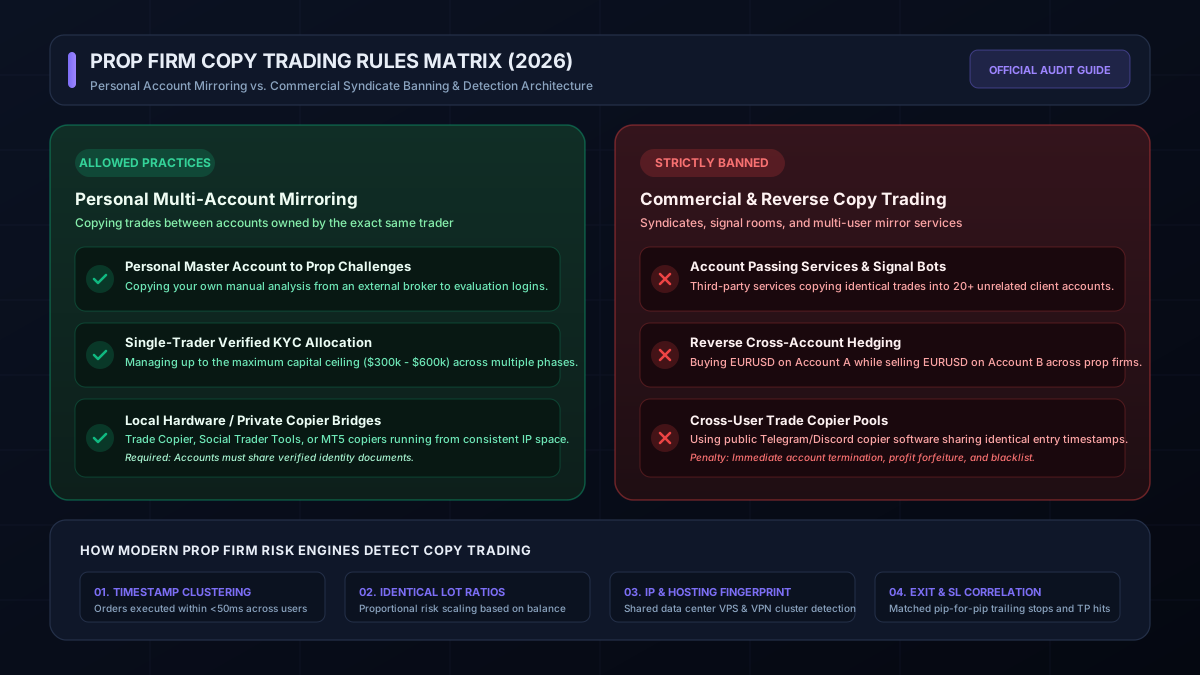
Prop firm copy trading rules define how traders can replicate positions between different accounts and whether external trade copiers are allowed. Most modern prop firms allow you to copy trades between multiple accounts that you personally own. Every evaluation firm strictly bans commercial account passing, public signal copying, and reverse arbitrage syndicates.
Understanding these policies protects your capital and prevents unexpected account terminations. While retail brokerages often permit unrestricted trade mirroring, proprietary trading platforms enforce strict risk monitoring. Automated trade engines track entry timestamps, lot allocations, and IP routing to distinguish genuine manual diversification from organized account passing operations.
What Are Prop Firm Copy Trading Rules?
Prop firm copy trading rules govern the software tools and execution methods traders use to mirror orders across multiple accounts. These regulations specify whether you can connect a master trading terminal to slave accounts using local trade copiers, cloud bridges, or social trading networks. Evaluation firms establish these boundaries to ensure that each funded trader possesses genuine risk management skills rather than relying on automated pass syndicates.
In the retail prop industry, firms manage substantial simulated and live capital exposure across thousands of active users. When hundreds of traders copy identical orders from a single external signal provider, the firm faces concentrated systemic risk on a single market move. For instance, if a public Telegram channel triggers a fifty-lot long position on gold across three hundred accounts, a sudden reversal could create millions of dollars in drawdown within seconds.
Firms separate trade copying into two distinct categories: personal account mirroring and commercial third-party copying. Personal copying involves replicating your own proprietary strategy across accounts registered under your verified legal name. Commercial copying involves following external signals, joining account passing syndicates, or letting an unauthorized manager trade on your behalf.
Review our guide on prop firm challenge systems to understand how evaluation stages evaluate trading consistency. You can also explore how prop firm risk management audits real-time trader exposures across connected terminals.
Personal Account Copying vs Commercial Pass Syndicates
Personal account copying allows a verified trader to execute orders on one master terminal and automatically distribute those trades across multiple challenges. Prop firms permit this practice because the trading decisions, risk parameters, and strategy originate from the account owner. A trader managing three separate hundred-thousand-dollar accounts can trade a single chart while keeping total position sizing proportional to each balance.
Commercial pass syndicates operate on an entirely different business model designed to exploit evaluation rules. In a commercial syndicate, an external manager collects challenge credentials from dozens of retail clients. The syndicate uses high-speed cloud copiers to replicate identical trades across all client accounts simultaneously, charging upfront fees or taking an unapproved percentage of trader payouts.
Prop firms universally ban commercial syndicates because they violate the core intent of the evaluation model. Proprietary firms seek disciplined individuals who can manage risk over extended market cycles. When an unverified third party passes an account using automated tools, the registered client rarely possesses the emotional discipline required to maintain a funded account.
The table below contrasts legitimate personal account mirroring with prohibited commercial copying practices across the evaluation industry.
| Execution Feature | Personal Account Mirroring | Commercial Pass Syndicates |
|---|---|---|
| Account Ownership | Same legal individual across all logins | Unrelated third-party retail clients |
| KYC Verification | Matching government ID and proof of address | Mismatched identities managed by one operator |
| IP & Network Origin | Consistent residential IP or private VPS | Shared data center hosting clusters |
| Signal Source | Trader's own manual or algorithmic analysis | Centralized master signal or Telegram room |
| Firm Policy Status | Widely allowed up to capital limits | Strictly banned with zero payout eligibility |
| Risk Engine Flag | Clean single-user cluster profile | High-risk millisecond timestamp collision |
Why Prop Trading Firms Restrict Copy Trading
Prop trading firms restrict copy trading to eliminate unhedged liquidity risk and prevent market manipulation schemes. When thousands of traders mirror identical oversized orders, the firm cannot accurately manage its capital reserves or route volume to liquidity partners. If an evaluation firm passes order flow to institutional clearing houses in London or New York, clustered copy trades cause severe slippage and execution rejection.
Another major threat is cross-firm reverse arbitrage. In this scheme, a syndicate opens opposing maximum-volume trades on two different prop firms minutes before high-impact economic news. Account A buys EURUSD on Firm 1, while Account B sells EURUSD on Firm 2. One account inevitably fails, but the winning account captures massive profit, extracting payouts while exploiting simulated demo execution.
Firms also enforce copy rules to uphold regulatory standards. Financial authorities in Cyprus, Dubai, and European jurisdictions require commercial platforms to maintain strict anti-money laundering and account custody safeguards. Allowing unverified entities to trade client accounts undermines these regulatory frameworks and exposes the firm to legal sanctions.
Review our analysis of prop firm news trading rules to see how news straddling restrictions combat latency abuse. You can also examine our guide on prop firm weekend holding rules to protect your positions across market closures.
Skip the monthly fees
Own your prop firm platform outright. One time purchase.
Full source code. Live in 7 days. No revenue share. No monthly SaaS bill. See the exact platform before paying anything.
Demo login: haris / asdf1122. No signup needed
How Automated Risk Engines Detect Copy Trading
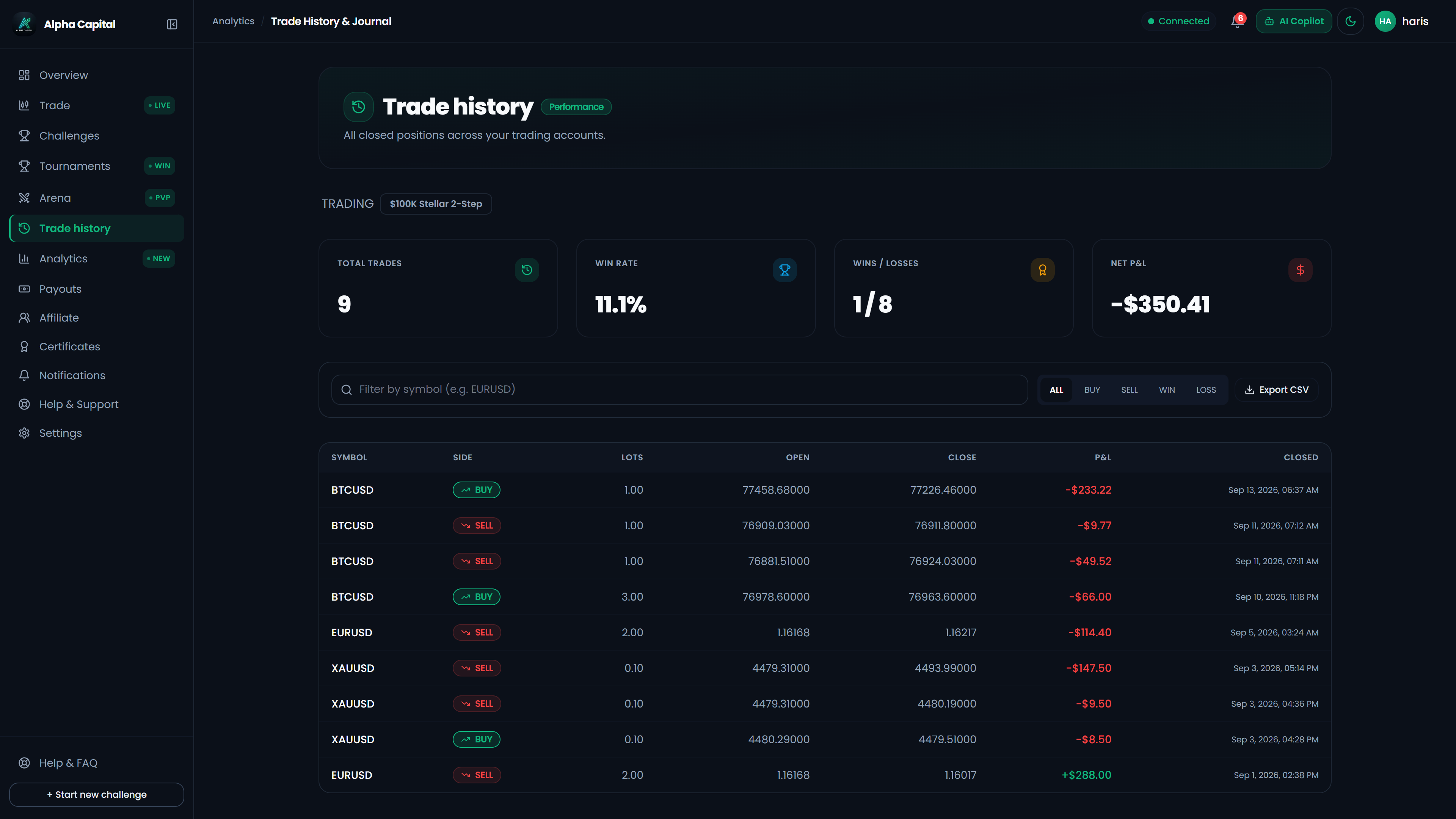
Modern prop firm trading engines use automated surveillance algorithms that monitor execution metrics across every active login. Rather than relying on manual account inspections, the platform analyzes tick-level database logs to identify matching execution patterns. Even if traders use different lot sizes, the underlying mathematical signatures reveal automated replication immediately.
Timestamp clustering serves as the primary detection mechanism. When a master account dispatches a market order, connected copiers execute slave orders within ten to fifty milliseconds of each other. While two unrelated traders might occasionally enter the same asset on the same minute, they will never match entries within twenty milliseconds across fifteen consecutive trades.
Risk engines also analyze lot size proportionality and stop-loss placement. If three accounts with balances of twenty-five thousand, fifty thousand, and one hundred thousand dollars enter trades with exactly 0.25, 0.50, and 1.00 lots respectively, the system flags a proportional multiplier copier. When entry prices, stop-loss distances, and take-profit targets match pip-for-pip across unrelated accounts, the algorithm issues an automated breach alert.
Network infrastructure monitoring provides the final confirmation layer. The platform inspects IP subnets, device MAC hashes, and browser fingerprints associated with trade execution. If multiple accounts connect from the exact same commercial VPS facility in Frankfurt or London, the firm links those logins to an account passing syndicate.
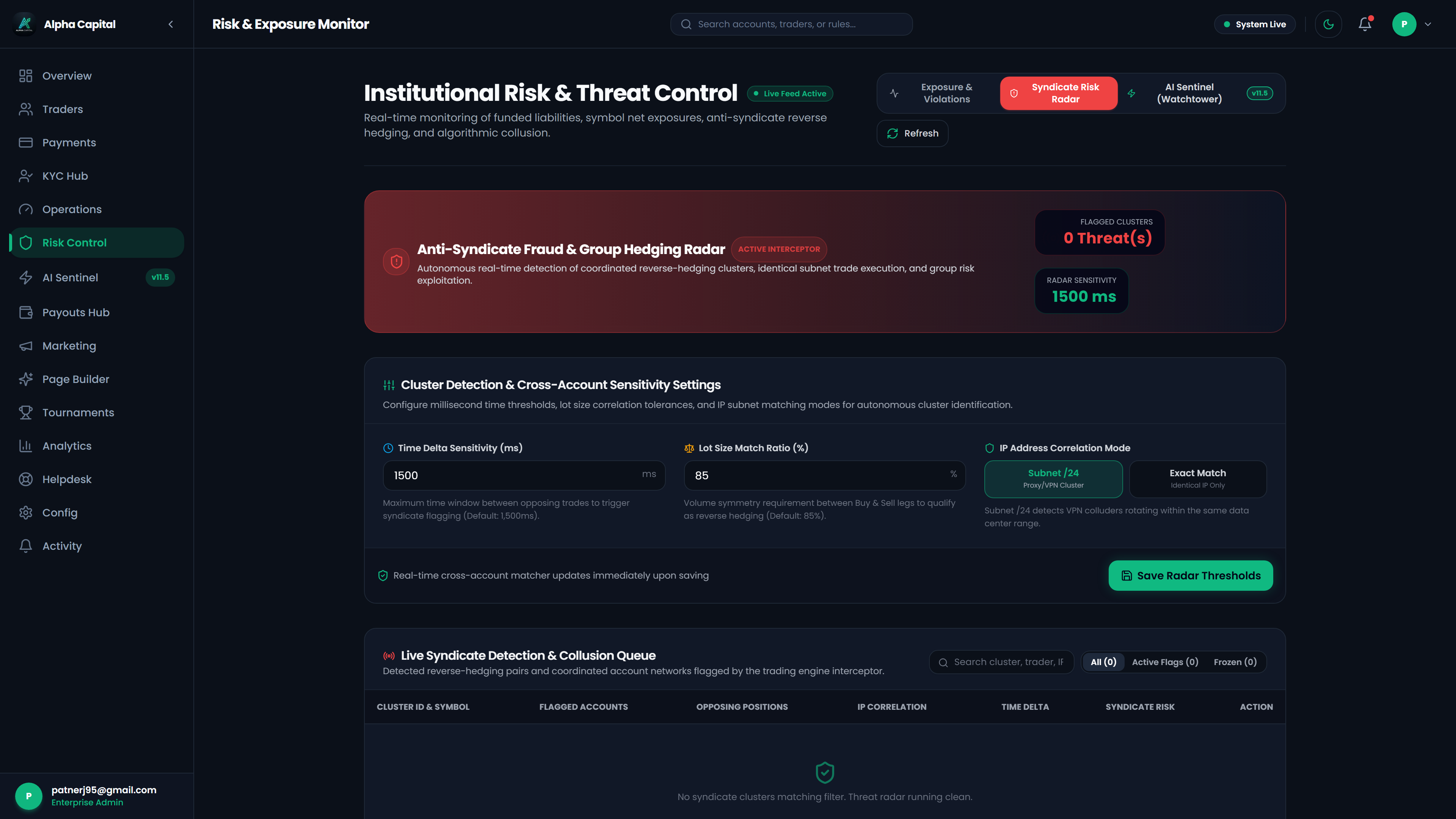
Operator Tip: Institutional trading platforms like LaunchPropFirm include automated correlation detectors that group matching orders in real time. Operators can configure custom tolerance windows to permit verified personal copiers while automatically suspending commercial syndicates.
Best Practices for Legitimate Multi-Account Mirroring
Traders who copy trades across personal accounts must follow strict operational procedures to avoid false compliance flags. Following these guidelines ensures that your execution history reflects legitimate multi-account portfolio management rather than unauthorized pass activity.
- Verify all accounts under the exact same legal name before deploying a trade copier.
- Use a dedicated residential connection or private personal VPS rather than public cloud servers.
- Keep your total combined capital within the firm's published maximum allocation limits.
- Avoid public commercial signal feeds that broadcast identical trades to hundreds of subscribers.
- Maintain trade logs and execution records in case compliance teams request proof of manual origin.
- Inform customer support in advance if you plan to mirror positions across multiple challenge accounts.
Review our guide on prop firm IP address rules to configure clean network settings for your trading setup. You can also study the prop firm consistency rule to ensure your lot size distributions remain fully compliant.
Major Prop Firm Copy Trading Policies Compared
Copy trading rules vary across prop firms, making it essential to review platform-specific rulebooks before connecting external software. While some firms welcome personal trade mirroring, others prohibit any form of automated copier integration.
FundedNext permits copy trading between accounts owned by the same trader, provided the total capital does not exceed their maximum funding cap. However, they strictly prohibit copying trades from external individuals, signal services, or account management pools. Any detection of cross-trader trade mirroring results in immediate disqualification.
FTMO allows traders to use trade copiers across their own personal FTMO accounts. They state that the trading strategy must belong to the individual account holder. Copying positions from other traders, public Expert Advisors with identical default settings, or commercial pass services is categorized as prohibited trading behavior.
Funding Pips enables personal trade copying across evaluation accounts registered to the same user profile. They enforce strict surveillance against reverse hedging and multi-account latency arbitrage. Accounts found sharing identical trades with unrelated users are permanently banned without refund.
Topstep enforces dedicated rules for its futures evaluation platform, allowing traders to trade multiple Express Funded Accounts simultaneously. They allow internal trade copiers built into supported platforms like NinjaTrader and Tradovate, provided all accounts belong to the same verified individual.
The table below outlines current copy trading policies across leading proprietary trading providers in 2026.
| Prop Trading Provider | Personal Account Copying | External Signal Services | Reverse Arbitrage | Max Allocation Cap |
|---|---|---|---|---|
| FundedNext | Permitted | Prohibited | Prohibited | $300,000 |
| FTMO | Permitted | Prohibited | Prohibited | $400,000 |
| Funding Pips | Permitted | Prohibited | Prohibited | $300,000 |
| Topstep | Permitted | Prohibited | Prohibited | $150,000 |
| The 5%ers | Permitted | Prohibited | Prohibited | $640,000 |
| LaunchPropFirm Engine | Operator Configured | Flagged by Engine | Auto Blocked | Unlimited |
FAQ
Can I copy trades from my personal broker account to a prop firm?
Yes, most major prop trading firms allow you to copy trades from your personal brokerage account to your evaluation challenges. The critical requirement is that you own both accounts and execute your own proprietary strategy. If compliance requests verification, you may be asked to provide statements proving ownership of the master brokerage account.
Will I get banned if someone else takes the exact same trade as me?
No, prop firm risk engines do not ban accounts based on occasional coincidental entries. Thousands of technical traders enter positions at common support and resistance levels, moving averages, or psychological round numbers. Risk algorithms look for continuous, millisecond-level timestamp correlations and identical lot multipliers across dozens of trades before issuing a violation.
Can I use a trade copier on MT4 and MT5 prop accounts?
Yes, you can use local software trade copiers to replicate orders between MetaTrader 4 and MetaTrader 5 accounts. Popular commercial utilities like Local Trade Copier and Social Trader Tools run smoothly on Windows computers and private virtual servers. Always ensure that the software operates locally on your machine rather than through a shared public server.
What is reverse copy trading in prop firms?
Reverse copy trading is an abusive scheme where a trader opens opposing positions across two different prop firm accounts. The trader buys an asset on Account A and sells the identical asset on Account B with oversized position sizing. While one account fails, the opposite account captures outsized profit, exploiting demo execution to secure a payout without genuine trading risk.
How do prop firms catch account passing services?
Prop firms catch account passing services by identifying identical entry timestamps, shared IP address blocks, and synchronized execution clusters. When an account management service trades for multiple clients, their copier triggers orders across all accounts within milliseconds. Automated risk engines flag these clusters instantly, prompting compliance teams to freeze payouts and terminate accounts.
Can two family members copy each other's prop firm trades?
No, two different individuals cannot copy each other's trades, even if they live in the same household or share a residential internet connection. Evaluation rules mandate that every account holder must trade independently. If two family members execute identical trades, the risk engine will flag the activity as unauthorized copy trading or account sharing.
Evaluate Your Prop Firm Readiness Score (0-100)
Answer 5 quick operational questions about your acquisition channels, runway, and engine tech to get a personalized launch roadmap.
Prop Firm Monthly Profit Simulator
Simulate your challenge revenue, payout liability, and net monthly take-home profit.
$20,000
From upfront challenge fees-$2,800
~10 funded payouts budgeted$0 / month
Saves $3,000/mo vs SaaS$17,200/mo
Run-rate: $206,400/yr
M.Haris
Founder & Platform ArchitectBuilding open prop trading software infrastructure for operators worldwide
I built LaunchPropFirm to give forex educators, trading communities, and fintech operators complete ownership of their platform with full source code and zero monthly SaaS rent. Every article on this blog is drawn from hands-on platform development, live MT5 risk bridge mechanics, and real operator economics.
All content, financial models, ROI estimates, and architecture guides on LaunchPropFirm are published strictly for educational and informational purposes. LaunchPropFirm provides institutional prop trading software and technology infrastructure; it does not operate as a broker, custodian, or registered investment advisor.
Evaluation challenges and funded trader accounts referenced in this guide operate in simulated demo trading environments using real-time market data feeds. Simulated trading results do not represent actual trading performance or financial advice.
Recommended Next Reads
Hand-picked operator guides to scale your prop trading platform.
TradingView Prop Firms (2026): Best Web Terminals
Complete 2026 guide to TradingView prop firms. Compare top firms offering browser TradingView charts, execution latency, and funded account rules.
Funding Pips Account Sizes and Prices 2026: Evaluation Tiers, Rules, and Scaling Plan
Complete 2026 Funding Pips account sizes and prices guide. Compare challenge fees ($5k to $100k), 2-step evaluation rules, drawdown limits, and the $2M scaling plan.
Skip the monthly fees
Own your prop firm platform outright. One time purchase.
Full source code. Live in 7 days. No revenue share. No monthly SaaS bill. See the exact platform before paying anything.
Demo login: haris / asdf1122. No signup needed