Prop Firm Hedging Rules (2026 Guide)
Learn exact prop firm hedging rules for 2026. Understand same-account hedging, banned cross-firm trades, latency arbitrage, and how operators enforce limits.
Hedging remains one of the most debated trading strategies in the proprietary evaluation industry. Many retail traders use hedging on standard broker accounts to manage risk during choppy market sessions. When transitioning to funded challenges, traders often discover that prop firm hedging rules differ drastically from retail brokerage policies.
Understanding what is allowed and what triggers an immediate account ban is essential before risking evaluation fees. This guide covers how prop firms treat offsetting positions, why certain hedging strategies trigger fraud detection, and how risk engines monitor trades.
How Hedging Works in Prop Trading
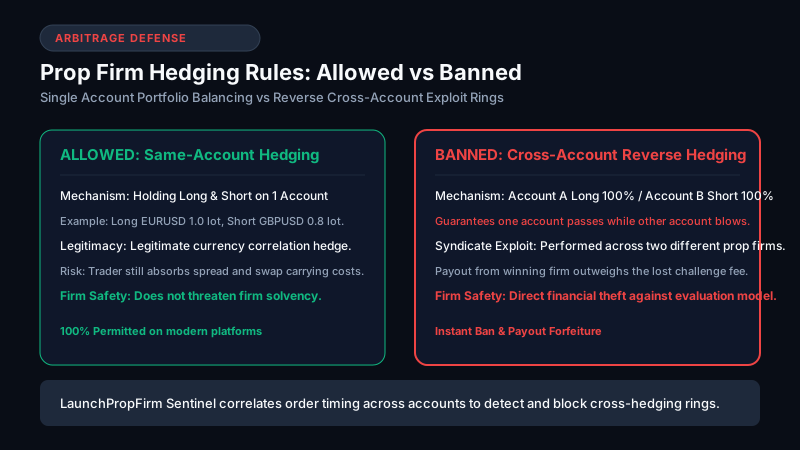
Hedging in financial markets involves opening two or more positions to offset adverse price swings. In a standard retail forex account, a trader might buy one lot of EURUSD and simultaneously sell one lot of EURUSD on the same ticket. This freezes floating profit and loss, allowing the trader to navigate volatile market events without closing trades.
Proprietary trading firms operate simulated accounts against real market feeds. Because evaluation firms evaluate risk management discipline, their treatment of hedging focuses on intent. If a trader uses hedging as an orderly risk mitigation tactic on a single account, most firms allow it.
Problems arise when traders attempt multi-account hedging to game evaluation metrics. When two opposite trades are split across two accounts, one account passes while the other blows up. Evaluation firms view this behavior as malicious exploitation rather than legitimate trading skill.
You can read our breakdown of prop firm drawdown rules to understand how firms calculate equity dips during active positions.
Three Types of Prop Firm Hedging
Prop firms classify hedging into three distinct technical categories. Each category carries a different level of regulatory scrutiny and enforcement.
1. Same Account Intra-Day Hedging
Same-account hedging occurs when you hold long and short positions on the identical instrument inside one single account. A trader holding a long swing position on GBPUSD might open a short scalp position on a 5-minute chart to capture a quick retracement.
Most major evaluation firms allow this practice on MT5 and modern web terminals. It does not exploit firm capital or bypass drawdown limits. The total floating drawdown of both positions continues to count toward your daily loss limit.
2. Cross Account Reverse Hedging
Cross-account reverse hedging involves opening opposing high-volume trades on two distinct accounts. For example, a trader buys 10 lots of NASDAQ on Account A and sells 10 lots of NASDAQ on Account B seconds before a high-impact news release.
One account fails its maximum drawdown rule within minutes. The other account hits its profit target and advances to funded status. This is considered capital gaming because the trader eliminates market risk while shifting 100% of the financial downside onto the prop firm.
Risk Warning: Hedging opposite positions between two distinct evaluation accounts will lead to instant account termination and payout forfeiture across both firms.
3. Coordinated Group Hedging
Group hedging happens when multiple traders pool capital or follow signal rooms to execute coordinated opposite positions. Five members of a Discord group buy Gold while five other members sell Gold with maximum position sizing.
The winning traders split payouts with the losing traders, creating a synthetic risk-free arbitrage ring. Proprietary firms deploy telemetry filters that match order entry timestamps and IP addresses across accounts to stop this practice.
Check our detailed guide on prop firm IP address rules to see how multi-accounting and proxy networks get detected by risk monitors.
Hedging Rules Across Major Prop Firms
Different proprietary firms enforce distinct rule sets for offsetting trades. The table below summarizes current hedging permissions across leading firms in 2026.
| Prop Trading Firm | Same-Account Hedging | Cross-Account Hedging | News Event Hedging | Weekend Holding |
|---|---|---|---|---|
| FTMO | Allowed | Strictly Banned | Allowed (Swing Acct) | Allowed (Swing) |
| FundedNext | Allowed | Strictly Banned | Restricted on News | Allowed |
| AlphaCapital | Allowed | Strictly Banned | Allowed | Allowed |
| 5%ers | Allowed | Strictly Banned | Restricted | Allowed |
| Topstep (Futures) | Prohibited (FIFO Rules) | Strictly Banned | Restricted | Banned on Daily Close |
US-based futures evaluation firms like Topstep enforce strict First-In, First-Out (FIFO) compliance mandated by the NFA and CFTC. On futures platforms, opening an opposing contract automatically closes your existing position rather than hedging it.
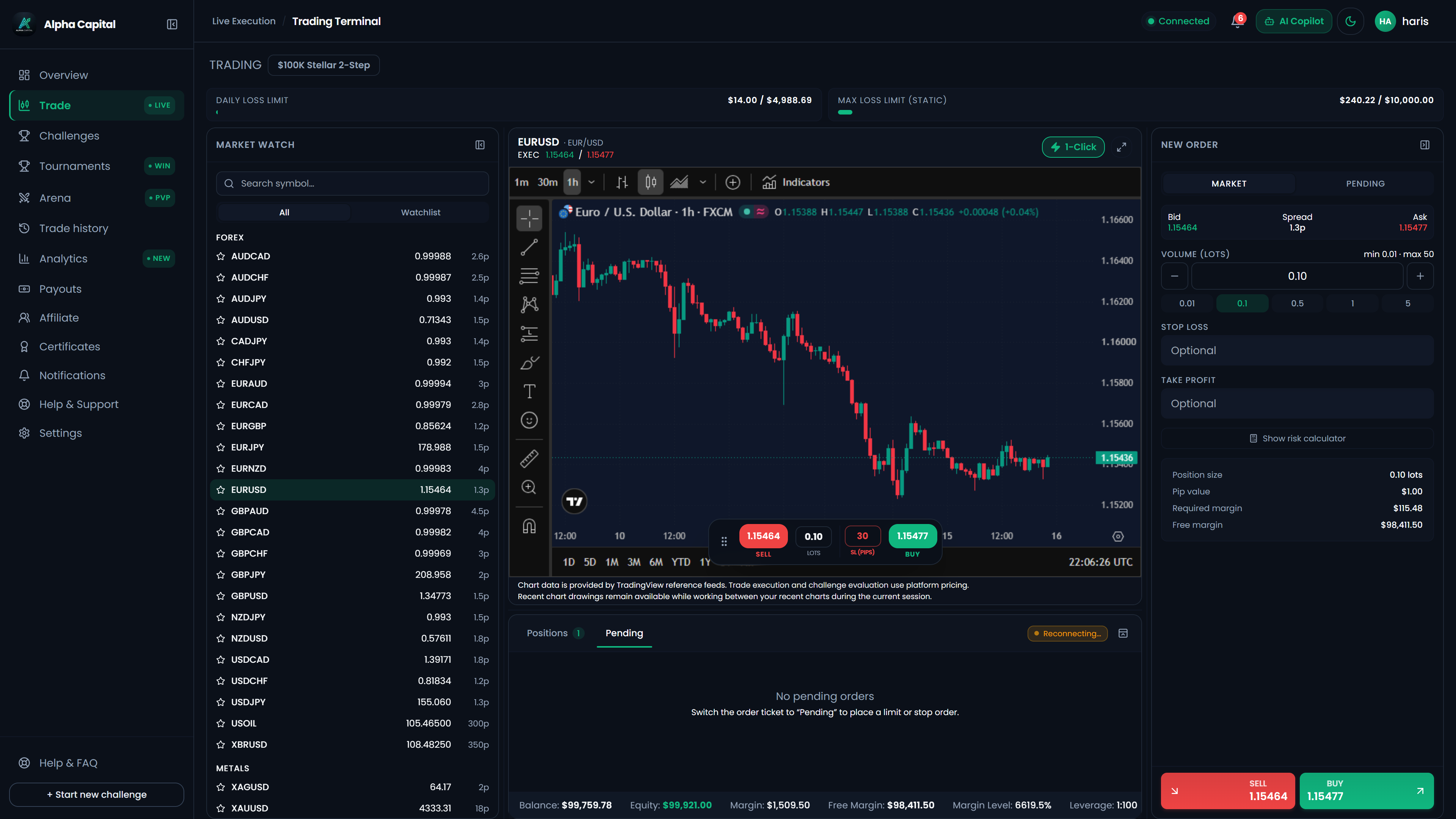
On forex and CFD evaluation platforms, same-account hedging is widely supported as long as positions comply with overall margin limits.
Skip the monthly fees
Own your prop firm platform outright. One time purchase.
Full source code. Live in 7 days. No revenue share. No monthly SaaS bill. See the exact platform before paying anything.
Demo login: haris / asdf1122. No signup needed
Why Cross Firm Hedging Gets You Banned
Cross firm hedging is considered financial fraud in the evaluation industry. When traders buy an evaluation account at Firm A and a matching account at Firm B, they attempt a zero-risk arbitrage.
Evaluation firms do not operate as charity pools. Each firm sells access to evaluation infrastructure, server capacity, and real-time MT5 pricing data. When an operator detects reverse trading between platforms, both accounts get flagged and closed without refunds.
Firm compliance teams share blacklist data through anti-fraud consortiums. If your name, KYC documentation, or payout wallet gets flagged for cross-account hedging, you risk getting blacklisted across dozens of evaluation providers simultaneously.
Review our breakdown of prop firm news trading rules and prop firm weekend holding rules to see how news straddling and gap risk are handled by institutional risk engines.
How LaunchPropFirm Detects Reverse Hedging
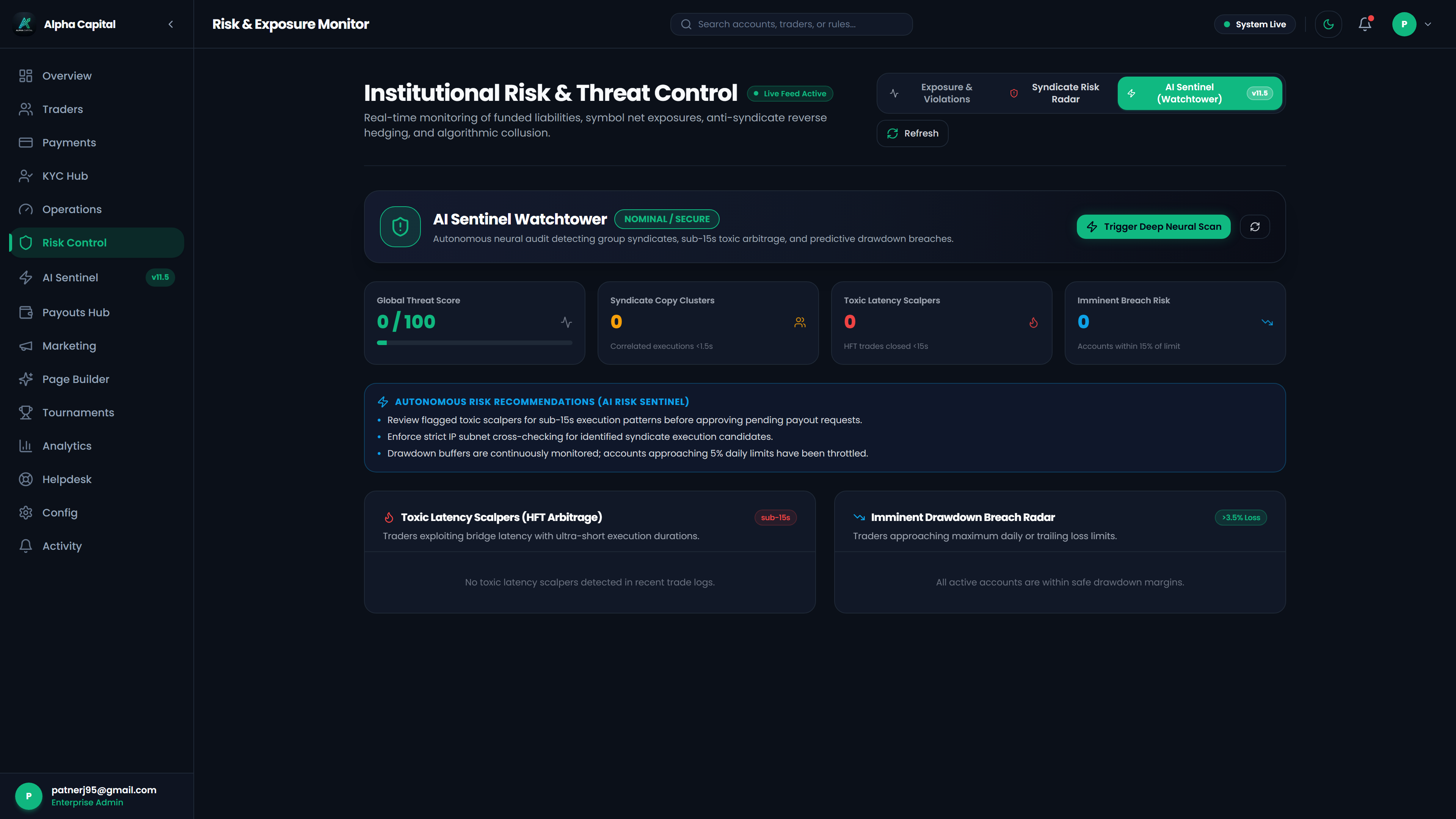
Prop firm risk management engines analyze order timing down to the millisecond. Modern white label platforms do not rely on manual human chart inspections to catch rule breakers.
At LaunchPropFirm, our institutional risk monitor automates compliance surveillance for operators. The system tracks multiple telemetry vectors simultaneously:
- Sub-second execution matching: The engine identifies opposite orders placed within 500 milliseconds across correlated pairs like EURUSD and GBPUSD.
- Correlation matrices: The risk dashboard flags offsetting positions across correlated indices such as US30, NAS100, and SPX500.
- IP and device telemetry: Accounts sharing hardware IDs or residential proxy networks are grouped for forensic inspection.
- Equity curve symmetry: Reverse hedged accounts display identical inverse equity curves that trigger automated breach notifications.
Operator Tip: Modern risk management platforms like LaunchPropFirm track server timestamps across symbols to identify coordinated group hedging instantly.
For entrepreneurs planning to start their own funded trader brand, having automated risk surveillance is vital to protecting cash flow. Explore our complete white label prop firm platform to review how our six modular engines manage evaluations.
Best Practices for Hedging Funded Accounts
Traders who trade multiple evaluation accounts must follow clear guidelines. Keeping your trading record clean ensures smooth payout approvals without compliance delays.
First, keep all risk management within a single account ticket. If your strategy requires hedging to manage drawdown during consolidation, execute both legs within the same login ID.
Second, avoid trading correlated assets in opposite directions across accounts. Holding long EURUSD on one account while holding long USDCHF on a second account creates an inverse synthetic hedge that risk algorithms flag as cross-trading.
Third, maintain an independent trading journal. If a prop firm compliance desk asks for trade rationales, providing clear technical screenshots of your setup resolves flagged flags quickly.
To explore platform pricing and ownership options, visit our pricing packages page.
FAQ
Can I hedge on FTMO?
Yes, FTMO permits same-account hedging on all standard and swing accounts. You can hold long and short positions on the same currency pair simultaneously. However, hedging across multiple FTMO accounts or against another prop firm is strictly prohibited.
What happens if I accidentally hedge across two accounts?
Prop firm automated risk engines flag matching opposite orders immediately. If cross-account hedging is detected, both accounts face disqualification and any accrued simulated profit split is forfeited.
Does MT5 allow hedging by default?
Yes, MetaTrader 5 supports hedging accounts where opposing positions on the same symbol remain open concurrently. Some brokers configure MT5 in netting mode where opposite trades cancel each other out, but evaluation firms standardly provide hedging-enabled logins.
Can I use an EA to hedge prop firm accounts?
Automated Expert Advisors that hedge within a single account are generally permitted if the firm allows algorithmic trading. EAs that execute multi-account latency arbitrage or reverse grid hedging across accounts are universally banned.
Why do futures prop firms ban hedging?
Futures evaluation firms operate under US regulatory bodies like the CFTC and NFA which enforce strict FIFO (First-In, First-Out) order processing. Under FIFO rules, an opposing trade automatically liquidates your earlier position.
Evaluate Your Prop Firm Readiness Score (0-100)
Answer 5 quick operational questions about your acquisition channels, runway, and engine tech to get a personalized launch roadmap.
Prop Firm Monthly Profit Simulator
Simulate your challenge revenue, payout liability, and net monthly take-home profit.
$20,000
From upfront challenge fees-$2,800
~10 funded payouts budgeted$0 / month
Saves $3,000/mo vs SaaS$17,200/mo
Run-rate: $206,400/yr
M.Haris
Founder & Platform ArchitectBuilding open prop trading software infrastructure for operators worldwide
I built LaunchPropFirm to give forex educators, trading communities, and fintech operators complete ownership of their platform with full source code and zero monthly SaaS rent. Every article on this blog is drawn from hands-on platform development, live MT5 risk bridge mechanics, and real operator economics.
All content, financial models, ROI estimates, and architecture guides on LaunchPropFirm are published strictly for educational and informational purposes. LaunchPropFirm provides institutional prop trading software and technology infrastructure; it does not operate as a broker, custodian, or registered investment advisor.
Evaluation challenges and funded trader accounts referenced in this guide operate in simulated demo trading environments using real-time market data feeds. Simulated trading results do not represent actual trading performance or financial advice.
Recommended Next Reads
Hand-picked operator guides to scale your prop trading platform.
Funding Pips Account Sizes and Prices 2026: Evaluation Tiers, Rules, and Scaling Plan
Complete 2026 Funding Pips account sizes and prices guide. Compare challenge fees ($5k to $100k), 2-step evaluation rules, drawdown limits, and the $2M scaling plan.
List of Prop Trading Firms (2026 Directory): Best Evaluated and Instant Funding Programs
Complete 2026 list of prop trading firms. Compare the top 6 evaluated prop firms across platforms (MT5, cTrader), drawdown rules, profit splits, and entry fees.
Skip the monthly fees
Own your prop firm platform outright. One time purchase.
Full source code. Live in 7 days. No revenue share. No monthly SaaS bill. See the exact platform before paying anything.
Demo login: haris / asdf1122. No signup needed