Forex Trading Strategies for 2026
Compare top forex trading strategies for prop firm challenges. Learn how trend, breakout, and scalping methods align with strict daily drawdown limits.
Forex trading strategies fall into a handful of core approaches: trend following, breakout, range trading, scalping, and carry trade. Most guides rank them by profitability alone, using backtests run with no time limit and no daily loss rule.
That comparison breaks down inside a prop firm challenge. A strategy that performs fine with your own capital and unlimited time can fail fast against a 5% daily loss limit and a 10% max drawdown. Here is how the main strategies actually hold up under those constraints.
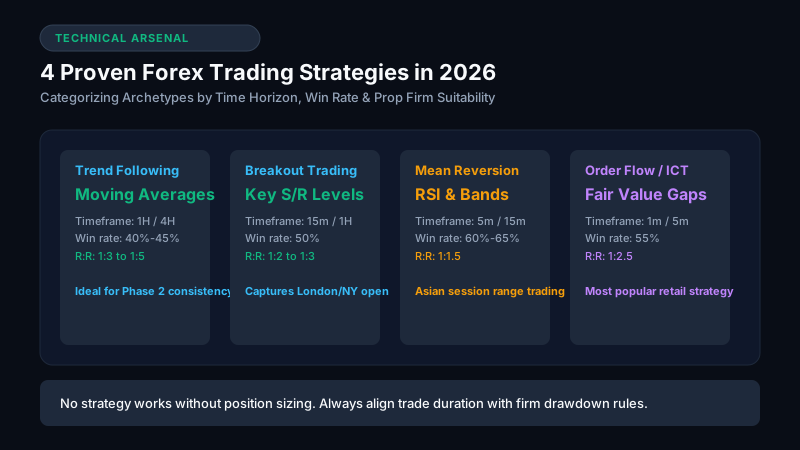
Trend Following
Trend following means entering in the direction of an established price move and holding until the trend shows signs of reversing. It is the most widely taught forex strategy because it does not require picking exact tops or bottoms, only confirming direction.
The drawback for challenge traders is trade duration. A trend trade can stay open for days, which means floating losses sit against the drawdown limit while the trade develops. Firms that calculate drawdown on floating P&L rather than closed trades make trend following considerably riskier.
Trend following fits well within prop firm rules when position size is reduced to account for the longer holding period. A trader risking 1% per trade on a multi-day trend position has more room to survive normal pullbacks than one risking 2% or 3%.
Breakout Trading
Breakout trading means entering when price moves beyond a defined support or resistance level, betting the move continues. It produces fast, clear signals and works well during higher volatility sessions like the London and New York overlap.
False breakouts are the main risk. Price breaks a level, triggers the entry, then reverses back inside the range. This is the kind of quick loss that daily loss limits are built to survive, since one or two false breakouts rarely consume an entire day's limit if position size is controlled.
Breakout trading suits challenge accounts better than trend following because trades resolve faster. A breakout either confirms or fails within hours, not days, which limits how long capital sits exposed to overnight risk.
Range Trading and Mean Reversion
Range trading means buying near support and selling near resistance inside a price range that is not trending. It works when a currency pair is consolidating, which happens more often than sustained trending moves.
The risk with range trading inside a challenge is that ranges eventually break. A trader who keeps buying support during an actual breakdown can take a loss large enough to threaten the daily limit in a single trade. Range trading requires a clear invalidation level and the discipline to exit the moment price breaks the range rather than adding to a losing position.
Used with a firm stop loss, range trading is one of the more predictable strategies for hitting a profit target without wide drawdown swings, since position sizes and targets stay consistent across similar setups.
Skip the monthly fees
Own your prop firm platform outright. One time purchase.
Full source code. Live in 7 days. No revenue share. No monthly SaaS bill. See the exact platform before paying anything.
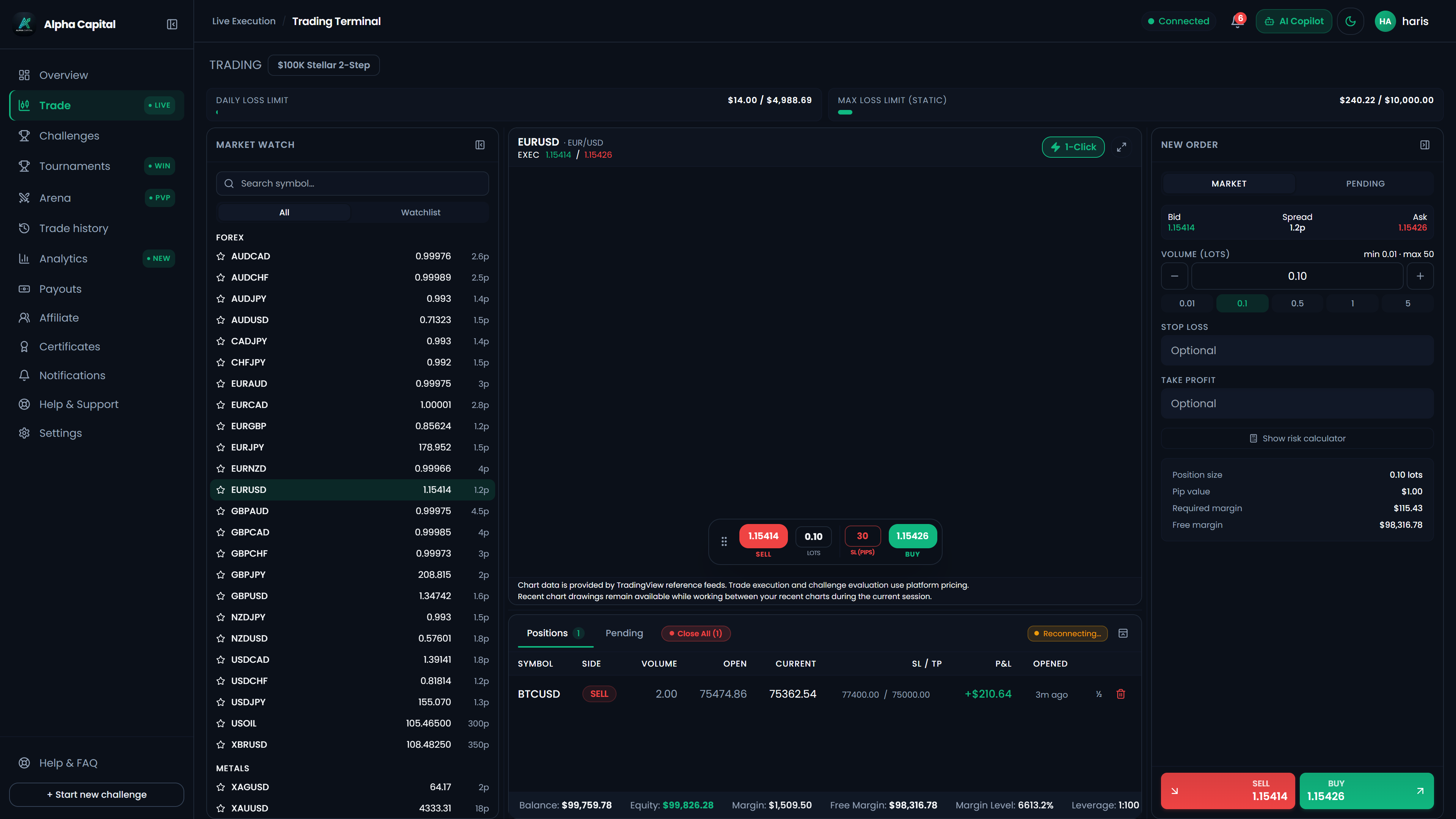
Demo login: haris / asdf1122. No signup needed
Scalping
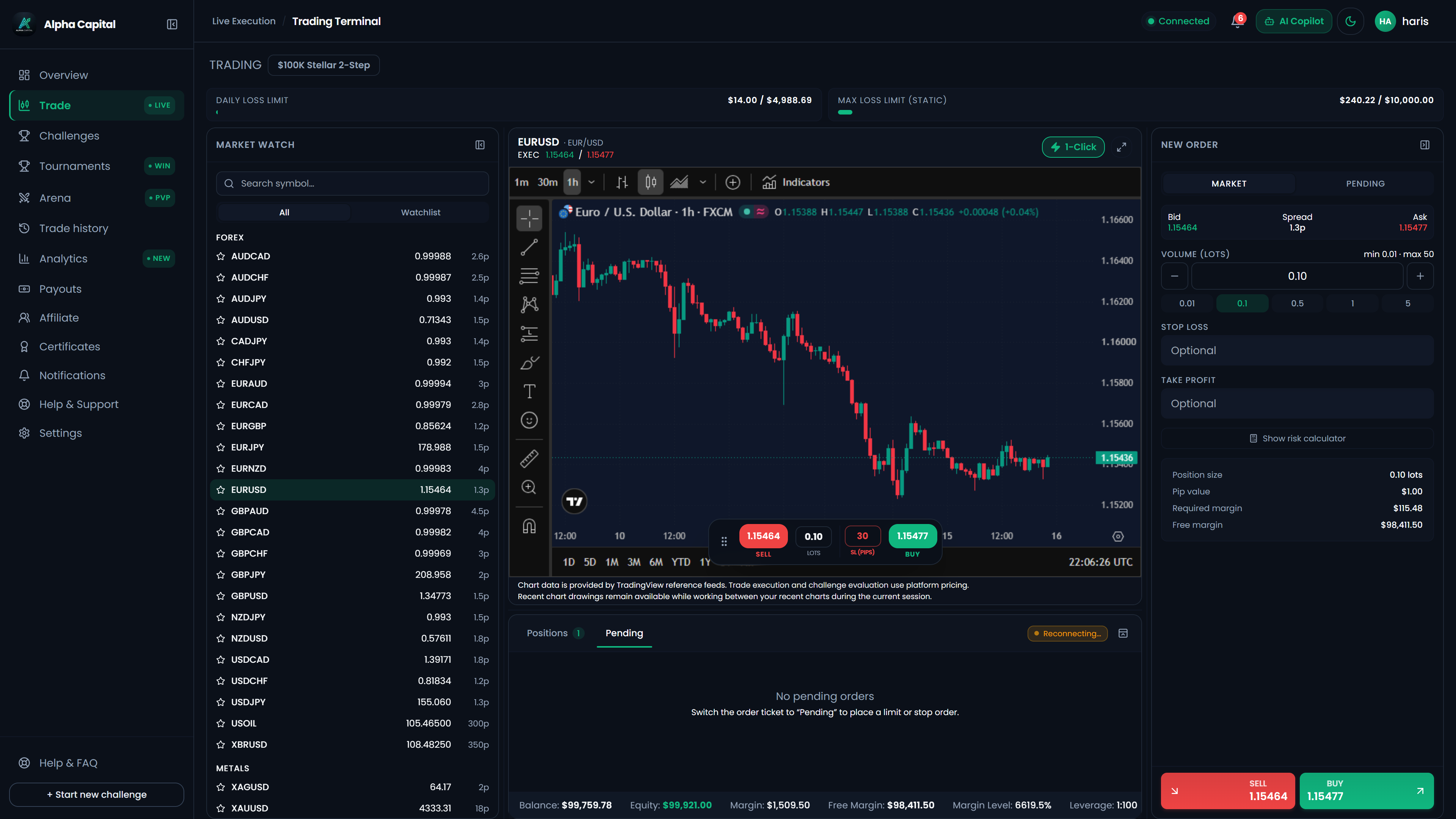
Scalping means taking many small trades that last seconds to minutes, targeting a handful of pips per trade. It requires tight spreads, fast execution, and constant attention to the chart during the trading session.
Risk Warning: Scalping is the strategy most likely to breach a prop firm's minimum trading day rule or trigger consistency violations. High trade frequency also means transaction costs from spread and commission eat into the profit target faster than with lower frequency strategies. Confirm the firm allows scalping and does not restrict trade duration before committing to this style.
Not every firm permits scalping. Some prop firms set a minimum trade duration or restrict high-frequency strategies specifically because rapid trades can exploit pricing gaps between the firm's server and the liquidity provider. Read the challenge rules for minimum hold time restrictions before choosing scalping as a primary strategy.
Which Strategy Fits a Prop Firm Challenge
Strategy selection inside a challenge comes down to how each approach interacts with drawdown limits and time pressure, not just historical win rate.
| Strategy | Trade Duration | Drawdown Exposure | Best Fit For |
|---|---|---|---|
| Trend following | Days | High (floating P&L) | Static drawdown firms |
| Breakout | Hours | Medium | Most challenge types |
| Range trading | Hours to 1 day | Low to medium | Static or trailing |
| Scalping | Seconds to minutes | Low per trade, high frequency | Firms with no min hold time |
| Swing trading | 1 to 5 days | High | Static drawdown only |
| Carry trade | Weeks | Very high | Not suited to challenges |
Breakout and range trading generally survive challenge rules better than trend following or carry trade because they resolve faster and expose less floating risk. Traders combining two styles, breakout for entries and range logic for exits, often build the most stable equity curve for hitting a profit target within a 30-day window.
Swing and Position Trading
Swing trading holds positions for one to five days, while position trading holds for weeks to months. Both face the same core problem inside a challenge: time pressure and drawdown exposure grow together, since more days open in a trade means more days that a floating loss can sit against the limit.
Position trading with weeks-long holds rarely fits challenge time limits at all. Most challenges impose a 30-day window, and position trades built for multi-month conviction plays do not resolve fast enough to reliably hit a profit target in that period.
Swing trading works better within these constraints when combined with static drawdown and explicit overnight hold permission. See swing trading in a prop firm for the specific rules to check before running this style on a challenge.
Choosing a Strategy Before You Buy a Challenge
Strategy fit should be confirmed against the specific firm's rules before paying for a challenge attempt, not after a position gets flagged for a rule violation. Daily loss limit, drawdown type, minimum trading days, and news trading restrictions each interact differently with each strategy above.
LaunchPropFirm is a white-label prop trading platform that operators use to run their own funded trader programs, with one-time pricing, full source code, and no monthly revenue share. Firms built on LaunchPropFirm configure every one of these rules directly, so the parameters traders see in the challenge rules document are exact, not marketing approximations.
Try the challenge experience before committing to a strategy at demo.launchapropfirm.com or see pricing. The demo shows live daily loss tracking and drawdown calculation exactly as traders experience it, which makes it possible to test how a strategy's typical drawdown pattern interacts with real limits. For the broader risk framework behind position sizing, see trading risk management.
FAQ
What is the best forex trading strategy for a prop firm challenge?
Breakout and range trading generally survive challenge rules better than trend following, scalping, or carry trade because they resolve within hours rather than days and expose less floating risk to drawdown limits. The single best strategy depends on the specific firm's drawdown type and minimum trading day requirement, so check prop firm challenge tips for the broader passing framework.
Can you scalp on a prop firm challenge?
Some firms allow it, some restrict it through a minimum trade duration rule. Scalping produces high trade frequency, which increases transaction costs from spread and commission relative to the profit target. Confirm the specific firm's rules on minimum hold time before building a challenge attempt around scalping.
Does trend following work inside prop firm drawdown rules?
Trend following works better with static drawdown than trailing drawdown, since a multi-day trend trade needs room for floating losses without the drawdown floor rising against it. Reducing position size to 1% risk per trade instead of 2% to 3% gives more room to survive normal pullbacks during a multi-day hold.
Why do some strategies fail prop firm challenges more than others?
Strategies that hold positions longer expose more floating risk to daily loss and drawdown limits, since a challenge measures risk in real time rather than only at trade close. Carry trade and long-term position trading rarely fit a 30-day challenge window for this reason. Faster-resolving strategies like breakout and range trading are more compatible with fixed evaluation periods.
Should beginners use a single strategy or combine multiple?
A single, well-tested strategy is generally safer for a first challenge attempt than combining multiple approaches, since mixing styles makes it harder to isolate what is working and what is causing losses. Traders who have passed a challenge once with one strategy are better positioned to layer in a second approach on a funded account.
How much should I risk per trade with any forex trading strategy?
Most challenge rules tolerate 1% to 2% risk per trade without threatening the daily loss limit, assuming a handful of trades per day at most. Higher frequency strategies like scalping need smaller per-trade risk since losses compound faster across many trades. See how to pass a prop firm challenge for the full risk framework.
Evaluate Your Prop Firm Readiness Score (0-100)
Answer 5 quick operational questions about your acquisition channels, runway, and engine tech to get a personalized launch roadmap.
Prop Firm Monthly Profit Simulator
Simulate your challenge revenue, payout liability, and net monthly take-home profit.
$20,000
From upfront challenge fees-$2,800
~10 funded payouts budgeted$0 / month
Saves $3,000/mo vs SaaS$17,200/mo
Run-rate: $206,400/yr
M.Haris
Founder & Platform ArchitectBuilding open prop trading software infrastructure for operators worldwide
I built LaunchPropFirm to give forex educators, trading communities, and fintech operators complete ownership of their platform with full source code and zero monthly SaaS rent. Every article on this blog is drawn from hands-on platform development, live MT5 risk bridge mechanics, and real operator economics.
All content, financial models, ROI estimates, and architecture guides on LaunchPropFirm are published strictly for educational and informational purposes. LaunchPropFirm provides institutional prop trading software and technology infrastructure; it does not operate as a broker, custodian, or registered investment advisor.
Evaluation challenges and funded trader accounts referenced in this guide operate in simulated demo trading environments using real-time market data feeds. Simulated trading results do not represent actual trading performance or financial advice.
Recommended Next Reads
Hand-picked operator guides to scale your prop trading platform.
Funding Pips Account Sizes and Prices 2026: Evaluation Tiers, Rules, and Scaling Plan
Complete 2026 Funding Pips account sizes and prices guide. Compare challenge fees ($5k to $100k), 2-step evaluation rules, drawdown limits, and the $2M scaling plan.
List of Prop Trading Firms (2026 Directory): Best Evaluated and Instant Funding Programs
Complete 2026 list of prop trading firms. Compare the top 6 evaluated prop firms across platforms (MT5, cTrader), drawdown rules, profit splits, and entry fees.
Skip the monthly fees
Own your prop firm platform outright. One time purchase.
Full source code. Live in 7 days. No revenue share. No monthly SaaS bill. See the exact platform before paying anything.
Demo login: haris / asdf1122. No signup needed