Trading Risk Management Guide for 2026
Poor risk management is the top reason funded traders lose their accounts. Here is the exact framework for position sizing, daily stops, and drawdown control.
Poor risk management ends funded trading accounts faster than bad trades. A trader who sizes correctly loses less when wrong, stays in the account through a bad week, and comes back for another session.
What Trading Risk Management Is
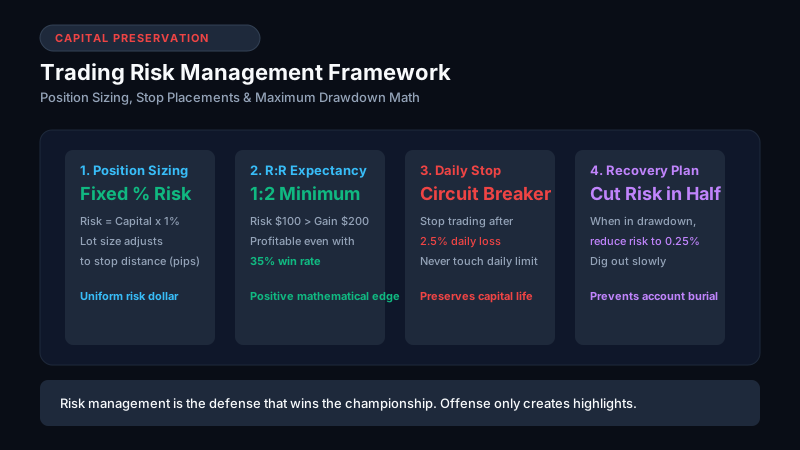
Trading risk management is the set of rules a trader uses to control how much capital is at risk on any single trade, any trading day, and across the full account. It covers position sizing, stop placement, daily loss limits, and total drawdown control.
Without a risk framework, a single large loss or a losing streak compounded by oversizing ends the account. With one, even a losing week rarely causes permanent damage.
Position Sizing: The Core Rule
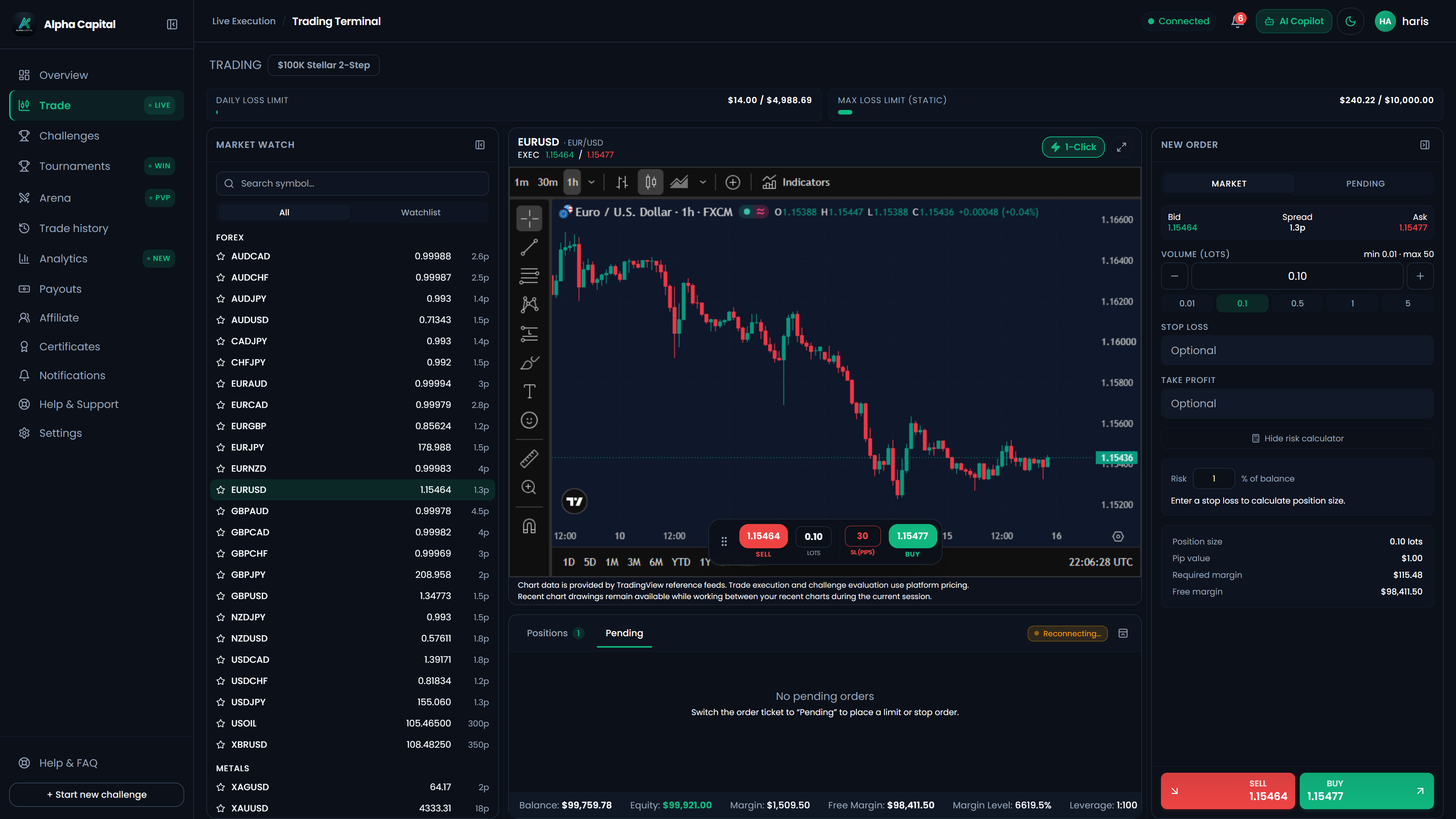
Position sizing determines how much capital is exposed on each trade. It is the single most controllable variable in trading.
The standard approach for funded traders is to risk 0.5% to 1% of the account balance per trade. On a $100,000 funded account, that means risking $500 to $1,000 per trade.
A trader who risks 1% per trade can lose 20 consecutive trades and still hold 82% of the account balance. The same trader risking 5% per trade would breach a 10% drawdown limit in just two losses.
Risk-Reward Ratio
Risk-reward ratio is the comparison between the potential loss and the potential profit on a trade. A 1:2 ratio means risking $500 to gain $1,000.
A trader with a 50% win rate and a 1:2 risk-reward ratio is profitable over time. Five wins at $1,000 equals $5,000 gained. Five losses at $500 equals $2,500 lost. Net profit of $2,500 across ten trades.
Without a ratio of at least 1:2, a 50% win rate produces a net loss over time. The ratio is not optional.
Skip the monthly fees
Own your prop firm platform outright. One time purchase.
Full source code. Live in 7 days. No revenue share. No monthly SaaS bill. See the exact platform before paying anything.
Demo login: haris / asdf1122. No signup needed
Daily Loss Limits
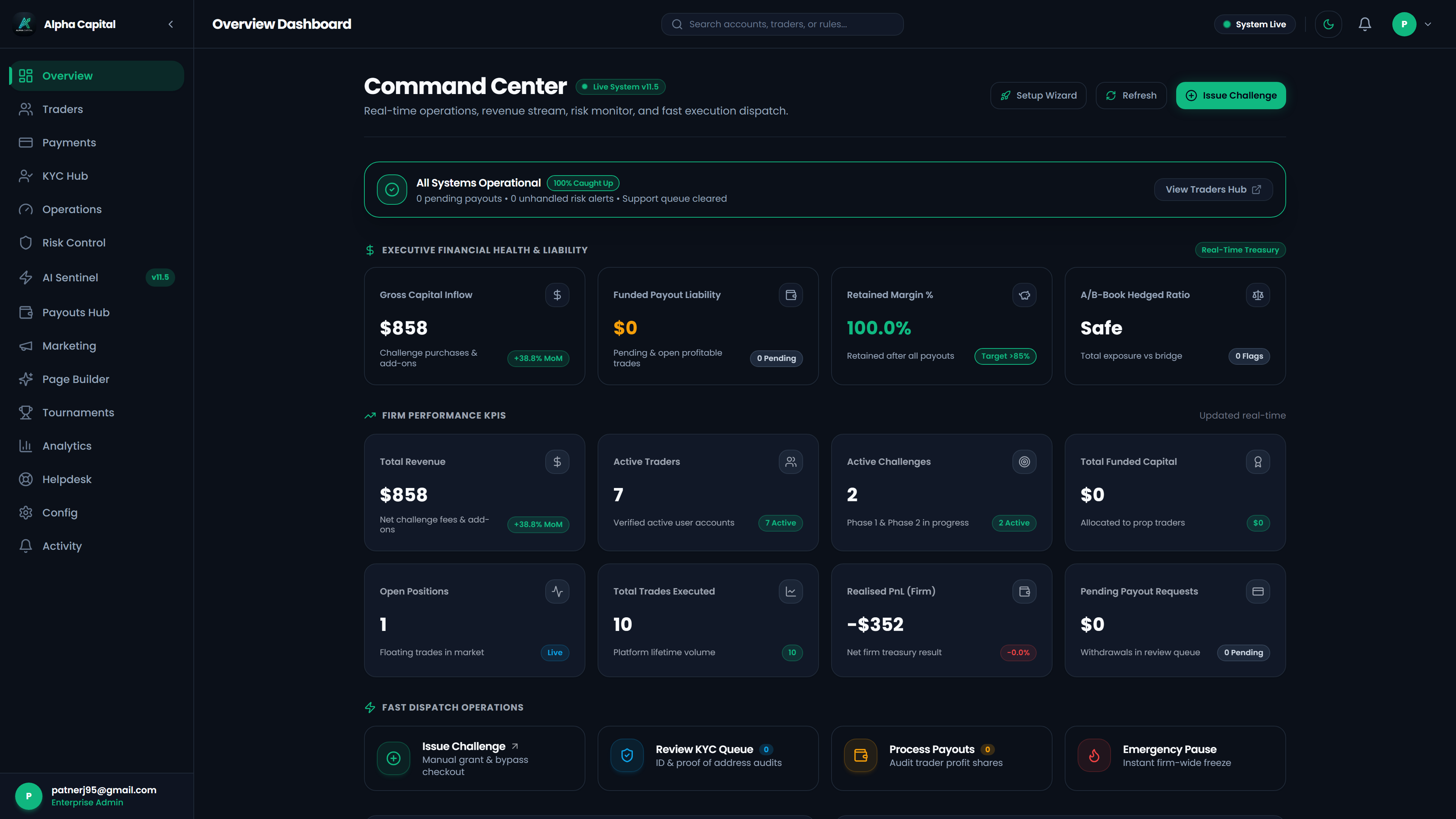
Every prop firm sets a daily loss limit, usually 5% of the account balance. This is the firm's enforced ceiling. Breaching it closes the funded account for that day or permanently, depending on the firm's rules.
Set a personal daily stop at half the firm's limit. If the firm allows 5%, stop trading at 2.5%. On a $100,000 account, that is $2,500. When the P&L hits negative $2,500, close all positions and stop for the day.
This buffer protects against a single bad position triggering the firm's automatic breach. It also prevents the emotional trap of chasing losses within the same session.
You can see how daily loss limits are tracked live in a funded trader account at demo.launchapropfirm.com. LaunchPropFirm builds white-label prop firm software on a one-time fee with full source code included and no monthly revenue share.
Total Drawdown Control
Total drawdown is the maximum the account can fall from its starting balance before the firm closes it. Most firms set this at 10%.
On a $100,000 funded account, the account closes if the balance reaches $90,000. Some firms use static drawdown, where the floor is fixed at the starting balance. Others use trailing drawdown, where the floor rises as the account grows.
A trader who builds the account from $100,000 to $120,000 with trailing drawdown now has a floor of $108,000, not $90,000. Knowing which type your firm uses changes how you manage the account in profit.
Risk Management Numbers by Account Size
| Account Size | Max Risk Per Trade (1%) | Personal Daily Stop (2.5%) | Firm Daily Limit (5%) | Max Drawdown (10%) |
|---|---|---|---|---|
| $25,000 | $250 | $625 | $1,250 | $2,500 |
| $50,000 | $500 | $1,250 | $2,500 | $5,000 |
| $100,000 | $1,000 | $2,500 | $5,000 | $10,000 |
| $200,000 | $2,000 | $5,000 | $10,000 | $20,000 |
Write these numbers down and keep them visible during every trading session. Knowing the number before you open a position is the only reliable way to follow the limit under pressure.
How to Handle a Losing Streak
Risk Warning: Increasing position size after a losing streak to recover faster is the single most common way funded accounts get closed. A losing streak of 5 to 10 trades in a row is statistically normal for any consistent trader. Respond by reducing size, not increasing it.
When three consecutive losses occur, cut position size in half. Not permanently. Until one or two winning trades come through. This keeps drawdown from compounding during a rough period.
If the losing streak extends beyond five trades, stop trading for 24 to 48 hours. Return when the emotional pressure has cleared.
Correlation Risk
Correlation risk occurs when a trader holds multiple positions in assets that move together, effectively taking the same trade twice.
A trader long EUR/USD and long GBP/USD simultaneously holds two positions that are roughly 75% correlated. If USD strengthens sharply, both positions lose at the same time. The combined loss exceeds the single-trade risk calculation.
In forex, limit correlated pairs so the total exposure across related instruments stays within your single-trade risk budget. Read how to pass a prop firm challenge for more on applying these rules during an active evaluation.
FAQ
What is trading risk management?
Trading risk management is the framework a trader uses to control financial exposure on every trade and across the full account. It includes position sizing rules, stop loss placement, daily loss limits, and total drawdown limits. It is the structure that keeps a strategy alive long enough to show results.
What percentage should I risk per trade?
0.5% to 1% per trade is the standard range for funded traders. At 1% risk, a trader can lose 20 consecutive trades before the account drops 20%. Higher risk percentages reduce the number of losing trades the account can absorb before a drawdown limit is breached.
What is risk-reward ratio in trading?
Risk-reward ratio is the comparison between the amount risked on a trade and the amount the trade can gain. A 1:2 ratio means risking $500 to make $1,000. At a minimum 1:2 ratio, a trader with a 50% win rate remains profitable over time.
How do I manage risk on a prop firm funded account?
Use 0.5% to 1% risk per trade, set a personal daily stop at half the firm's limit, avoid holding correlated positions simultaneously, and stop trading when three consecutive losses occur. See prop firm challenge tips for how to apply these rules during an active evaluation.
What is drawdown in trading?
Drawdown is the percentage decline in account value from a recent high. A funded account that falls from $100,000 to $88,000 has experienced a 12% drawdown. Prop firms enforce a maximum drawdown limit that permanently closes the account when breached. Staying well below the limit at all times is the foundation of account preservation.
Evaluate Your Prop Firm Readiness Score (0-100)
Answer 5 quick operational questions about your acquisition channels, runway, and engine tech to get a personalized launch roadmap.

M.Haris
Founder & Platform ArchitectBuilding open prop trading software infrastructure for operators worldwide
I built LaunchPropFirm to give forex educators, trading communities, and fintech operators complete ownership of their platform with full source code and zero monthly SaaS rent. Every article on this blog is drawn from hands-on platform development, live MT5 risk bridge mechanics, and real operator economics.
All content, financial models, ROI estimates, and architecture guides on LaunchPropFirm are published strictly for educational and informational purposes. LaunchPropFirm provides institutional prop trading software and technology infrastructure; it does not operate as a broker, custodian, or registered investment advisor.
Evaluation challenges and funded trader accounts referenced in this guide operate in simulated demo trading environments using real-time market data feeds. Simulated trading results do not represent actual trading performance or financial advice.
Recommended Next Reads
Hand-picked operator guides to scale your prop trading platform.
Congrats on Being a Funded Trader: What to Do in the First 48 Hours
Received the 'congrats on being a funded trader' email? Here is the exact survival protocol for contract signing, KYC verification, drawdown buffers, and your first payout.
Funding Pips Account Sizes and Prices 2026: Evaluation Tiers, Rules, and Scaling Plan
Complete 2026 Funding Pips account sizes and prices guide. Compare challenge fees ($5k to $100k), 2-step evaluation rules, drawdown limits, and the $2M scaling plan.
Skip the monthly fees
Own your prop firm platform outright. One time purchase.
Full source code. Live in 7 days. No revenue share. No monthly SaaS bill. See the exact platform before paying anything.
Demo login: haris / asdf1122. No signup needed