Is Forex Trading Worth It in 2026?
Real numbers on forex trading: how much capital you need, what traders actually earn, the rules that matter, and whether forex trading is worth your time.
Forex trading attracts millions of people every year. Most of them lose money within 90 days. This guide covers the real numbers, the rules that work, and an honest answer to whether forex is worth your time in 2026.
No fantasy figures. No motivational fluff. Just the math.
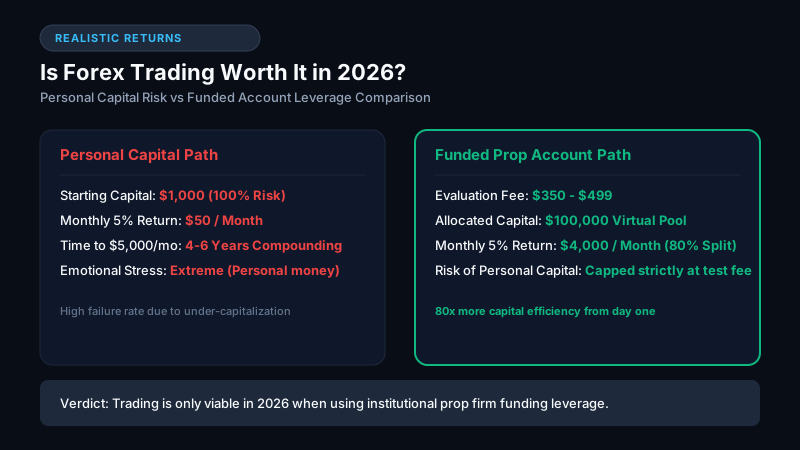
Is Forex Trading a Good Idea?
Forex is the largest financial market in the world. Daily volume runs around $7.5 trillion. Banks, hedge funds, and institutions account for roughly 90% of that. Retail traders like you and me compete in the remaining slice.
That is not a reason to avoid it. It is a reason to go in with accurate expectations.
Is forex trading legal in the US?
Yes. The CFTC and NFA regulate all retail forex brokers in the United States. You can trade freely through any registered broker.
Position multipliers are capped at 1:50 for major currency pairs and 1:20 for minors under US regulations. Outside the US, brokers often offer 1:100 or higher.
Is forex a skill or luck?
Mostly skill, but the learning curve is steep. Most traders who become consistently profitable spend 2 to 3 years studying before they see reliable results.
Traders who treat it like a casino rarely survive 6 months. The market does not care about gut feelings. It rewards preparation and a verifiable edge.
Is forex trading gambling?
Technically no. Gambling is a fixed-odds game where the house always wins. Forex has no fixed odds. A trader with a genuine positive expectancy system can be profitable over thousands of trades.
For traders without a defined system, trading randomly based on emotions or tips, it functions exactly like gambling. The line between the two is whether you have a real edge.
How many forex traders are successful?
Broker disclosures required by EU and UK regulators consistently show 70 to 80% of retail forex traders lose money. The "90% rule" in trading says 90% of new traders lose 90% of their account in the first 90 days. These figures are not meant to scare you. They reflect what happens when people enter without proper preparation.
Is forex hard to learn?
The mechanics take a weekend. Charts, order types, reading a currency pair, placing orders, all of that comes quickly. Building a consistent edge is the hard part. Managing your emotions through losing streaks and sticking to a plan when trades go against you takes years of real practice.
Which trading is most profitable for retail traders?
Funded prop firm trading consistently produces the best risk-adjusted returns for skilled retail traders. You pass an evaluation, access $50,000 to $200,000 in capital, and keep 80 to 90% of profits.
You risk only the evaluation fee, not your own capital at scale. Compare current prop firm challenge fees here before choosing where to start.
How Much Do Forex Traders Actually Make?
Real numbers matter more than aspirational claims.
| Account Size | 5% Monthly | 10% Monthly |
|---|---|---|
| $500 personal | $25 | $50 |
| $1,000 personal | $50 | $100 |
| $10,000 personal | $500 | $1,000 |
| $50,000 funded | $2,000 (80% split) | $4,000 |
| $100,000 funded | $4,000 (80% split) | $8,000 |
| $200,000 funded | $8,000 (80% split) | $16,000 |
A trader with a $10,000 personal account targeting 5% monthly return makes $500 per month. That is a realistic target for an experienced trader. 10% monthly is aggressive but achievable in good conditions.
Any system promising consistent 50% monthly returns is a scam or a blowup waiting to happen.
How much can you make with $1,000 in forex?
At 5% monthly, a $1,000 account generates $50. At 10% in a strong month, $100. Neither number replaces income. The math only works at scale.
A trader with $100,000 in funded capital at 5% monthly and an 80% profit split earns $4,000 per month. For a detailed breakdown across small, full-time, and funded traders, read our guide on how much forex traders make a year. Same skill, different capital base. That is why funded accounts matter more than saving up your own money for years.
How much do forex traders make a month?
It varies by account size and strategy. Professional traders at prop firms targeting 5 to 8% monthly on $100,000 to $500,000 earn $4,000 to $20,000 per month after their profit split. Retail traders with small accounts make pocket change or lose money. Account size determines income ceiling more than skill does, beyond a certain level.
Can trading make you a millionaire?
Yes, but the path is specific. Develop a proven system, pass a prop firm evaluation, scale to $500,000 or more in funded capital, and generate 5 to 10% monthly returns.
At 80% split on $500,000 at 5% monthly, that is $20,000 per month. That path is real. It requires skill and time, not just a brokerage account.
Who is the richest forex trader in the world?
George Soros made $1 billion in a single day shorting the British pound in 1992. Stanley Druckenmiller, Bill Lipschutz, and Bruce Kovner are other names at the top of the list. Every one of them managed institutional capital. Their wealth came from managing billions, not compounding a $1,000 retail account.
Do people make money from forex? Yes. The traders who do it long-term treat it as a profession, not a side hustle.
How Much Capital Do You Actually Need?
Risk Warning: Starting with too little capital is one of the most common reasons traders fail early. Small accounts force oversized positions and emotional decisions. Give yourself enough runway to learn properly before risking money you cannot afford to lose.
Is $100 enough to start forex?
Technically yes. Practically, no. With $100 and a 1:30 US margin ratio, you control $3,000. A 1% risk rule means risking $1 per trade.
At that position size, normal spread costs eat into any gains before your system has time to prove itself. Use $100 to practice on the platform, not to build a career.
Is $500 enough to start forex?
Better. With $500 and a 1% risk rule, you risk $5 per trade. You can trade micro lots on major pairs.
This is enough to practice with real money and start building a track record. It is not enough to live from, but it is a real starting point.
Do I need $25,000 to trade forex?
No. The $25,000 pattern day trader rule applies to US stock trading, not forex. Forex brokers set their own minimum deposits, usually $1 to $100. There is no regulatory minimum for retail forex in the US or anywhere else.
What is a realistic weekly profit goal for a novice with $1,000?
For a beginner, breaking even in the first 3 to 6 months is a success. Once consistently profitable, targeting 1 to 2% weekly is realistic. On $1,000, that is $10 to $20 per week.
These numbers sound small because they are. The goal at this stage is building the skill and the track record, not the income.
| Account Size | 1% Risk Per Trade | 5% Monthly Return | Realistic Monthly Income |
|---|---|---|---|
| $100 | $1 | $5 | Not viable |
| $500 | $5 | $25 | Practice only |
| $1,000 | $10 | $50 | Practice only |
| $10,000 | $100 | $500 | Supplement |
| $50,000 funded | $500 | $2,000 | Part-time income |
| $100,000 funded | $1,000 | $4,000 | Full-time income |
The table shows why retail accounts with small capital struggle. The funded account path solves the capital problem. Compare current challenge fees to find the cheapest entry point.
Can you start forex with $5?
Some brokers accept $5 deposits. The position sizes at that level teach nothing useful about real risk management. Paper trade for free while saving up at least $500. Then fund with real money when you have a system that works on a demo account.
Skip the monthly fees
Own your prop firm platform outright. One time purchase.
Full source code. Live in 7 days. No revenue share. No monthly SaaS bill. See the exact platform before paying anything.
Demo login: haris / asdf1122. No signup needed
The Rules Every Profitable Trader Follows
Five rules separate the traders who survive from the ones who blow up in the first year.
What is the 90% rule in forex?
The 90% rule describes reality. 90% of new traders lose 90% of their account in the first 90 days. EU brokers must legally disclose the percentage of retail clients who lose money. Most report 70 to 85%.
The rule exists as a reminder that trading without preparation is not investing. It is expensive tuition.
What is the 2% rule in forex?
Never risk more than 2% of your account on a single trade. On a $1,000 account, that is $20 per trade. On a $50,000 funded account, $1,000.
This rule ensures one bad trade cannot destroy your account. Most professional funded traders actually risk 0.5 to 1% per trade.
What is the 1% rule in forex?
A stricter version. With 1% risk per trade, you can lose 100 consecutive trades before losing your account. No legitimate trading system loses 100 trades in a row. The 1% rule is the professional standard for funded traders at most prop firms, because it keeps drawdown within evaluation limits.
What is the 3-5-7 rule in trading?
Risk no more than 3% on any single trade, keep total open exposure under 5%, and aim for a reward-to-risk structure that targets 7% gain for every 3% risked over time. Different traders define this slightly differently. The core principle is conservative sizing combined with asymmetric reward targets.
What is the 5-3-1 rule in forex?
Trade only 5 currency pairs. Master 3 trading strategies. Pick 1 time of day to trade.
Specialization beats variety for new traders. Most losing traders fail because they trade every pair, use every indicator, and trade at all hours. Narrow focus builds a real edge faster.
What is the 4-week rule in forex?
Take a four-week break from trading after a significant drawdown. Forced rest prevents revenge trading and creates space to review losses objectively. It is less a mechanical rule and more a discipline practice for managing trading psychology after a rough period.
Why do 95% of forex traders lose money?
Three causes cover most retail losses.
First, position sizing is wrong. Traders risk 10 to 20% per trade. A string of normal losses wipes the account before the system has time to work.
Second, there is no defined edge. Entries and exits are based on emotion, news, or social media tips rather than repeatable criteria.
Third, fees are ignored. Spread, commission, and overnight swap costs eat into systems that look profitable on paper.
Can You Turn $100 Into $1,000 in Forex?
The math: you need a 900% return. At 5% monthly compounding, that takes about 47 months. At 10%, about 24 months. Both assume zero losing months, which does not happen in practice.
Traders who grow small accounts quickly either got lucky short-term (which usually reverses) or risked so much that they should have blown up first and got lucky instead.
What lot size can I trade with $100?
With $100 and a 1:100 margin ratio (available outside the US), you can trade 0.01 micro lots on major pairs, about $0.10 per pip of movement. With the US 1:30 limit, even smaller. It is workable for platform practice, not for income.
What lot size can I trade with $1,000?
With $1,000 and a 1% risk rule ($10 per trade), you can trade 0.1 mini lots on major pairs with a 10-pip stop loss. That gives you roughly $1 per pip. Tight, but workable for real learning.
How many dollars is 1 lot in forex?
One standard lot equals 100,000 units of the base currency. On EUR/USD, 1 lot controls $100,000 worth of euros. One pip on a standard lot is worth $10.
With a $1,000 account, trading standard lots is a guaranteed account wipeout. Stick to micro or mini lots until your account size supports it.
Is it possible to make $1,000 a day in forex?
On a $100,000 funded account at 1% daily return, yes. On a $1,000 retail account, that requires a 100% daily return. Nobody sustains that. The path to $1,000 per day goes through funded capital, not retail accounts.
Risk Warning: Any system or mentor claiming you can reliably make $1,000 per day from a small retail account is either selling something or has never traded with their own money. Realistic daily targets for professional traders range from 0.2 to 1% of their funded capital.
The Funded Account Path
If you have a working system, the fastest path to meaningful income is funded trading. You do not need years to save your own capital to the six-figure level.
Prop firms give you access to $25,000 to $200,000 in trading capital after passing an evaluation challenge. You keep 80 to 90% of profits. You risk only the evaluation fee, which typically runs $100 to $500 depending on account size.
See how the prop firm challenge system works before paying any evaluation fee. Understanding what you are buying matters.
Some traders who build a solid funded trading track record eventually choose to build their own prop firm rather than remaining a funded trader. The comparison between trading a funded account versus building your own firm is worth reading if you are thinking longer term.
LaunchPropFirm provides the platform for operators who want to run their own funded trader business. See how the platform works or check what a launch costs.
FAQ
Is $500 enough to trade forex seriously?
For learning with real money, yes. For generating income, no. A $500 account at 5% monthly generates $25.
Use $500 to build a track record and prove your system. Scale through a funded account once you have consistent results.
Do forex traders pay tax?
In the US, most retail forex gains are taxed under Section 988 as ordinary income. Traders can also elect Section 1256 treatment, which taxes 60% of gains at long-term capital gains rates and 40% at short-term rates. Consult a tax professional for your specific situation and jurisdiction.
What is the best time to trade forex?
The London-New York overlap, roughly 1pm to 5pm UTC, is the highest-volume period for major pairs. Spreads are tighter, moves are more directional, and liquidity is deepest. Avoid trading major economic news events unless your strategy is built specifically for news conditions.
How long does it take to become a profitable forex trader?
Most traders who reach consistency take 2 to 3 years of serious study and live trading before they are reliably profitable. Traders who rush this process usually blow accounts along the way. There are no legitimate shortcuts, only a faster or slower path through the same learning curve.
What currency pairs should beginners trade?
Start with EUR/USD, GBP/USD, USD/JPY, or USD/CHF. Major pairs have the tightest spreads, the most analysis available, and the most predictable behavior. Avoid exotic pairs until you have at least a year of consistent results on majors.
Is it possible to learn forex on your own?
Yes. Many profitable traders are entirely self-taught. BabyPips covers the basics for free.
TradingView provides free charting and community analysis. The market itself is the best teacher. Paid courses are rarely worth the price compared to the same time spent on deliberate practice with a small live account.
What is flipping in forex?
Flipping refers to turning a small account into a larger one quickly through high-risk trading. It works occasionally and blows up regularly. The traders who "flip" accounts on social media either had many failed attempts before the one they post, or they are not trading real money. Do not model your approach on flipping content.
What happens if I invest $100 in forex?
With $100 and a 1:30 margin ratio, you control $3,000 in currency exposure. A 1% adverse move against your position costs you $30, which is 30% of your account. Retail forex with $100 is high-risk with limited ability to apply proper position sizing. Use it as a platform familiarization account, nothing more.
Model Your Firm's Monthly Cash Flow & Profit
Simulate challenger intake, pass rate payout reserves, and net operator margins with our free real-time economic calculator.
Prop Firm Monthly Profit Simulator
Simulate your challenge revenue, payout liability, and net monthly take-home profit.
$20,000
From upfront challenge fees-$2,800
~10 funded payouts budgeted$0 / month
Saves $3,000/mo vs SaaS$17,200/mo
Run-rate: $206,400/yr
M.Haris
Founder & Platform ArchitectBuilding open prop trading software infrastructure for operators worldwide
I built LaunchPropFirm to give forex educators, trading communities, and fintech operators complete ownership of their platform with full source code and zero monthly SaaS rent. Every article on this blog is drawn from hands-on platform development, live MT5 risk bridge mechanics, and real operator economics.
All content, financial models, ROI estimates, and architecture guides on LaunchPropFirm are published strictly for educational and informational purposes. LaunchPropFirm provides institutional prop trading software and technology infrastructure; it does not operate as a broker, custodian, or registered investment advisor.
Evaluation challenges and funded trader accounts referenced in this guide operate in simulated demo trading environments using real-time market data feeds. Simulated trading results do not represent actual trading performance or financial advice.
Recommended Next Reads
Hand-picked operator guides to scale your prop trading platform.
TradingView Prop Firms (2026): Best Web Terminals
Complete 2026 guide to TradingView prop firms. Compare top firms offering browser TradingView charts, execution latency, and funded account rules.
Funding Pips Account Sizes and Prices 2026: Evaluation Tiers, Rules, and Scaling Plan
Complete 2026 Funding Pips account sizes and prices guide. Compare challenge fees ($5k to $100k), 2-step evaluation rules, drawdown limits, and the $2M scaling plan.
Skip the monthly fees
Own your prop firm platform outright. One time purchase.
Full source code. Live in 7 days. No revenue share. No monthly SaaS bill. See the exact platform before paying anything.
Demo login: haris / asdf1122. No signup needed