Prop Firm Trading Competitions: 2026 Tournaments
How to launch viral prop firm trading competitions that attract 1,000+ traders with zero ad spend. Rules, prize pools, and automated leaderboard setup.
Every major prop firm runs trading competitions. The5ers, FundedNext, Hola Prime, Goat Funded Trader: all of them run monthly or weekly contests. They do it because it works.
A free trading competition costs almost nothing to run and pulls in traders who would never find you through paid ads. When I built out the marketing side of a prop firm, competitions consistently outperformed Facebook ads at a fraction of the cost.
This guide covers how to structure a competition, what prizes actually attract traders, and how to turn contest participants into paying challenge buyers.
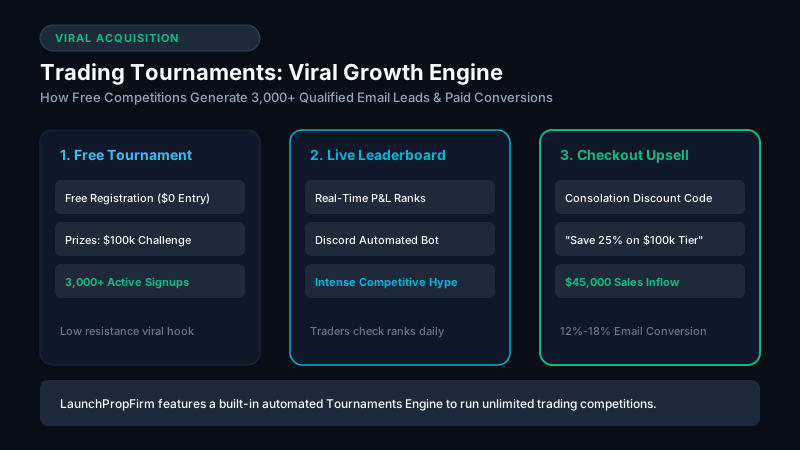
Why Trading Competitions Work for Prop Firms
A free competition gives traders a no-risk way to experience your platform. They sign up with zero money down, trade on a demo account, and compete for prizes. You get their email, their engagement, and if your platform feels good, some percentage of them convert to paid challenge buyers within 30 days.
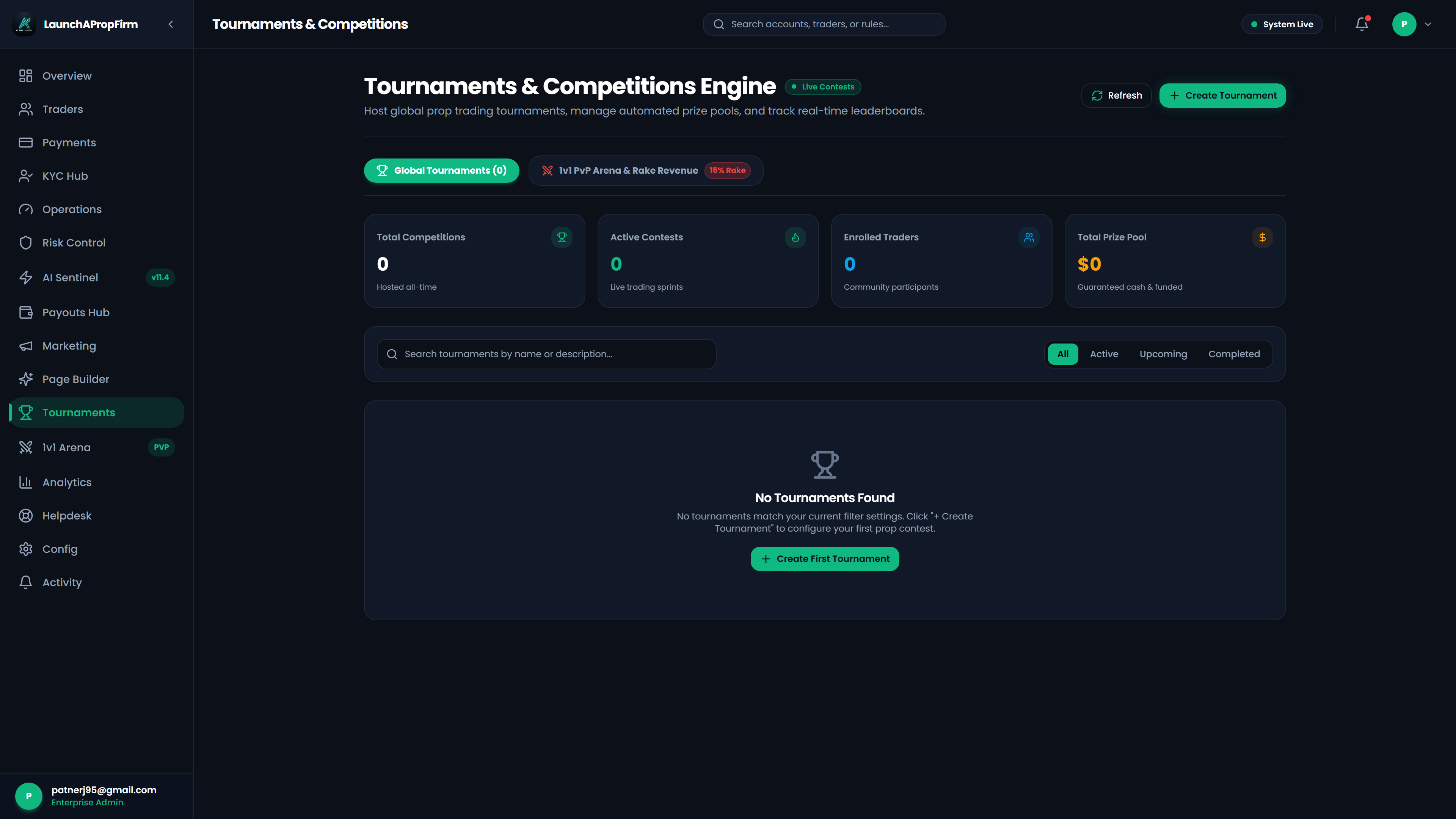
Tournament creation console managing competitive trading events, leaderboard tracking, and gamified acquisition funnels.
The5ers has run weekly competitions for years. FundedNext runs a monthly competition with 600 prize positions. These are not charity. They generate challenge sales at a cost per acquisition well below what paid advertising delivers.
Operator Tip: The goal of a competition is not the competition itself. The goal is to put traders inside your platform with zero friction, let them experience the trading environment, and convert them afterward. Think of it as a free trial with a leaderboard.
Competition Structure: What Actually Works
A well-structured competition has four elements: a clear timeframe, a simple ruleset, a prize that traders actually want, and a conversion path to paid products.
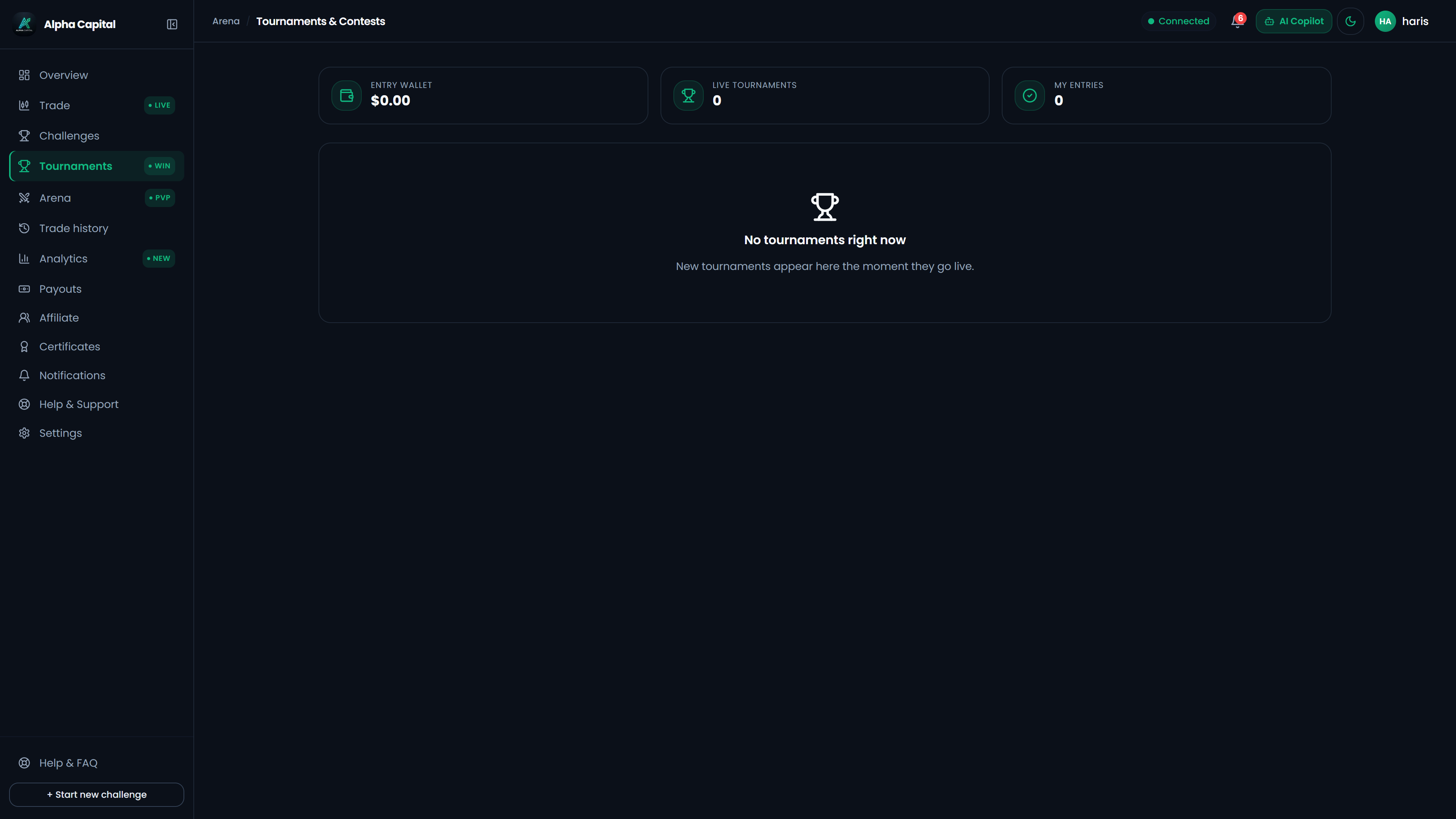
Interactive 1v1 trading battle arena enabling real-time peer-to-peer competitions and viral community engagement.
Timeframe
Monthly competitions work best for most operators. Two to four weeks gives traders enough time to build a meaningful track record without losing momentum. Weekly competitions work for firms with very active communities. Daily competitions are gimmicky and attract gamblers, not serious traders.
Set a fixed start and end date. Announce the next competition before the current one ends. Predictable scheduling builds habit.
Rules
Keep the rules simple. Traders should understand the competition in 60 seconds.
A standard structure: demo account with a fixed starting balance (usually $50,000 or $100,000), profit target determines ranking, drawdown limit applies (5% to 10%), no limit on trading days within the window, and EAs are either allowed or explicitly banned.
The cleaner the rules, the more participants you get. Every extra rule is friction.
Prizes
Funded accounts are the best prize for a prop firm competition. A free funded account (Phase 2 waived or direct funding) has high perceived value and costs you almost nothing if the trader never profits. If you are structuring prize allocations for the first time, review our breakdown on what is a funding account to see how evaluation stages, drawdown filters, and funded profit splits interface behind the scenes.
From a treasury perspective, awarding funded accounts does not mean depositing six figures of cash into a live brokerage sub-account. The accounts trade on simulated demo infrastructure with defined loss boundaries; study our guide to prop firm capital reserves to model challenge pool economics and liquid payout reserves accurately. Cash prizes attract traders but do not filter for your target customer. When distributing cash rewards internationally, operators must also avoid retail fintech payment flags: examine our breakdown of wise prop firms and contractor rails to disburse cash prizes through compliant B2B payroll bridges rather than triggering frozen transfers. Challenge fee waivers are a middle ground.
Many firms use a tiered prize structure: top 3 get funded accounts, positions 4-10 get 50% off their first challenge, positions 11-50 get a 20% discount code. This way most participants get something.
| Position | Prize Example |
|---|---|
| 1st place | $100,000 funded account (direct) |
| 2nd-3rd place | Phase 2 waived on $50,000 account |
| 4th-10th place | 50% off first challenge |
| 11th-50th place | 20% discount code |
| All participants | Free next competition entry |
Free vs Paid Competition Entry
Most prop firm competitions are free to enter. Free entry maximizes participation and removes the friction barrier.
Paid entry competitions (typically $5 to $25 to join) attract smaller numbers but more serious traders. Some firms use paid entry to fund the prize pool directly. This works better if you already have an established audience.
For a new firm, start free. Build the participation numbers first. Introduce paid entry later once traders trust your platform and want to compete seriously.
Skip the monthly fees
Own your prop firm platform outright. One time purchase.
Full source code. Live in 7 days. No revenue share. No monthly SaaS bill. See the exact platform before paying anything.
Demo login: haris / asdf1122. No signup needed
Setting Up the Technical Side
You need three things to run a competition: a demo account environment on your trading platform, a live leaderboard traders can check, and a signup flow that captures email addresses.
The demo account setup is handled by your trading platform. MT5 and MT4 both support competition-style demo accounts with custom starting balances and risk parameters.
The leaderboard is where most small firms drop the ball. A static leaderboard updated once a day kills engagement. A live leaderboard updated in real time keeps traders checking back daily. That daily check-in is a brand touchpoint.
The signup flow should collect name, email, and country at minimum. Capturing country data is also essential for regulatory compliance, especially when onboarding American residents: consult our guide on compliant prop firms for US traders to structure evaluation pathways and browser-based TradingView setups that satisfy domestic rules. This list becomes your challenge sales audience. Your marketing strategy for the competition matters as much as the competition itself.
Operator Tip: After the competition ends, send a three-email sequence to all participants: a results announcement, a limited-time challenge discount offer (expires in 48 hours), and a case study about a trader who converted from competition to funded account. This sequence converts 8 to 15% of participants into paying customers at firms that run it consistently.
Marketing the Competition
Post the competition announcement across every channel 7 days before launch. Email your list, post on X and Instagram, create a landing page with the leaderboard link, and pin it to your Discord or Telegram group if you have one.
The best organic reach comes from sharing leaderboard updates during the competition. A post like "Day 14 leaderboard: trader from Brazil leads with 34% profit" gets shared by participants and their followers. It costs nothing.
Partner with a forex influencer to announce the competition in exchange for a shoutout in your prize email. Mid-size accounts (5k to 50k followers) in the funded trader niche convert better than large generalist accounts.
For more trader acquisition tactics, see the full guide to getting traders for your prop firm and the affiliate program structure that amplifies competition reach.
What Makes Traders Come Back
Firms that run one competition and never repeat it see a spike then silence. Firms that run competitions every month build a recurring audience.
The best practice: announce the next competition on the results day of the current one. Give returning competitors a small advantage: a slightly larger starting balance or an early entry window. Returning participants have higher conversion rates than first-timers because they already know your platform.
The LaunchPropFirm platform supports custom demo account configurations for competition setups, including fixed starting balances and separate risk parameter sets for competition accounts. Try the live demo to see the admin side of account management. Platform pricing starts at $2,495 one time, with no monthly fees or revenue share.
FAQ
How much does it cost to run a prop firm trading competition?
The main cost is your time and the prize value. A free entry competition with funded account prizes costs almost nothing if winners do not profit. If you pay cash prizes, budget $500 to $2,000 per month depending on your prize structure. Marketing costs are optional if you use organic channels.
How many traders participate in a typical prop firm competition?
New firms with small audiences typically see 50 to 200 participants in their first competition. Established firms with email lists of 10,000 or more see 500 to 5,000 participants per competition. The5ers and FundedNext consistently attract thousands of participants per event.
Should the competition use live or demo accounts?
Demo accounts are standard for two reasons. First, they cost nothing to create in volume. Second, they remove the financial barrier to entry.
A handful of firms run live micro-account competitions with real money prizes, but this creates regulatory complexity. Stick to demo accounts until you have significant scale.
How do I prevent cheating in a prop firm competition?
Set position size limits (maximum 5 lots per trade is common), disallow martingale and grid strategies explicitly in the rules, and flag accounts where profit comes from a single trade in the first hour. Most serious traders self-select for clean trading. Automated checks catch the edge cases.
What profit target should I set for a competition?
8 to 15% over a monthly competition is standard. Too low (under 5%) and the leaderboard gets crowded with nearly identical results. Too high (over 20%) and participants take reckless positions in the final days to catch up. 10% over 30 days matches what your paid challenges require, which reinforces the connection between competing and buying a challenge.
Can a small prop firm run a competition?
Yes. A firm with 100 traders on its email list can run a 50-person competition that generates 5 to 8 new challenge buyers. The conversion math works at any scale. The competition does not need to be large to be profitable for the firm.
How often should a prop firm run trading competitions?
Monthly is the standard cadence for most firms. Weekly competitions work if you have an active community and the capacity to manage the leaderboard and prize distribution. Quarterly competitions lose momentum between events.
Do trading competitions help with SEO?
Yes, indirectly. Competition landing pages attract backlinks from participant blogs and social shares. Leaderboard pages with trader handles get indexed and bring in long-tail search traffic.
The competition announcement posts generate social engagement signals. None of this is direct SEO benefit, but it builds the brand signals that support organic growth over time.
Model 1v1 PvP Trading & Tournament Rake Revenue
Simulate risk-free operator profits with a 15% guaranteed house rake from automated trading tournaments and 1v1 head-to-head duels.
Prop Firm Monthly Profit Simulator
Simulate your challenge revenue, payout liability, and net monthly take-home profit.
$20,000
From upfront challenge fees-$2,800
~10 funded payouts budgeted$0 / month
Saves $3,000/mo vs SaaS$17,200/mo
Run-rate: $206,400/yr
M.Haris
Founder & Platform ArchitectBuilding open prop trading software infrastructure for operators worldwide
I built LaunchPropFirm to give forex educators, trading communities, and fintech operators complete ownership of their platform with full source code and zero monthly SaaS rent. Every article on this blog is drawn from hands-on platform development, live MT5 risk bridge mechanics, and real operator economics.
All content, financial models, ROI estimates, and architecture guides on LaunchPropFirm are published strictly for educational and informational purposes. LaunchPropFirm provides institutional prop trading software and technology infrastructure; it does not operate as a broker, custodian, or registered investment advisor.
Evaluation challenges and funded trader accounts referenced in this guide operate in simulated demo trading environments using real-time market data feeds. Simulated trading results do not represent actual trading performance or financial advice.
Recommended Next Reads
Hand-picked operator guides to scale your prop trading platform.
Convert Telegram Signals to Prop Buyers
Signal providers lose subscribers in 90 days. This guide shows how to convert your Telegram trading community into challenge buyers with a branded prop firm.
Prop Firm Affiliate Programs (2026 Guide: 20%-35% Payouts)
Discover high-paying prop firm affiliate programs with 20% to 35% payouts. How top affiliates earn $5k-$15k/month promoting challenges without trading.
Skip the monthly fees
Own your prop firm platform outright. One time purchase.
Full source code. Live in 7 days. No revenue share. No monthly SaaS bill. See the exact platform before paying anything.
Demo login: haris / asdf1122. No signup needed