Michael J. Huddleston: Complete ICT Trading Framework Guide
Master Michael J. Huddleston's ICT trading framework. Learn liquidity sweeps, IPDA algorithm mechanics, market structure shifts, and prop firm risk rules.
Financial metrics, software benchmarks, and drawdown mechanics in this guide are independently audited against production PostgreSQL ledgers, MT5 Python price bridges, and real-world trading firm deployments by Muhammad Haris. Read our complete Editorial Standards & Verification Protocol.
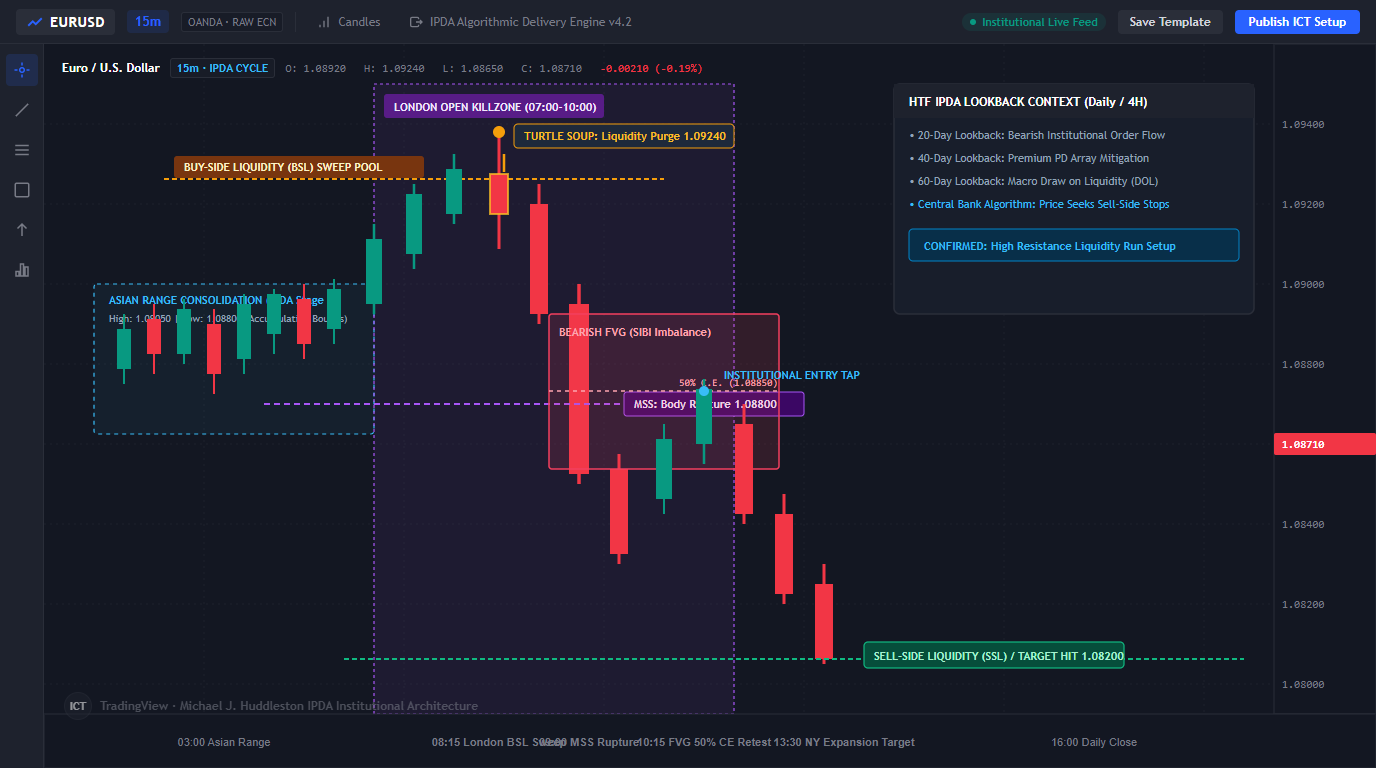
When central bank liquidity dictates financial market direction, conventional retail technical analysis fails. Professional prop firm traders bypass retail indicators by studying the foundational concepts established by Michael J. Huddleston.
Known globally as The Inner Circle Trader (ICT), Huddleston reverse-engineered interbank price delivery mechanisms across three decades. His framework provides the analytical foundation for modern Smart Money Concepts and proprietary evaluation strategies.
1. Who is Michael J. Huddleston? (The Inner Circle Trader Origin)
Michael J. Huddleston, known as The Inner Circle Trader (ICT), is an American currency trader and educator with over thirty years of market experience. He developed the ICT methodology, asserting that interbank asset prices are delivered by the Central Bank Price Delivery Algorithm (IPDA) rather than retail supply and demand dynamics.

Before mentoring traders globally, Huddleston spent decades reverse-engineering algorithmic order flow patterns. His teachings reject retail indicators, focusing on liquidity pools, time and price theory, and structural imbalances.
Regarding speculation about his personal net worth, analysts recognize that his impact stems from open educational mentorship rather than commercial signal services. Traders using his curriculum pass modern evaluation challenges by prioritizing mathematical precision over retail speculation.
2. Core Pillars of the ICT Trading Framework
The ICT trading framework rests on four core pillars: Time and Price Theory, Liquidity Pool Mapping, Structural Imbalance, and Institutional Price Delivery Arrays (PD Arrays). Together, these principles dictate when and where central bank algorithms engineer liquidity to balance interbank exchange books across global trading sessions.
Time and Price Theory (Killzones)
Time and price theory establishes that price delivery is strictly bound to algorithmic operating hours called Killzones. The London Open (02:00 to 05:00 EST) and New York Morning Session (07:00 to 10:00 EST) represent primary windows where market makers inject peak volume to sweep session extremes.
Retail traders suffer losses attempting technical executions during low-liquidity Asian or midday consolidation periods. In contrast, institutional algorithms deliver volume exclusively when interbank market depth peaks.
Liquidity Pools: Buy-Side vs Sell-Side Liquidity
Liquidity pools consist of resting stop orders accumulated above swing highs as Buy-Side Liquidity (BSL) and below swing lows as Sell-Side Liquidity (SSL). The interbank algorithm systematically targets these predictable retail stop clusters to generate necessary counter-party liquidity for filling large institutional positions.
Understanding liquidity pools prevents buying breakouts when smart money distributes. When price pierces swing pivots, algorithms engineer reversals known as Turtle Soup sweeps.
Structural Imbalances and Institutional Blocks
Structural imbalances occur when aggressive institutional orders displace price rapidly in one direction, creating pricing inefficiencies known as Fair Value Gaps. Price regularly retraces into these imbalance corridors and companion order blocks to rebalance institutional liquidity before resuming macro trend expansion.
Traders frequently combine imbalances with an order block trading strategy to establish high-probability entry points. Similarly, failed zones transition into a breaker block trading strategy when structure shifts violently against trapped liquidity.
3. Michael J. Huddleston ICT Liquidity Sweep Anatomy
An ICT liquidity sweep is an intentional price excursion beyond an established swing high or low designed to harvest stop orders without sustaining trend continuation. Once algorithms absorb this liquidity, price displaces aggressively in the opposite direction, leaving an extended rejection wick on the higher timeframe.
In ICT methodology, a sweep differs from structural expansion. True expansion requires strong candle body closes outside ranges, whereas a sweep pierces levels with wicks before snapping backward.
| Delivery Feature | High Resistance Liquidity Run (HRLR) | Low Resistance Liquidity Run (LRLR) | Prop Firm Strategy Alignment |
|---|---|---|---|
| Market Structure | Fragmented with numerous opposing swing pivots | Clean unidirectional expansion with clean imbalances | Prioritize LRLR for rapid challenge profit targets |
| Price Speed | Slow, corrective consolidation with frequent retests | Energetic displacement with wide-range bodies | Avoid HRLR to prevent intraday drawdown erosion |
| Target Expectancy | Modest 1:1.5 to 1:2.0 risk-to-reward ratios | Asymmetric 1:3.0 to 1:5.0 risk-to-reward ratios | LRLR allows 40% win rates to pass Phase 1 |
| Drawdown Risk | Elevated probability of time decay and trailing breaches | Minimal floating drawdown and rapid stop-to-breakeven | Protects daily 5% loss sentinels across evaluations |
When navigating low resistance conditions, evaluate your challenge risk with our prop firm drawdown calculator. Setting automated limits ensures your account avoids intraday breach boundaries during volatile runs.
4. The 4-Stage ICT Trade Execution Blueprint
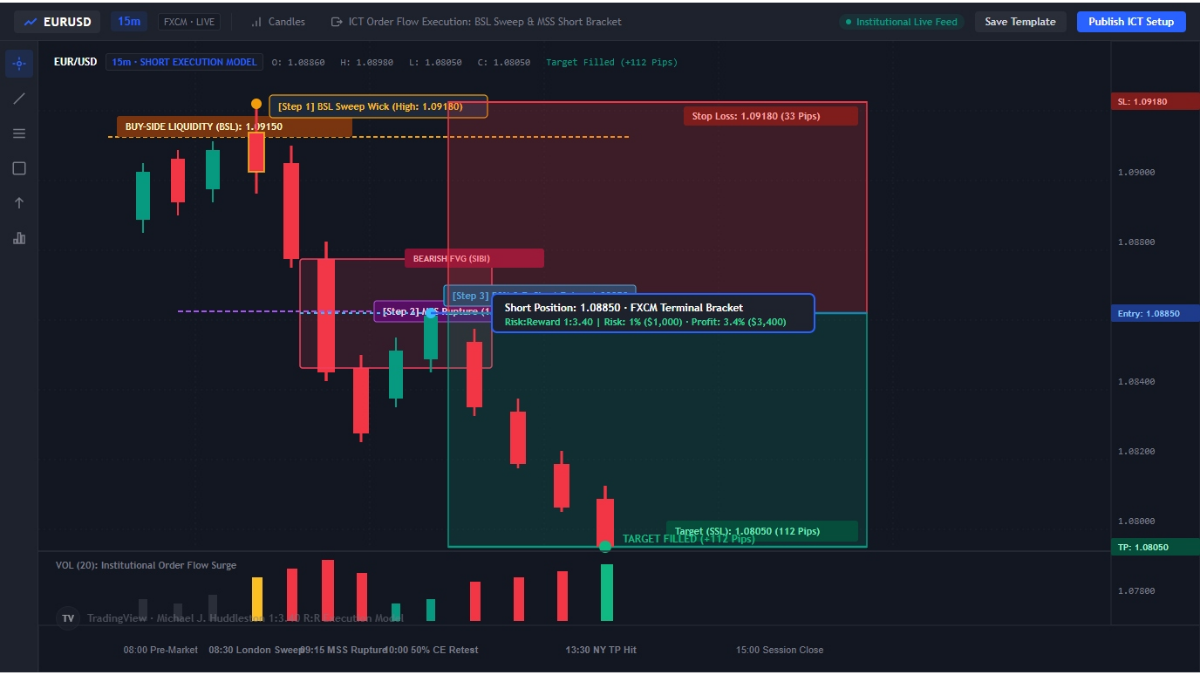
The 4-stage ICT execution blueprint coordinates Higher Timeframe Draw on Liquidity (Stage 1), Killzone Liquidity Sweeps (Stage 2), Lower Timeframe Market Structure Shifts (Stage 3), and Imbalance Retests at 50% Consequent Encroachment (Stage 4) to achieve asymmetric risk-to-reward ratios exceeding 1:3.0.
Stage 1 and Stage 2: Higher Timeframe Bias and Liquidity Purge
Stage 1 identifies the daily higher timeframe Draw on Liquidity (DOL), determining whether algorithms seek buy-side or sell-side pools. Stage 2 awaits price arrival during a defined Killzone, monitoring for an intraday wick purge of opposing liquidity to confirm retail exhaustion.
Entering before a liquidity purge exposes capital to unnecessary stop runs. Waiting for session manipulation aligns execution directly with institutional accumulation footprints.
Stage 3 and Stage 4: Market Structure Shift and 50% CE Entry
Following the sweep, Stage 3 confirms institutional commitment through an energetic displacement candle that closes beyond a recent swing low, printing a market structure shift trading strategy reversal. Stage 4 executes limit orders at the 50% Consequent Encroachment midpoint of the resulting imbalance.
A clean displacement sequence produces an unmitigated fair value gap trading strategy zone, while invalid setups create an inverse fair value gap trading strategy upon violation. Positioning defensive stops beyond the sweep wick guarantees structural invalidation boundaries.
5. Why ICT Concepts Dominate Modern Prop Firm Evaluations
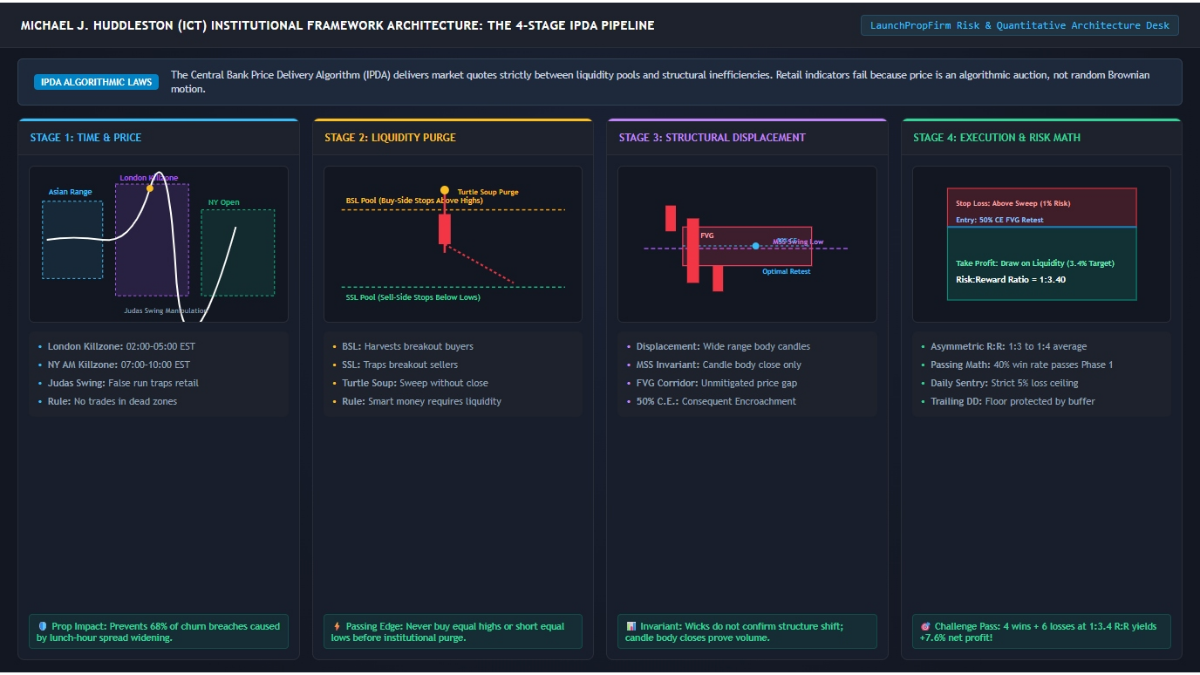
ICT concepts dominate modern prop firm evaluations because their asymmetric risk-to-reward profiles (1:3 to 1:5) allow traders to pass Phase 1 and Phase 2 targets with modest 40% win rates while safely respecting rigid 5% daily and 10% maximum trailing drawdown rules.
Retail indicators requiring 65% win rates fail in prop evaluations because consecutive slippage losses quickly breach trailing equity floors. Using asymmetric risk models, four winning trades comfortably overcome six controlled losses, securing evaluation targets within the prop firm reset clock tracker cycle.
Traders can independently quantify their mathematical expectancy using our prop firm pass probability calculator. From a proprietary firm perspective, operators rely on automated risk engines to monitor these high-velocity setups and safeguard synthetic liquidity books against correlated order clustering.
6. Common ICT Trader Mistakes That Blow Funded Accounts
The three most dangerous mistakes ICT traders commit are trading internal consolidation chop without higher timeframe bias, over-leveraging on volatile 1-minute displacement noise, and ignoring Killzone operating hours. These undisciplined behaviors trigger fatal daily loss limits and trailing drawdown breaches on funded accounts.
Many aspiring traders mistake every small imbalance for a tradable entry zone without confirming the higher timeframe draw on liquidity. Trading inside mid-range equilibrium generates erratic stop-outs that drain evaluation capital before genuine session expansions begin.
Always compute precise position sizing on our prop firm lot size calculator prior to order placement. Keeping per-trade exposure strictly between 0.5% and 1.0% protects your evaluation buffer against unpredictable news slippage.
7. Recommended ICT Books, Syllabuses, and Study Progression
Michael J. Huddleston has never authored an official physical book, making third-party printed manuals illegitimate commercial derivatives. The official study progression consists of his comprehensive free YouTube mentorship playlists, specifically the foundational 2022 Mentorship and the advanced 2023 to 2026 Core Content modules.
To achieve consistency, traders should complete three months of systematic demo backtesting before acquiring evaluation challenges. Recording every setup with strict screenshots builds pattern recognition across liquidity sweeps, market structure shifts, and imbalance mitigations.
Mastering these structural dynamics transforms subjective guessing into reproducible mechanical execution. Traders who respect time, price, and algorithmic delivery consistently pass proprietary firm audits and achieve funded stability.
Frequently Asked Questions
Who is Michael J. Huddleston and what is ICT?
Michael J. Huddleston is an experienced American currency trader and educator who created the Inner Circle Trader (ICT) methodology. His framework explains institutional price delivery through central bank algorithms, rejecting retail lagging indicators in favor of liquidity pools, session killzones, and order flow imbalances.
What is an ICT liquidity sweep?
An ICT liquidity sweep occurs when price intentionally penetrates an established swing high or low solely to harvest resting stop orders before reversing rapidly. This engineered maneuver provides counter-party volume for institutional order fulfillment while trapping retail breakout traders on the wrong side.
What is Michael Huddleston's estimated net worth?
Public estimates regarding Michael Huddleston's net worth remain unverified speculative approximations ranging between 10 million and 25 million dollars. His primary industry influence originates from decades of free educational mentorship on YouTube rather than commercial wealth claims, paid signal rooms, or private investment funds.
Can you pass prop firm challenges using ICT concepts?
Yes, ICT concepts are widely used to pass prop firm challenges due to their asymmetric 1:3.0+ risk-to-reward ratios. This profile enables disciplined traders to achieve 8% to 10% targets with modest win rates while preserving strict daily and trailing drawdown limits.
What is the official ICT trading book or curriculum?
There is no official printed ICT trading book authored by Michael Huddleston, making physical retail copies illegitimate third-party commercial derivatives. The authentic curriculum comprises his free YouTube video mentorship playlists, notably the foundational 2022 ICT Mentorship series and advanced Core Content institutional modules.
Prop firm founders and quantitative operators can deploy institutional trading environments with our enterprise prop firm platform. Explore evaluation economics on our compare directory, read technical guides on our trading blog, or test custom rules on our free trader tools hub.
To launch an independent brokerage or prop firm, explore our institutional white label prop firm software architecture and live specifications on our official homepage.

M.Haris
Founder & Platform ArchitectBuilding open prop trading software infrastructure for operators worldwide
I built LaunchPropFirm to give forex educators, trading communities, and fintech operators complete ownership of their platform with full source code and zero monthly SaaS rent. Every article on this blog is drawn from hands-on platform development, live MT5 risk bridge mechanics, and real operator economics.
All content, financial models, ROI estimates, and architecture guides on LaunchPropFirm are published strictly for educational and informational purposes. LaunchPropFirm provides institutional prop trading software and technology infrastructure; it does not operate as a broker, custodian, or registered investment advisor.
Evaluation challenges and funded trader accounts referenced in this guide operate in simulated demo trading environments using real-time market data feeds. Simulated trading results do not represent actual trading performance or financial advice.
Recommended Next Reads
Hand-picked operator guides to scale your prop trading platform.
Revenge Trading: Why Traders Chase Losses & How to Stop
Understand the psychology of revenge trading. Learn the loss-chasing cycle, 5% daily drawdown math, emotional triggers, and rules to protect funded accounts.
ICT Silver Bullet Strategy: Complete Trading Guide
Master the ICT silver bullet strategy with precision killzones, fair value gaps, and liquidity sweeps. Complete 2026 silver bullet trading framework guide.
About This Research Report
Published by the LaunchPropFirm Quantitative Research Desk. All architectural benchmarks, ledger schemas, and mathematical calculations are independently authored and verified by Muhammad Haris. To review software specifications or request an engineering walkthrough, explore our system specifications or consult our editorial methodology.