Revenge Trading: Why Traders Chase Losses & How to Stop
Understand the psychology of revenge trading. Learn the loss-chasing cycle, 5% daily drawdown math, emotional triggers, and rules to protect funded accounts.
Financial metrics, software benchmarks, and drawdown mechanics in this guide are independently audited against production PostgreSQL ledgers, MT5 Python price bridges, and real-world trading firm deployments by Muhammad Haris. Read our complete Editorial Standards & Verification Protocol.
1. What Is Revenge Trading in Financial Markets? (Core Psychology)
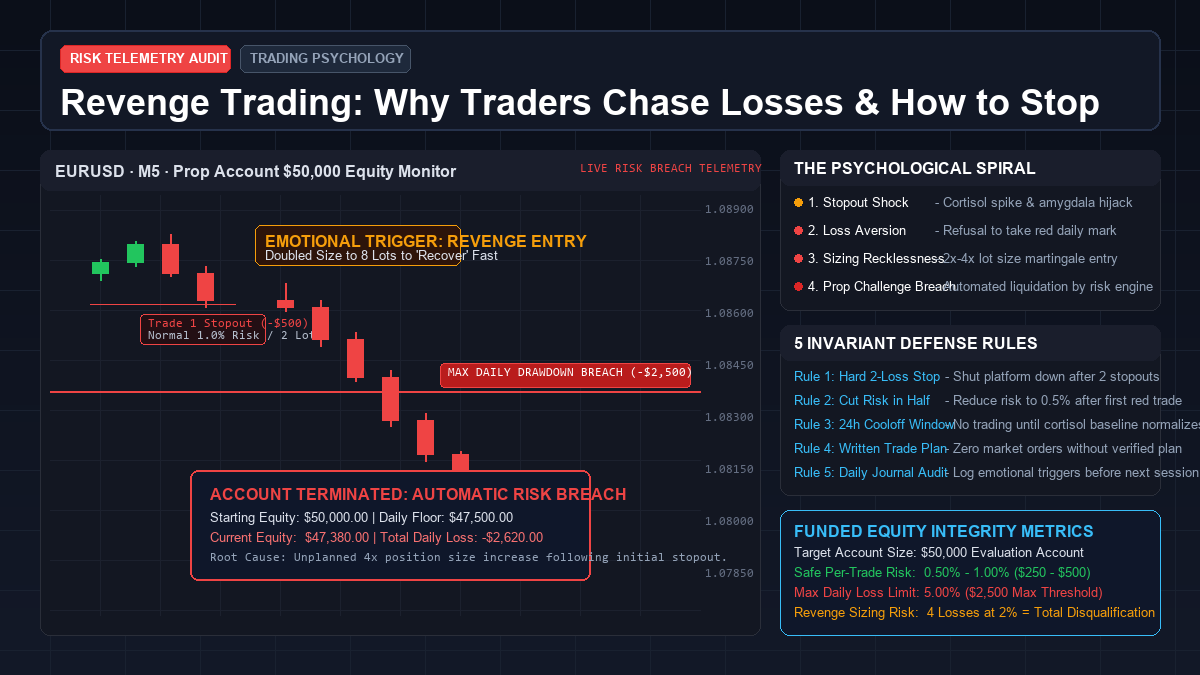
What is revenge trading in financial markets? Revenge trading is an emotional reaction where a trader enters unplanned, aggressive positions to recover losses from a previous trade immediately. This impulsive behavior abandons disciplined risk management, doubles normal leverage, and bypasses defined technical criteria out of frustration, anger, or wounded ego.
When an unexpected stopout hits, the human brain interprets the financial loss as an attack. Cortisol and adrenaline surge, blinding the prefrontal cortex and activating fight-or-flight survival mechanisms. Instead of accepting the loss as an ordinary cost of business, the trader feels an overpowering impulse to force the market to yield profits.
In proprietary trading, this psychological breakdown creates severe structural damage. Automated broker risk engines enforce hard drawdown floors that liquidate accounts without human discretion. Traders can calculate their exact capital boundaries with our prop firm drawdown calculator to recognize danger zones before emotional tilt begins.
2. The Loss-Chasing Cycle: How Emotions Overwrite Strategy
The loss-chasing cycle operates as a predictable behavioral loop that snares undisciplined market participants. It begins with a standard trade that hits an ordinary invalidation level. Once price stops out, emotional rationalization takes command.

First, the trader experiences the shock of the initial stopout. Instead of stepping back, they monitor tick movements obsessively. They convince themselves that the market hunted their stop loss maliciously.
Second, emotional denial triggers the urgent desire to break even on the session. The trader cannot tolerate ending the day in negative equity. Sunk cost fallacy whispers that the next trade will wipe the deficit clean.
Third, the trader enters a hasty revenge trade without waiting for a verified setup. To recover capital quickly, they double or triple position size. Trading erratic swings on low timeframes, they risk equity they cannot afford to lose.
Fourth, the market inevitably moves against the oversized, unplanned position. Volatility expands, and the absence of a structural stop loss causes panic. The trader freezes while the second stopout compounds drawdown damage exponentially.
Finally, compounded losses trigger a catastrophic account breach. Automated broker risk sentinels detect a violation of daily loss rules and revoke credentials permanently. A standard loss transforms into a forfeited challenge and lost evaluation capital.
3. Why Revenge Trading Destroys Funded Prop Accounts (5% Daily Drawdown Math)
Retail traders managing personal spot accounts can occasionally endure drawdowns through extended recovery timelines. Funded proprietary traders do not have that luxury, making strict trading risk management rules non-negotiable under firm loss ceilings. A standard 5% daily drawdown rule on a $50,000 account creates an absolute loss ceiling of exactly $2,500.
When an operator risks a disciplined 1% ($500) per setup, an initial stopout leaves $2,000 in daily buffer. The trader retains four standard risk units before reaching terminal liquidation. As detailed in our blueprint on how to pass prop firm challenge evaluations, this risk cushion keeps the mind calm and protects evaluation capital.
When revenge trading takes over, mathematical asymmetry accelerates capital destruction. An angry trader doubles lot size to 2% ($1,000) on trade two to recover fast. If trade two fails, remaining daily risk capital collapses to $1,000, leaving zero margin for error.
| Execution Model | Trade 1 Risk | Trade 2 Risk | Trade 3 Risk | Cumulative Loss | Remaining Daily Buffer |
|---|---|---|---|---|---|
| Disciplined Trader (1.0% Fixed) | $500 (1.0%) | $500 (1.0%) | $500 (1.0%) | -$1,500 (-3.0%) | $1,000 (Safe Buffer) |
| Revenge Escalation (Martingale) | $500 (1.0%) | $1,000 (2.0%) | $2,000 (4.0%) | -$3,500 (-7.0%) | -$1,000 (Account Terminated) |
| Halved Risk Protocol (0.5% Safety) | $500 (1.0%) | $250 (0.5%) | $250 (0.5%) | -$1,000 (-2.0%) | $1,500 (Preserved Capital) |
As shown above, the revenge escalation model breaches the $2,500 threshold on trade three. The trader loses access to the account before lunchtime, forfeiting weeks of dedicated evaluation work.
To prevent oversized allocations, operators must calibrate contract quantities against exact stop distances using our prop firm lot size calculator. Enforcing mathematical boundaries stops emotional urges before orders reach liquidity providers.
4. 5 Common Triggers That Spark Revenge Trades
Revenge trading rarely happens without warning. It is ignited by specific psychological triggers that exploit cognitive biases under pressure. Recognizing these catalysts allows operators to erect protective firewalls around their trading terminals.
First, taking consecutive stopouts within a single trading hour creates acute frustration. The trader perceives the market as personally antagonistic, prompting an urgent desire to fight back. Cortisol saturation prevents rational analysis, leading to frantic market orders.
Second, wiping out a multi-day win streak in minutes deals a brutal blow to trader pride. After building equity over days, losing accumulated profit feels intolerable. The trader takes reckless gambles to claw back paper gains before daily settlement.
Third, an immediate price reversal right after invalidation triggers intense indignation. Being stopped out by one pip before price rallies to target tempts traders to chase the move without structural invalidation.
Fourth, high-impact economic news releases generate sharp spread expansion and slippage. When an automated stop executes several pips worse than planned, anger erupts. Chasing erratic news candles creates catastrophic whipsaws that demolish account equity.
Fifth, boredom during extended range consolidations causes impatient operators to invent setups where none exist. Choppy losses irritate the trader, breeding emotional revenge trades that derail otherwise sound weekly performance.
5. How to Stop Revenge Trading: 5 Practical Risk Rules
Eliminating revenge trading requires mechanical constraints rather than relying on mental willpower. Willpower degrades rapidly under emotional stress, while hard rules function autonomously. Implement these five operational standards to protect your funded equity.
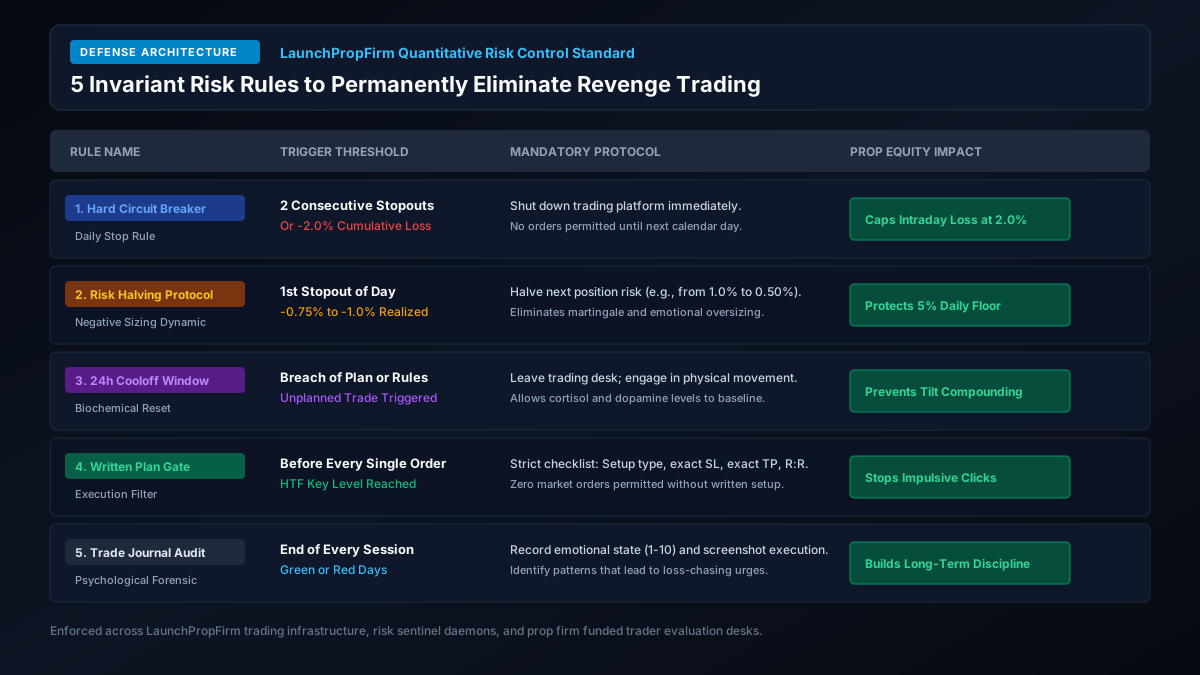
First, establish a non-negotiable hard circuit breaker after two consecutive stopouts. Reviewing proven prop firm challenge tips shows that capping daily drawdown at 2% preserves your equity cushion. Close your execution terminal and walk away from your desk physically.
You can calculate your challenge survival odds across win rates with our prop firm pass probability calculator. Preserving capital for tomorrow is the primary obligation of professional risk management.
Second, apply the fifty percent position size halving protocol after any initial loss. If trade one risked 1%, trade two must risk no more than 0.50%. This asymmetric sizing rule counteracts the subconscious temptation to double down and resets emotional equilibrium.
Third, enforce a mandatory twenty-four-hour cooloff window whenever an unplanned trade occurs. Neurobiological research proves that elevated cortisol levels require several hours to baseline. Step outside, exercise, or review closed trades in a quiet environment.
Fourth, never open an order ticket without a pre-market written trading plan documented before the session begins. The plan must state higher timeframe bias, exact invalidation level, and profit target. You can verify your daily consistency metrics using our prop firm consistency calculator.
Fifth, maintain a systematic trade journal capturing both technical parameters and emotional stress levels. Recording psychological data exposes personal tilt patterns before they escalate into account failures.
Download our free Professional Trading Journal Workbook to track your daily equity curve and risk metrics. Auditing your journal weekly transforms painful losses into actionable statistical edges.
6. Revenge Trading vs FOMO: Key Differences and Overlaps
Traders frequently confuse revenge trading with Fear of Missing Out (FOMO). While both behaviors stem from emotional instability, their underlying psychology, triggers, and execution patterns diverge significantly.
| Operational Dimension | Revenge Trading | Fear of Missing Out (FOMO) |
|---|---|---|
| Primary Emotional State | Anger, wounded pride, frustration, desperation | Greed, anxiety, envy, social comparison |
| Underlying Catalyst | Experiencing an unexpected financial stopout | Watching a rapid market rally without an open position |
| Position Sizing Habit | Drastically oversized lots (martingale escalation) | Standard or irregular sizing on extended price candles |
| Entry Timing Pattern | Immediate impulsive entries counter-trend or at market | Late chasing at the extremes of parabolic expansions |
| Primary Account Danger | Catastrophic daily drawdown limit breach | Poor risk-reward ratios and immediate adverse pullbacks |
Revenge trading is rooted in loss aversion and active defiance of market reality. FOMO is fueled by greed and the anxiety of being left behind by peers. Both emotional traps violate systematic execution and destroy prop firm evaluation accounts.
Disciplined traders neutralize both hazards by adhering strictly to predefined liquidity models. When strategy governs every click, emotional impulses lose their power over capital allocation. Practicing execution routines in a free prop firm challenge sandbox helps traders master emotional control before deploying funded capital.
Frequently Asked Questions
What is the primary cause of revenge trading?
Revenge trading is caused by acute loss aversion and an inability to accept statistical drawdowns. When a trade hits a stop loss, emotional frustration overrides rational risk management, prompting impulsive entries to break even.
How does revenge trading breach prop firm rules?
Proprietary trading firms enforce strict daily drawdown limits, typically four to five percent of starting equity. Revenge trading involves doubling position sizes after losses, causing traders to hit automated liquidation floors rapidly.
How do professional traders handle consecutive losses?
Professional traders use mechanical circuit breakers, such as halting trading after two consecutive losses or reducing position sizes by half. They step away from screens to allow cortisol levels to normalize before re-engaging.
What is the difference between revenge trading and overtrading?
Overtrading involves taking excessive trade setups due to boredom or impatience, often with normal risk sizes. Revenge trading is a specific, aggressive reaction to a recent loss where the trader increases risk to recover capital quickly.
Can a trading journal prevent emotional revenge trades?
Yes, maintaining a structured trade journal forces accountability and highlights emotional triggers before they lead to catastrophic mistakes. Reviewing historical metrics reinforces statistical expectancy and reminds traders that individual losses are routine.

M.Haris
Founder & Platform ArchitectBuilding open prop trading software infrastructure for operators worldwide
I built LaunchPropFirm to give forex educators, trading communities, and fintech operators complete ownership of their platform with full source code and zero monthly SaaS rent. Every article on this blog is drawn from hands-on platform development, live MT5 risk bridge mechanics, and real operator economics.
All content, financial models, ROI estimates, and architecture guides on LaunchPropFirm are published strictly for educational and informational purposes. LaunchPropFirm provides institutional prop trading software and technology infrastructure; it does not operate as a broker, custodian, or registered investment advisor.
Evaluation challenges and funded trader accounts referenced in this guide operate in simulated demo trading environments using real-time market data feeds. Simulated trading results do not represent actual trading performance or financial advice.
Recommended Next Reads
Hand-picked operator guides to scale your prop trading platform.
ICT Silver Bullet Strategy: Complete Trading Guide
Master the ICT silver bullet strategy with precision killzones, fair value gaps, and liquidity sweeps. Complete 2026 silver bullet trading framework guide.
Michael J. Huddleston: Complete ICT Trading Framework Guide
Master Michael J. Huddleston's ICT trading framework. Learn liquidity sweeps, IPDA algorithm mechanics, market structure shifts, and prop firm risk rules.
About This Research Report
Published by the LaunchPropFirm Quantitative Research Desk. All architectural benchmarks, ledger schemas, and mathematical calculations are independently authored and verified by Muhammad Haris. To review software specifications or request an engineering walkthrough, explore our system specifications or consult our editorial methodology.